Mom Cat Dies In Fire Protecting Kittens With Her Own Body

The sacrifices mom cats make for their kittens illustrate that cats are capable of great empathy and love.

One of the most compelling cat stories I’ve ever heard involved a reader of this blog, a woman who took in a white stray she named Snowy.

Snowy was a street cat who was always with a male cat, and the woman fed them both whenever they came by. Soon it became clear Snowy was pregnant, and her trusting tom — the father of her babies — nuzzled her goodbye as Snowy accepted the woman’s invitation to move inside at least temporarily so she’d have a safe place to give birth to her kittens.

In the three weeks that followed, Snowy raised her kittens in the woman’s home, and the tomcat would come by daily to see her and their little ones.

Snowy died when a pair of dogs climbed the porch steps, snapping at her kittens. Snowy fought the dogs off while her babies escaped, but she died from her injuries.

The poor tom who had been her constant companion came by the next night and meowed for her. He showed up again and again, meowing mournfully each night, distraught at her disappearance.

The story shows cats are capable of extraordinary empathy and love: The love between Snowy and her mate, who was protective of Snowy and loving with their babies, an unusual trait in toms. The love Snowy had for her babies, sacrificing her life for theirs. And the love the crestfallen woman had for those kittens when she returned home and found Snowy dead and the kittens hiding.

Another story of a mother who gave her life for her kittens reinforces the idea that cats are capable of great love and empathy.

When a mobile home in Pasco County, Florida, caught fire this week, the man who lived there was able to escape but his cats were trapped and firefighters couldn’t reach them.

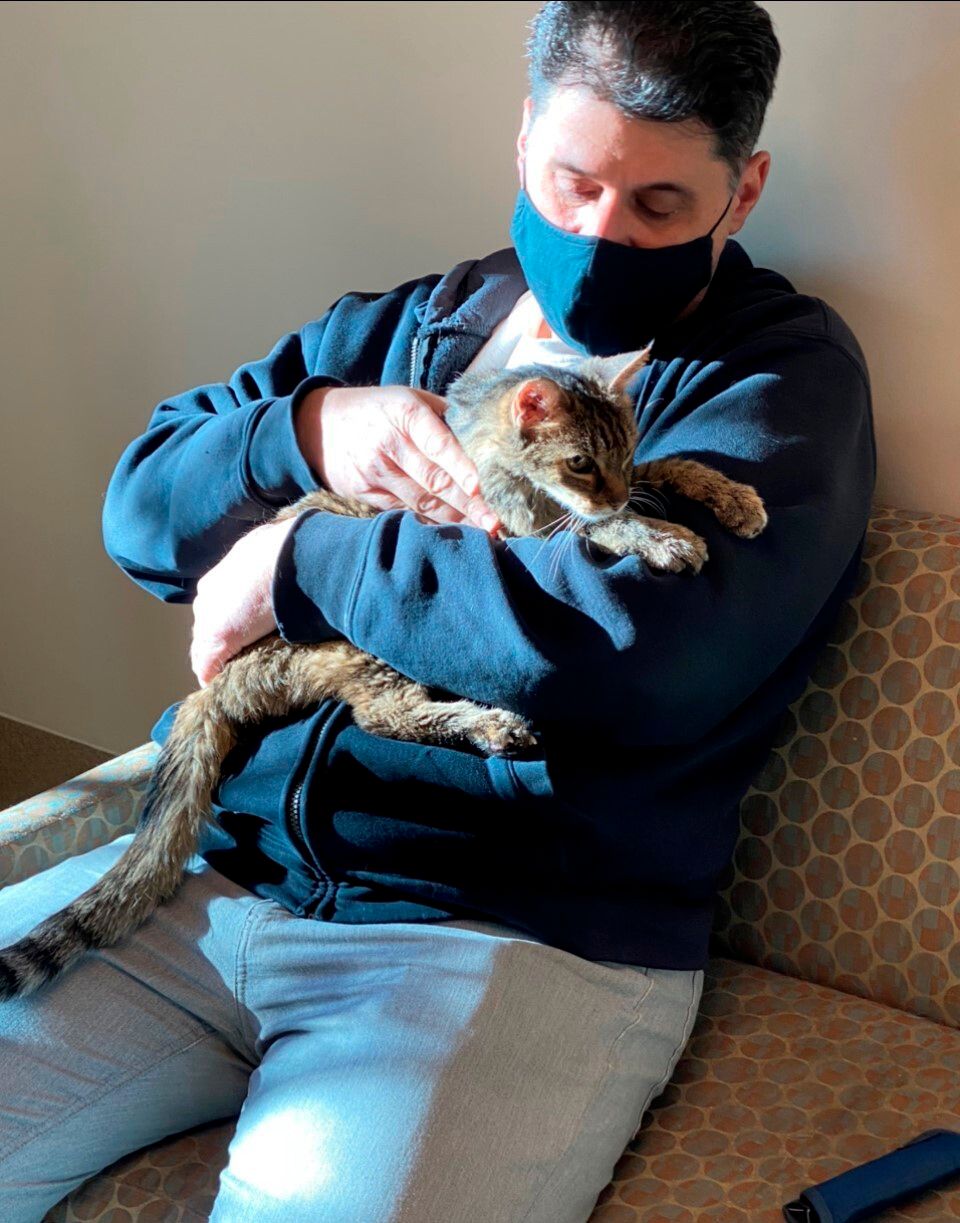
Molly the kitten
Molly’s mom sacrificed her life to save the 2 1/2-week-old kitten.

The mother cat covered her kittens with her body, laying on top of them and remaining there even as the fire scorched her.

When firefighters poked through the debris, they found the cat and her kittens. The mom and one of her babies died at the veterinary hospital, but one kitten survived.

“It seemed as if mom did everything possible to protect her kittens, even risking her own life in their defense, but the flames and the smoke were too much,” said Rick Chaboudy, executive director of the Suncoast Animal League. “But mom managed to protect one of her kittens from the blaze, enough to give that kitty a chance at life. Other than her whiskers being burned completely off and a slight odor of smoke, she is doing well with her bottle feeding and her cuddling.”

Staff at the shelter named the kitten Molly after Molly Williams, a former slave who became the first black female firefighter in the US. Molly the kitten is expected to make a full recovery.

What’s that? A tear, you say? Absurd! Buddy and I do not cry. Now if you’ll excuse us, we’re going to toss a football around, talk about trucks and fix some things around the house with power tools.

Buddy the Manly
“In addition to being handsome, I am very meowscular and I know kung fu!”

4 Cats Rescued From Imminent Death In Garbage Crushers In Two Separate Incidents

Three cats were pulled from a garbage conveyor in New Jersey, while another was pulled from a compactor in Russia.

May the people who threw these cats — an adult and three kittens — into trash bins experience spectacular karmic retribution for their inhumanity.

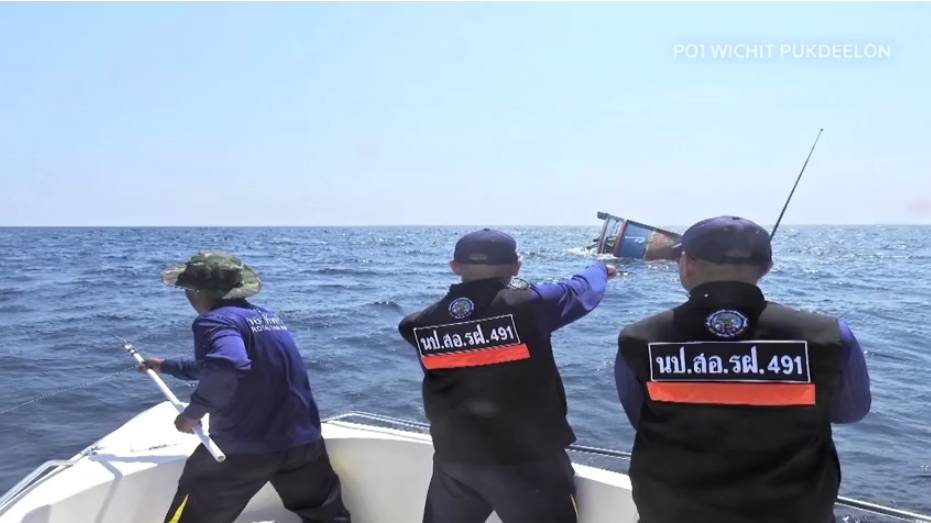
In Moscow, alert trash-sorters pulled a terrified tuxedo cat from a conveyor belt seconds before it would have been crushed on Dec. 21.

“The cat wasn’t meowing and the bag wasn’t moving,” municipal waste employee Mikhail Tukash told local television. “I needed to cut the bag to screen it for metals. I was just doing my job.”

In an eerily similar incident, three kittens were pulled from a conveyor belt in New Jersey on Dec. 17, just before they would have been killed in the threshing metal teeth of a glass crusher, the local CBS News affiliate reported.

Someone had disposed of the kittens in a backpack. This time the bag was moving, prompting Burlington Recycling Plant employee Barrie Donaldson to stop the conveyor.

“I looked at it real closely and they were moving,” Donaldson told the station. “And I was like, ‘Oh wow, there is something in this bag.”

Co-worker Ashley Bush, who was with Donaldson when he rescued the kittens, adopted one of the three baby cats and named her Precious.

“I looked to my right and I see all the teeth going,” Bush said. “That would have been horrendous.”

“Right away, I said, ‘I gotta have her,'” Bush added.

The other two were adopted by a local family. Police in Burlington are asking the public for tips to help them track down the person who disposed of the kittens.

As for the lucky Russian feline, local government officials in Ulyanovsk are holding a public contest to name the fluffster, who will also be named an honorary wildlife minister in the government’s efforts to tell the public not to toss animals in the garbage.

Screenshot_2020-12-27 201224-russia-cat2 jpg (WEBP Image, 2000 × 1333 pixels) — Scaled (72%)
This cat, who has yet to be named, was rescued from a garbage processing plant in Russia’s Ulyanovsk region.

‘Rehomed’ Cat Makes 228-Mile Journey Back Home

A Texas cat’s epic trek home covered 228 miles, and no one’s sure how she did it.

Despite the current golden age of feline cognition studies and a growing body of research that shows cats have genuine affection for their humans, people still think of the little fluffballs as aloof, antisocial and ambivalent.

Old stereotypes about cats die hard, but maybe this latest story will finally give people pause: A cat named Gray C. made an epic, 228-mile journey back to a Texas town after she was ‘rehomed’ a week earlier.

Vikki and Eugene Braun told KTBC, a Fox affiliate in Austin, that they brought Gray C. and their other cat, Sissy, to a friend’s ranch in Terrell, about 35 miles east of Dallas. Both were outdoor cats, they said.

“We thought because they weren’t ‘pet’ cats, they wanted to live outside, we thought, well, maybe they’d rather live in the barn,” Eugene told the Fox affiliate.

The next day, their friend from the ranch in Terrell phoned to tell them the cats were gone. A week later, Vikki Braun was shocked when she came home and found Gray C. inside, helping herself to some food.

“I thought one of the neighbor’s cats had got in through the doggie door and that’s never happened, but I picked it up and I was like, this is Gray C.!” Vikki Braun said.

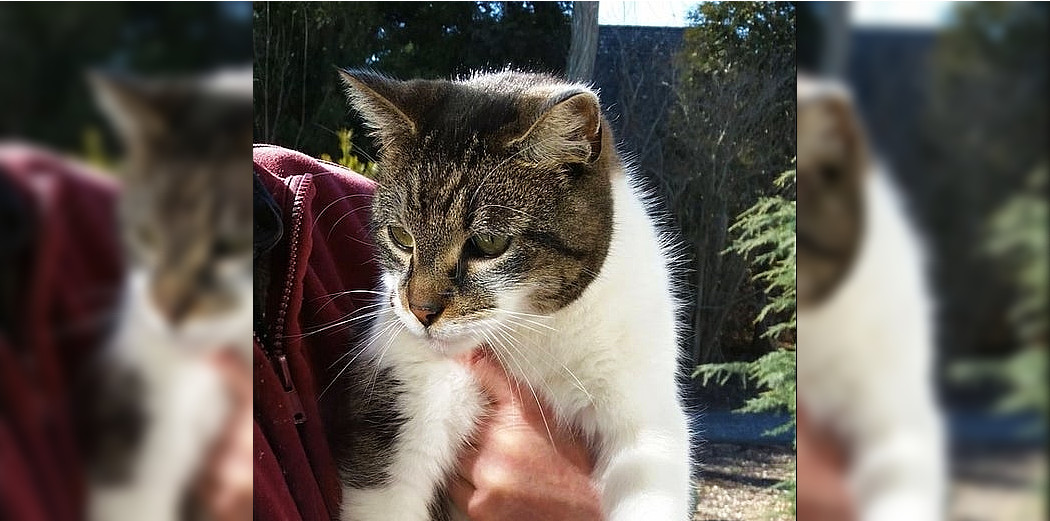
gracy
Gray C. is held by Vikki Braun after her long trek back to Burnet, Texas.

That was about three weeks ago. The Brauns say they don’t know what happened to Sissy. Hopefully she shows up unhurt.

No one is sure how Gray C. managed to cover so much distance in a little more than a weeks’ time. It seems unlikely a cat could cover more than 32 miles in a day.  The little felines are considerably faster than humans but like all felids, they’re built for shorter bursts of intense activity and require lots of rest.

“That’s a lot of miles per day, you know, but I’m sure she probably didn’t stop. She just kept on going,” Eugene Braun said.

garfieldcat
Garfield walked 40 miles back to his owners in London in June 2020.

Gray C’s story mirrors the story of Garfield, an orange tabby who walked 40 miles back home this summer after his owners gave him away. It took Garfield considerably longer to get home as he navigated London and its crowded suburbs, but his determination struck a chord with his people, who reconsidered their decision and kept him after his journey.

What Animal Is Your Heart?

“This cat has not always been feral. It had known the warm spot on the rug in front of the fireplace. But on a summer’s day someone left the door open. The cat, not knowing any dark thing, leapt away from love.”

I stumbled into this on Twitter, and it’s a reminder that amazing things can still exist in this cesspit we call the internet.

Teacher Kate Clanchy writes: “What animal is your heart? Is one of my favourite poetry questions. But I’ve never had an answer like this.” She’s referring to this poem by one of her students, 17-year-old Kyla Pereles:

“My heart is a cockroach caught in the mouth of an alley cat.

This cat has not always been feral. It had known the warm spot on the rug in front of the fireplace. But on a summer’s day someone left the door open.

The cat, not knowing any dark thing, leapt away from love. (My heart leaves open cans of sardines for the alley cat. Every runaway full of regret deserves to be fed.)

The cat makes a bed of missing pet posters the wind tore down.

And the cat is hissing at shadows in its sleep.

And the cat is shivering in its matted fur.

And the cat is meowing at the restaurant backdoor.

A waiter, who is also my heart, leaves the back door open so the cat can be warm for the rest of his shift.

But the cat is feral. The owner of the restaurant shoves him back into the snow with a broom.

The cat sleeps until the snow reminds it of the rug. Small things seem sadder when they are alone.

So the cockroach does not mind being in the jaw of something just as lonely.

A little girl follows the paw prints that made a snow angel around the cat. Despite the cockroach in its mouth and its matted fur, she picks it up.

And the cat, who knows of dark things now, spends summer in the lap of the little girl, who is also my heart.”

Kyla’s got a hell of a career ahead of her if she chooses to pursue writing.

catinsnow2

After 7 Shelters And 3 Adoptions, Merlin The Cat Found Love

Merlin the cat died on Dec. 9. This is what his life was like.

Merlin was born during 2007’s storm season in the Carolinas, and it was a hurricane that took him from his mom and siblings.

“He was found all alone in rubble and ruin,” his human mom, Meg Ferra, recalled. “Rescue picked him up but mom and litter mates were nowhere to be found, and Merlin was inconsolable. He was not yet weaned.”

Merlin’s kittenhood and first few years were chaotic, cruel and marked by repeated disappointment: The little guy, then called Shadow, was cycled through seven shelters and two families who adopted him, only to bring him back to the shelter system like a defective toy.

He was traumatized by his early experiences, shy and fearful, the kind of cat who huddled miserably in the back of the cage while more outgoing kitties found their forever homes.

His last stop — and last chance — was a kill shelter in New Jersey. The shy grey tabby with tufts of epic white-and-grey fur may have sensed his time was running out and uncharacteristically reached out to a couple that wandered into the shelter one day.

merlin2
Merlin getting some fresh air. Credit: Meg Ferra.

“Merlin put his rather large paw out and grabbed my husband’s shoulder — a feat in itself since three bullies kept pushing him into the corner and making him sit in his food,” Ferra said. “He was malnourished, skinny, oily, messy and sad.”

Ferra hesitated. Long-haired cats usually mean lots of shedding on clothes, carpets and couches. A cat with such a complicated history would present challenges as well.

“Once my husband held him, well, my thoughts of avoiding lots of hair went out the window,” she said.

The Ferras brought Shadow home and renamed him Merlin, a name befitting such a regal feline. They were surprised to discover he didn’t shed much despite his great tufts of wild fur. A subsequent DNA test identified him as a Siberian forest cat, an ancient, accidental breed that developed its characteristics naturally because it lived in isolation from other cat populations, deep within the Russian tundra.

Siberians have quite a few unique qualities. They have three fur layers — guard, awn and down hair — and rival Maine Coons in their floofiness, but their fur is easy to maintain and resistant to matting. They moult twice a year. Their moulting phases are milder than similarly-floofy cats, and their fur has lower levels of the allergen Fel-d1.

merlin6
Good boy: A collage of Merlin’s moments. Credit: Meg Ferra

Merlin was fearful and shy in his new home, and it became clear that he was not going to soften any time soon. He’d flinch, hinting at past traumas: “You couldn’t raise a hairbrush near him, or hold your hand over his head to caress him.”

“It took five years to break through Merlin’s wall of anger and fear when we brought him home,” Ferra said. “We played it low key, never loud, pushy, punishing, forceful or insulting. By insulting I mean with Merlin, you don’t make deals! Deals always hurt his feelings.”

One day, Ferra was trying to get Merlin to play with one of his toys when he lashed out at her.

“He tore up my forearm. I was dripping blood from wrist to elbow. I didn’t move. He didn’t move. His eyes were black orbs. I could see the wheels spinning. ‘Will she hit me? Yell? Throw me? Send me away?’

“I exhaled slowly and in my calmest demeanor said to him: ‘Merlin, what are you still so angry about? Frightened about? Don’t you know by now no one is going to hurt you here? It’s been five years and you’re safe, honey. You’re home, nothing will ever harm you again. They’d have to go through your family, daddy and me. You’re not alone, my love.’ And damned if his pupils didn’t recede. He let out a little whimper and his whole body relaxed.”

merlin3
Ferra with Merlin. Credit: Meg Ferra

From there, Ferra said, “it’s been belly kisses and raspberries,” but Merlin “was not a cuddler.”

“But like clockwork every week he would approach me, tap my leg and stare up at me. Not too mushy, but as if to say ‘I want a hug now!’ I ate up those two minutes. I’d pick him up and simulate his lost mom’s cheek rubs, which he loved and craved.”

Merlin developed health problems. In particular, his hips and neck began to bother him. Those are side effects typical of his breed, which has longer back legs that make Siberians powerful jumpers. He began suffering from hyperthyroidism and arthritis in his later years.

At seven years old, Merlin fought off a bout of pneumonia. But when he came down with it in early December, he didn’t have the strength to fight it off.

Ferra and her husband, Joe, stayed up with their beloved cat for almost 48 hours, monitoring him. Her husband even put off his dialysis to stay with the little guy.

But by Tuesday, when Merlin could no longer lift his head, Ferra knew it was the end. Merlin was euthanized on the morning of Dec. 9 at the veterinarian’s office. He was 13 years old.

merlin4
The Wizard of Fuzz: Merlin was a Siberian, a naturally-occurring breed known for its epic coat. Credit: Meg Ferra

The typical symptoms of grief set in: Ferra kept looking for the little furball, momentarily forgetting he was gone. She left his food bowl and his water fountain untouched. Her life suddenly had a vacuum in it.

That this happened now in the midst of a pandemic, as the death and infection rates skyrocket, lock-downs begin anew and the prospect of a dark winter casts a gloom over life, makes Merlin’s absence especially challenging. The Ferras’ children are adults, and their house is now quiet. Merlin’s presence mitigated the isolation and dreariness of life in a pandemic, as cats and dogs have done for millions of Americans this year.

For Joe, even his treatments remind him of his cat: Merlin would stand guard when Joe settled in for dialysis, remaining for the length of the treatment.

Ferra said she and her husband are considering adopting litter mates or inseparable friends. They feel Merlin would want them to provide a home to new cats.

“Joe has asked me how long I need until we open our home and hearts to a bonded pair. My husband can’t stand the emptiness. I just need a little more time. But with COVID and and the overflowing shelters I feel even Merlin wouldn’t want me to wait too long.”

Special thanks to Meg for talking to us about Merlin despite her fresh grief at losing the special little guy. We wish Meg and Joe the best this holiday season, and when they open their home to new kitties who need some love and a place to call their own.

siberiancat
A male Siberian forest cat. Siberians have thick coats, but they don’t produce as much allergens as most other breeds. Credit: Wikimedia Commons