A man writes a stirring tribute to his beloved cat.
We take a break from our usual inanity, humor and Buddy’s mind-bogglingly terrible advice column to call your attention to this beautiful tribute to a special cat.
Tom Wrobleski, an opinion writer for the Staten Island Advance, said a tearful goodbye to his cat, Malkovich, on Jan. 11.
“I’ve cried more for that cat over the last three weeks than I have over some people that I’ve lost in my life,” he writes.
Tom says Malkovich was supposed to be his kids’ cat, but ended up bonding with him:
Mal would meet me at the door when I came home, flopping down and giving me his belly. He followed me into the bathroom. He curled up next to me in bed. He would flop in the hallway upstairs and rub his face on my foot.
Don’t let anyone tell you that cats don’t bond, that cats don’t love, that cats are stand-offish. Mal loved me. And I loved him. He was my buddy. My best boy. The top cat.
He became part of the fabric of our lives. He even grudgingly tolerated Lucy, the neighborhood stray we adopted in 2017.
Mal’s illness snuck up on Wrobleski, as so many cat health problems do because our furry friends are so stoic.
“We thought that Mal was getting a little chubby in recent months. It turns out that he was ill, with fluid gathering in his abdomen,” he wrote. “The news from the vet was dire: Mal had cancer throughout his body. There wasn’t a lot we could do.”
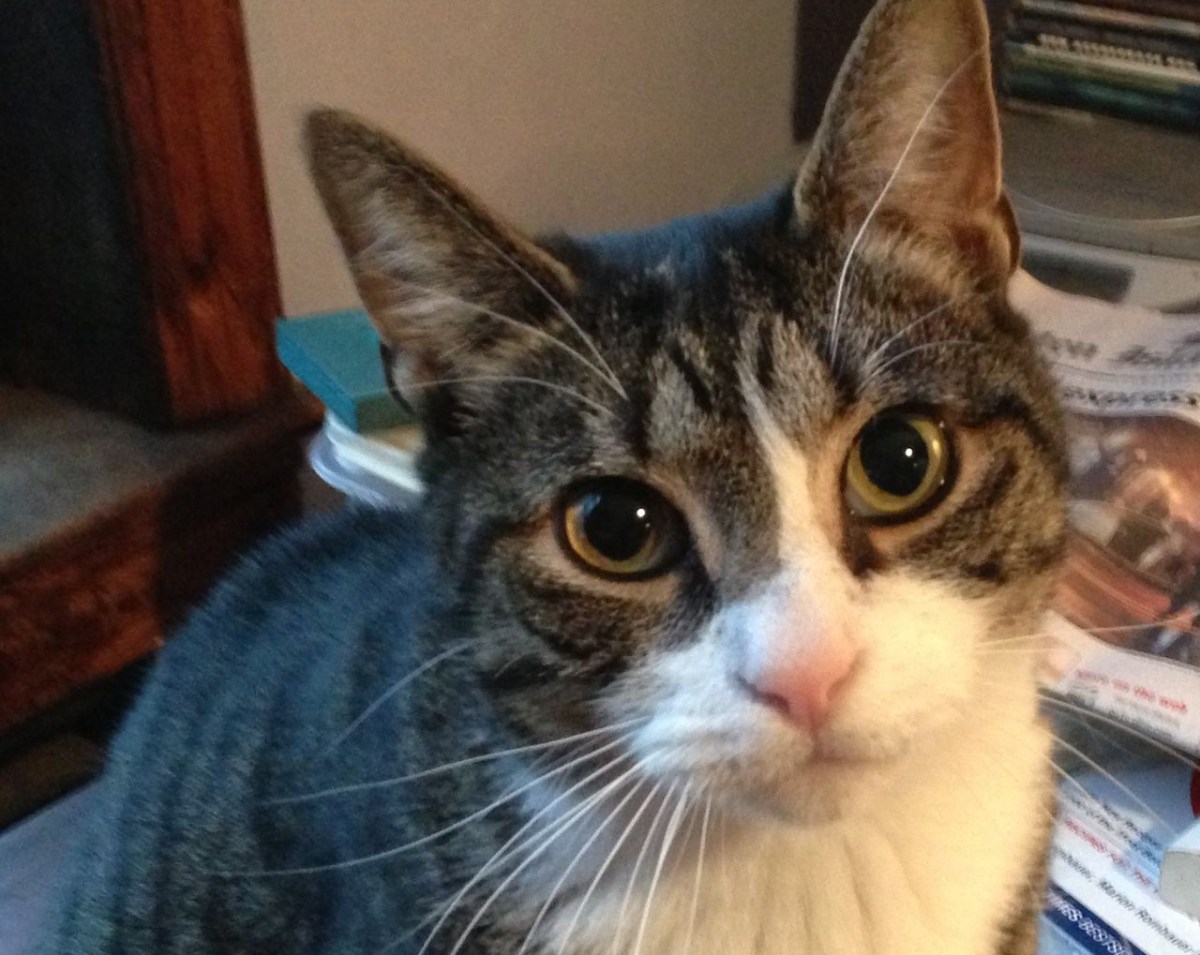
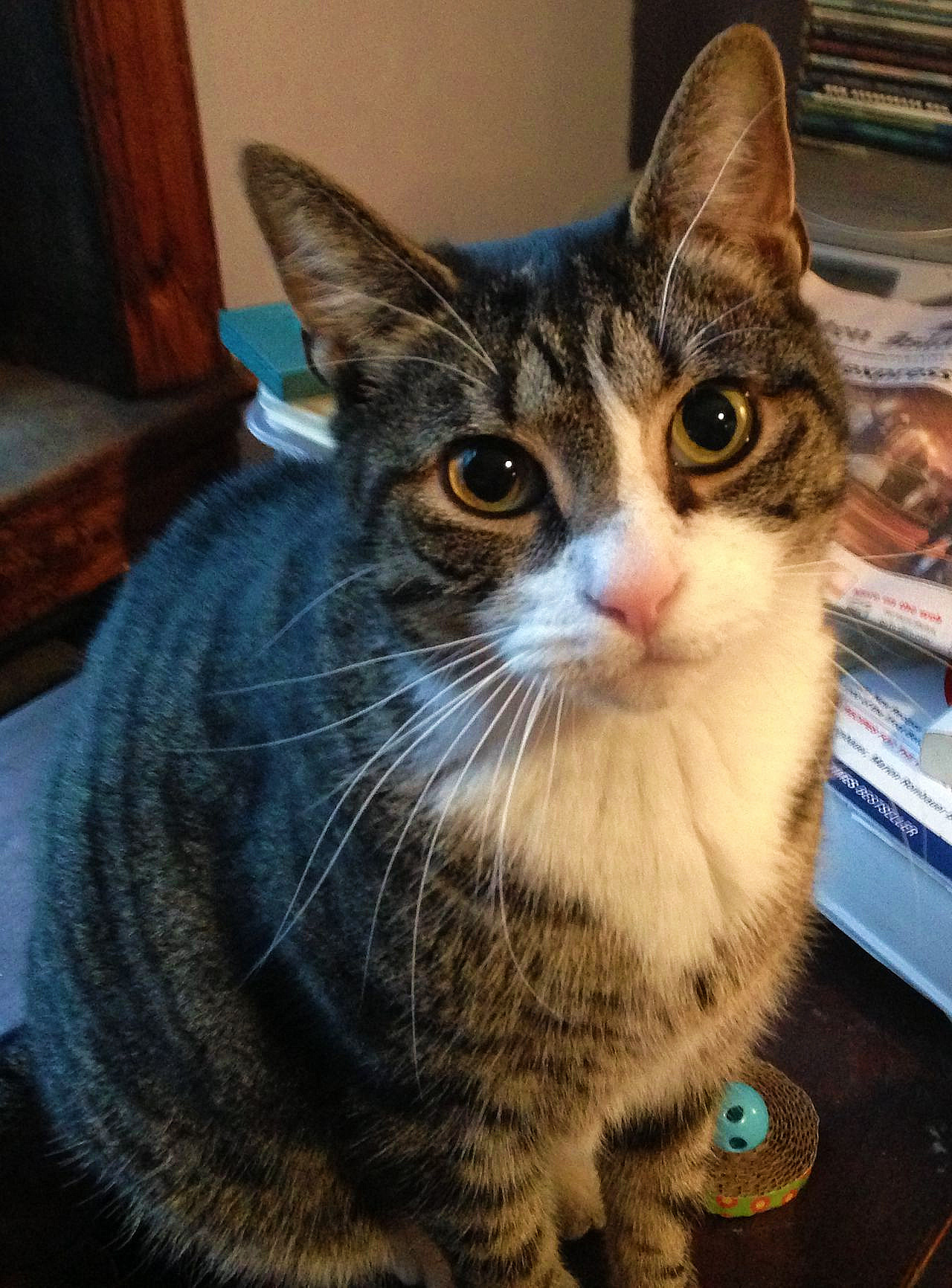
The author’s favorite photo of Malkovich the cat. Credit: Tom Wrobleski
The rest of it is really sad and would have made Buddy and I cry if we weren’t so manly and tough. Wrobleski writes about how much he misses Mal, and how much Mal changed his life during the 11 years he was a part of the family. (They adopted the little guy when he was four years old, and he lived until he was 15.)
His pain at losing the little guy is evident in every word and anecdote.
Be warned, though, that if you’re not as tough as Buddy and I, you probably will shed some tears, which Buddy and I definitely did not do. In fact, immediately after reading Wrobleski’s tribute to Malkovich, Bud and I watched a football game, drank Budweiser and shopped for a good old American pick-up truck while practicing our Sam Elliot voices.
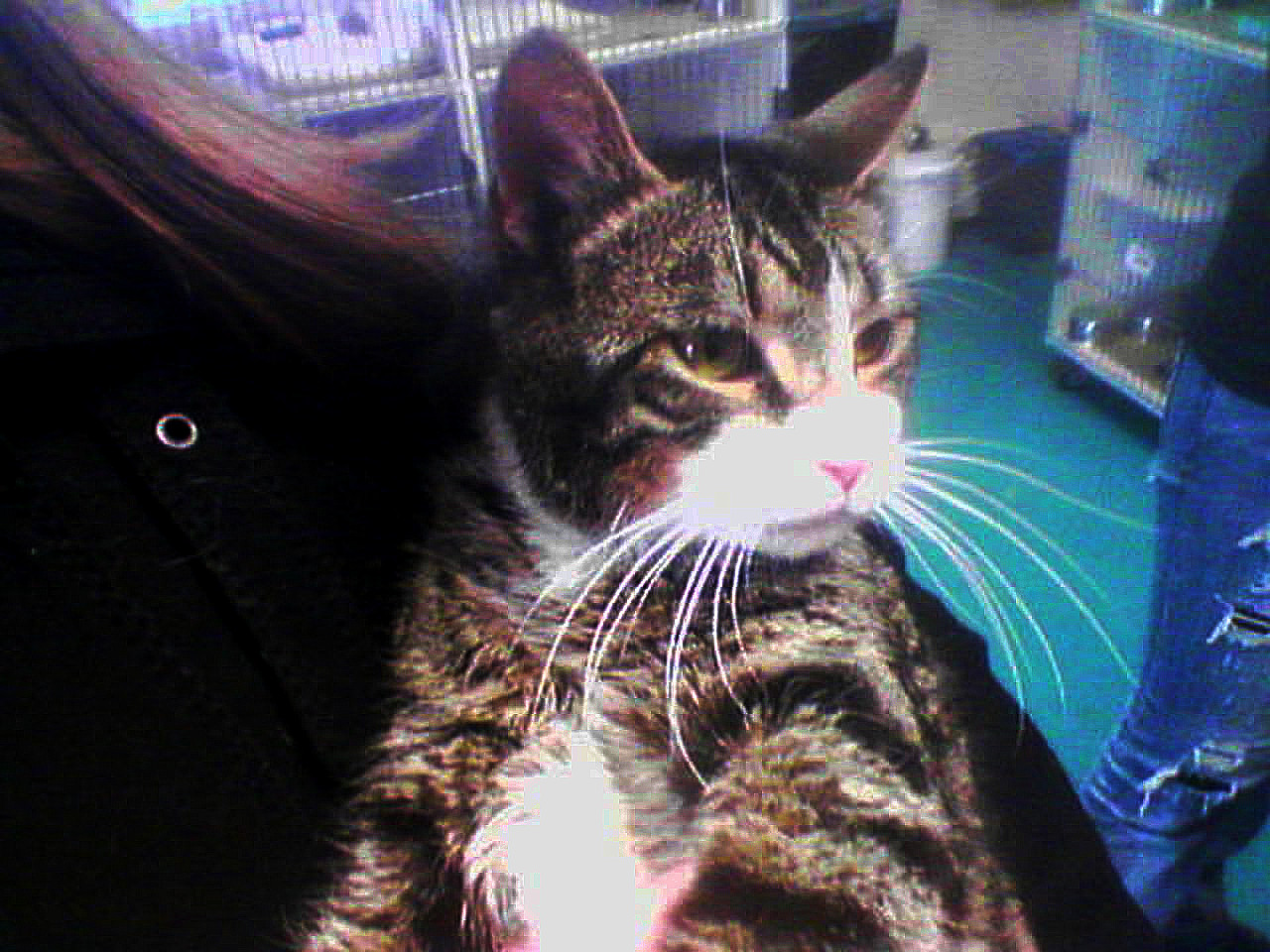
Malkovich on the day he was adopted. Credit: Tom Wrobleski
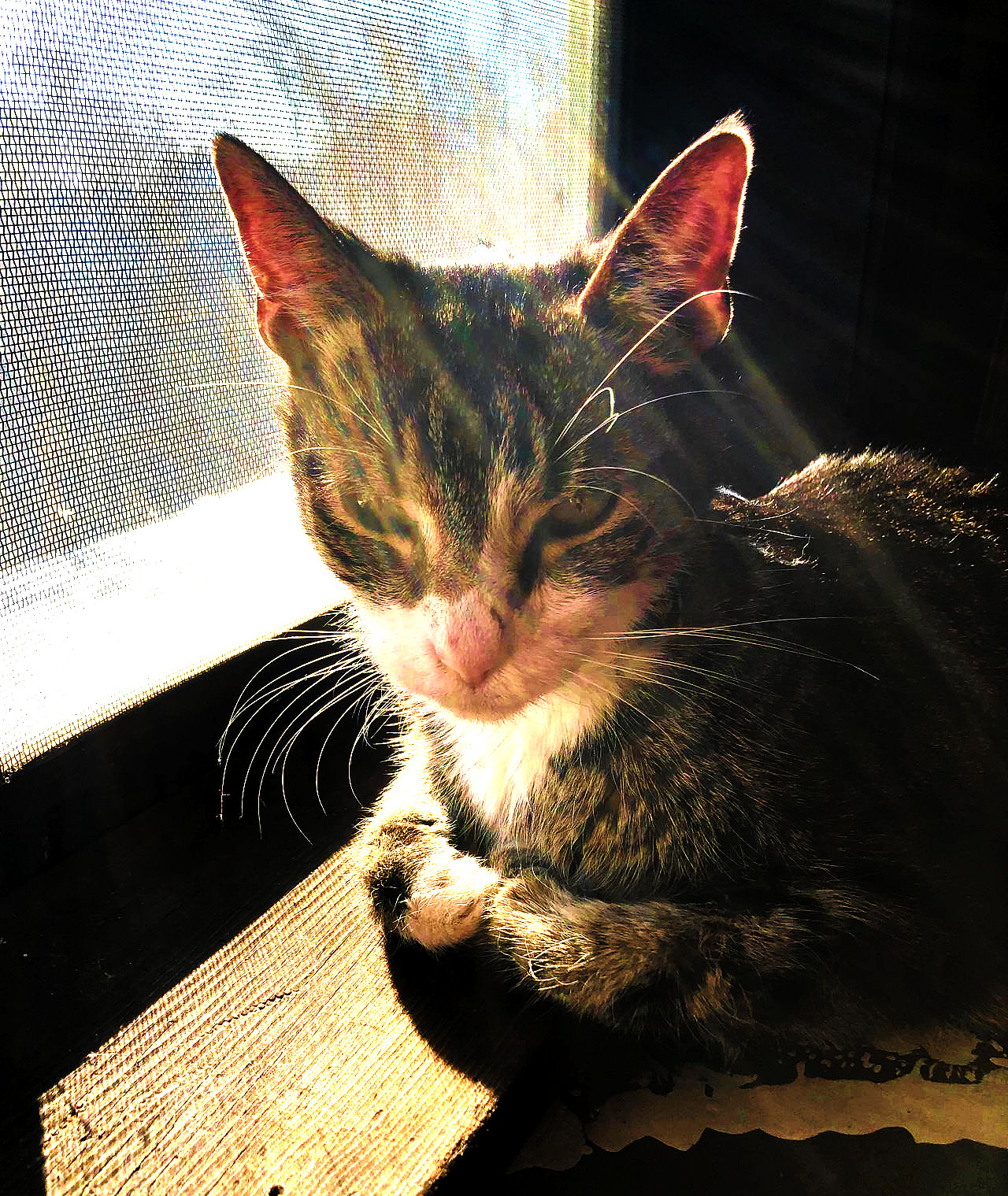
Malkovich on his last day, sitting in one of his favorite spots and soaking up the sun for the last time. Credit: Tom Wrobleski
“I don’t cry about anything…except vacuums, rustling paper bags, truck back-up beepers, dinner, and being locked out of the bathroom. But other than that, I’m fearless and keep a firm leash on my emotions!”
A non-profit helps terminally ill and elderly clients find future homes for their beloved cats so they don’t end up in shelters.
Buddy has a dirty little secret: He’s a biter and scratcher.
The little guy has improved dramatically over the past few years and it’s something we actively work on, but he occasionally has his moments when he gets freaked out and indiscriminately lashes out, or gets frustrated and redirects his flood of emotion on the nearest person, which is almost always me.
I love the little dude anyway, I can anticipate his moments of overstimulation or freak-outs, and I know how to calm him down.
But I also know that, if anything were to happen to me and Buddy ended up in the shelter system, he probably wouldn’t make it out. He’s even more likely to lash out in a scary, unfamiliar situation, and cats who bite and scratch are usually deemed unadoptable and put on the express route to the needle.
That’s why I made my relatives promise that, if I get hit by a bus or something, one of them has to adopt Bud, give him a loving home, and treat him as an extension of me.
Not everyone has that luxury, especially the elderly and the terminally ill. That’s why Angela Rafuse, a 27-year-old from Novia Scotia, founded My Grandfather’s Cat.
Rafuse’s grandfather had recently lost his wife of almost 60 years and had his own health problems that demanded urgent attention, but he resisted going to the hospital because he didn’t want to leave his wife’s cat, Mackenzie, alone.
“That cat was all he had left of my grandmother, and he didn’t want Mackenize to end up in a shelter,” Rafuse told People.
Rafuse with Mackenzie. Credit: My Grandfather’s Cat
When her grandfather passed away in 2019, Rafuse adopted Mackenzie. When she posted a video of the quirky cat to TikTok, the resulting discussion in the comments led to the realization that lots of people have been in similar situations, with relatives whose illnesses were compounded by worry about what will happen to their beloved pets when they’re gone.
“We heard stories from people who had to put their grandparents’ pets into shelters after they passed because there wasn’t a family member to adopt them,” Rafuse told blogTO, a local news site focused on Toronto.
My Grandfather’s Cat works “to keep the animal with their human up until the very last day and provide the comfort of knowing a loving family will adopt their pet when the time comes,” according to the non-profit’s site.
Refuse and volunteers work with people who are terminally ill, seniors who are forced to move into housing situations that don’t allow pets and other situations, and helps them find loving homes for their pets. Knowing their cats and dogs will be taken care of after they’re gone grants peace of mind to people who are already dealing with major life changes or their own mortality.
The group relies entirely on donations and doesn’t charge clients or adopters. My Grandfather’s Cat offers its services to all Canadian regions, and Rafuse said she hopes to expand to the US.
“It is the most rewarding thing in the entire world to be doing this,” she said, “and I know my grandfather would be proud.”
“She’s not showing you her baby because it’s a cat. A feline! A house pet!”
I’m just going to present this here without comment, because nothing I can say can possibly make this any better than it is. If you’re unfamiliar with the original saga of breastfeeding cats at 40,000 feet, read our previous post here.
An office employee demanded ‘sensitivity training’ after a co-worker joked about an orange cat’s smarts.
Humane Societies in California and Indiana hope people have it in their hearts to welcome new cats into their homes this holiday season after 110 cats were rescued from two different hoarding situations.
In Pasadena, Calif., the Humane Society rescued 52 cats who were living in a nearby home and in a crawlspace under the house. They’re calling the rescued kitties “Christmas Cats,” have given them names like Jolly, Merry and Jingle, and will offer discounted adoption fees in addition to spaying/neutering and microchipping the kitties before they’re sent to their forever homes.
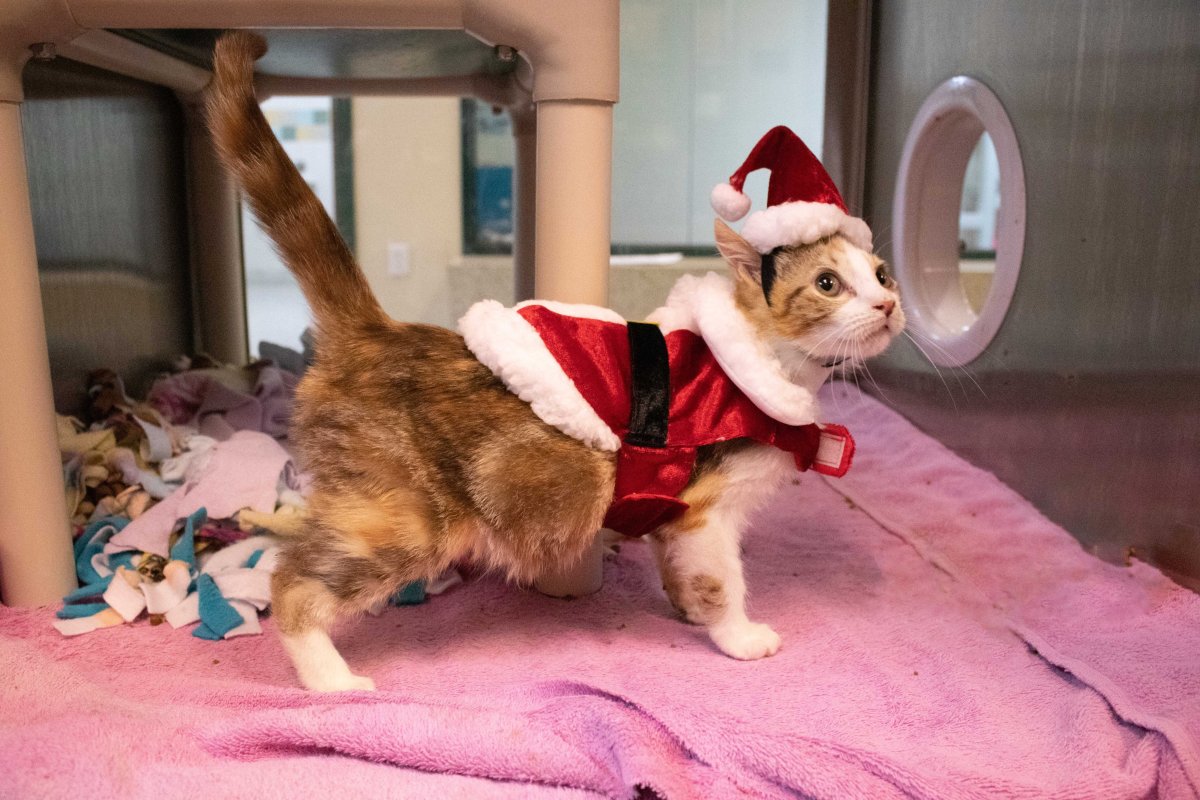
A ‘Christmas Cat’ rescued from a hoarder in California. Credit: Pasadena Humane Society
A ‘Christmas Cat’ rescued from a hoarder in California. Credit: Pasadena Humane Society
A ‘Christmas Cat’ rescued from a hoarder in California. Credit: Pasadena Humane Society
A ‘Christmas Cat’ rescued from a hoarder in California. Credit: Pasadena Humane Society
Meanwhile, local authorities rescued 58 cats from a hoarding situation in Evansville, Indiana. The kitties were crammed into a single-wide trailer and many of them were in poor health, according to Kendall Paul of the Vanderburgh Humane Society.
“I think it probably started innocently enough, with the person trying to take care of just a couple of cats and then things got out of hand,” Paul said. “Most of these cats are ill with upper respiratory infections, some with more serious issues.”
The organization is calling its holiday cat adoption event “Deck the Paws,” and adopters will be able to choose from “presents” from beneath a Christmas tree, each containing discounts on adoption fees.
“We’re certainly hoping people will step up and help us,” Paul told the Evansville Courier & Press. “If you want to adopt a cat, we have lots here that are ready for new homes.”
Epic Cat Battle: Employee Demands ‘Sensitivity Training’ For Co-Worker Who Joked ‘Orange Cats Are Often Dumb’
A Redditor sought the sage advice of the always-hilarious “Am I The Asshole?” sub-Reddit, explaining her dire situation. She works in an agency with two office cats: Jean, a tortoiseshell, and Jorts, the new cat on the block who is an orange tabby.
Jorts isn’t the sharpest claw on the paw.
The Redditor explains that Jorts is “kind of a simple guy” who can’t open doors and gets himself locked into rooms and the closet where he and Jean have their food nook. When kitty Jean can’t rescue Jorts (she can open most of the doors in the office, the Redditor wrote), Jorts meows until one of the employees rescues him from his predicament.
A co-worker named Pam decided Jorts should be more independent and “has been spending a lot of time trying to teach Jorts things.”
The Redditor favored a more simple solution and put a doorstop against the closet door so Jorts wouldn’t get himself stuck every time he went for a bite. That angered Pam, who insisted using a doorstop was depriving poor Jorts of a “chance to learn.”
Then Pam went full Karen, drawing up “a series of special learning activities for Jorts, and put the tasks on the whiteboard of daily team tasks.”
“Who you callin’ dumb?” Credit: Nantenaina Andrianjaka/Pexels
The Redditor tried to put the entire thing to rest by installing a cat flap and tried to diffuse the office tension by joking that they couldn’t “expect Jean’s tortoiseshell smarts from orange cat Jorts.”
The joke made Pam “furious”: “She started crying and left the hallway, then sent an email to the group (including volunteers) and went home early. In her email Pam said I was ‘perpetuating ethnic stereotypes by saying orange cats are dumb’ and is demanding a racial sensitivity training before she will return.”
The Redditor followed up with a second post after HR stepped in and — unlike many HR departments — had some level-headed people bring much-needed sanity to the kerfuffle. They told Pam to chill out and to stop assigning “Jorts-related tutoring” tasks to her co-workers. They also told her it was inappropriate to compare a co-worker installing a helpful doorstop to ethnic insensitivity.
During her little chat with HR, Pam also admitted she’d taken the tutoring thing too far:
“Lastly, and this made us both laugh so hard we can’t deal with it in person and will be said via email: Pam admits that she has been putting margarine on Jorts in an attempt to teach him to groom himself better. This may explain the diarrhea problem Jean developed (which required a vet visit).”
Speaking as a fellow redhead, I’m outraged! My people (human and cat alike) have been the butt of jokes for too long, and it’s time we organized a Union of Extraordinary Redheads to promote our shared interests, protect our own, and show the brown- and blonde-headed people of the world that we will not take their ridicule anymore! Jorts will receive his invitation in the mail shortly.
Can cats learn rudimentary human language with the assistance of devices like talking boards? Some people are giving it a go through an online program.
Billi the cat’s fans hang on her every word.
She’s a cute tabby with bright green eyes and an expressive face, but what sets her apart from the thousands of felines on Instagram isn’t her looks — it’s the fact that she communicates with her human using a talking board.
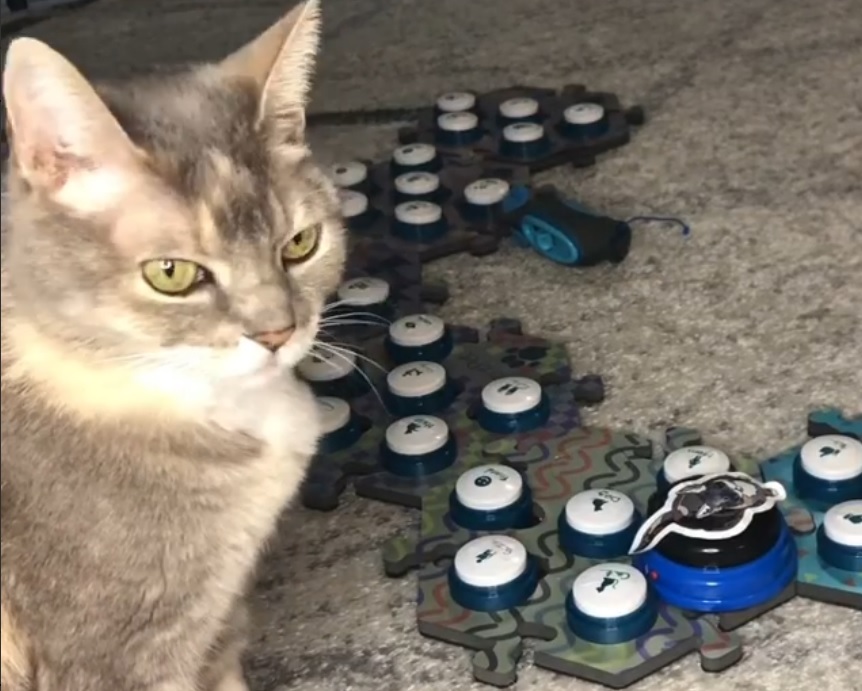
In her videos, the 13-year-old domestic shorthair pads over to a setup on the floor and presses buttons that trigger audio clips of words and short phrases: “Dog,” “Food,” “Tummy,” “All done” and many others.
“I started with a word that I’d really not recommend that you start with, which is ‘food,’ because it becomes very motivating for them. And Billi loves food,” Billi’s human, Kendra Baker, told Salon.
Starting with food “kind of backfired on me,” Baker admitted, “but it definitely got the ball rolling.”
Baker enrolled Billi in an informal online research group called TheyCanTalk comprised of pet owners who try to teach their animals to communicate using talking boards. Ninety five percent of the animals involved in the program are dogs, but TheyCanTalk founder Leo Trottier, a cognitive scientist, told Salon he was “pleasantly surprised” when people began signing their cats up as “learners.”
He’s not the only professional keeping tabs on the progress of felines using talking boards.
“I’m very intrigued by the cats that are using the boards, because there’s really a dearth in cat cognition studies, particularly those that happen in the home,” cognitive scientist Gabriella Smith said. “Cats are really kind of overlooked in the companion animal cognition world. I’ve been a big fan of Billi, and my animal cognition scientist brain just lights up because I see these behaviors that I know from my own cat — but now I’m able to look at it from a cognition lens.”
“What do you mean you don’t understand me, human? I’m speaking your language!”
We had fun with the idea here on the blog exactly one year ago when we wrote about Kristiina Wilson, an animal behaviorist who battled the boredom of lockdown by constructing a DIY talking board for her cat, who is naturally communicative and “very clear about his needs and wants” even without the board.
We imagined Buddy taking to a talking board with gusto, sparking an arms race in which he rapidly educates himself, expands his talking board, hooks it up to the internet and builds himself a prosthetic opposable thumb as part of his evil plans to take over the world.
Watching clips of Baker’s cat, Billi, I really want to believe she’s learning rudimentary language, and that I’m seeing a cat pause thoughtfully after her human poses a question, thinking over her answer before deliberately pressing a button of her choosing. I want to believe our cats can process words and simple phrases, even if syntax is beyond them. I’d like to believe my cat, like Billi, would tap out a plea for me to stay at home and hang out instead of running out to do errands.
But I don’t.
There are a few things that stretch credibility as far as the videos go, starting with the fact that Billi’s communication array has more than 50 buttons and many of them represent abstract concepts like “before,” “want,” and “later” as well as mental states or reactions like “mad” and “ouch.”
Billi and her board.
At times Baker reminds me of Penny Patterson, the animal psychologist famous for teaching Koko the gorilla to “use” sign language. There are plenty of videos of Koko throughout the years on Youtube and one constant, as different visitors, celebrities and kittens interact with her, is Patterson’s trinary role as surrogate mother, scientist and interpreter.
Koko would sign a seemingly random assortment of words, and Patterson would explain to her befuddled guests that “play nipple eat” meant Koko wanted to play, examine their nipples, and then have lunch. (Koko was obsessed with nipples for unknown reasons, to the point where media reports described her obsession as a “fetish.” It even resulted in a lawsuit in which two female employees claimed Patterson threatened to fire them if they “did not indulge Koko’s nipple fetish” and expose their breasts to the gorilla. The parties eventually settled for an undisclosed sum.)
Koko’s communications were filtered through Patterson, and her antics — whether pretending to blow her nose, feeding her kitten or signing — were done at the behest, and urging of, Patterson.
Billi’s buttons
Likewise, Baker praises Billi like any loving cat caretaker would do, but does a lot of interpreting. Billi hits the button for “bird” after sundown and Baker compliments the tabby on her ability to peer into the dark outside. Then Billi pads back over to her board and presses a button for “before,” and Baker decides her cat isn’t saying she sees a bird out there now, but that she saw one earlier in the day.
When Billi presses the buttons for “mom” and “settle,” Baker interprets it as a request to lay down and cuddle. But the buttons are right next to each other, and Billi doesn’t so much press them as she stands on them the way cats do when they rest their front paws on a surface.
When Baker prompts Billi to look for her toy mouse, she presses the buttons for “where,” “mousey” and “hmmm?” Billi looks around, scratches herself for a few seconds and looks around some more before Baker picks up the toy and gives it to her. Then Baker tries again, pressing the buttons in the same order.
Billi idles, glances at Baker and finally pads over to her toy. Baker sees it as confirmation that her cat understood the words, was able to string them together, understood the sequence was a request for information, and responded appropriately.
It’s a fun informal experiment, it’s neat to see a cat using a talking board, but I think there’s a significant burden of proof for anyone claiming it qualifies as science. Even the seemingly straightforward words and phrases — “food,” “catnip” and “love you” — are more likely conditioning than understanding.
Is Billi really saying she loves Baker when she presses the button for “love you,” or has she learned that pressing that particular button always rewards acknowledgment and attention? Does Billi know “love” corresponds to the feelings of affection she has for Baker? Does Billi understand that “food” means food, or does she know pressing that button results in Baker giving her a tasty snack?
Those of us in the audience aren’t watching in real time. Videos of Billi, like videos of “talking dogs” like Bunny the sheepadoodle, are heavily edited. Long stretches of inactivity are clipped or condensed. While almost all online influencers (Bunny has a million followers on Instagram alone) make heavy use of edits to satisfy the short attention spans of their viewers, communication has a crucial temporal context. There’s a chasm of difference between someone answering a question with “no” within a second, and an animal pressing a “no” button after three minutes have passed.
The videos also constitute editing by omission. Instagrammers who upload videos of their pets using talking boards are choosing the best ones, those that confirm their belief that their cats and dogs are genuinely learning human language. We don’t see the footage of pets banging on buttons randomly or activating them accidentally as they walk over the talking boards.
That’s not to say Billi doesn’t experience the emotions associated with her talking board buttons. Behaviorism fell out of favor in 1959 with the advent of the cognitive revolution, and experiments in recent years have removed any lingering doubt behaviorist diehards may have had about animals.
Animals think and feel
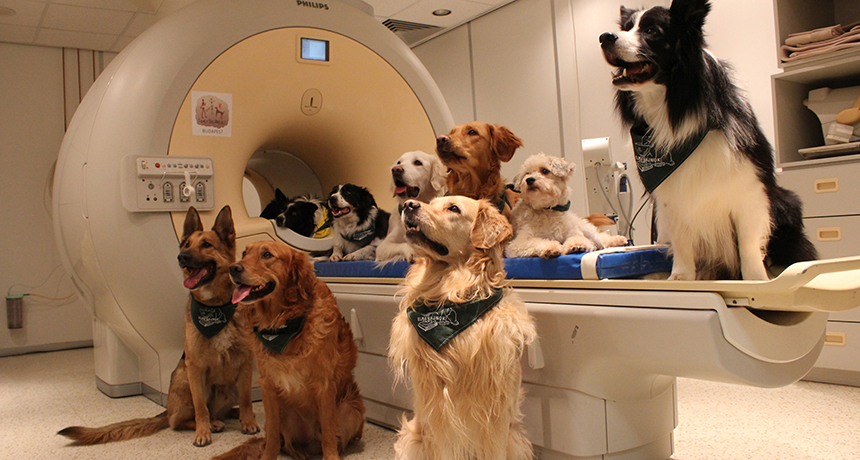
Our furry friends experience the full range of primary and secondary emotions. They feel pain, depression, excitement and joy just as acutely as humans do, and well-designed experiments — like the neurologist Gregory Berns training dogs to sit still in fMRI machines so their brains can be scanned — have confirmed animals have internal thought processes and rich cognitive lives. (Like all good science, Berns’ work is repeatable.)
Neurologist Gregory Berns trained dogs to sit still in MRI units. Berns got the idea and began to train his pooch, Bella, after watching a documentary about Navy SEALs and their dogs jumping out of helicopters. Credit: Emory University
The question isn’t whether animals think and feel, it’s whether we’re expecting them to do something they aren’t meant to do — and anthropomorphizing them in the process — by pushing them to learn human language.
They already meet us halfway, and in the case of cats in particular, more than halfway: The little ones communicate by scent and body language, but they’re smart enough to realize we humans are hopeless at learning those subtle languages, so when they communicate with us, they vocalize as we do.
We know that even great apes, our closest relatives in the animal kingdom, and dogs — who were the first animals to be domesticated and are born with the ability to parse human facial expressions — can’t get a handle on human language.
With Koko’s passing in 2018, the sun has set on the age of primate language experiments partly because funding has dried up, partly because the undertaking involves becoming a parent in a very real sense to an animal that can live for half a century or more, and mostly because it turns out gorillas, chimpanzees and bonobos weren’t really learning language at all.
Nim with Bill Tynan and Joyce Butler.
Nim Chimpsky as a baby.
Nim and Joyce Butler, working on communication.
Herbert Terrace, the scientist behind the infamous “Nim Chimpsky” experiment of the 1970s, set out to prove behaviorist B.F. Skinner right — and linguist Noam Chomsky wrong — and ended up admitting failure in a book that explains how he came to realize ape language experiments were unintentional exercises in the Clever Hans Phenomenon.
“Careful examination of videotapes revealed that the human trainers had inadvertently been cuing the chimp in advance of his signing,” the Wall Street Journal wrote of the Chimsky experiment. “To Mr. Terrace’s great credit, he acknowledged his error, and then went on to discover similar mistakes had been made in most—perhaps all—prior and subsequent claims of apes acquiring human-type language. He has, to some extent, been actively engaged as an animal-language myth-buster ever since.”
The horse who changed science
If a horse can pick up on unintentional body language cues, and fool tens of thousands of people into believing it can answer questions and perform calculations as a result, then it’s a certainty that primates and cats — our closest genetic relatives and domesticated animals who live with us as members of our family, respectively — can easily pick up on cues, especially when there are rewards involved.
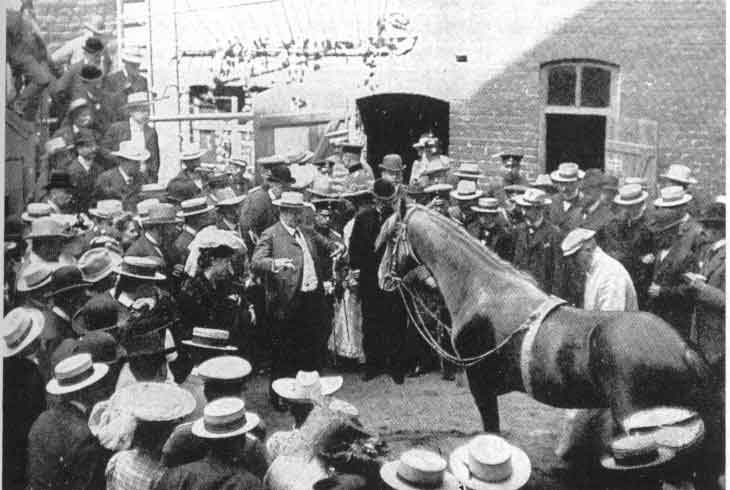
“Clever Hans was hailed as the first and most famous ‘thinking’ animal,” the authors of a 2013 paper on the phenomenon wrote. “Except a few skeptics, the majority of biologists, psychologists, and medical doctors, experts of all kind, and laymen were rather convinced by this example that animals are able to think in a human way and to express human ideas in non-verbal human language. In 1904, the German board of education even set up a commission to determine if the claims made about Hans were genuine. After an extended period—a year and a half of study—they concluded that there was no hoax involved.”
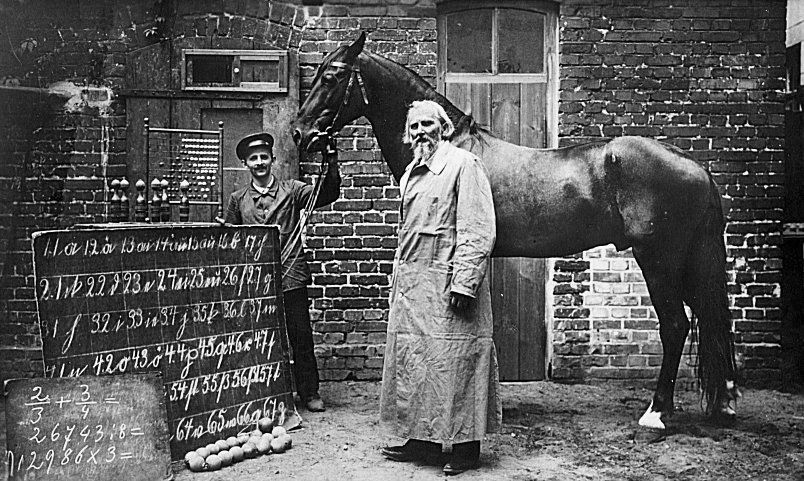
Clever Hans fooled lay people, scientists and animal behaviorists alike until finally, “by the meticulous examination of Professor Oscar Pfungst, a biologist and psychologist,” Pfungst realized Hans couldn’t answer correctly if the person asking him the question did not know the answer either.
In other words, Hans was reading the answers off the faces and via the body language of the people around him. In the end it turned out Hans wasn’t a math genius or a connoisseur of the arts, but he was clever. Hans showed the world just how closely attuned animals can be to human behavior.
The fact that a horse, and not a primate or a dog, revealed such an ability reflects the thousands of years horses have been taking subtle cues from their trainers and riders. An experienced horse can determine a rider’s intent by the slightest tension on the reins or shift in weight.
Clever Hans the horse with his human, mathematician Wilhelm von Osten. Credit: Wikimedia Commons
Clever Hans astounded crowds with his apparent ability to perform simple math and answer questions, but it skeptics eventually discovered the horse was picking up cues from the people around him. Credit: Wikimedia Commons
In fact, it was the Clever Hans Phenomenon that led to innovations like double blind studies and forced scientists to really think about how they design their studies, as even the most careful and well intentioned researcher can unconsciously convey information to study participants. When we’re close to our subjects, as pet caretakers are, it’s almost a guarantee that we’re giving our pets cues without awareness of what we’re doing.
Animals like cats and dogs may not think like people do — and it’s a mistake to expect that of them — but that doesn’t mean they’re not experts at gleaning information from our body language, facial expressions and tone of voice. In fact, that’s their natural way of communicating information.
Even though I can’t bring myself to believe Billi, or any other cat, is learning to use human language, there’s value because failure tells us just as much as success does. Any attempt to better understand cats is a worthy pursuit.
Regardless, it’s clear Billi likes pressing the buttons on her talking board, and the entire exercise is a stimulating game for her. Cats may not have the ability to use human language, but they do like to play, and they like anything that results in interaction and attention.
Maybe that’s the most important takeaway.
“I really believe that the majority of house cats are bored and depressed,” Baker said. “We don’t give them any stimulation . . . and if this pandemic has taught us anything, it’s that staying inside your house all day is terrible. So you know, anything that we can do for them that gives them a better life, I’m for it.”
All photos credit Wikimedia Commons and Pexels unless otherwise noted.





 Pain In The Bud