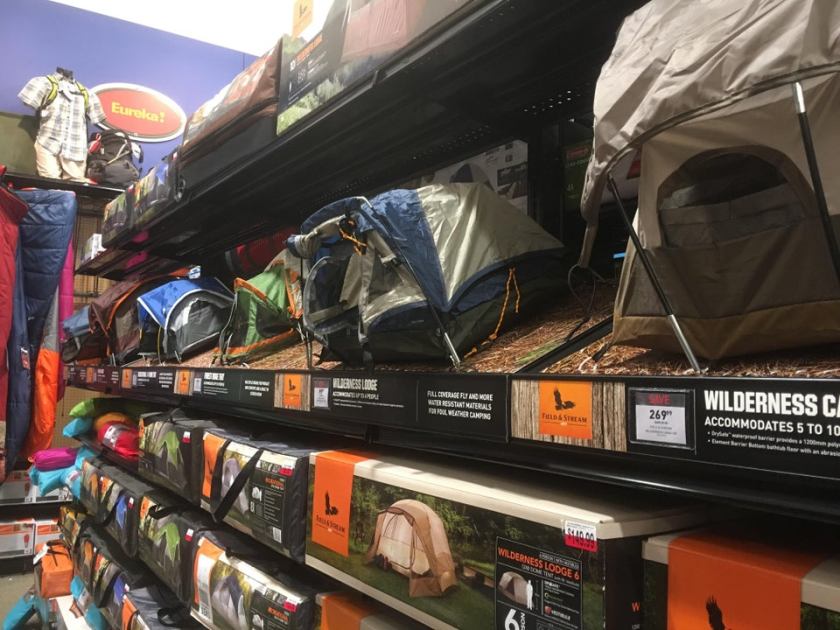
Go to any store that sells camping gear and you’ll see display tents — tiny versions of the real thing, so customers can see exactly what they’re buying.
A few people, mostly employees at various sports and camping supply stories, got their hands on display tents, brought them home for their cats to use, and a trend was born when they began posting photos of their camping kitties online.
Miniature tents at a sporting goods store. Credit: Arkenzi/Reddit
The hashtag #tinytents turns up Instagram photos of cats lazing in their own tents. They’re apparently even more appealing to them than boxes, according to some cat servants whose felines are taken with the miniature camping shelters.
Because the tents are just smaller versions of real models, they’ve got all the bells and whistles, including bug netting, awnings, tie-back doors and zip-up windows. (There’s also a company that markets them at cat owners for $59.99, but you can find them for 20 bucks on TinyTent.com.)
I think I’m going to have to get one of these for Bud!
Click the thumbnails below for larger versions of the photos:
Also, we assume, known as Xherdan the Sun Eater, Xherdan the Bane of Hope, He Who Sups on Souls, and Xherdan the Earthcrusher.
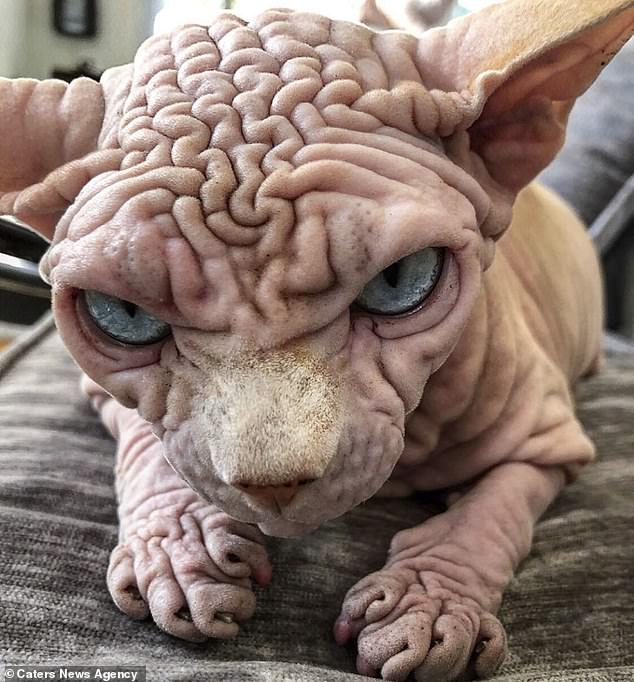
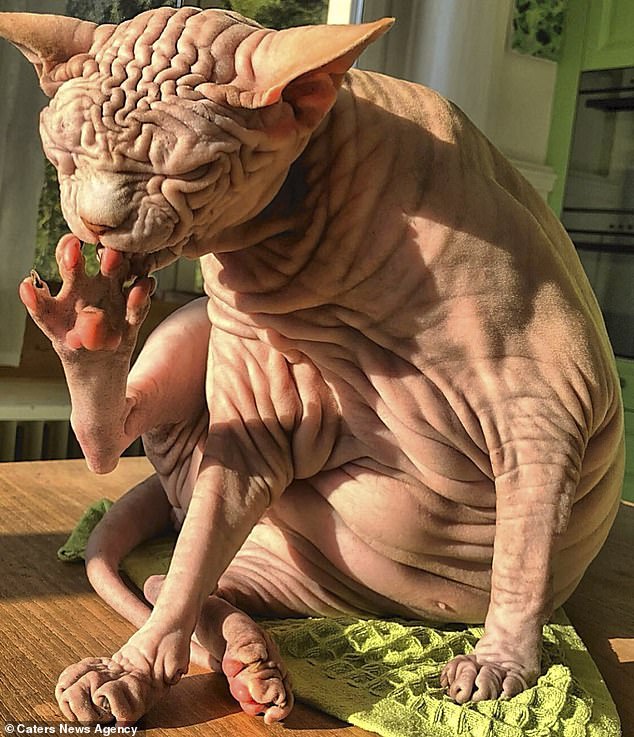
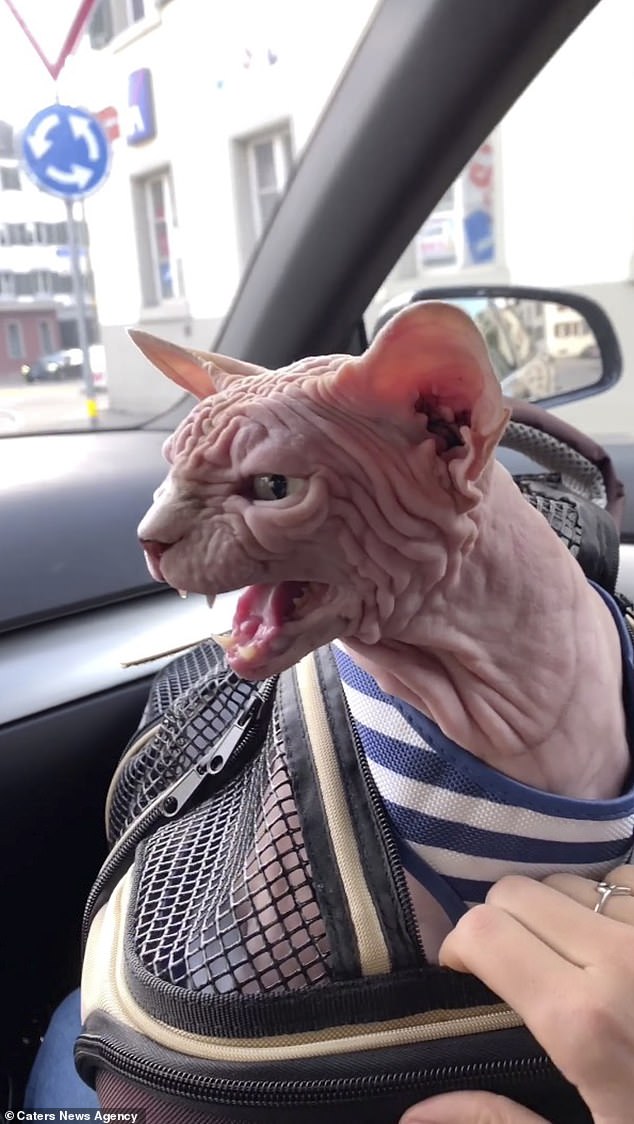
The incredibly wrinkly Sphinx cat is served by a Swiss woman named Sandra Filippi, who insists the feline, despite looking like the brain of a malevolent alien, is just a big softy who enjoys cuddling and napping when he’s not talking. We’ll give Filippi the benefit of the doubt and won’t allege those talks include nefarious plans for the subjugation of the human race, but only until we get solid evidence.
Where some of us see a Lovecraftian horror from the deepest Cthulian depths, Filippi sees an adorable kitty.
“When I first saw him, he immediately stole my heart,” Filippi told the Daily Mail. “His wrinkled pink skin, as fine as a peach, and his turquoise eyes, I was in love.”
Although she doesn’t explicitly say so, it appears her cat is named after footballer Xherdan Shaqiri, a Swiss midfielder who plays for Liverpool.
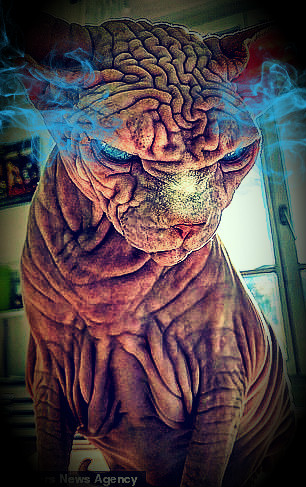
We’ve taken the liberty of making some very small adjustments (barely noticeable, really) to one of Xherdan’s photos in Pixlr, just to show our readers what an excellent Evil Overlord this cat would make:
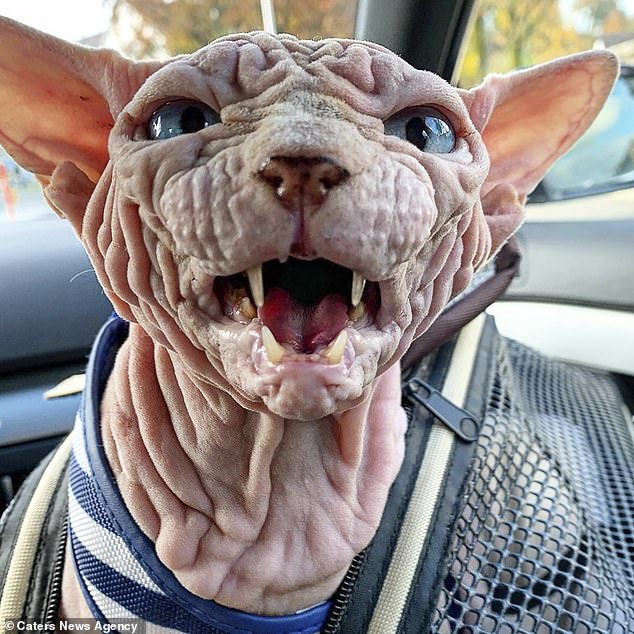
But the truth is, he doesn’t need glowing smoke coming from his eyes or dramatic lighting. He looks terrifying enough as it is:
Xherdan orders his minions to feast on the corpses of unbelievers.Xherdan grooms himself after easily reducing another human city to rubble and salting the earth it stood on.Xherdan threatens to wipe motorists from existence in a column of balefire if they don’t make way for his vehicle.
Cupid the cat finally has a home and humans who love him after suffering through an incredible ordeal when someone shot him in the head with an arrow.
Google News is a wonderful thing if you put it to good use.
A handful of alerts keep me abreast of cat-related news, arming me with potential topics and stories to share with you, the readers of Pain In The Bud.
Unfortunately when it comes to cat news, bad comes with the good. Lots of it.
For every story about lovable chonksters, cute kittens or miraculous reunions with lost cats, there are articles about dying felines rescued from hoarding situations, future serial killers torturing innocent animals and lunatics putting cats in microwaves.
Sometimes I have to stop, click off the browser and go find something to distract me from how disgusting the human race can be.
That’s why I’ve taken a pass on writing about Cupid the Cat — until now. (The story has a happy ending, thankfully.)
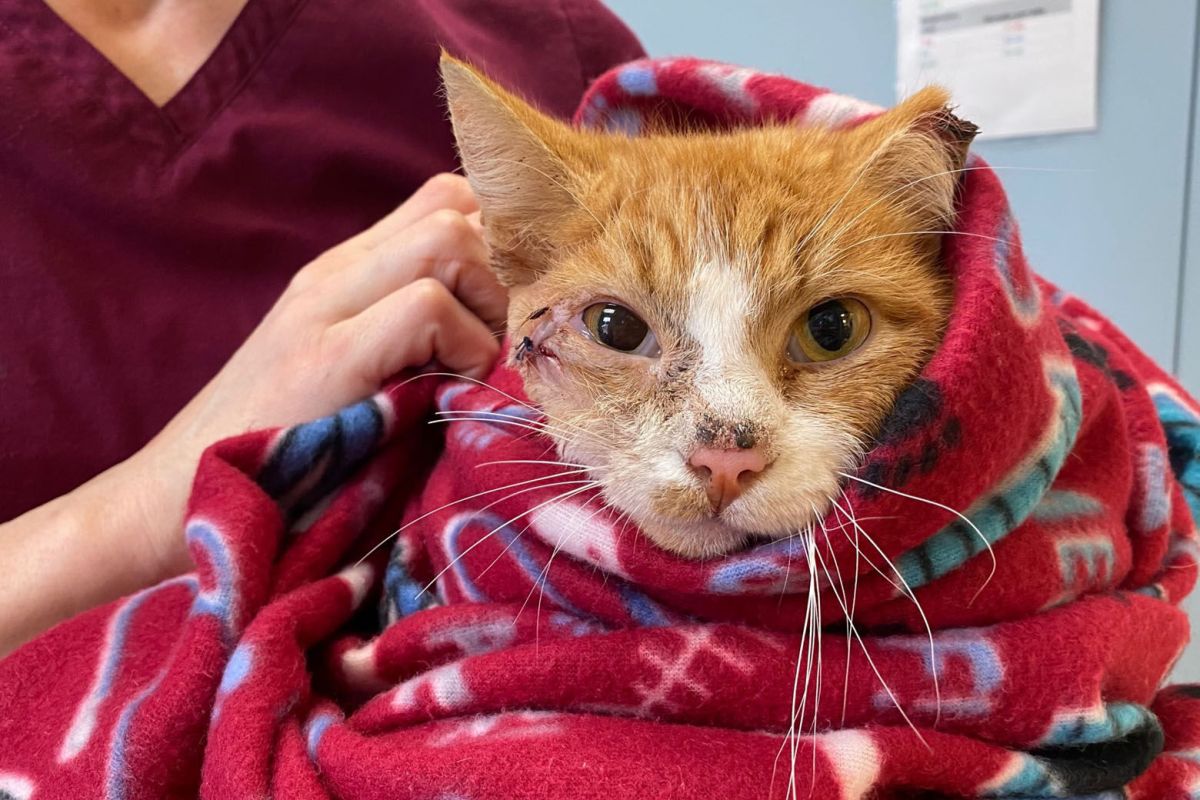
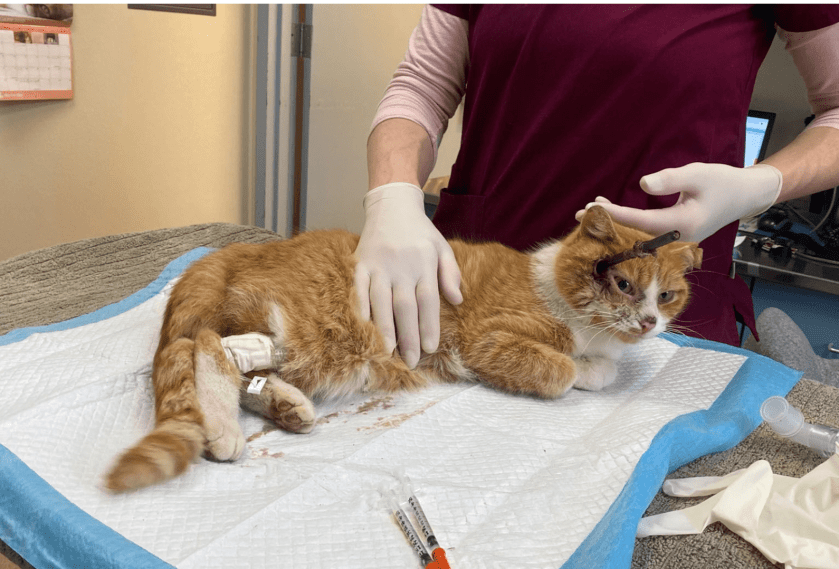
Last month, a Good Samaritan contacted the Animal Welfare League of Arlington, Virginia, about a stray cat suffering from a horrific injury: The poor boy had been shot in the head with an arrow, leaving the shaft protruding from the side of his face.
The cat’s rescuers dubbed him Cupid because he was found on Valentine’s Day, Feb. 14, and appealed to the public for help to cover the costs of several surgeries little Cupid would need to survive.
Despite the horrific act of violence committed against him by humans, and despite the pain he was enduring, Cupid was happy to see his rescuers, Chelsea Jones of the Animal Welfare League said.
“When he arrived and we opened his crate, we’re kind of shocked to see this cat with an arrow shaft sticking out of his face, is making biscuits …. That’s when cats knead their paws,” she said. “It’s a very comforting, positive behavior. And he was purring, and he wanted us to scratch his tummy and his chin. And we just could not believe that this cat was being so affectionate and friendly in how much pain he must be in.”
“So, it was kind of right there and then,” Jones said, “we were like, ‘We gotta call this guy Cupid.’”
Veterinarians worked for several hours to remove the arrow, clean the wound and stitch the little guy back up, putting him on antibiotics and painkillers. The arrow miraculously missed Cupid’s brain, eyes and other vital organs, but his rescuers feared he could succumb to a serious infection from the wound.
Cupid was placed on antibiotics and pain killers after his surgery. Credit: Arlington Animal Welfare League
The Animal Welfare League put out an emergency appeal for $6,500 to cover the cost of Cupid’s surgery. Well-wishers covered the cost within hours, and by week’s end the League had taken in more than $87,000, allowing it to fund life-saving surgery for two other animals in addition to Cupid.
The young cat fought hard and recovered from his wounds, and after whittling down dozens of applications to 14 finalists, the League held a drawing.
“It would be amazing if we could send him home with everyone but only one lucky person gets to take cupid home,” Jones said.
Well, two people: Cupid went home with a loving couple from the Washington, DC, area. No more cold, no more hunger, no more loneliness — and protection from the kind of horrible people who would hurt an innocent animal. Congratulations to Cupid on getting better and finding a forever home!
Cupid finally has a home — and humans — of his own after an incredible ordeal and a rough start to life. Credit: Arlington Animal Welfare League
The international feline superstar escaped unharmed, authorities confirmed.
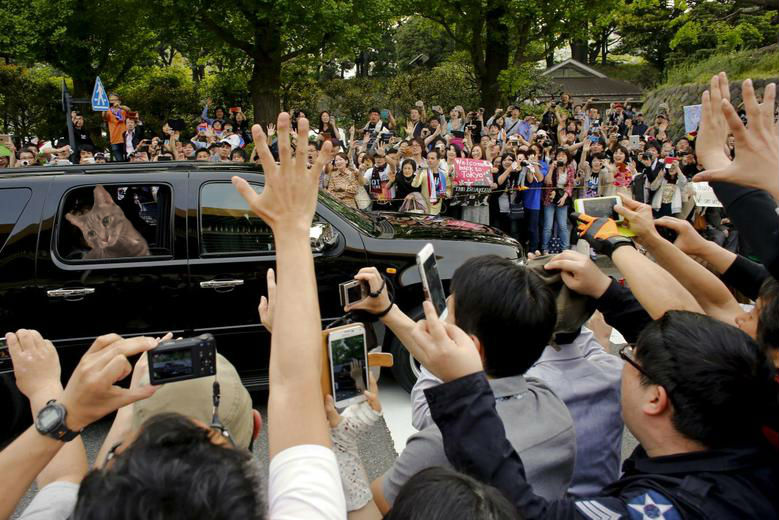
TOKYO — Buddy was uninjured after his tour bus was besieged and overturned by a massive crowd of screaming Japanese school girls, the famous cat’s representatives said Sunday.
Buddy, who touched down Friday in Tokyo for his “Got 2 Have Turkeys” tour, was en route to a performance and album signing in Shibuya Tower Records on Saturday afternoon when his tour bus was blocked by a phalanx of paparazzi. A large crowd that had assembled outside the store gravitated toward the street, surrounding the bus and making it impossible for the vehicle to escape in reverse.
“At first it was just normal stuff: The crowd chanting for Buddy, girls throwing their bras at the windows, boys calling out for autographs,” said MC Kibble, who has been touring with Buddy as the opening act and hype cat. “But when I felt the bus lurch, I knew we were in deep litter. The shit hit the sand, so to speak, and we got jolted around pretty good when they shoved the bus onto its side.”
Ai Imajo, left, Asako Imamura and Yuki Mori react after spotting Buddy surrounded by guards and handlers at Haneda International Airport in Tokyo on Friday night.
The crowd was dispersed by Tokyo Metropolitan Police as paramedics arrived and cleared the bus. One roadie suffered a fractured rib, authorities said, but most of the occupants made it out with only a few scrapes and bruises.
An ambulance took Buddy to an undisclosed hospital, where he was discharged after only an hour.
“It was just a precautionary measure,” said the celebrity cat’s human servant, Big Buddy. “We had to make sure His Grace was in top shape before he continues his tour.”
Buddy is scheduled to perform for sold-out crowds at Saitama Super Arena on Monday and Sapporo Concert Hall in Hokkaido on Tuesday before heading to Hong Kong for the next leg of the “Got 2 Have Turkeys” tour.
Scientists now clone animals for experimentation and genetics companies clone pets.
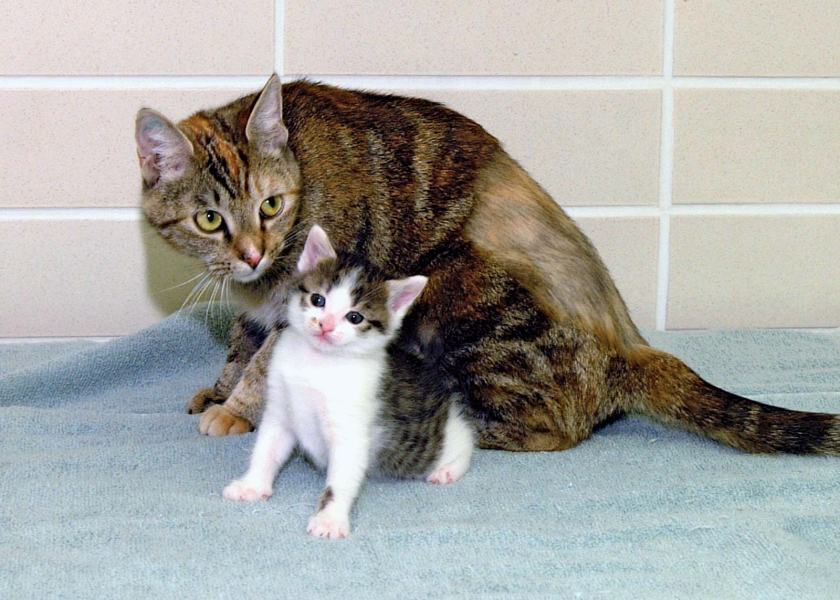
Like Dolly the sheep, CC the cat’s arrival into this world was accompanied by apocalyptic pronouncements, grave concerns about man’s hubris at playing God and warnings that human clones wouldn’t be far behind.
At the time cloning was revolutionary, something that was only supposed to exist in science fiction movies. Most people were uneasy with it, and much of the public debate centered around ethical concerns.
It was 2001: The world had just gotten over the Y2K scare, the Sept. 11 attacks and an abundance of turn-of-the-century, end-of-the-world prophesies. When people thought of cloning, they pictured tyrannosauruses rampaging through Jurassic Park and Jeff Goldblum’s scientist character lecturing the park’s proprietors on playing with the awesome power of nature.
CC passed away on March 4, 2020 at 18 years old — a full life by feline standards. The real consequences of her existence were less dramatic than predicted, but ultimately disappointing.
CC with her surrogate mother, Annie. Credit: Texas A&M
Copy Cat’s birth didn’t herald an age of human cloning, but it did open the door to widespread animal cloning — including, as of last year, non-human primates — and eventually, to pet cloning.
A Mixed Legacy
Mark Westhusin, a scientist who was part of the team that successfully cloned CC, sees it as progress.
“CC’s passing makes me reflect on my own life as much as hers,” Westhusin said Wednesday. “Cloning now is becoming so common, but it was incredible when it was beginning. Our work with CC was an important seed to plant to keep the science and the ideas and imagination moving forward.”
CC lived as any typical house cat would, according to Shirley and Duane Kraemer, who adopted the famous feline. Duane Kraemer was also part of the research team involved in CC’s cloning.
Kraemer with CC. Credit: The Eagle (Bryan, Texas)
When Barbra Streisand admitted she had her dog cloned in 2017, she responded to the backlash by writing an editorial in the New York Times, defending cloning as a way to get over the heartbreak of losing a pet.
There are now several genetics companies that offer pet-cloning services for people who want to bring their dear dogs and cats back to life.
“The human–animal bond is a pretty strong thing,” said Kerry Ryan, a veterinarian who works for pet cloning firm Viagen. “Our pets truly are a part of the family, and people want to have a piece of their pets around forever.”
Clones, But Not Your Real Pets
Except, of course, they really aren’t bringing cats and dogs back to life, and the animals won’t be around forever. Viagen’s customers get a genetic copy, but that doesn’t mean the clone will look or even act the same.
“It can be a genetically identical animal that can come out looking differently than the animal that you had,” veterinarian Katy Nelson told WTOP in 2018.
To the people who can afford dropping between $25,000 and $50,000 to clone their cats and dogs, it doesn’t seem to matter that both nature and nurture will ensure differences.
Pet cloning has also drawn the ire of animal welfare activists and major organizations like the Humane Society and SPCA, who point out that every cloned cat or dog means one less home for strays in shelters.
The Humane Society “opposes cloning of any animals for commercial purposes due to major animal welfare concerns,” HSUS’s Vicki Katrinak told National Geographic. “Companies that offer to clone pets profit off of distraught pet lovers by falsely promising a replica of a beloved pet. With millions of deserving dogs and cats in need of a home, pet cloning is completely unnecessary.”
False Starts, Gene Splicing and Clone Experimentation
Then there’s the truly dark side of cloning.
Each cloning attempt involves implanting eggs into several surrogate cat (or dog) moms, and no one wants to know what happens to the other clones, whether or not they make it to term. There’s no law requiring the companies to disclose the fate of those animals, so for now it remains a mystery.
Not all clones end up in loving homes, either. The lucky handful do, but others are birthed into the world to be experimented on, like a quintet of monkeys cloned by scientists in China.
Scientists edited the DNA of these monkeys to remove a gene that regulates sleep, resulting in depression and anxiety, among other problems. Three of the five monkeys pictured here are sucking their thumbs, which is a sign of stress when primate infants are taken from their mothers. Credit: Institute of Neuroscience, Shanghai
The scientists who brought the monkeys to life also edited their genes, “cutting out a gene involved in regulating the sleep/wake cycle.” A 2019 story on Phys.org explained the consequences:
“The gene removal created multiple effects in edited monkeys, such as reduced sleep time, increased movement during the night, changed blood hormone levels, increased anxiety and depression, and some schizophrenia-like behaviors.”
Which was precisely the point: The research team wanted to study the unintended consequences of gene-editing on animals to learn more about how it could impact humans.
To be sure, none of this is Copy Cat’s fault.
The famous cat, who was delivered by a surrogate mother, lived for 18 years, a year or two more than the average house cat. She spent the remainder of her days as a typical house cat, albeit one whose vet visits and blood work were carefully pored over as geneticists confirmed she was as healthy as any other kitty.
But as science barrels forward and labs — many of them in countries with no regulations — are bringing cloned animals into this world, we should think about the consequences for animals and the human race.







 Pain In The Bud