
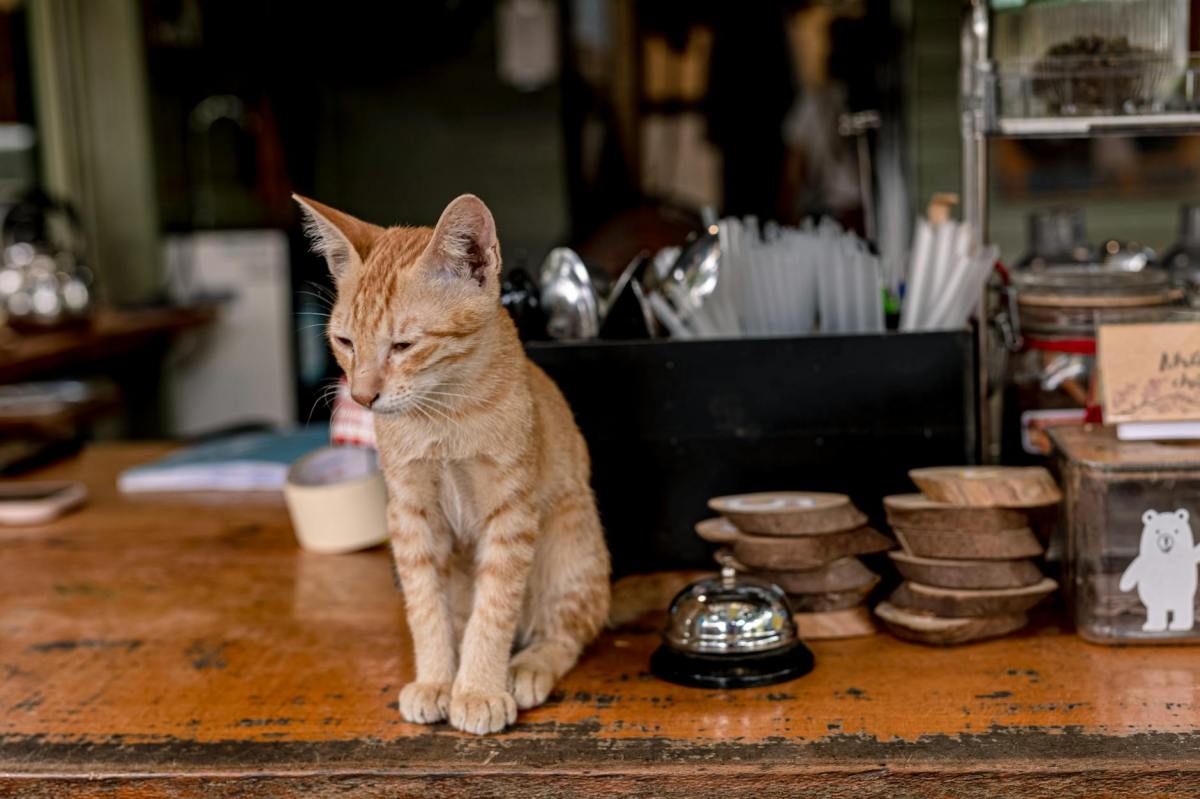
Two major feline advocacy groups in the UK are urging the government to stop issuing new licenses for cat cafes, arguing they’re not good living situations for the felines who are their main attraction.
Many people see the cafe model as a win-win for cats and people. The latter get to unwind and spend time with cute animals who have a knack for lowering blood pressure, helping the stressed to relax. The cats, who are adoptable, get to run, play and live in an environment much better than a shelter cage while they wait for their forever homes.
But the RSPCA and Cats Protection, the most prominent feline welfare organization in the UK, say its “almost impossible” to meet the needs of the animals, who may be stressed by living with other cats and, they argue, are used as “entertainment” for customers.
“We don’t believe these environments can consistently provide cats with a good quality of life and are hugely concerned that many cats will be unhappy as a result,” said Alice Potter, a cat welfare specialist with the RSPCA.
“Generally cats are not sociable, and many felines often prefer to live without other cats, or prefer to form social groups with their relations.”

I’m not sure how I feel about this, and I’m not particularly familiar with how most cat cafes are run. The only ones I’ve been to were in Japan, and they were miraculously clean spaces with lots of things to climb, as well as nooks and private areas where cats could hide. The cats were well cared-for, staff were friendly, and the environments were relaxed.
Cat cafes also offer a unique opportunity for finding homes for the little ones. They’re much more likely to meow their way into the hearts of would-be adopters when they’re given space to run around, play and enjoy themselves as opposed to the often sullen, frightened state they’re in at shelters.
Are the UK cats groups right, or are they making perfect the enemy of good?


Everyone, it seems, have cats in their cross-hairs. This world is fecked up indeed – and filled with malicious intent.
LikeLiked by 1 person
The vet tech who works at my vets office and volunteers for one not too far from me. Here’s the thing. You cannot put a cat in a cafe if they do not get along with other cats. That is a no brainer. My neighbor adopted thier cat from one. Cat cafes are needed as there are not enough fosters. These so- called advocates should foster cats or shut the hell up. My first volunteering was in Manhatten about 25 years ago. All in cages. They were left there 24/7. Some looked depressed. Will always regret not adopting a cat named Bruiser. I went home depressed myself thinking about him in that cage.
LikeLiked by 3 people
Yeah it’s difficult to believe a shelter staffed by decent people would force a cat to live in a cafe if they can’t deal with other cats.
LikeLiked by 2 people
I, too, have volunteered at shelters. Cat do indeed get depressed sitting in cages by themselves all the time. I volunteered at a great shelter when I lived up North. Open space with lots of shelves and hidey-holes plus a roll-up door that had been tricked-out with fencing so on nice days the cats would get fresh air and sunshine. Some of the kitties had to stay in the quarantined area for extended periods and those were the ones that got depressed. It was part of my job as a volunteer to interact with them. It was so satisfying.
I think many humans view cats as nothingness so their feelings towards them are empty, as welll. Stop thinking cats should act like dogs! Otherwise, get the feck out of Dodge.
LikeLiked by 1 person
Knowing what we know about how they get the zooms, how much play time and attention they need, it’s no wonder they’re so depressed in those cages.
Seems to me cats have a much better chance of getting adopted if they’re happy, playing and confident rather than huddled in the back of a cage, not even looking at people who come in.
The most depressed-looking cats I saw were at NYC Animal Control in Manhattan. The place is big, noisy with barking dogs who are also depressed, and the cages are pretty small. Still, they do the best they can in a city of 8 million people and God knows how many cats and dogs who need homes.
LikeLiked by 2 people
There’s an independently funded rescue group in a nearby town where the cats all live together in several big rooms. A friend volunteers to help care for them (one of many caregivers I’m sure) and takes still pics and videos. The cats sure look happier than those in shelter cages. Same goes for cats in a similar rescue group up North, which has a blog. I really wonder about the sociability statements. I think it varies from cat to cat. You read of barn cats who bond together to raise their kittens. And feral colonies. The Internet is full of pictures of cats outside walking happily side by side, with obvious affection.
LikeLiked by 1 person
I feel the same way. Tabby’s Place in New Jersey does that as well, and I know just from reading their blog and talking to their people that they are very serious about making sure they move cats to different groups if there are conflicts, as well as making educated decisions based on each cat’s personality.
They also set the rooms up so the cats have places to hide, climb and keep to themselves when they just want to chill.
It requires more of an effort to evaluate their personalities and get to know them as individuals, but it’s worth it.
LikeLiked by 3 people
I think I partially agree with our RSPCA in that there must be people who force cats into cafes in order to make money and dress it up as “good”. My own experience of cat cafes that I have been to is positive and I saw no evidence of stress or distress. However my experience is hugely limited and I can easily to see humans trying cats together and selecting cats that appear to get on with each other ( even Bella who is notoriously ‘single’ tolerates Bertie on his very occasional visits) I agree that shelters are better if well run – my own local ARC shelter of which I’m a trustee believes in fostering as a shelter method and we have an extensive network. So I bow to the RSPCA raising this through their knowledge and I see it as a ‘warning’ to people to be alert to cat cafes and raising any concerns by alerting the RSPCA to any issues urgently.
LikeLiked by 1 person
There are people talking about regulation for cat cafes, not just as cafes but as animal facilities, so there’s an effort to make sure the needs of the animals are met.
That sounds like a decent compromise, but might require amended laws depending on whether the cafes are considered “entertainment” venues or more like extensions of rescues.
LikeLiked by 2 people
It would seem that cats not well suited to cafe life would not be forced to live there. I’ve only been to one cat cafe (in Ontario, Canada), but it was very low-key. You could only have a cat on your lap if the cat chose to be on your lap. They seemed pretty content. I’m sure there are bad cat cafes, but it would be a shame to shut them all down. From what I’ve read, a LOT of cats get adopted out.
LikeLike
AFAIK every cat cafe here in NY has adoptable cats and partners with local rescues. It’s Definitely a better way for people to get to know adoptable cats and see them in a different context.
Some sort of regulatory system for ensuring the welfare of the animals seems like a good compromise.
LikeLiked by 1 person
(You may get this message twice. The first one disappeared.) I can’t imagine that they force cats to live in cat cafes if they are not comfortable there. I’ve only been to one cat cafe (in Ontario, Canada), and it was very low key. You couldn’t have a cat on your lap unless the cat chose to go there. I’m sure there are some bad ones, but it would be a shame to shut them all down. I’ve read that they’ve adopted a LOT of cats out.
LikeLike
I could see phasing out if cat cafes were owned by corporations, but it seems to me that they’re mostly owned by caring people who are looking to get these cats and kittens adopted,
LikeLike
When you think about it, cat cafes are the biggest innovation in popularizing cats and getting them homes in decades probably.
LikeLike