The Swiss Have A Unique Way Of Stealing Cats: By Feeding Them! PLUS: More Fun Claims About Litter Boxes In Schools

In Switzerland you can be charged with a crime and face significant fines for feeding other people’s cats. Meanwhile. the “kids identifying as cats” culture war rumors are back and as inane as ever.

The Swiss seem to take cat theft pretty seriously, to the point where they’re perfectly willing to drag people to court for feeding other people’s cats.

That’s what happened to a 68-year-old woman in Zurich who is accused of being so nice to Leo, a neighbor’s cat, that the little guy decided her house was now his house.

According to local media reports, a Zurich prosecutor wants to fine her 3,600CHF (Swiss francs), which is $4,370 in ‘Merican greenbacks! That’s a lot of money for giving a cat some Temps and cans of tuna.

To be fair, Leo’s original family isn’t happy, especially because they specifically asked the woman to stop feeding their cat. She can’t claim she accidentally adopted him, since she let him into her apartment and even installed a cat flap for him, according to Swiss media reports.

“Cases like this are increasingly ending up in court because the rightful owners report the “feeders”. Under Swiss law, cats are “other people’s property” and systematic feeding and giving a home to another person’s cat is considered unlawful appropriation.

But if a neighbour’s cats are only fed occasionally, this is not a punishable offence in Switzerland.”

There’s really not enough information to form an opinion about this particular case. Was Leo mistreated or not getting enough to eat? Did his new human have designs on him from the beginning? Did she just think she was doing the right thing?

“Gimme the nomnoms, human!” Credit: Wikimedia Commons

As for me, this is another good reason to keep Bud inside. If I let him roam the halls of the building unsupervised, he’d probably start a bidding war between me and neighbors in two or three other apartments, making it clear that whoever supplies him with the most delicious and most frequent snacks will enjoy the great honor of serving him.

Kids identifying as cats: the fake controversy that won’t die

Just a quick recap, for anyone who hasn’t been keeping up on this uniquely American culture war spectacle: Politicians of a certain stripe really like rumors about kids identifying as cats, so much so that they’ve confidently asserted it’s happening all over America, telling anecdotes about it while on the campaign trail during the 2020, 2022, and 2024 political cycles.

That encompasses two presidential elections and a midterm year, but it’s not relegated to federal cycles. State-level pols love to talk about it too.

It’s a culture war dog whistle, and politicians from both parties love stuff like this because it gets everyone all riled up, which means no one’s talking about all the grift, insider trading and other fun activities our “leaders” involve themselves in.

The thing is, to date not a single one of the claims has been backed up by proof. I know this because I’ve investigated every one of them, and invariably they turn out to be rumors. I’ve gotten emails and comments telling me I’m a fool for debunking the claims, and I’ve literally begged people to give me a real example of cat-identifying kids dropping deuces in litter boxes, but again, all the claims collapse under minimal scrutiny.

Every time a politician has told a story about allegedly cat-identifying kids and litter boxes in schools, it follows the same pattern: they insist it’s true, double down on the claim, try to change the goalposts, and finally, they grudgingly admit they can’t point to a single example.

In a week or two, we go from righteous condemnation and fury to “Well, my wife’s best friend teaches sixth grade, and she said she heard from a teacher in another district that kids were meowing in class.”

Furries outside a convention, not a school. Credit: Furscience

Texas state Rep. Stan Gerdes is in the righteous condemnation stage after introducing the Forbidding Unlawful Representation of Roleplaying In Education Act, aka the FURRIES Act.

Gerdes wants to ban meowing, hissing, barking, litter boxes, leashes and animal costumes from school grounds and events, but in his wisdom he’s excluded school mascots and Halloween costumes.

He is, however, fast approaching the “my cousin’s best friend’s co-worker said” stage, after he couldn’t point to a single cat- or furry-related incident when pressed during a committee meeting on May 1. He eventually named a school district, saying he’d gotten a “extremely concerning” and verified account of an incident there, only for the district to issue a statement saying it didn’t happen.

Gerdes did call to ask if there were litter boxes in the school, the district said, and when he was told there was not, he insisted a manual check of all school bathrooms, which also came up empty. Let’s see how long he sticks to his story before he finally admits he has no proof.
The Greatest Feline In Science Fiction Film History Is About To Turn 45

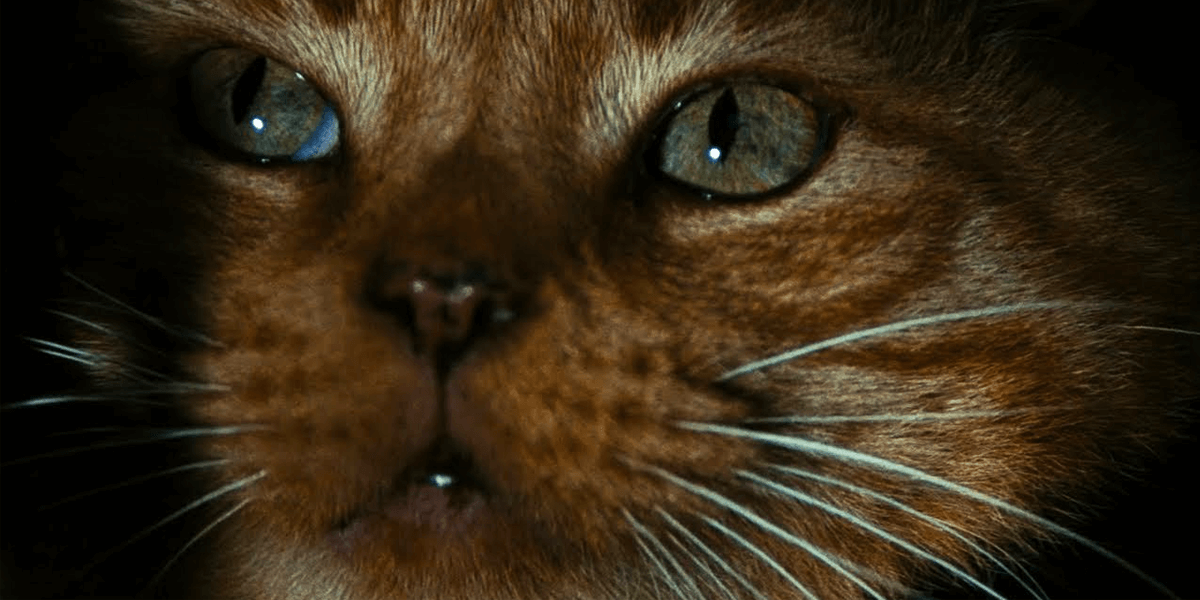
Making his debut in 1979’s Alien, Jonesy is one of the most famous felines in cinema history.

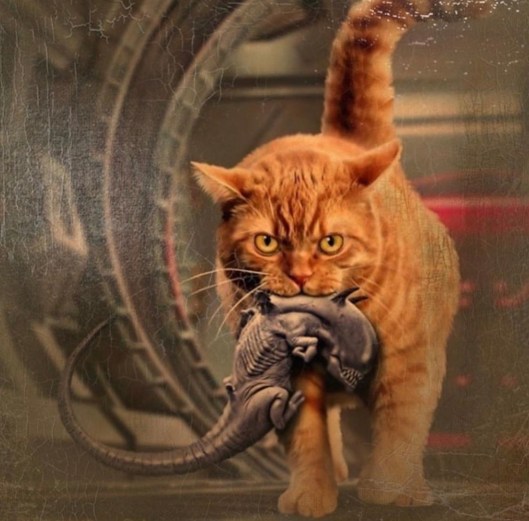
There’s a popular meme among Alien fans that depicts Jonesy the Cat walking nonchalantly down one of the starship Nostromo’s corridors with his tail up, carrying the corpse of the recently-spawned alien in his mouth like he’s about to present a dead mouse as a gift to his humans.

The joke is self-evident: if the crew of the Nostromo had allowed Jonesy to take care of business from the get-go, the alien would have been disposed of before it had the chance to grow into the monstrosity that haunted the decks of the Nostromo and the nightmares of viewers.

Jonesy Alien
“Who’s a good boy? Who just saved his crew from certain violent death at the claws of a ruthless alien predator? That’s right, you did!”

Of course then there’d be no movie. No ripples of shock in theaters across the US as audiences were confronted by something more nightmarish and utterly alien than popular culture had ever seen before. No indelible mark left on science fiction.

Despite the film’s retrofuturistic aesthetic, it’s difficult to believe Alien first hit theaters almost half a century ago.

That’s testament to director Ridley Scott working at the height of his powers, the carpenters, artists and set dressers who created the starship Nostromo’s claustrophobic interior, the design of the derelict starship where the alien was found, and the bizarre creature itself.

The alien ship and creature designs were the work of Swiss surrealist H.R. Giger, who was little-known at the time but floored Scott and writer Dan O’Bannon with his hyper-detailed paintings of grotesque biomechanical scenes.

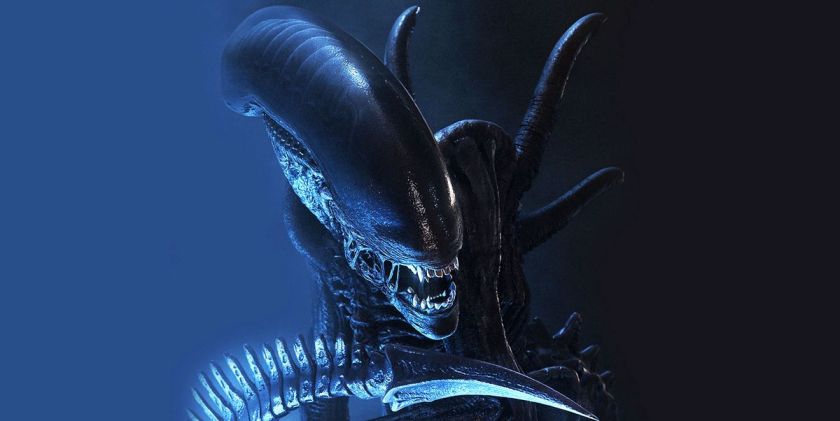
Giger’s work, specifically his 1976 painting Necronom IV, was the basis for the titular alien’s appearance. The alien, called a xenomorph in the film series, is vaguely androform while also animalistic. It is bipedal but with digitgrade feet and can crawl or run on all fours when the situation calls for it. It hides in vents, shafts and other dark spaces, coiling a prehensile tail that ends in a blade-like tip.

But it’s the creature’s head that is most nightmarish. It’s vaguely comma-shaped, eyeless and covered in a hard, armored carapace that ends just above a mouth full of sinister teeth like obsidian arrowheads. There’s perpetually slime-covered flesh that squelches when the creature moves but there are also veins or tendons or something fully exposed without skin, apparently made of metal and bone. Maybe those ducts feed nutrients and circulate blood to the brain. Maybe they help drain excess heat from the creature’s brain cavity.

Regardless, it’s a biomechanical nightmare that the Nostromo’s science officer, Ash, admiringly calls “the perfect organism” whose “structural perfection is matched only by its hostility.”

The alien, Ash declares, is “a survivor, unclouded by conscience, remorse, or delusions of morality.”

Alien xenomorph
The alien, also referred to as a xenomorph, “that thing,” a “dragon,” “the perfect organism” and various other names by characters in the series. Credit: 20th Century Studios

Part of what makes Jonesey so beloved is the fact that, together with the xenomorph and Ripley, he completes the triumvirate of survivors. We see Jonesy scurry into the protection of tiny confined spaces to escape the alien, hissing at it in the dark. We see him dart into the bowels of the ship after sensing the stalking creature, adding another blip to the crew’s trackers. Finally we see him settling into a cryosleep pod with Ripley, like so many other cats with their humans, when the threat has passed.

Jonesy — affectionately referred to as “you little shithead” by Ripley in the second film — appears in the franchise’s two most famous films, his own comic book series titled Jonesy: Nine Lives on the Nostromo, a 2014 novel (Alien: Out of the Shadows), and in hundreds of references in pop culture over the last half century, from appearances in video games (Halo, World of Warcraft, Fortnite) to references and homages in movies and television shows.

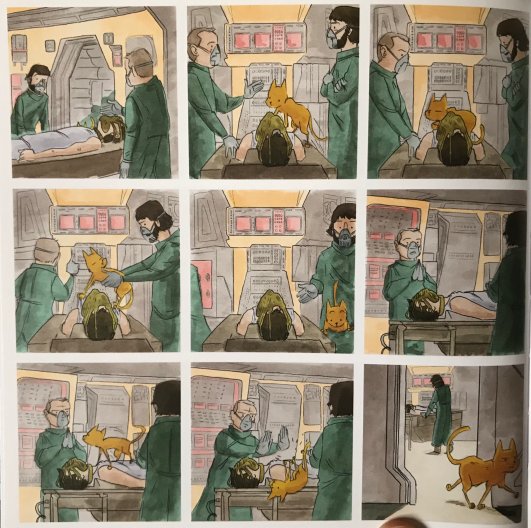
Jonesy: Nine Lives On The Nostromo
A page from Jonesy: Nine Lives On The Nostromo, which tells the story of Alien from the cat’s perspective. These panels depict Jonesy watching Ash and Dallas examining Kane in the ship’s medical lab.

He’s like the anti-xenomorph. Cats are predators, after all, and Jonesy might be the xenomorph to the ship’s rodents just like every ship’s cat in thousands of years of human naval endeavors. But to the crew members Jonesy’s a source of comfort, a warm, furry friend to cuddle with. Unlike the xenomorph he’s got no biological programming urging him to impregnate other species with copies of himself in one of the most horrific gestation processes imaginable.

Xenos are like predators on steroids, gorging themselves on their victims to fuel unnaturally swift cell reproduction and growth. As a result, over the decades some have speculated that the alien simply ignored the cat, deeming its paltry caloric value unworthy of the effort to kill.

The idea that Jonesy was too small to interest the alien is proved a fallacy in later franchise canon when we see the aftermath of a xenomorph consuming a dog. It’s indiscriminate in its quest for energy, feasting on adult humans and animals alike until two or three days pass and it’s a 12-foot-tall, serpentine nightmare the color of the void of interstellar space.


Just imagine sitting in a theater in 1979. Your idea of science fiction is sleek jet-age spacecraft, Star Trek and Stanley Kubrick’s clinical orbital habitats from 2001: A Space Odyssey. You’re expecting astronauts, heroes, maybe a metal robot or an alien who looks human except for some funky eyebrows, green skin or distinct forehead ridges.

Instead you get a crew of seven weary deep space ore haulers inhabiting a worn, scuffed corporate transport ship, complaining about their bonuses and aching for home, family and the familiar tug of gravity.

But home will have to wait. The ship has logged an unusual signal of artificial origin broadcasting from a small planet in an unexplored star system. The crew has no choice but to investigate. It’s written into their contracts, which stipulate the crew will forfeit their wages if they disregard the signal.

So they land, suit up, move out and find a derelict starship. An incomprehensibly massive vessel so strange in detail and proportion that it could only have been built by an alien mind, with unknowable motivations and psychology.

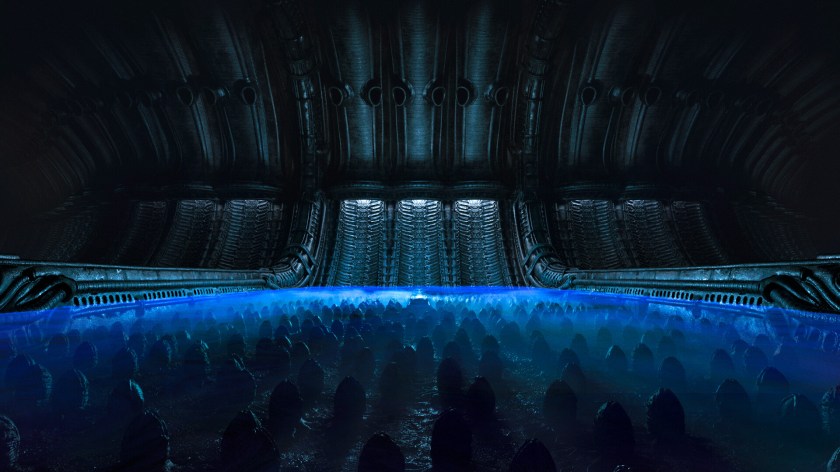
The Egg Chamber
The egg chamber of the derelict alien ship, designed by Giger.

Inside, hallways that look like ribcages lead to vast chambers with utterly bizarre, inscrutable machinery that seems to consist of biological material — skin, bone, joints, organs — fused with metal. In one of them the corpse of an alien, presumably a pilot, is integrated into a complex array. It’s at least twice the size of a large human man. Its elephantine head is thrown back in the agony of its last moment, when something exploded outward from its body, leaving a mangled ribcage, torn papery skin and desiccated organs.

And beneath that, a shaft leading to another horror — a chamber that seems to stretch for kilometers in either direction, where leathery eggs are cradled in biomachinery and bathed in a bioluminescent cerulean mist.

The decision to enter that chamber sets off one of the most shocking scenes in cinema history, leads to the birth of pop culture’s most terrifying monster, and sent millions of theater-goers home with nightmares in the spring and summer of 1979.

It’s almost too much to handle. But take heart! The unlikely female protagonist makes it to the end, and so does the cat. What more can you ask for?

Jonesy on the Nostromo
Jonesy grooming himself on the flight deck of the starship Nostromo. Credit: 20th Century Studios