Pet Theft Up 40 Percent Since Pandemic, Criminologist Says

Incidents like Sunday’s attempted cat robbery are happening more often in recent years, a forensic investigator specializing in animal-related crimes says.

Pet theft is a low-risk, high-reward way for the criminally-minded to make a quick buck, which is one reason why such crimes have become much more common since the pandemic, a forensics professor told the New Haven Register.

Virginia Maxwell, who specializes in forensic investigation of animal cruelty, spoke to the newspaper in the wake of Sunday’s failed gunpoint robbery when two men broke into an East Haven, Conn., home and demanded the victims’ “high dollar value cat.”

But first we’d like to draw your attention to an announcement we made back in February of 2021. At the time pet theft was in the headlines after robbers shot a man walking Lady Gaga’s breed dogs, while across the country in Portland a man stole a van full of daycare-bound pups.

Here’s what we wrote at the time:

“Buddy would like everyone to know he does not actually live in New York, and that his true location is a secret.

“I could be living in Rome,” the troublemaking tabby cat said. “I could be Luxembourgish. Maybe I live in Königreich Romkerhall or the Principality of Sealand. You just don’t know.”

“The one thing you can be certain of is I definitely don’t live in New York.”

We would like to make clear that we continue to blog from Not New York.

On a more serious note, financial woes brought on by the pandemic, painful inflation and a generally difficult economy have attracted the criminally inclined to the petnapping trade, and as Maxwell pointed out to the Register, few people are held accountable for animal-related crimes. That includes darker endeavors like dog fighting and puppy/kitten mills.

“Sadly, animal cruelty in general is under-prosecuted, and very, very few actually end up resulting in jail time,” Maxwell said.
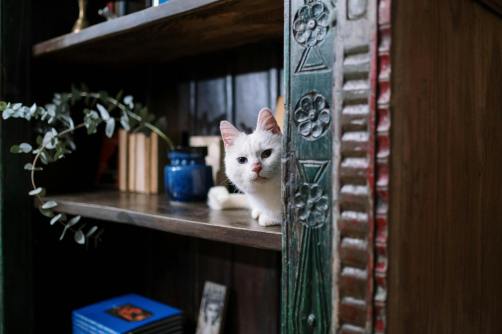
white cat on brown wooden shelf
A cat stays above the fray and surveys her surroundings from an elevated perch. Credit: cottonbro studio/Pexels

Sometimes pet thieves are opportunists who see a cat or dog who catches their fancy, or they believe might be worth money. Those cases often include people luring well-loved animals off porches and property with food.

Most, however, are people who intentionally target breeds that command high prices and are primarily responsible for what Maxwell says is a 40 percent spike in petnappings since early 2020. For felines that means Bengals, Savannahs, Ragdolls, Maine Coons, Norwegian Forest Cats and other breeds that can net the thief a solid payday for minimal effort.

“They’re going to steal your pedigree cat, your pedigree dog that’s worth thousands” and immediately flip the animal, Maxwell told the newspaper.

Social media, it turns out, is a double-edged sword.

While cops and animal welfare organizations warn people against showing off valuable pets online — and urge people to disable features like location tagging — the same platforms are often invaluable for retrieving stolen cats and dogs. Groups on sites like Reddit and Facebook help people find their well-loved four-legged family members and warn others when they identify resellers.

You can help keep your furry friends safe by making sure they’re microchipped, only allowing them outdoors when you’re there to accompany them, and keeping gates, doors and garages closed and locked.

Jury Awards Oregon Man $1.4 Million In Stolen Cat Case

The man’s attorney styled the decision as a victory for animal lovers.

An Oregon man didn’t get his cat back but he could be almost $1.4 million richer after a jury decided in his favor in a cat-napping case.

Joshua Smith, 41, adopted a cat he named Frank in 2017 after finding the little guy, apparently a stray, in an alley.

At the time Smith was living in a single room in a group drug recovery home in Portland, according to the Oregonian. The terms of his lease didn’t allow him to keep pets so when Smith’s landlord — a man named Devon Andrade — discovered Smith had been keeping a cat, Andrade took matters into his own hands and stole Frank, admitting under oath he’d taken the tabby and given it to his girlfriend, who then took Frank to a local shelter.

Smith and Frank were never reunited: It turns out Frank has a microchip and he was returned to his original family, the people who were his caretakers before he went missing and Smith discovered him more than six years ago.

Frank the cat
Frank the cat, as seen in a photo Fuller showed to the jury.

But it took a jury less than two hours to decide against Andrade and Pine Street LLC, the company behind Pine Street Recovery Housing. The defense argued that even though Andrade should not have acted unilaterally, Smith was still in violation of his lease agreement, but the jurors weren’t buying it.

“The jury’s message should be loud and clear to landlords,” said Michael Fuller, Smith’s lawyer. “You need to respect the rights of tenants, especially when it comes to pets.”

The jury awarded Smith a shocking $1.375 million although it’s not clear how much of that Smith will see. An earlier story, published in 2019, said Smith had sought $250,000 in damages. It’s not clear why the jury went with the much larger amount.

Fuller credits the jury, saying there were several sympathetic animal lovers in the juror box.

Smith said he’s been successfully sober for years. He’s since married, moved to California and opened his own barber shop.

“The most important thing was that I got my day in court,” Smith said. “I got really lucky because I told the truth, no matter what.”

The Bizarre Effort To Brand Cats And Dogs According To Political Ideology

“Things are just a little more progressive here in San Francisco.”

In one of my favorite South Park episodes, Kyle’s father Gerald uproots his family and moves to San Francisco because, he explains, he can no longer stand the narrow minded, gas-guzzler-driving, gun owning people of South Park.

He throws a party in his San Fran townhouse, inviting his new neighbors who all have multi-hyphenate last names and a habit of speaking with their eyes closed, settling into deeply self-satisfied reverie as they literally savor the smell of their own farts.

“Can you believe those morons in Texas just executed another prisoner?” one of Gerald’s new neighbors says, tooting into an empty wine glass before raising it to his nose like an aromatic vintage and taking a deep, enthusiastic huff. “Things are just so much more progressive in San Francisco.”

While reading this article about the Portland metro area boasting the highest percentage of single cat-owning men in the country (more than twice the percentage here in New York, and almost three times more than Miami), I couldn’t help but picture some of the men in the story as crudely drawn South Park characters, inhaling air biscuits as they associate an animal with their politics.

“I think it makes sense because it’s a more progressive part of the country,” one of the men told the Seattle Times as he tried to explain Portland’s high percentage of single “cat daddies.” “I think there’s more freedom to not be ‘toxically masculine’ in this part of the country.”

https://youtu.be/havq7pZQNrk

Because we can’t help but ruin everything with politics in this country, the effort to drag cats and dogs into the left-right divide has been picking up steam in recent years, aided by click-seeking media.

Republicans Are Dog People, While Democrats Prefer Cats,” reads a Business Insider headline. “What our cats and dogs say about our politics,” reads another from the Washington Post. Time magazine quizzed 220,192 readers on their politics and pet preferences, concluding: “It’s True, Liberals Like Cats More Than Conservatives Do.”

The alleged political divide over companion animals has been the subject of research papers in psychology and veterinary journals, and pets are now routinely included in the ideologically-motivated invective that saturates social media. Conservatives are portrayed as poor, shotgun-toting rednecks driving beat-up pickups covered in Gadsden flags while their faithful but stupid dogs hang their heads out of the windows, trailing globs of drool.

Liberals, meanwhile, are portrayed as unmarried middle age women who spend their Saturday nights on their couches with pints of Ben & Jerry’s and their feminine, useless cats, bemoaning their lack of relationships.

The incels and pick-up game “artists” have even gotten in on it.

“Only a cat-owning bitch would complain to the police about a f—ing joke,” manosphere influencer Andrew Tate raged in a 2022 video after one of his intentionally inflammatory social media posts provoked a stronger response than he anticipated. “Who calls the police on a f—ing joke? Cat owners. Cat owners are liberals. Cat owners believe in hate speech. Cat owners are Democrats. Cat owners are dickheads!”

Tate, by the way, has been rotting in a Romanian prison since December after he was arrested and accused of running a human trafficking ring that exploited young women. Tate, his brother and their associates lured the victims with declarations of love and promises to get married. Once the young women arrived in Romania, the country’s authorities said, Tate and his crew would confiscate their passports, imprison them in Tate’s mansion near Bucharest, and force them to perform sex acts on live streams for the financial benefit of the defendants.

Tate was arrested after unsuccessfully trying to troll Greta Thunberg on Twitter by showing off his expensive, gas-guzzling hypercars and bragging that he likes to eat pizza without recycling the boxes. Romanian police, who were already looking at Tate in a wider human trafficking probe, noticed the pizza boxes seen in his videos were from a local chain and moved quickly to arrest him.

Tate has lost three appeals to toss the case, which is ongoing. But the alleged human trafficker still boasts a massive and loyal online following, and as far as his fans are concerned, his words are law. If Andrew Tate says cats are the preferred pets of “liberal bitches,” then it’s true in the eyes of his fans, many of whom pay hundreds of dollars a month for an online “school” where Tate purports to teach them the finer points of masculinity.

Aside from ruining yet another one of life’s joys by dragging politics into it, I’m worried that pets will pay the price for the misguided effort to associate them with ideology.

Cats in particular are already extremely vulnerable and tend to get the brunt of abuse by proxy. That is to say, studies show men who are abusive toward women often target cats belonging to women as proxies for their anger. They associate felines with the feminine. Women target cats to harm their exes and significant others as well, but there’s a lack of statistics since men don’t usually seek help in domestic violence situations.

Likewise, sitting on porches while drinking beer and shooting at critters who happen by is practically an official sport in some parts of the country. As someone who has Google News alerts set up for cat-related stories, I see the same depressing stories every day: cats who die a few feet from their front doors or who make it home with BB wounds, arrows sticking out of their chests or actual gunshot wounds.

Those stories are so common, it’s difficult not to despair for the poor cats and for whatever diseased way of thinking prompts people to hurt and kill innocent animals.

Do we really want to give people more incentive to kill cats?

Do we want gun owners regaling each other with stories about how many “liberal cats” they’ve shot?

Do we want potential caretakers passing on adopting cats because they’re worried their choice of pet indicates they belong to a certain ideological tribe? After all, everything from the cars we drive and the stores we shop, to observing basic hygienic practices during a pandemic, allegedly says something about our political beliefs.

Buddy the Handsome Cat
Buddy the Cat: Not wimpy!

As for men who love cats, we already deal with absurd stereotypes. (We’re invariably described as gay, feminine and somehow not as manly as dog owners, even those of us who have hulking, muscular house tigers like Buddy!) We don’t need to encourage even more stereotypes, and in general I think we could all do with less box-checking. Life is not a Myers-Briggs test.

I know one thing for certain: cats are masters of living in the moment, and they have no patience for human nonsense like politics. They are innocent and pure. Sullying them with political associations is a disservice to these regal, wonderful animals.

Bring Your Cats Inside: Thieves Are Snatching Cats From Yards And Selling Them Online

As cat thefts increase on both sides of the pond, a UK woman’s security cameras caught a pair of thieves trying to stuff a neighbor’s cat into a plastic bin under cover of darkness. The cats are later sold online.

A week after a brazen thief stole a Portland family’s cat off their front porch, a pair of cat thieves were caught on security footage snatching a cat from a residential street in the UK.

The latter is not an isolated incident. A group of amateur sleuths, comprised of people whose cats were stolen and others concerned about the spate of thefts, found several of the missing cats listed for sale on a UK pet classifieds site, Pets4Homes.co.uk.

The latest cat-napping happened in East Birmingham, where home security cameras captured footage of a man and a woman creeping along a residential street shortly before 4 am, armed with cat treats, milk and a plastic bin and quietly searching for neighborhood felines.

East Birmingham’s Charlene Jones told the UK Sun that she was woken up by her dogs, who alerted her to intruders on her property.

“I didn’t notice anything until the dogs started barking, and I looked out the window and caught them in the act,” Jones said. “It all happened around 20 to four in the morning, at this point she was just putting the cat into the bin. I opened the window and the cat escaped.”

Cat thieves
In this still from Jones’ security cameras, the cat thieves are seen with the treats, milk and plastic bin they were using to capture neighborhood kitties.

An angry Jones, whose own cat was stolen three weeks ago, confronted the thieves, who claimed they were working for a local animal welfare charity and were trapping strays.

“I went out and spoke to them and she started reeling off all these charity numbers and claiming she worked for them,” Jones said.

When Jones later reviewed the footage she recognized the cat, who belongs to a neighbor a few doors down the street.

“I feel angry,” Jones told the paper. “I have done my own research, she has been selling cats for eight months.”

Jodie Smith of Solihull, a town of about 123,000 about 18 miles from Birmingham, said her family’s cat, Arlo, was stolen in January. A friend later spotted Arlo on Pets4Homes, but the Smiths weren’t able to recover him.

“It’s awful, this is my daughter’s cat,” Smith said. “My daughter can’t go to bed with cuddles from her fur baby. She is absolutely gutted.”

Arlo the cat
Arlo was listed on Pets4Homes but the family was unable to recover him.

Pet thefts on both sides of the Atlantic have been on the rise since the beginning of the Coronavirus pandemic in 2020. As entire countries went into lockdown, demand for companion animals skyrocketed, leaving many shelters bare and breeders sold out.

Criminals saw an opportunity and began stealing pets, mostly dogs at first, from yards, homes and kennels, prompting the owner of one lost pet site to dub 2020 “the worst year ever” for dog thefts, according to the BBC.

With exotic cat breeds commanding large amounts of money on the open market, from a few hundred dollars for breeds like Persians to $20,000 for Savannah cats, opportunistic thieves began targeting felines as well. “Moggies,” cats of indeterminate origin or no particular breed, aren’t exempt either. Some may be stolen because thieves mistake them for exotics, while other thieves apparently find it worth their time to snatch cats that can net them $100 or more on sites like Craigslist and Pets4Homes.

In the UK, cat thefts have increased threefold within the last five years, a trend accelerated by the pandemic and the resulting scarcity of cats, especially those with breed pedigree. Police rarely recover the stolen pets, and authorities say some people are targeted after sharing photos and video of their pets online.

Stealing cats is especially easy in the UK, where the majority of people allow their cats to roam free outdoors and the idea of keeping cats strictly indoors is seen as cruel or improper, even though felis catus are domesticated animals and don’t have a “natural habitat.”

In the Portland case, no one has come forward with any solid information in the theft of Kiki the cat despite two relatively clear shots of the suspect’s face and extended footage of her approaching and taking the cat from the Autar family’s front porch on Feb. 20. Like the UK catnappings, the Portland suspect seemed motivated by profit: The family said their cameras also caught the woman checking for open car doors, and the way she grabbed and held the cat — holding him at arm’s length, dangerously carrying him by the scruff of his neck — indicated she saw him as an object, not a living creature.

Karina Autar told PITB on March 1 that her family hasn’t given up hope.

“We are all just getting by, we are coping by putting in all our energy [into finding] him,” she said.

Cat thief suspect
The thief was caught snatching KiKi off his family’s front porch on Feb. 20.

In the UK, Jones is not the only person to confront the cat thieves. Amy Buckley, 29, told The Sun that the woman seen in Jones’ footage also told her she was an employee of an animal welfare organization.

“She came to mine around January, claiming she worked for the PDSA and that they’d had a report about a large number of stray cats in the area,” Buckley told the paper.

She said she was immediately suspicious because PDSA (People’s Dispensary for Sick Animals) is a charity run by veterinarians that provides care, not TNR or general trapping services.

PDSA confirmed the woman does not work for the organization, while local police told the paper they had taken several reports from people whose cats had been stolen and were investigating the thefts. Meanwhile, an RSPCA spokesperson urged caretakers to have their cats microchipped.

In the meantime the victims are trying their best to locate their stolen furry family members, but they’re also angry at the pain the thieves have caused families and children.

“There are other families going through the same heartbreak,” Smith said. “For a lady to have some money in her pocket, she is destroying little children.”

Help Catch This Portland Cat Thief And Get Kitty Returned To His Family

New videos show the entire sequence of events when a woman stole a family’s cat right off their front porch on Sunday morning.

We’re putting out a call to our readers and all cat lovers to help identify a woman who brazenly snatched a family’s cat off their front porch in Portland, Oregon, on Sunday.

The woman was wearing a pink jacket with a white scarf, black jogging pants, white sneakers and green socks.

Cat thief suspect
The thief was caught snatching KiKi off his family’s front porch on Feb. 20.

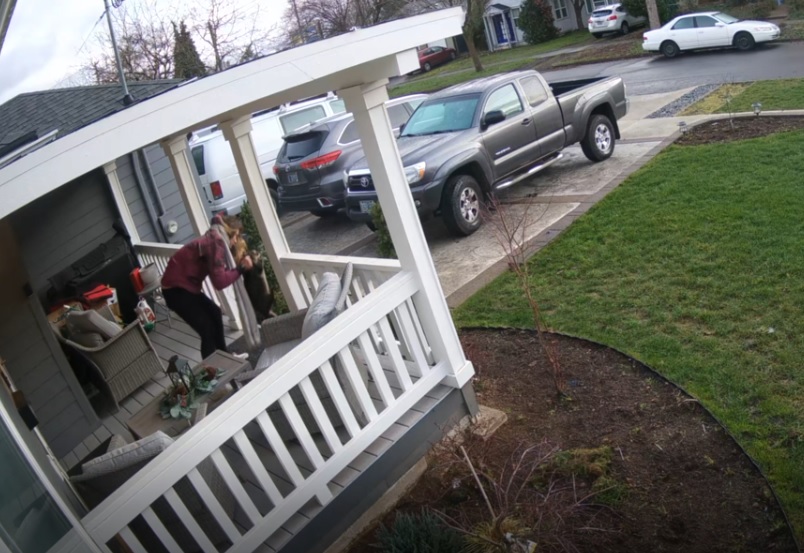
Home security footage shows that at 7 a.m. on Feb. 20, the woman approached the Autar family’s home and tried to get their cat, KiKi, to approach her. KiKi wasn’t having it and turned toward the front door several times, refusing to approach the woman, but she slowly made her way onto the porch and snatched the well-loved kitty.

It’s clear from the way she holds KiKi that she’s not familiar with cats: Footage shows her holding him by the scruff of the neck, which is extremely painful for adult cats. Here’s a video of the entire sequence courtesy of Karina Autar:

And here’s a video from a second camera overlooking the driveway. The thief is clearly holding poor KiKi by the scruff with one hand as she briskly walks off:

The woman leaves in what looks like a black or dark blue Chevy suburban, quickly fleeing the neighborhood with the trunk still open. The SUV did not have a front license plate:

Earlier footage shows the same woman on a bicycle stopping in front of cars on the block and checking their doors. It appears she tossed the bike in the back of the SUV and drove off quickly, perhaps after someone spotted her.

Anyone who recognizes the woman or has information about the theft can call the Portland Police Department’s non-emergency number at 503-823-3333 or email Karina Autar directly.