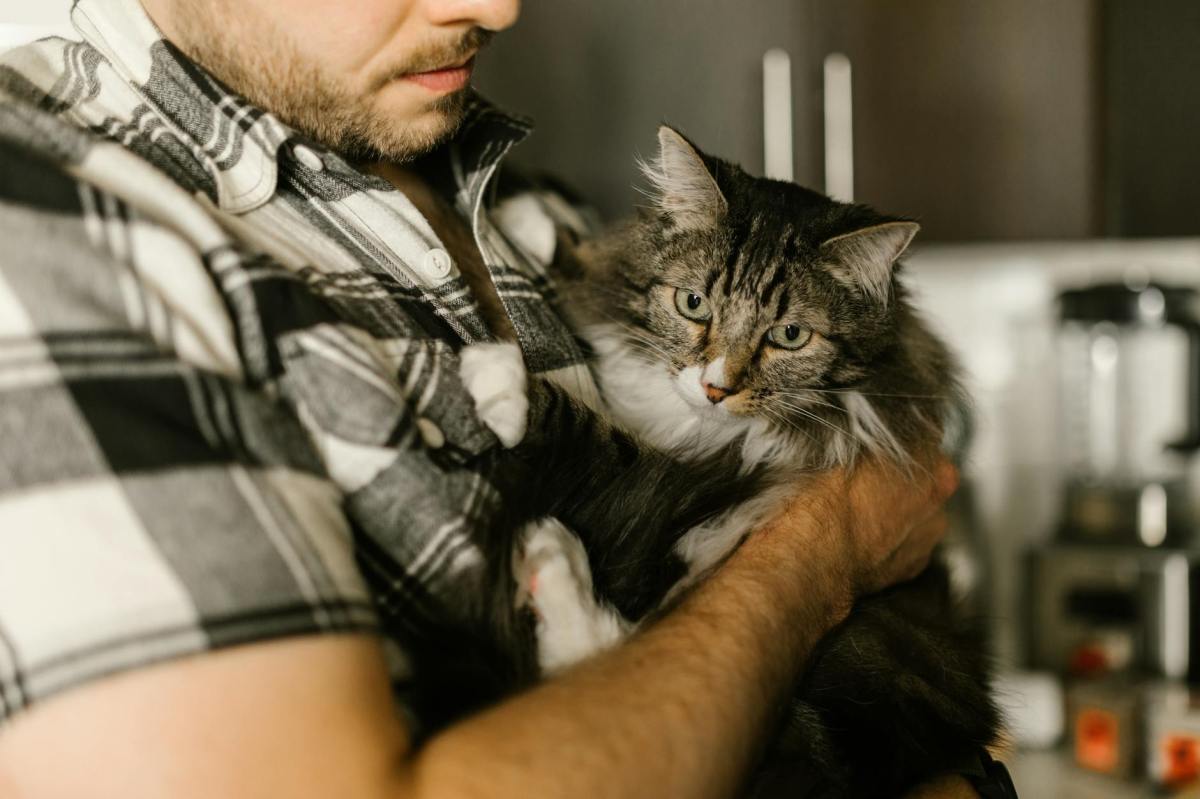
What’s With The Stories Claiming Men Don’t Bond With Or Listen To Their Feline Buddies?

There’s a disconnect between the usually careful language of research studies and the exaggerated claims of news articles.

The headlines over the past few weeks have all been variations on the same riff: cats meow more frequently to male caregivers because we don’t know how to bond with the little stinkers, we disregard their feelings, and we ignore their pleas.

Others are more blunt in their assessment, like a story from YourTango that stated women “bond deeply” with cats, whereas we men are merely “manipulated” by them.

“Other studies have found that women are much better at giving their cats more attention, understanding their cats’ emotions, and are more likely to mimic their cats’ vocalization, too,” the YourTango story claims. “Whereas for men, the same cannot be said. Considering they tend to give affection more sparingly than women, it’s no wonder that the dynamic is different.”

Just picture it: women levitating above the rest of us, sharing their amazing Female Affection with the poor, emotionally starved pet felines who belong to men. If we’re trying to get rid of the “crazy cat lady” stereotype and spread the idea that cats are great companions for every kind of person, this probably isn’t helping.
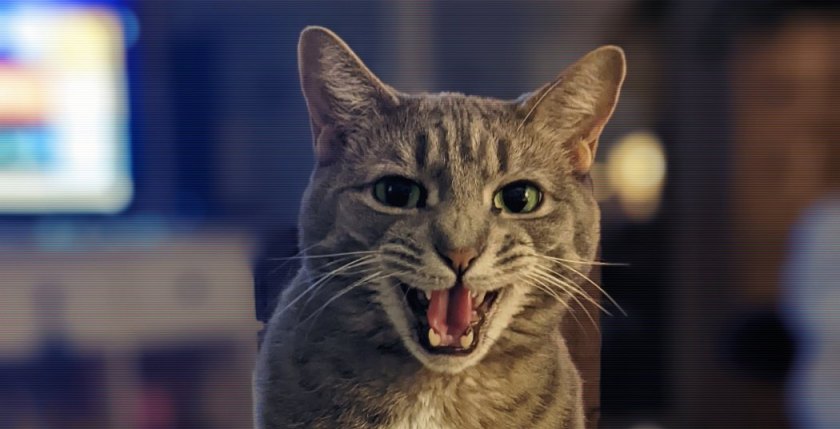
“I am NOT a loudmeowth!”

So what’s the source of these claims?

Apparently a study out of Turkey that involved just 31 cats and their humans. All of the human participants were Turkish, and just 13 of them were male. All were recruited online. (And for some parts of the study, like the analysis of greetings by owner gender, only 26 participants were included because the other five did not submit complete data, including the ages of their cats.)

It’s important to make a distinction between what the study’s authors claim and what the media reports, because they’re almost always two different things.
“Science” doesn’t “say” anything. Science is a method for investigating things we don’t understand. It’s not an entity, it has no opinions, and the only clear conclusion from such a small study is that we need more data.
Hogwash! Balderdash! Codswallop!

The research team from the University of Ankara counted more meows directed at the 13 male caregivers in their study compared to the 18 female caregivers. In their paper, the team acknowledged their sample size was too small to draw any conclusions, and lacked the demographic diversity to rule out innumerable potential reasons why those 13 cats meowed more frequently than the 18 cats cared for by women.

Even with a more robust sample size including men of different ages, social classes, and nationalities, correlation is not causation, and it may be that the apparent difference in feline vocalizations disappears with a larger study group that more accurately reflects universal demographics.

Indeed, the study’s authors state clearly that feline greeting behavior is “a complex, multidimensional phenomenon that defies straightforward explanation.” (Emphasis ours.)

The conclusion, as always, is that we need more data, which is one reason why studies must be repeatable.

That nuance doesn’t make it into listicles or stories optimized for maximum shareability on Facebook, so instead we get headlines that present studies as the last word instead of the first tentative steps to understanding a phenomenon.

In case it wasn’t obvious, there is no data to support the claim that men “give attention more sparingly” than women, or that women are better at reading feline emotions. We don’t even have baselines or criteria for those claims. How do we objectively measure “better” when it comes to reading cats, especially when every cat and human bonded pair have their own pidgin “language”? What’s the “right” amount of attention?

Buddy the Cat, a gray tabby cat, with a synthwave background.
“Brrrrrrrruuuuppp!”

As the loyal servant of an infamously talkative cat, I’m not sure gender makes any difference. Bud’s vocal tendencies were already present from kittenhood, and I simply nurtured them by engaging in conversations with him, giving him loads of attention and doting on him.

Often our conversations go like this:

Bud: “Mreeeoww! Mow mow! Brrrrrt a bruppph!”

Me: “I know, little dude. You told me, remember?”

Bud: “Brrrrrr! Brrrruppp! Yerp!”

Me: “Yes, but they’ve tried that already. It’s not just about tokamak design, it’s…”

Bud: “Merrrrrp! Mow mow!”

Me: “No, it’s about plasma containment. No containment, no reaction, no energy gain!”

Bud: “Brrrrr! Mrrrowww! Brupbrupbrrrruppp!”

Me: “Yeah, well that’s just, like, your opinion, man.”

I really do talk about science and science fiction with my cat, since he seems to respond to it. Of course it’s gotta be at least partially due to my tone, but strangely if I talk to him about other abstract things, he acts like I’m bothering him with so much human nonsense.

Regardless, Buddy and I object to the claim that a talkative cat is a disengaged or neglected cat. It’s not that he talks a lot, it’s that he never stops!

Cat Guys Get No Respect

Data from Match.com suggests being photographed with cats hurts single straight men’s chances of connecting with female users.

Remember the study from this past summer that claimed single men with cats are perceived as “less masculine” and are less likely to score dates than their cat-less counterparts?

Now Match.com has some bad news for us as well, saying their internal data shows men who have cats are less attractive to women on the popular online dating platform. From the Wall Street Journal:

‘If you’re a heterosexual man looking for love this Valentine’s Day, here’s something you probably don’t want to do: include a cat in your online dating profile.

“Chicks don’t want a guy with a cat,” said Rachel DeAlto, chief dating expert for Match, an online service that promises to connect compatible romantic partners.’

The Match.com data mirrors the data from the earlier Colorado State University study, which showed women photos of men with and without cats. When the authors asked women whether they’d consider dating those men, the female participants said they were less likely to date the cat servants by a margin of about five percent. Match.com’s data says men with cats are five percent less likely to receive “likes” than men without cats.

“Men holding cats were viewed as less masculine; more neurotic, agreeable, and open; and less dateable,” said study authors Lori Kogan and Shelly Vosche, who titled their paper “Not the Cat’s Meow? The Impact of Posing With Cats on Female Perceptions of Male Dateability.”

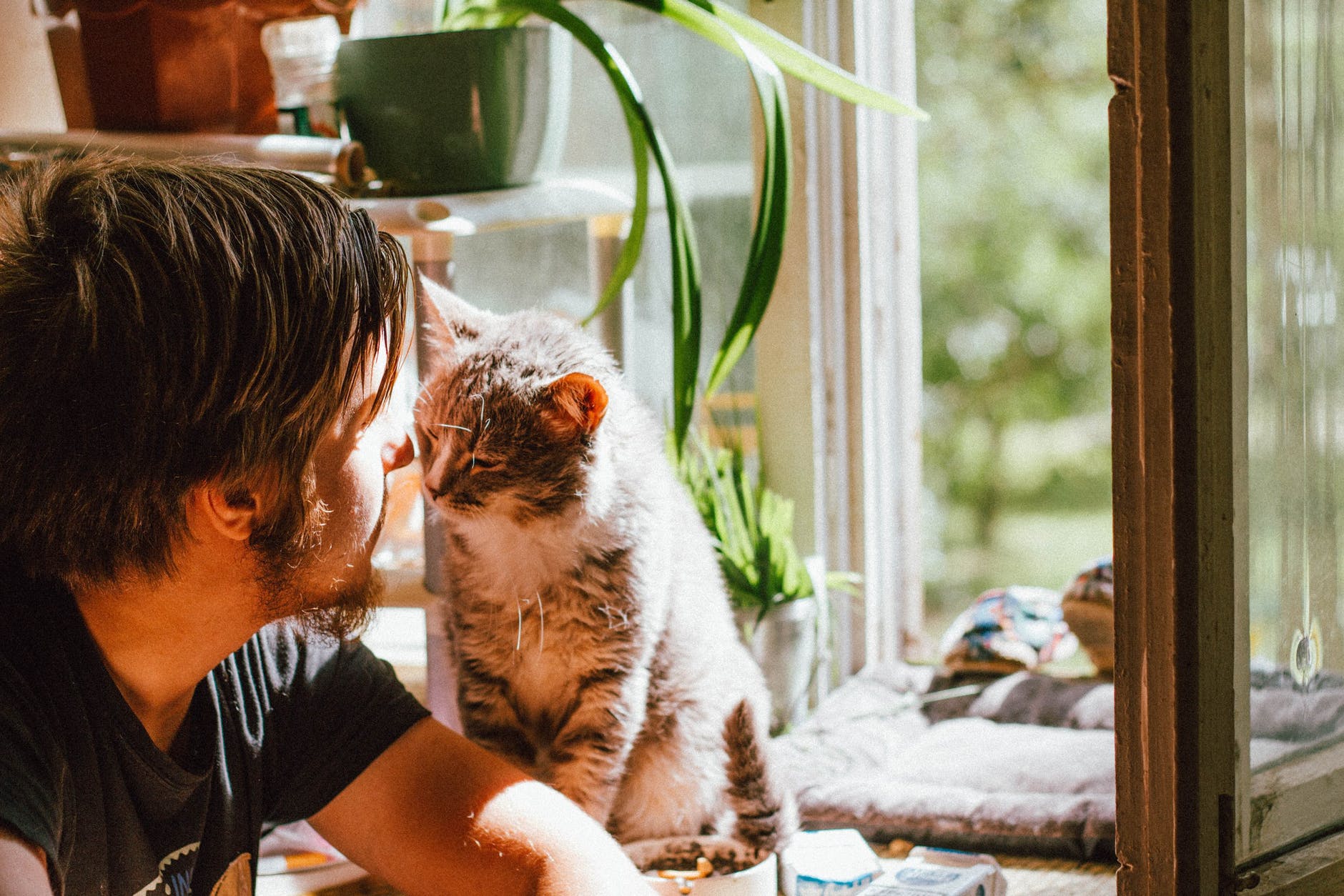
cute cat smelling unrecognizable bearded man on windowsill at home
Photo by Yuliya kota on Pexels.com

That study was limited: The authors worked with about 700 female participants who were all between the ages of 18 and 24. At the time, we speculated that the anti-cat bias would probably be negligible among women in older age brackets, but there were worrying signs, including the idea that men who care for cats aren’t as manly as men who haven’t discovered the joys of hanging with a miniature tiger.

“Women prefer men with ‘good genes,’ often defined as more masculine traits,” they wrote. “Clearly, the presence of a cat diminishes that perception.”

The results, they said, indicate “women are more likely to seek masculinity first, then consider other components of the potential mate.”

The findings were “influenced by” whether the women self-identified “as a dog or a cat person,” although it wasn’t clear just how much that impacted their responses.

Vosche and Kogan speculate “that American culture has distinguished ‘cat men’ as less masculine, perhaps creating a cultural preference for ‘dog men’ among most heterosexual women in the studied age group.”

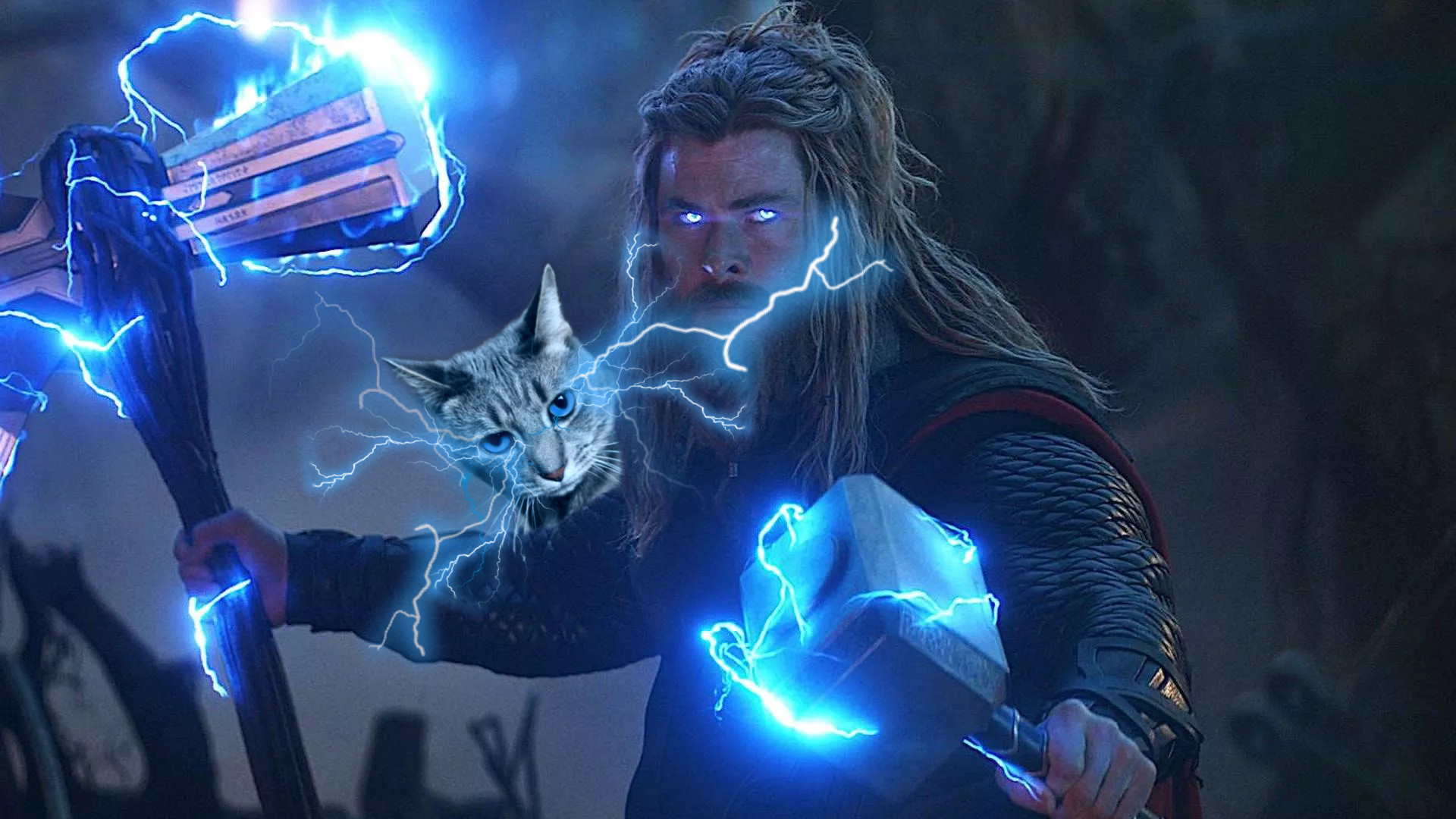
That study also prompted us to write a fake news post headlined: “Study: Male Actors, Models Are 96% More Handsome When Pictured With Buddy,” alongside the “proof”: A photograph of actor Chris Hemsworth in a fat suit, sans Buddy, and a photo of Hemsworth playing Thor the god of thunder, pictured with Buddy and looking heroic. Haha!

Thor with Buddy
Australian actor Chris Hemsworth photographed WITH Buddy, illustrating a dramatic difference in perceived power, masculinity and handsomeness.

It’s worth pointing out the difference is in perception. There’s nothing to indicate men who care for cats don’t have “good genes” any more than there’s evidence that men without cats have supposedly superior genes. Rather, as the study authors note, the perception is reinforced by cultural biases, at least here in the US.

Likewise, both the Colorado State University study and the Match.com data are looking at first impressions based on photographs, which means women are evaluating the men in question based only on limited visual information, to the exclusion of everything else that factors into whether one person views another as attractive.

We don’t know if the same biases hold true in other situations. For example, how would women respond to men who are out and about walking their cats on harnesses? How would they respond to a man who casually mentions he’s got a cat back home?

The Match data also cuts both ways, to the detriment of women. While straight men with cats receive five percent fewer “likes” than other men, straight women with cats suffer an even larger perception penalty, receiving seven percent fewer “likes,” probably due to the “crazy cat lady” stereotype.

Some people think that makes perfect sense:

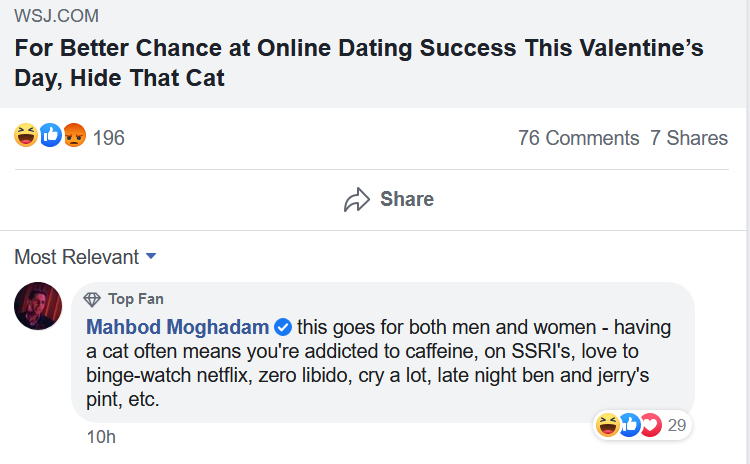
Screenshot_2021-02-12 The Wall Street Journal(1)

“[T]his goes for both men and women – having a cat often means you’re addicted to caffeine, on SSRI’s [sic], love to binge-watch netflix, zero libido, cry a lot, late night ben and jerry’s pint, etc.,” Mahbod Moghadam wrote in a Feb. 12 Facebook post in response to the WSJ story.

Mahbod Moghadam. I know that name. Where do I know that name from?

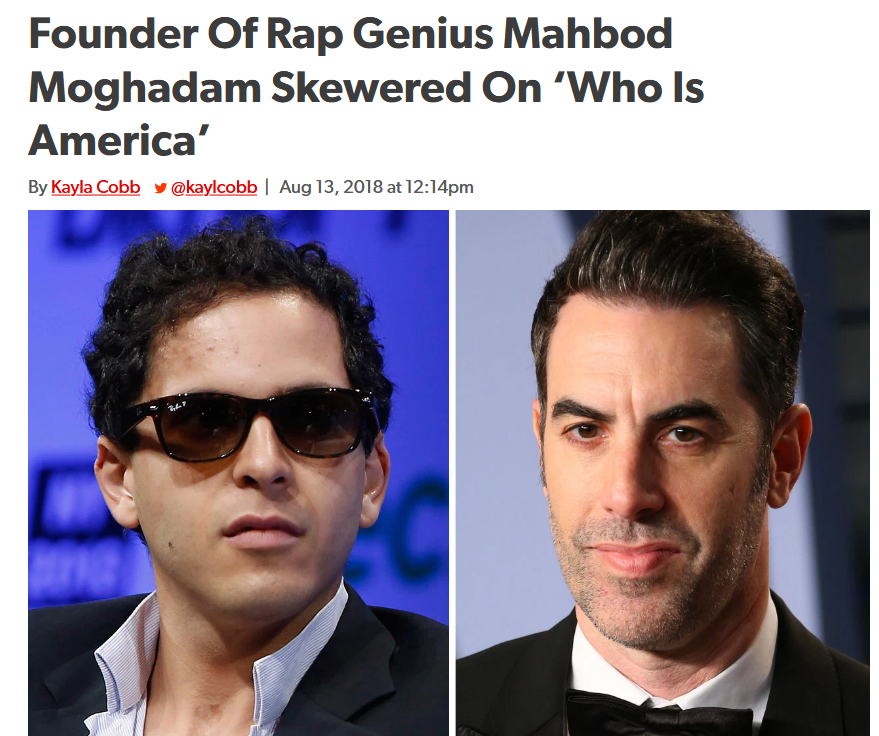
Oh, right. He’s the Rap Genius (Genius.com lyric site) co-founder who was thoroughly clowned by Sacha Baron Cohen on his Showtime series, Who Is America?

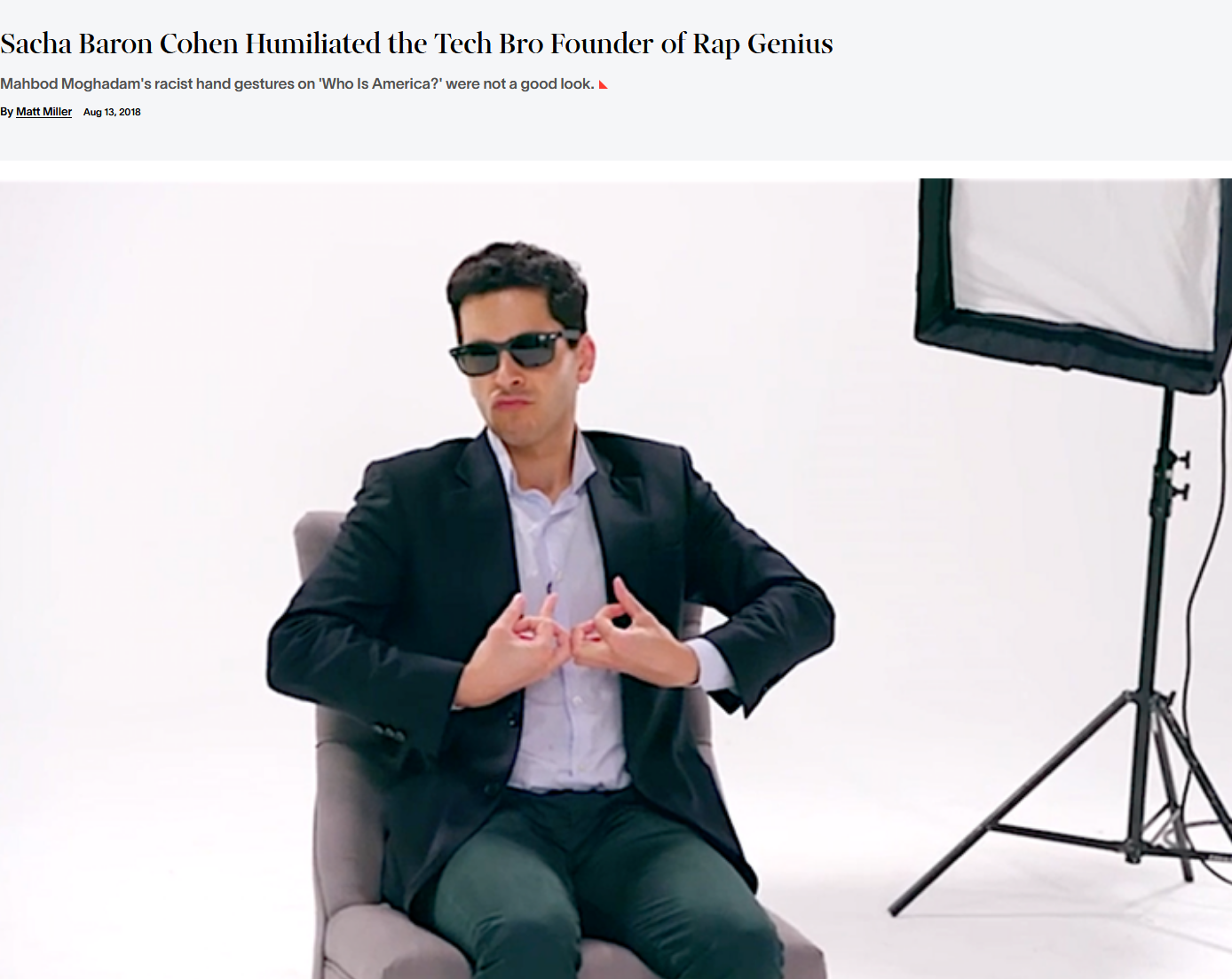
I say “clowned.” Esquire says “humiliated.” In reality, neither word captures Moghadam’s so-cringeworthy-it’s-hard-to-watch appearance on the show. Believing he’s there to be photographed and interviewed by an Italian fashion photographer named Gio Monaldo (Baron-Cohen in disguise), Moghadam is legendarily awful in the segment:

In the middle of the photoshoot, Gio compliments Moghadam repeatedly, calling him cool. He then asks he to “do something like a black guy.” Seemingly without missing a beat, Moghadam makes the Blood sign and mimes shooting a gun at the camera while saying “pop, pop.” Of course a lot of editing goes into Who Is America?‘s segments, but there’s really no excuse for that.

Much like with the Olympios interview, Cohen then persuaded Moghadam to pose with a green screen so he can photoshop the founder feeding starving children. In the middle of the shoot, Gio stops, convincing his muse that he needs to make his penis look bigger. Naturally the only solution to this is to stuff the arm of a babydoll down his pants. Moghadam never seems to protest any of this, not even when an intentionally racist Gio swaps out the white babydoll arm for an African-American one.

I’d link the footage, because there’s no way I can do justice to how awful it is, but miraculously it looks like it’s disappeared. Indeed, Moghadam comes off looking so bad in the segment that it looks like he’s gone to incredible lengths to get every clip of it removed from sites like Youtube and DailyMotion. If that guy is the kind of person who thinks men with cats are less masculine, then we’ve got nothing to worry about.

Screenshot_2021-02-13 Founder Of Rap Genius Mahbod Moghadam Skewered On ‘Who Is America’

Mahbod Moghadam
Mahbod Moghadam on ‘Who Is America?’