The palm oil and logging industries have killed so many orangutan mothers, there are now more than a dozen major orangutan orphanages in Borneo and Sumatra. The pressure on orangutans, with whom we share 97% of our DNA, shows no signs of abating.
Orangutans are critically endangered, and the biggest threat to their continued existence comes from the agricultural sector, which has razed 55 percent of the species’ habitat in recent decades.
Jarang, a baby orangutan born in 2023. Credit: Blackpool Zoo
Logging companies clearing irreplaceable, old-growth jungle to claim more land for palm oil plantations have no compunction when it comes to flattening jungles despite the presence of orangutans hiding in the trees. The loggers often shoot the large apes on sight, leaving terrified, traumatized babies still clinging to their dead mothers, or taking them to sell as pets.
Of those left to die, the lucky babies are rescued before they starve and are brought to one of the many orangutan orphanages in Borneo and Sumatra, where they attend “school” to learn how to do everything from climb to forage. It takes at least eight years to teach them how to survive on their own, which is about the time it takes orangutan mothers to do the same job in the wild.
The unlucky babies end up as local pets, sold off to entertainment troupes or shipped off to places like Dubai, where wealthy clients will pay a premium for them.
Caretakers must start by teaching rescued orphans the most basic things, like how to climb and move through the jungle Credit: Borneo Orangutan Survival FoundationLogos, an orphaned baby orangutan who was rescued in 2023 by the Jakarta Animal Aid Network (JAAN) Credit: International Animal Welfare Fund (IAWF)Baby Galaksi (Indonesian for galaxy), was found wandering the jungle without his mother in 2021 by a villager in Borneo. He’s now in a “school” that teaches orphaned orangutans how to do everything from evading predators to discerning edible fruit from harmful and poisonous varieties. Credit: Samboja Lestari Orangutan Rehabilitation Centre
So what is palm oil, and why are countries in Asia bulldozing ancient jungles and forests to clear room and make more plantations?
Per the WWF:
“Palm oil has been and continues to be a major driver of deforestation of some of the world’s most biodiverse forests, destroying the habitat of already endangered species like the Orangutan, pygmy elephant and Sumatran rhino. This forest loss coupled with conversion of carbon rich peat soils are throwing out millions of tonnes of greenhouse gases into the atmosphere and contributing to climate change. There also remains some exploitation of workers and child labour. These are serious issues that the whole palm oil sector needs to step up to address because it doesn’t have to be this way.
…
Palm oil is in nearly everything – it’s in close to 50% of the packaged products we find in supermarkets, everything from pizza, doughnuts and chocolate, to deodorant, shampoo, toothpaste and lipstick.”
Palm oil is in constant demand, and it’s an easy to grow, incredibly efficient crop. Indonesia and Malaysia, the only two countries in the world where orangutans exist, produce 85 percent of the world’s palm oil.
Images of orangutan babies in wheelbarrows are common on social media, but usually stripped of context. Orphanages use the wheelbarrows to bring infants and toddlers to and from “school” every day. Credit: International Animal RescueAsoka was found crying in the jungle by a fisherman in Borneo. He was brought to an orphanage in Borneo. Credit: International Animal Rescue’s rehabilitation Centre in Ketapang, West Kalimantan
We share 97 percent of our DNA with orangutans, making the species our second-closest cousins from a genetic standpoint. Some studies claim orangutans are our closest relatives based on our phenotypical similarities.
Orphaned orangutans attending “school” to learn how to survive in the wild. Credit: Borneo Orangutan Survival FoundationA baby at an orangutan orphanage is fed by a caretaker. Credit: Borneo Orangutan Survival Foundation
Want to read more and learn how to help?
Here are some links to get you started. PITB is a big fan of the Jakarta Animal Aid Network, which successfully pushed Jakarta’s municipal government to ban the incredibly cruel “topeng monyet” monkey street shows:
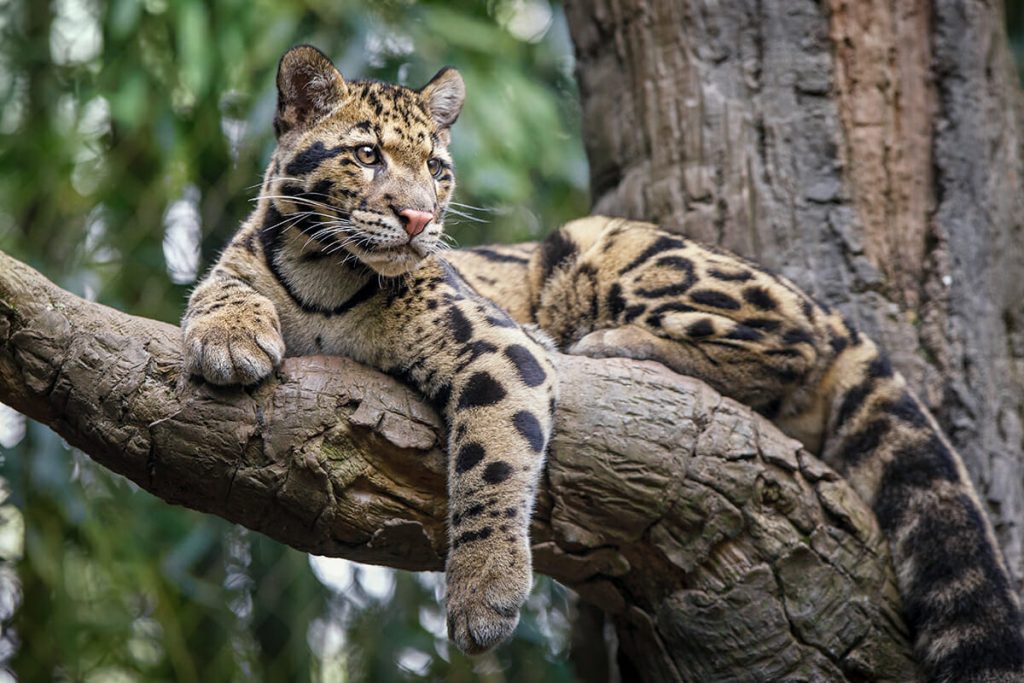
This singular species of wildcat exists only on two islands and has evolved to live a semi-arboreal existence deep in the jungle.
While tigers, lions and domestic cats are the stars of the felid world and command the lion’s share (pun intended) of the attention, even from cat lovers, there are obscure species living in far-off locations where they’re rarely glimpsed by human eyes.
There’s the fishing cat, the black-footed cat and the sand cat, and then there are species that are obscure even among the obscure. The Sunda clouded leopard fits into that category, inasmuch as the unique felid can fit into any category.
Like orangutans, the Sunda clouded leopard can be found in only two places in the world: the Indonesian islands of Borneo and Sumatra. They’re faced with the same existential threat that has pushed orangutans dangerously close to extinction, which is the relentless destruction of old-growth jungle to clear land for more palm oil plantations.
The species has an incredibly long tail that can match or exceed the length of its body. The large tail is crucial in a jungle environment, where it acts as a counterbalance high above the ground. Credit: Panthera
Palm oil is coveted by multinational corporations in the food and cosmetics businesses, and it’s in everything from chocolate and instant noodles to lipstick and margarine, according to the World Wildlife Fund.
The problem with razing old growth jungle and forest is that it doesn’t just grow back. They’re extremely delicate ecosystems that have arrived at a natural balance over thousands of years, with every species of animal and plant contributing something vital to the vibrant tapestry of life the jungles host and support. You can’t just plant trees and usher animals to a new home. It would take hundreds of years for those new jungles to even superficially resemble the lifegiving old growth jungle.
There are heartbreaking images of shocked orangutans sitting in the ruins of their former homes, with nothing but the stumps of trees and dozer-trodden vegetation as far as the eye can see.
Those are the lucky ones. The loggers who work for massive multinational corporations aren’t bound by rules or ethics, and they won’t wait for animals to clear out before they destroy. They often shoot orangutans on sight regardless of whether the animals are carrying young.
Roux, a baby orangutan in a “boot camp” for orphans, learns how to walk. Credit: Phys.org
That’s the primary reason why Borneo and Sumatra are now home to entire academies for orangutan orphans, who spend at least eight years learning how to fend for themselves with the help of specialists who teach lessons that would normally be taught by the orphan orangutans’ mothers. They include the very basics, like how to move and climb through the jungle, as well as crucial information such as which berries to avoid while foraging.
While there’s no “academy” for clouded leopards and the felids are more adept at avoiding human wrecking crews, they’ve suffered the same fate as orangutans when it comes to dwindling jungles.
This is the situation Sunda clouded leopards find themselves in, so when a trail camera recently captured footage of a mother and her two cubs, conservationists were thrilled.
The footage comes from camera traps belonging to the Orangutan Foundation, and it’s the first time anyone’s managed to obtain video of the Bornean clouded leopards with cubs in tow. The brief video shows the little family bounding through the jungle. They quickly move past the camera, but not before one of the cubs stops to look right at it with typical kitten curiosity.
Sunda clouded leopards are extraordinary cats. Size-wise, they are firmly in the “medium size wildcat” category, with males weighing about 50 pounds. Despite that, they are members of pantherinae, the genus of big cats, having diverged from a common ancestor shared with tigers, leopards, lions and jaguars.
As further proof of their in-between status, Sunda clouded leopards can neither purr nor roar. Typically, each species of felid can do one or the other. Even the species’ scientific nomenclature, neofelis nebulosa, references its intermediate status. (If you encounter alternate taxonomy for them, it’s because the clouded leopards of Borneo and Sumatra are considered distinct subspecies.)
“Due to a different bone structure in their neck, the clouded leopard cannot roar like the larger cats, but also cannot purr because it lacks the fully ossified hyoid bone that allows small cats this ability,” the Smithsonian National Zoo’s keepers explain.
Sunda clouded leopards have several unique adaptations that allow them to thrive in arboreal environments. Their massive tails act as crucial counterweights, allowing them to traverse branches high above the ground without falling. Their paws and paw pads are specialized for gripping tree branches, and their ankles can articulate in ways other felid ankles cannot, allowing the jungle-dwelling wildcats to descend from trees head-first.
Domestic cats infamously lack this adaptation, which is why firefighters are also part-time cat rescuers, coaxing the terrified little ones down from trees, utility poles and rooftops.
Credit: Panthera
The clouded leopards of Borneo and Sumatra are also undeniably cute. People have noticed, which is why one of Google’s auto-complete suggestions for Sunda clouded leopard suggests the word “pet” as an addition. It’s okay to fantasize about having a clouded leopard buddy, but in addition to the fact that they are endangered, they’re also wild animals.
Consider the fact that across the estimated 200,000 years of our species’ existence, homo sapiens have domesticated precisely one felid species, and even that’s not entirely accurate. Felis catus played just as much of a role — and arguably more — than humans did in their own domestication. As predators and obligate carnivores, they are unique among domestic animals, and it took and equally unique set of circumstances to bring cat and man together.
Instead of lamenting the fact that Sunda clouded leopards can’t be pets, we can admire them in the best way possible, from a distance, while helping ensure the survival of this extraordinary, distinctive species by donating to groups like Panthera, the WWF and Global Conservation.




 Pain In The Bud