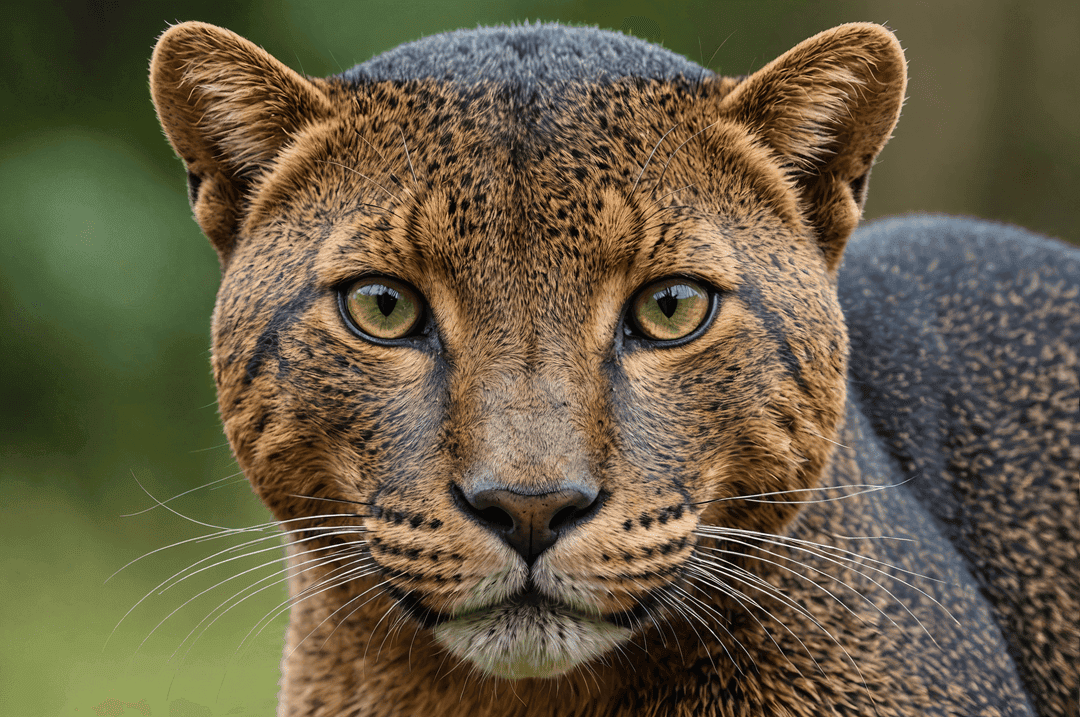
Amazing Cats: The Jaguarundi Is Adept, Adaptable And Mysterious

With their otter-like features, their squeaky vocalizations and their mastery of multiple environments, jaguarundis are unique in the world of cats.

Jaguarundi

Taxonomic name: Herpailurus yagouaroundi
Genus: Felis (small cats)
Size: Males weigh up to 20 lbs, with typical sexual dimorphism for felid species
Lifespan: Up to 20 years in captivity
Gestation: 75 days
Litter size: Between one and four kittens per litter
Distribution: Almost the entirety of South America as well as the southern US
IUCN Red List status: Least concern, but threatened by habitat loss
If you spot a jaguarundi in the wild, there’s a good chance you won’t know what you’re looking at.

Their sleek, elongated bodies are almost weaselesque when seen from the side, an impression made stronger by the way their heads are shaped in profile. From some angles they can strongly resemble otters, an likeness strengthened by their short, dusky coats.

But seen head-on they’re definitely cats, and even though they’re small felines — about one and a half to two times the size of domestic kitties — their facial features can be reminiscent of big cats, especially their broader noses, rounded ears and the set of their eyes.

Seen from an angle like this, jaguarundis resemble jaguar cubs:
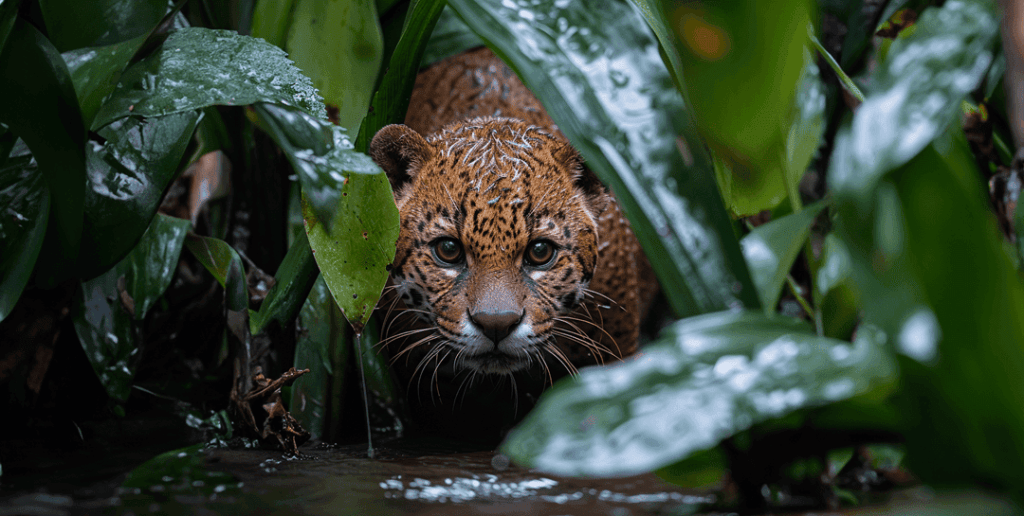
Indeed, jaguarundi means “dark jaguar” in Old Guarani, an extinct predecessor of the Tupi family of indigenous languages that were spoken in South America for thousands of years before the arrival of the conquistadors and the Spanish language. Modern variants of the language still exist in countries like Paraguay, which may account for the enduring names of several species of western hemisphere cats. (Jaguar itself is based on the indigenous Tupi word “yguara,” and pumas have dozens of surviving names with indigenous roots to go along with their many names in English.)

As New World cats, jaguarundis boast an impressive range that stretches from southern Argentina through Latin America and into the lower US states.

Like their larger cousins, the jaguars, jaguarundis are comfortable in the water and are strong swimmers. They’re also adept hunters on land, excellent climbers, and they’re impressively sure-footed while traversing branches high above ground level.

In short, the adaptable felines can just about do it all.
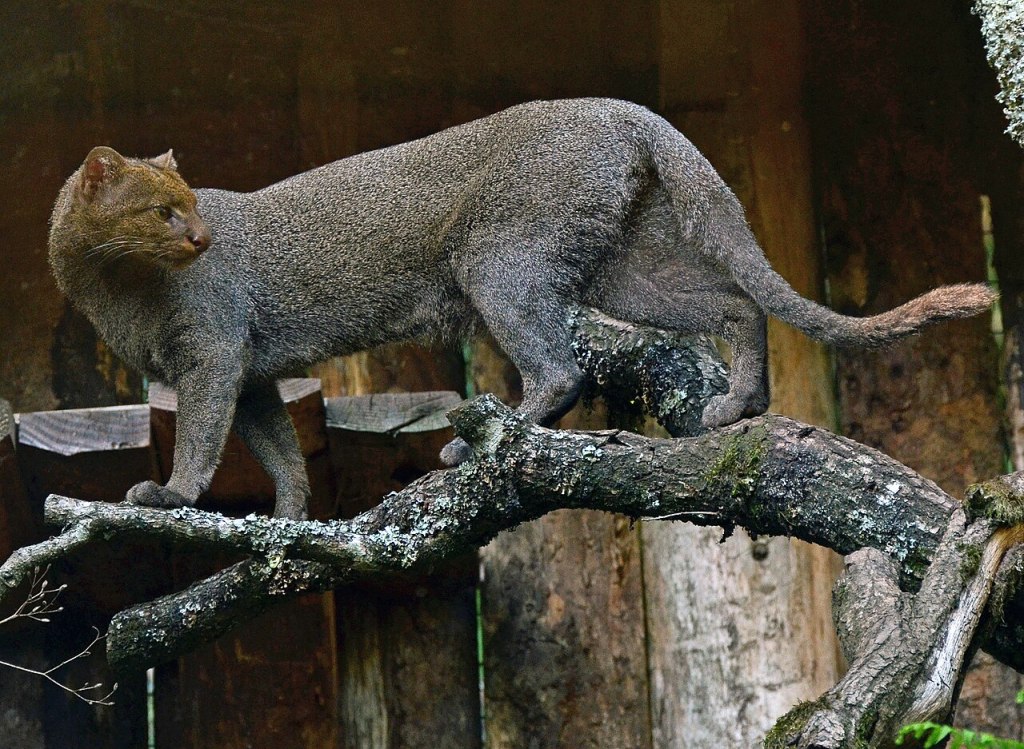
Note the otter-like appearance of the jaguarundi head in side profile.

In the wild, jaguarundis have been known to hunt prey as large as small deer and help themselves to seafood snacks when the mood strikes them, but analyses of their diets shows they have a strong preference for mammals, particularly a variety of wild rodents found in dense jungles and forests.
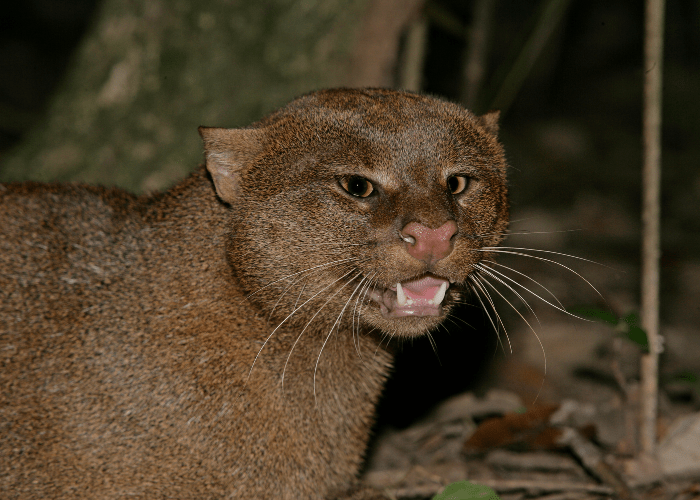
Jaguarundis don’t just look different compared to other cats — they sound different as well.

Conservationists call the jaguarundi’s vocalizations “whistles” and “chirps,” but to us they sound more like squeaks.

Take a listen for yourself:

It’s illegal under the Big Cat Public Safety Act to keep jaguarundis as pets, and the jaguarundi curl, a breed meant to mimic the appearance of the jaguarundi, is not related to the wild cat.

While they’re known to range in Texas and Arizona, sightings of jaguarundis are rare. From a distance their movement looks almost indistinguishable from those of house cats, and they’re famously elusive — by the time most people do a double take, the shy felines have disappeared into tall grass, brush or jungle.

Images via Wikimedia Commons

Previously:

Amazing Cats: The Mysterious Marbled Cat
Amazing Cats: The Rusty-Spotted Cat
Amazing Cats: ‘He Who Kills With One Bound’
Amazing Cats: The Puma

Amazing Cats: The Sunda Clouded Leopard

Amazing Cats: The Adorable Colocolo, Feline of the Pampas

Amazing Cats: The ‘Fire Tiger’ Is The Stuff Of Legend

Amazing Cats: Ocelots Love Trees, Water And Calvin Klein’s Obsession For Men

Amazing Cats: Pallas Cats Are The Grumpy Little Hobbits Of The Feline World

Wordy Wednesday: Critically Endangered Orangutan Babies

The palm oil and logging industries have killed so many orangutan mothers, there are now more than a dozen major orangutan orphanages in Borneo and Sumatra. The pressure on orangutans, with whom we share 97% of our DNA, shows no signs of abating.

Orangutans are critically endangered, and the biggest threat to their continued existence comes from the agricultural sector, which has razed 55 percent of the species’ habitat in recent decades.

Jarang, a baby orangutan born in 2023. Credit: Blackpool Zoo

Logging companies clearing irreplaceable, old-growth jungle to claim more land for palm oil plantations have no compunction when it comes to flattening jungles despite the presence of orangutans hiding in the trees. The loggers often shoot the large apes on sight, leaving terrified, traumatized babies still clinging to their dead mothers, or taking them to sell as pets.

Of those left to die, the lucky babies are rescued before they starve and are brought to one of the many orangutan orphanages in Borneo and Sumatra, where they attend “school” to learn how to do everything from climb to forage. It takes at least eight years to teach them how to survive on their own, which is about the time it takes orangutan mothers to do the same job in the wild.

The unlucky babies end up as local pets, sold off to entertainment troupes or shipped off to places like Dubai, where wealthy clients will pay a premium for them.

Caretakers must start by teaching rescued orphans the most basic things, like how to climb and move through the jungle Credit: Borneo Orangutan Survival Foundation
Logos, an orphaned baby orangutan who was rescued in 2023 by the Jakarta Animal Aid Network (JAAN) Credit: International Animal Welfare Fund (IAWF)
Baby Galaksi (Indonesian for galaxy), was found wandering the jungle without his mother in 2021 by a villager in Borneo. He’s now in a “school” that teaches orphaned orangutans how to do everything from evading predators to discerning edible fruit from harmful and poisonous varieties. Credit: Samboja Lestari Orangutan Rehabilitation Centre

So what is palm oil, and why are countries in Asia bulldozing ancient jungles and forests to clear room and make more plantations?

Per the WWF:

“Palm oil has been and continues to be a major driver of deforestation of some of the world’s most biodiverse forests, destroying the habitat of already endangered species like the Orangutan, pygmy elephant and Sumatran rhino. This forest loss coupled with conversion of carbon rich peat soils are throwing out millions of tonnes of greenhouse gases into the atmosphere and contributing to climate change. There also remains some exploitation of workers and child labour. These are serious issues that the whole palm oil sector needs to step up to address because it doesn’t have to be this way.

Palm oil is in nearly everything – it’s in close to 50% of the packaged products we find in supermarkets, everything from pizza, doughnuts and chocolate, to deodorant, shampoo, toothpaste and lipstick.”

Palm oil is in constant demand, and it’s an easy to grow, incredibly efficient crop. Indonesia and Malaysia, the only two countries in the world where orangutans exist, produce 85 percent of the world’s palm oil.

Images of orangutan babies in wheelbarrows are common on social media, but usually stripped of context. Orphanages use the wheelbarrows to bring infants and toddlers to and from “school” every day. Credit: International Animal Rescue
Asoka was found crying in the jungle by a fisherman in Borneo. He was brought to an orphanage in Borneo. Credit: International Animal Rescue’s rehabilitation Centre in Ketapang, West Kalimantan

We share 97 percent of our DNA with orangutans, making the species our second-closest cousins from a genetic standpoint. Some studies claim orangutans are our closest relatives based on our phenotypical similarities.

Orphaned orangutans attending “school” to learn how to survive in the wild. Credit: Borneo Orangutan Survival Foundation
A baby at an orangutan orphanage is fed by a caretaker. Credit: Borneo Orangutan Survival Foundation

Want to read more and learn how to help?

Here are some links to get you started. PITB is a big fan of the Jakarta Animal Aid Network, which successfully pushed Jakarta’s municipal government to ban the incredibly cruel “topeng monyet” monkey street shows:

World Wildlife Fund: Orangutans
Jakarta Animal Aid Network
Borneo Orangutan Survival Foundation
The Orangutan Project
Rainforest Trust