

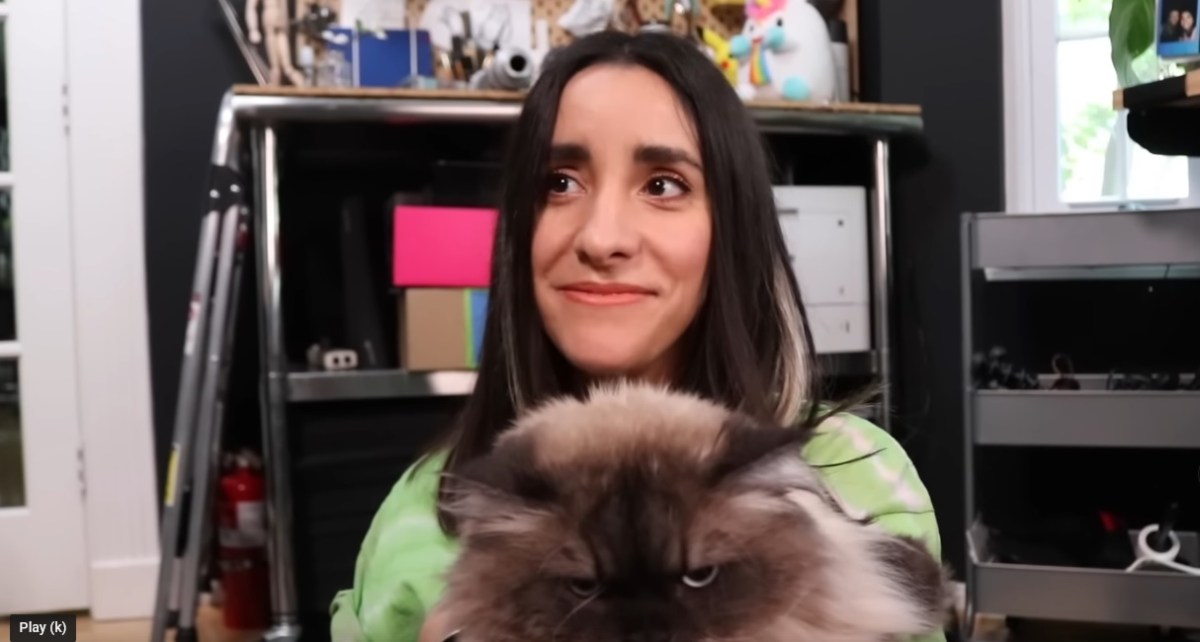
Last year we wrote about Youtuber Estefannie and her attempts to DIY a sophisticated artificial intelligence-enabled bathroom for her cat Teddy and her “cat’s cat,” Luna, after the former racked up a $3,000 vet bill prompted by an incorrigible plastic-munching habit.
One of the problems, Estefannie explained in her entertaining video on the building and coding process, was that Luna was “technically not my cat, this is Teddy-Bear’s cat.” Luna “uses the same litter box as Teddy,” so Estefannie had to train a machine learning algorithm for the high tech bathroom’s cameras to distinguish between felines.
I’ve always been fascinated by the phenomenon of “cat’s cats,” meaning stray cats who are adopted by la vida loca-living kittypets to share in their warmth, yums and human servantry.
“You gotta move in, Stripes,” I can imagine a well-fed moggie telling a stray buddy. “The service is great, the food is out of this world and the ambience? Oh, the ambience!”
In those cases, the stray usually follows the housecat right into their new home, which is what happened when Christian Fleming’s cat, Little, came back with a friend.
“I was surprised the cat came inside, initially,” said Fleming, who lives in Guam. “But if he’s hungry enough to be that brave, I wasn’t going to begrudge the food.”


Fleming named the new cat Tedo and told Newsweek he’s “90 percent sure he used to be someone’s pet or they left him, which is largely the case with friendly strays out here.” Guam is a US territory in the Pacific, about 1,450 miles east of the Philippines, and to say it’s got a stray cat and dog problem is an understatement, with tens of thousands of homeless animals.
One local veterinarian called the problem “astronomical” in an article for the Pacific Daily News, pointing out there more than 60,000 dogs alone on the 210 square mile island. By contrast there are 168,000 people living in Guam, meaning there’s more than one dog per three people. Cats similarly run rampant, although estimates of their population are harder to pin down.
There’s been a strong effort to spay and neuter in recent years, but local veterinary groups have a massive job in front of them to get the Micronesian island’s domestic animal population under control and reduce the suffering of unwanted cats and dogs.
Tedo is one of the lucky ones and has settled down nicely in his new digs. He’s adjusted to indoor life, regular meals and feeling protected with Little and Fleming, who says he now has “a small herd following me around” in his home.
“He has since gotten braver and more comfortable,” Fleming said. “When he jumped on me to snuggle with Little, I knew he had decided to live here.”
RIP Nacho
I’m not a fan of gastronomical fetishism, the concept of celebrity chefs or the idea that watching someone else eating food on television counts as entertainment, but I do respect Bobby Flay for two things: he’s a cat guy and he had a hilarious cameo in HBO’s Entourage in which he enraged high-powered agent Ari Gold by dating Mrs. Ari while the two were separated.
Flay, who has been the star of more than 20 cooking shows (not including specials) on the Food Network and Cooking Channel, saw the potential for profit in the pet food market and launched Made By Nacho in 2021, naming the food line after his little buddy.
Sadly the photogenic Maine Coon died this week, Flay announced in an Instagram post. Nacho was only nine years old and while that may seem a tragically young age for a cat to die — and it’s tragic any time someone’s beloved pet passes away — Maine Coons lose in lifespan what they gain in size, living an average of 10 to 13 years compared to the 13 to 18 year life expectancy of domestic felines in general.
Flay used the occasion of his cat’s death to hawk his outrageously expensive pet food line, which is weird. In his goodbye post, Flay wrote that “Nacho’s inclusiveness in our home inspired me to create something that would nourish cats everywhere.” Everywhere meaning houses where people don’t mind paying $3 for a 3oz can. (We don’t endorse any particular brand at PITB but Bud’s wet food, which always has real meat as the first ingredient and doesn’t include grain or fillers, costs 51 cents per meal when bought in bulk from Chewy.)
Cat food issues aside, Flay’s undoubtedly grieving his well-loved little friend, and although he recently adopted two more cats, that’s little consolation for losing a feline you’ve loved and bonded with. Best of luck to the Flay family and RIP Nacho.
 Pain In The Bud