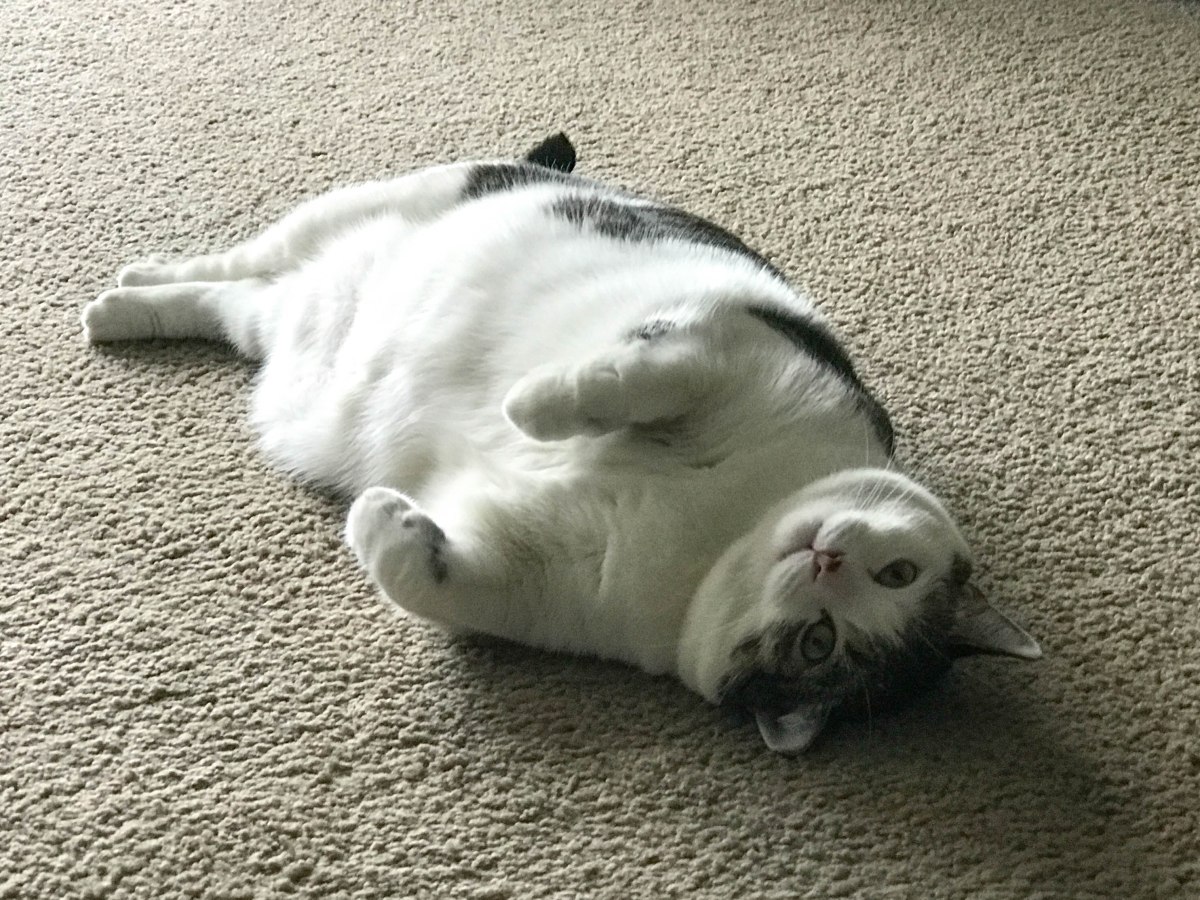
Oh Oh Oh Ozempic For Our Oh Oh Oh Obese Cats? It’s Close To Reality

In apocalyptic news for house cats everywhere, a pharmaceutical company is kicking off a trial of a GLP-1 drug for felines.

If cats could read newspapers, chances are they’d be gripped by a cold terror right about now, wondering if they’re among the unfortunates to have their yums curtailed by the same weight loss drugs their humans have been gobbling.

As the New York Times reports, a biopharma company headquartered in San Francisco, Okava Pharmaceuticals, is about to begin a trial to determine if GLP-1 drugs can help our chonksters slim down. More than 60 percent of American pets are packing extra pounds, the Times notes, while consequences like diabetes are shortening the lifespans and reducing quality of life for felines and canines.

“It is our belief that the condition of obesity, the condition of being overweight, is by far the number one most significant preventative health challenge in all of veterinary medicine,” Okava founder and CEO Michael Klotsman told the paper.

The upcoming study will include 50 cats. Most will receive a GPL-1 medication while a control group — about one third of the cats — will be given a placebo.

Since cats aren’t exactly known for being cooperative when it comes to taking oral medicine and weekly injections at a veterinary office are impractical, Okava has developed a system with a patch about the size of a microchip that will dispense the weight loss drugs over six months before a tiny cartridge needs to be replaced.

If all goes well with the trial, Okava will seek FDA approval and address other obstacles like convincing caretakers that their little pals can benefit from the feline version of Ozempic, Mounjaro and Wegovy.

That may be easier said than done considering our relationships with our furry friends and the role food plays in things like training, bonding and every day life

For lots of cat caretakers “their main way that they interact with and show their love to their pet often revolves around food,” Dr. Maryanne Murphy, a veterinary nutritionist at the University of Tennessee, told the Times.

How could the dynamic between cat and human change if the flow of yums is reduced to meals only? Will training — for everything from walking on a harness, to entering a carrier and fun tricks like high fives — still work if the reward is just a bit of encouragement or a scratch behind the ear?

An earlier weight loss drug developed for dogs, Slentrol, did not catch on because, as one veterinarian noted, “the main way [people] interacted with their pet was by feeding them, and seeing their excitement and happiness when they were eating the food.”

There’s also the not-so-small matter of cost. GLP-1 drugs are in high demand, and they’re expensive. One in eight Americans has taken Ozempic or one of its competitors. At times, the demand has threatened availability for diabetics, for whom the drugs were developed in the first place.

If the trials are successful and the GLP-1 drugs for pets gain FDA approval — which would require a series of much larger scale, more rigorous studies — the company hopes to offer them to consumers at a cost of about $100 per month per pet.

Even if this iteration of the drug fails, it’s unlikely to derail the larger effort. Vets have been prescribing tiny doses of the human version to cats with diabetes, and perhaps most telling of all, pet obesity continues to rise despite years of efforts by the veterinarian community to get people to play with their pets more and feed them less.

As Dr. Ernie Ward, a veterarian and founder of the Association for Pet Obesity Prevention, told the paper: “We haven’t moved the needle.”


And now we check in with our correspondent, Buddy the Cat. Buddy, what do you think about the possibility of GLP-1 for your species and the end of the proverbial gravy train?

Buddy? Bud? Are we having technical difficulties?

I’m sorry, ladies and gentlemen, we can’t find Buddy the Cat. We’ll resume this segment if and when we manage to locate him.
Parsnip Was Rescued From A Hoarder And Found Her Forever Home — Then She Got Sick

An experimental new drug offers hope for cats infected with FIPV, which is almost always fatal.

Anae Evangelista was reeling from the deaths of two close friends when she saw Parsnip in a local shelter’s online post.

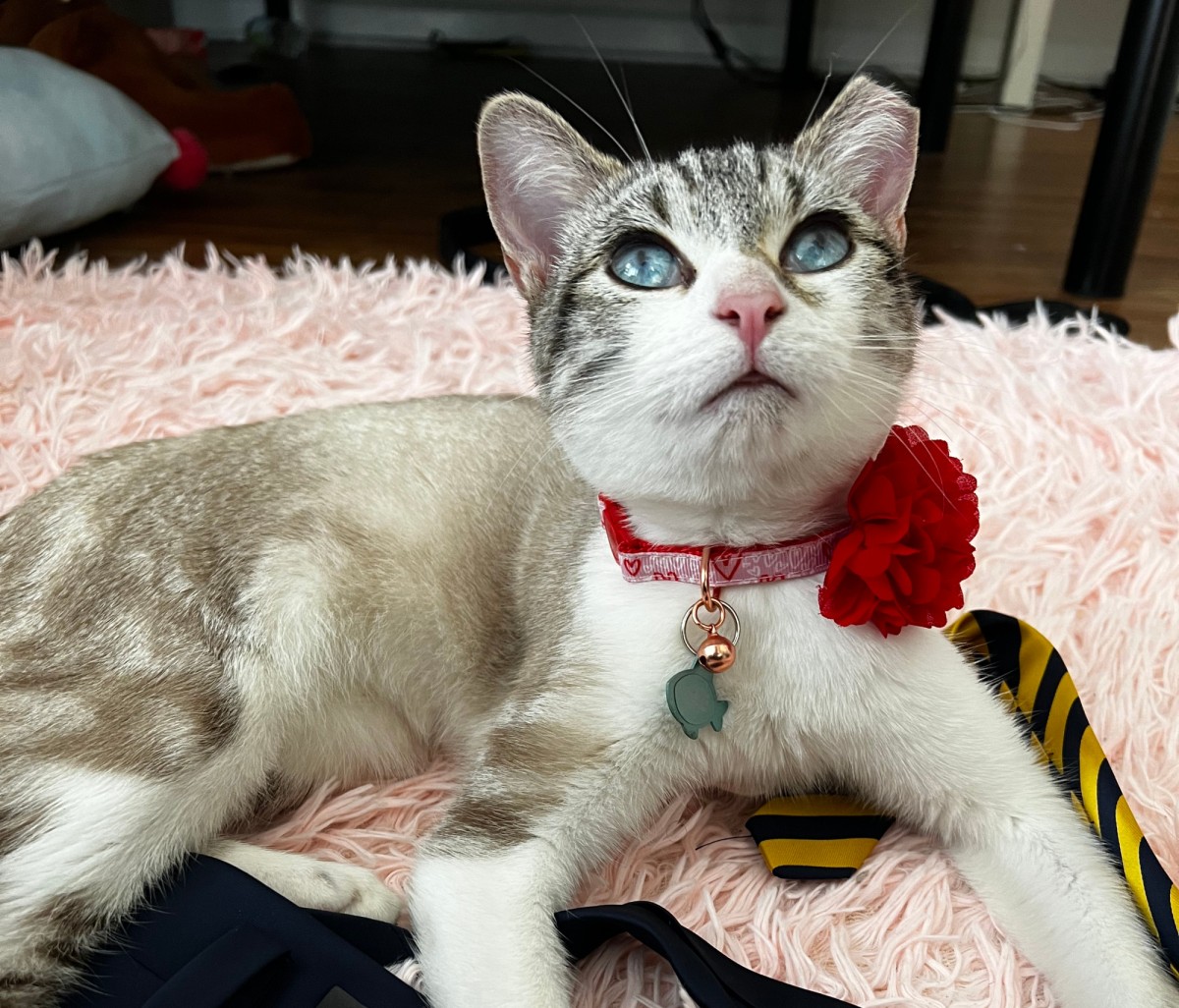
The 21-year-old college student had been thinking of getting a cat for weeks after accompanying a friend to a local shelter. After checking the shelter’s adoptable pets again, she fell in love with an adorable tabby with a clipped ear and sky blue eyes and immediately made plans to see her in San Diego.

Parsnip took to Evangelista immediately.

“She was so affectionate, pushing her head into my hand for pets, and I knew she was the one,” Evangelista told PITB.

Although many cats take days or weeks to adjust to their forever homes, Parsnip “strutted into my apartment as if she owned it from day one, zooming all over the place [with] enough energy to bounce off the walls,” Evangelista said.

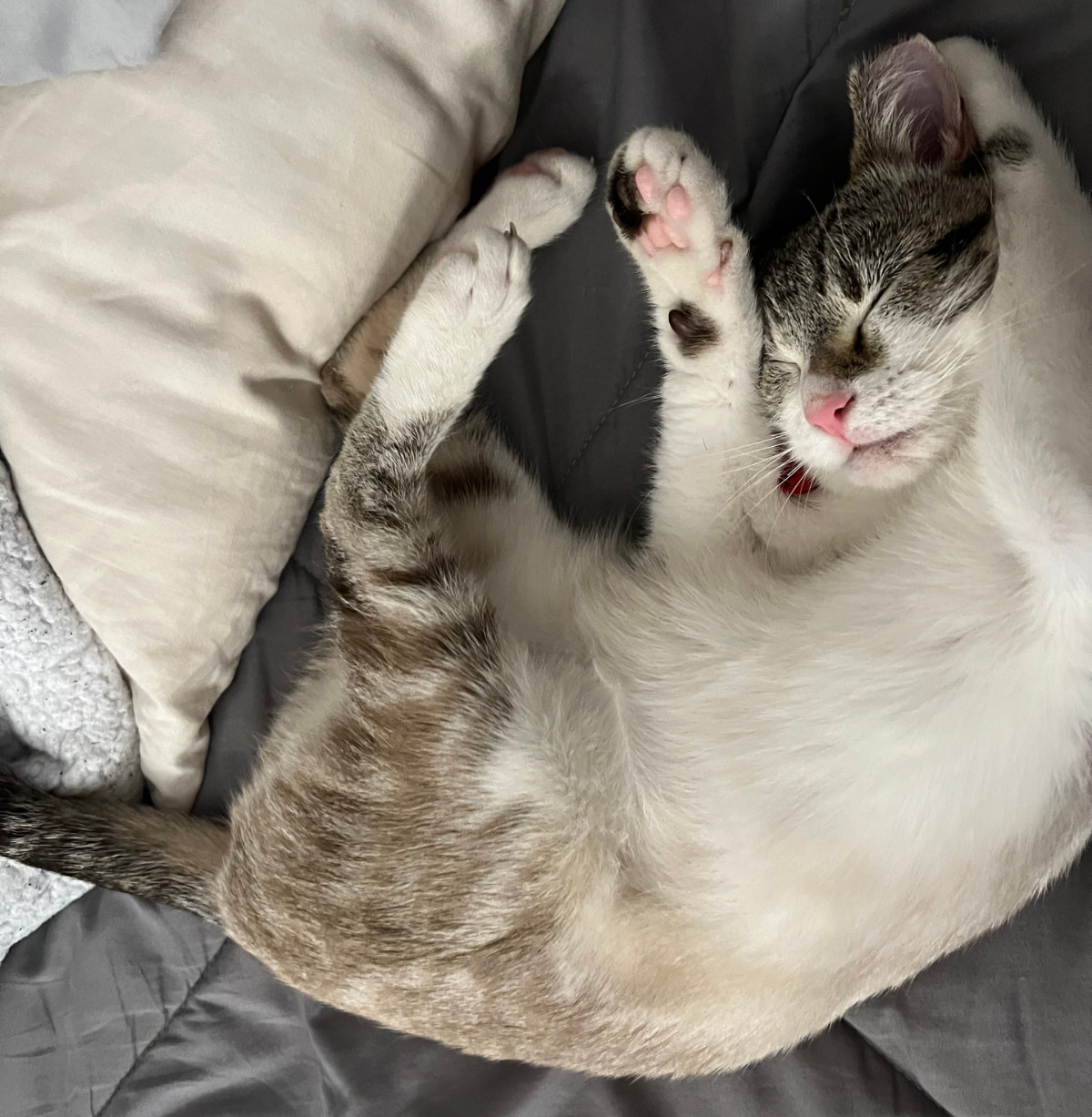
Parsnip sleeping
Parsnip enjoys a snooze with toe beans on display.

Although she had a rough start to life and was rescued from a hoarding situation, Parsnip was friendly, affectionate and warmed quickly to her new home. As human and kitten became fast friends, Parsnip’s presence was an immediate boost to Evangelista’s mental health.

‘She’s been my rock,” she said, “and although she can’t talk, I feel as if she’s constantly encouraging me to stay strong.”

But after about six weeks Parsnip’s energy level took a distressing dive. She was weak, slept a lot and wouldn’t eat much. A vet visit didn’t yield any answers, and the next day Parsnip displayed more telltale signs of a seriously sick cat — she stopped eating and drinking entirely, and began eliminating outside of her litter box.

After consulting another veterinarian, Evangelista finally had an answer. Little Parsnip was suffering from Feline infectious peritonitis, a more virulent strain of feline coronavirus that infects white blood cells resulting in dangerous inflammation, per the Cornell Feline Health Center.

“An intense inflammatory reaction to FIPV occurs around vessels in the tissues where these infected cells locate, often in the abdomen, kidney, or brain,” according to Cornell. “It is this interaction between the body’s own immune system and the virus that is responsible for the development of FIP.”

The disease is “usually progressive and almost always fatal without therapy.”

But there’s hope for Parsnip: With the help of her veterinarian and an online group for people whose cats have FIPV, Evangelista was able to get her kitty accepted for experimental treatment with GS-441524, a nucleoside analogue antiviral drug that has proven effective at treating all types of FIP in several trials in recent years. (It’s been so effective, in fact, that Chinese pharmaceutical manufacturers have been supplying GS-441524 on the black market to cat caretakers who haven’t been able to get their cats into trials.)

Since starting the treatment, Parsnip’s responded well: She’s eating again, the swelling has been in retreat, and she’s once again interested in play time, exploring and other things cats love to do. She’s even able to hop up on the couch again.

That’s a far cry from her condition just three weeks ago when she had a 105-degree fever, no interest in things around her and couldn’t get up under her own power.

The 84-day treatment, subsequent vet visits, monitoring and blood work is expensive: Evangelista estimates it’ll cost her about $5,000 in total. She’s looking to raise half that amount via a GoFundMe. It’s a huge expense, especially for a college student, but for Evangelista, spending the money is without question.

“She’s been my foundation and she deserves the world,” she said, “so I want to give her the chance to live to see it.”

Follow Parsnip’s progress on Instagram @lilmissparsnip