Sunday Cats: Expert Fails At Feline Facts, Aussie Karen Lures Cats From Home To Issue Roaming Fine

Declawing is evil and cruel, mmmkay?

This is why we always say it’s better for cat servants to regulate themselves than allow the government to get involved.

A Karen in Australia issued a $280 fine to a homeowner for allegedly allowing his cats to roam — after she lured the kitties onto the street herself.

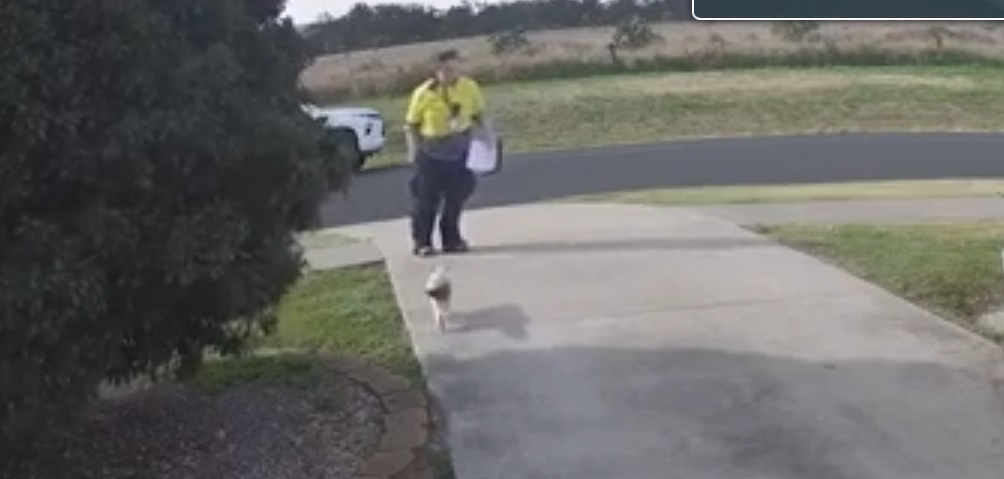
The entire bizarre spectacle was captured on security cameras at the home of Julie and Steven Stephens, a couple in Toowoomba, about 80 miles west of Brisbane. The uniformed Karen, who is employed by the Queensland council, totes a clipboard in one hand as she walks up the Stephens’ driveway in broad daylight.

As one of the curious cats approaches, Karen reaches for a pen in her pocket and starts scribbling on her clipboard, apparently eager to get started on the paperwork, before slowly backpeddling so the kitty will continue to follow her. When the cat reaches the sidewalk, the unnamed woman scoops it up and walks to her government-issued vehicle parked in front of the Stephens’ home.

Steven Stephens was watching the episode unfold via his camera system and bolted outside to stop the government employee from taking his cat, he told Yahoo News Australia.

The Karen wasn’t able to “impound” the cat, but she wrote Stephens a hefty fine for “allowing his cat to roam,” and promised she’d be back to inflict more misery.

“She said she would be back in two weeks with the police to take all but two of our dogs,” Mr Stephens said.
Queensland cat story
A municipal employee from the Queensland council is seen luring a cat away from its home in this still shot from surveillance video. Credit: Steven Stephens

We’re unable to embed the video, but you can watch it at Yahoo News Australia.

Unbelievably, Toowoomba Regional Council “CEO” Brian Pidgeon doubled down and quoted the relevant section of law on pet roaming when a local newspaper asked him about the incident. Pidgeon did acknowledge his employee was accused of luring the Stephens’ cat, but said he couldn’t talk about that because he’s conducting an “internal investigation,” which is bureaucrat-speak for figuring a way to worm his way out of the situation. There is, after all, clear video showing the Karen luring the cat away. There is nothing ambiguous about what happened.

Stephens admitted he and his wife have “too many” dogs according to local law, which has set arbitrary limits on animal custodianship, but said there are good reasons for that. The dogs sooth his wife, he said.

“A few years ago she had a severe car accident, her partner at the time died, she has a metal plate in her head and now has severe depression and anxiety,” Stephens said. “The dogs help with her anxiety.”

The family has been so rattled by the incident, and apparently has so little faith in their local government to treat them fairly, that they told Yahoo News they’re looking to sell their home and move to “a larger parcel of land in the bush.”

That in itself is an extraordinary admission, indicating they don’t expect basic courtesy, honesty or professionalism from the local authorities.

Now imagine how this would have played out if the Stephens family did not have security cameras. The council worker would have said their cats wandered off the family’s property of their own accord, and that would have been it. The Stephens would be forced to pay the fines, have a legal battle on their hands to get their cats back, and would be fretting over the impending confiscation of their dogs.

I know I sound like a broken record with regard to how local governments, guided by bunk “research” studies, impose themselves on pet caretakers, especially those of us who have cats. That’s why it’s important not to give them any reason to interfere — and to make sure everything is recorded, as the Stephens family wisely did.

Who knows what the government Karen’s motivations were. Was she trying to meet a quota? Does she dislike animals? Does she enjoy flexing the little bit of power she has, or inflicting misery on others? By preempting legislation on cat ownership and roaming, we can avoid putting ourselves at the mercy of such people in the first place, which is in the best interest of cat caretakers, and most importantly cats themselves.

Feline fact fail

I’m sure Nigel Barber, PhD., is a nice guy. I don’t mean to give him any grief. But when you present yourself as an expert on a topic and you write an authoritative column on a trusted site that has millions of readers, you really should make sure you’re not spreading misinformation or providing a picture of a situation that is decades behind the current science.

In a column for Psychology Today titled “Does Your Cat Love You?“, Barber rattles off a list of cliches, half-truths and outright falsehoods about cats, the kind of thing you might have expected 20 or 30 years ago before a wealth of research helped us dispel incorrect assumptions about felis catus.
close up of person cuddling cat
Credit: Sevra Karakuu/pexels

After mucking up the domestication timeline, Barber says cats are “fearful of people,” “tend to withdraw from strangers,” and paints an outdated picture of aloof animals who technically don’t need human care to thrive. He also says cats attack people, including their caretakers, without warning or provocation.

Then there’s this nugget:

“As essentially wild predators, cats can be quite unpredictable. Many owners who are devoted to their cats complain that the cat often scratches them unexpectedly. One acquaintance had the cat declawed and found that the pet reverted to using its teeth on her!”

Can you believe it?!?! A woman had her cat declawed, and the cat bit her!

It’s not just that we know cats give off plenty of nonverbal warnings when they’re uncomfortable, or that declawing makes a cat much more likely to bite. Organizations like the Humane Society, SPCA, The Paw Project and others have been saying that for years.

It goes well beyond that — studies, including the most comprehensive study to date on the effects of declawing, have proven without a doubt that cats are much more likely to bite when they’re subjected to the cruel and painful declawing procedure. (See “Pain and adverse behavior in declawed cats,” a 2017 paper in the Journal of Feline Medicine and Surgery.)

That’s because declawing a cat not only inflicts a lifetime of physical pain and psychological trauma, it robs felines of their primary defense mechanism, making them feel much more vulnerable. Without claws with which to warn off unwanted handling, the poor declawed cats have only one defensive weapon available to them — their teeth.

An evolutionary psychologist should understand that, and should also understand that scratching is a natural and necessary behavior for cats. It’s not right or wrong, it’s cats being cats. Mutilating innocent animals to protect inanimate objects like furniture is objectively wrong and cruel. When you adopt a cat, scratching comes as part of the package along with all the positives like unconditional love, amusing antics and calming purring.

There are ways to dissuade and train your cats to mostly avoid scratching furniture, but no one should expect their cats will never put a claw on their couches. If you don’t want your furniture scratched, don’t get a cat. End of.
Maryland Joins New York In Banning Barbaric Declawing Procedures

Two down, 48 to go.

Two U.S. states have now banned declawing as ‘Merica inches closer to joining the rest of the civilized world in prohibiting the brutal practice.

With a stroke of Gov. Larry Hogan’s pen, Maryland became only the second state to ban declawing, joining New York, which outlawed the practice in 2019. Like New York’s version, the new Maryland law prohibits declawing unless it’s deemed medically necessary.

As most cat lovers know, declawing isn’t the manicure-like operation it sounds like. It’s the totally unnecessary, horrific amputation of a cat’s toes up to the first knuckle.

Declawing inflicts a lifetime of pain on cats, changes feline gait and posture, leads to early arthritis and causes a long list of secondary problems. For example, declawed cats are much more likely to bite because they have no other form of defense when they feel threatened, and they’re also much more likely to stop using litter boxes because it hurts to walk on the sand-like and granule texture of the litter with half-amputated toes.

The fact that so much misery is inflicted on innocent animals to protect furniture is indefensible.

The law goes into effect on Oct. 1, and veterinarians who perform the procedure after that time face fines of $1,000 and disciplinary action by the state veterinary board. We’d have preferred immediate implementation and stiffer penalties to prevent a last-minute rush on declawing appointments and discourage anyone considering breaking the law, but a win is a win, and all the major animal advocacy groups are celebrating, as they should.

Now we’ve only got 48 states to go.

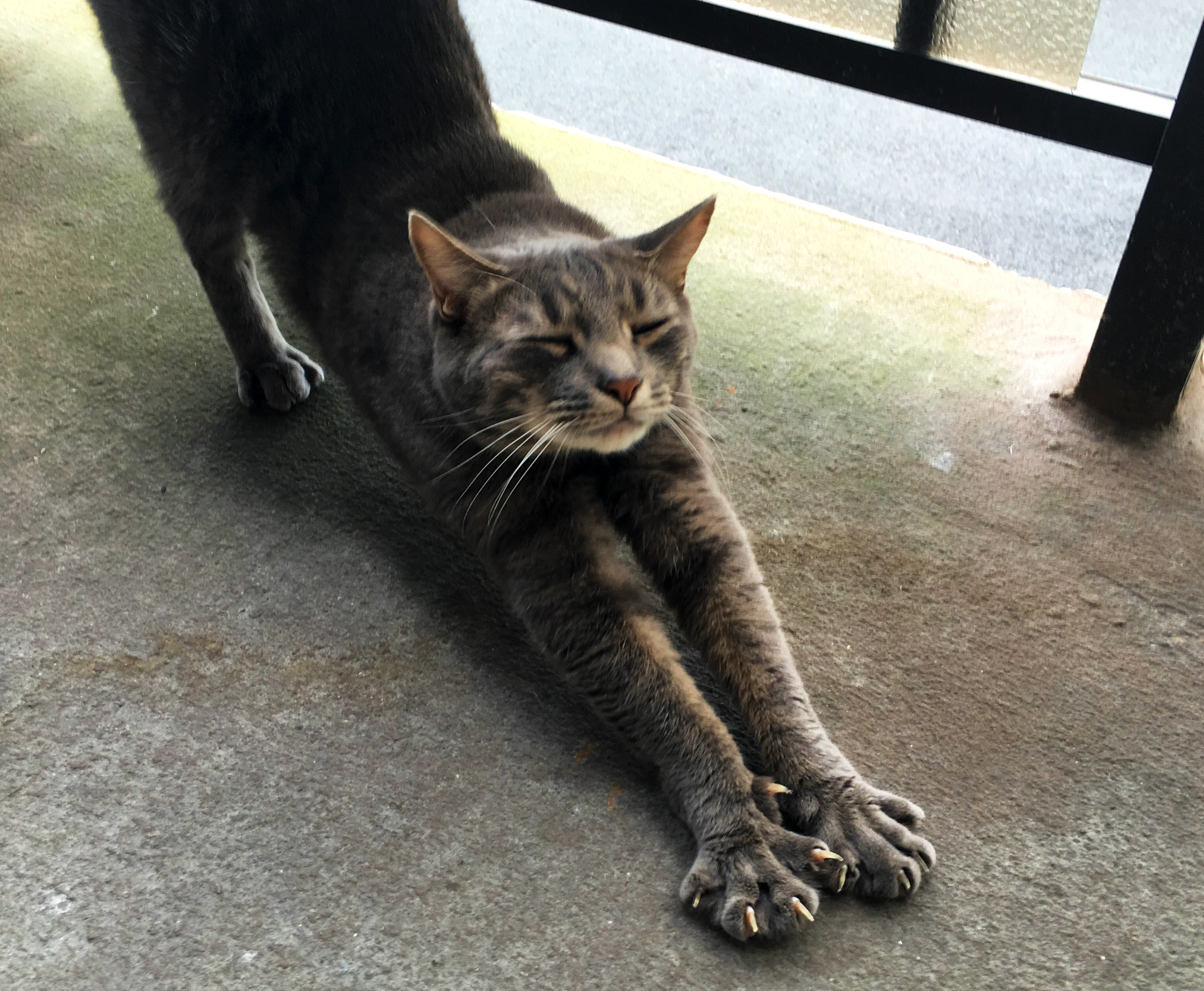
buddy_stretching
Buddy and his Claws of Cosmic Doom.

Declawing: Florida Moves Ahead On Ban, Ozzy Osbourne Joins PETA Campaign

Osbourne poses for a cartoonishly bloody ad denouncing declawing.

A ban on declawing passed a key committee vote in Florida this week, while Black Sabbath frontman and reality TV star Ozzy Osbourne has become the new face of a PETA campaign against the harmful practice.

Florida aims to become the second US state to ban the elective and harmful procedure after our home state, New York, passed the country’s first statewide ban on declawing in 2019.

The Florida bill, which was introduced in August, was approved by the state senate’s agricultural committee by a 4-1 vote on Tuesday. It’s expected to pass two more committee votes before it goes to a final vote on the senate floor.

The ban would levy relatively stiff penalties for owners and veterinarians who ignore the law. The former would face fines of $1,000 per cat, while veterinarians would be fined $5,000 per cat, as well as discipline from the state’s Board of Veterinary Medicine.

Meanwhile, Osbourne and People for the Ethical Treatment of Animals have teamed up for a public announcement campaign aimed at increasing awareness of the damage declawing does to cats.

The ads feature a striking image of Osbourne holding up both hands, with his fingers severed at the first knuckle to illustrate what’s done to cats during the procedure. It’s bloody, like Osbourne’s long-time stage antics, and controversial, like many PETA campaigns.

“Amputating a cat’s toes is twisted and wrong,” Osbourne said, per PETA. “If your couch is more important to you than your cat’s health and happiness, you don’t deserve to have an animal! Get cats a scratching post—don’t mutilate them for life.”

Ozzy Osbourne in PETA's declawing ad
Ozzy Osbourne poses for a bloody anti-declawing ad in cooperation with PETA. Credit: PETA

Cat Haters Are Out In Full Force

Defending innocent animals and innocent people aren’t mutually exclusive things.

Earlier this week New York became the first state in the US to ban cat declawing, which is a major victory not only for the many people who have been pushing for a ban for years, but especially for the potentially millions of cats who won’t be mutilated for the sake of someone’s couch or drapes.

It’s a time to celebrate, revel in a rare legislative victory for animal welfare, and look ahead toward similar proposals in other states. If more states follow New York, it could pave the way to a national ban.

Innocent, sentient creatures won’t be harmed as they have been for a long time. What could be better than that?

Here come the cat-haters

The thing is, legislation like this brings out the crazies and lots people who think protecting the innocent is a zero-sum game. In their world, helping animals and helping humans are mutually exclusive things instead of two goals that should be part of any coherent moral belief system.

Just because people are suffering in some parts of the world doesn’t mean we can’t help animals, just as helping animals doesn’t preclude us from helping people.

Declawing bans don’t take resources away from starving children in Somalia or America’s urban poor. Compassion for animals doesn’t somehow detract for compassion for people. In fact, all the research points to the opposite: That the way a person treats animals is a strong indicator of how they treat other human beings.

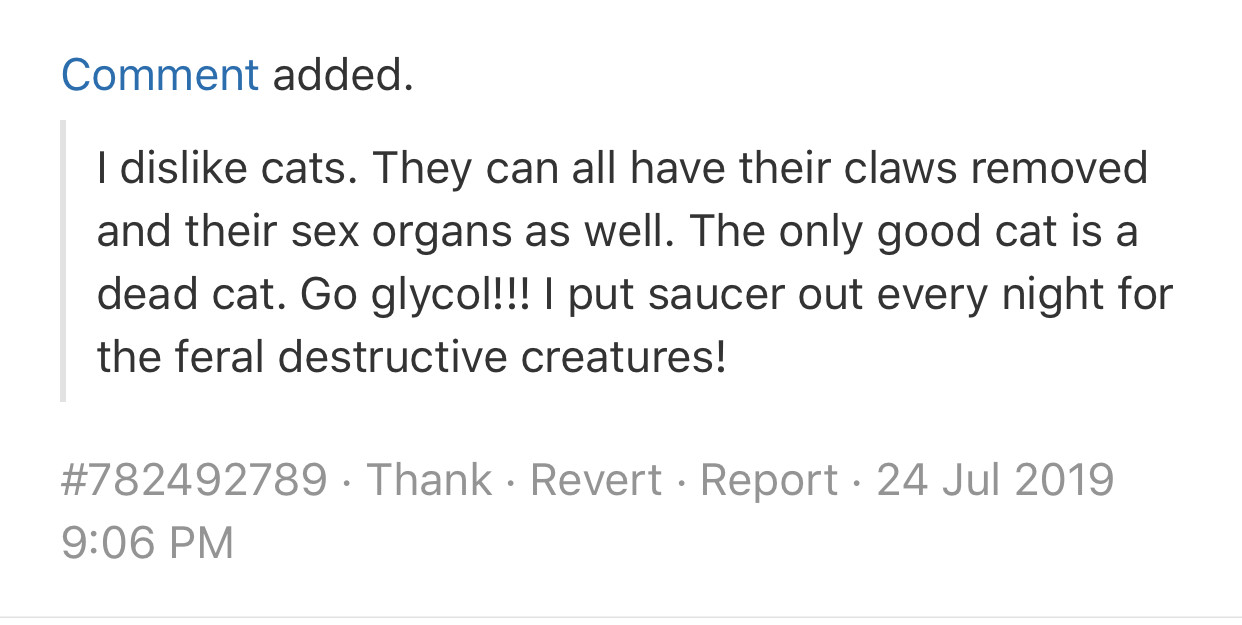
Twat
A comment on a story about New York’s historic declawing ban.

qcomment2
The zero-sum game that isn’t.

Animal abuse and violence crime

That’s why there’s a link between animal abuse and violent crime against people. Animal abusers are five times more likely to commit violence against fellow humans, research shows. Criminologists have been aware of this link for many years, and smart investigators know to keep tabs on animal abusers because they often “graduate” to hurting humans.

That was the case with Luka Magnotta, a notorious animal abuser who, among other crimes, filmed himself feeding a young kitten to a python. Magnotta went on to kill a man with an ice pick, a crime that could have been prevented had detectives in Canada taken Magnotta’s animal abuse more seriously. Animal life has intrinsic value, and Magnotta should have been imprisoned for killing the kitten.

Cats scratch. Get over it.

Then there are the declawing advocates, the people who inexplicably argue that it’s okay to brutally mutilate living, feeling creatures in order to protect inanimate objects like couches and drapes.

One thing should be absolutely clear to anyone looking to adopt a cat: Scratching is completely natural behavior, and it’s your responsibility as caretaker to make sure you provide adequate scratching posts, as well as redirect your cat to those posts and vertical scratchers.

If you can’t or won’t accept that responsibility, you should not adopt a cat.

Cute Kitty
“Don’t touch my paws!”

Of course there are people who will insist declawing has no negative effects on cats. They’re wrong. That’s not a matter of opinion, it’s fact: A 2017 study, the most comprehensive of its kind, detailed a long list of negative effects that result from declawing.

Declawing is NOT a manicure

Declawing, which is the amputation of a cat’s feet up to the first knuckle — and not “kitty manicure” — causes lifelong pain in cats. Because cats are digitigrade animals, meaning they walk with their weight on their toes, the act of walking itself becomes painful. That leads to cats altering their gaits to limit the pain, which in turn leads to poor posture, which ultimately leads to early-onset arthritis and other physical problems, according to the 2017 study in the Journal of Feline Medicine and Surgery.

It’s a cascade of physical problems that leads to misery.

Because cats are famously stoic, doing everything they can not to show pain — they are prey animals as well as predators, after all — it may not be obvious, but declawing hurts them. A lot.

While people may think they’re solving a problem by declawing their cats, they’re creating new ones. Declawed cats are several times more likely to bite because they no longer have their claws for defense. They’re five times more likely to stop using the litter box, because the simple act of standing on litter granules is painful on their raw toe stumps. They’re more likely to be aggressive and ill-tempered.

Insult to injury

Those are all prime reasons why people surrender cats to shelters, causing another type of cascade: One in which a negligent owner has his or her cats declawed, then surrenders the cats because they’re acting out. Declawed cats are twice as likely to be surrendered to shelters as cats who are not declawed.

That directly contradicts claims by proponents of declawing, who say declawed cats are more likely to be adopted. In fact, declawed cats are more likely to end up without homes.

It’s 2019. The information is out there for anyone to look up, and ignorance is no longer an excuse. Declawing is wrong.

Here’s to hoping New York is just the first of many states to ban the barbaric practice.

budhanging2
“You don’t wanna tangle with these talons, bro. I’ll cut you. I’ll cut you for real. And then you’ll have to lather anti-bacterial cream all over your skin, and you’ll smell like medicine. Hah!”