UK Man Pays $22k To Have Cat Cryogenically Frozen, Hoping To Revive Her In The Future

Using a technology most commonly associated with science fiction, the UK man is banking on a technologically gleaming future where he and his cat can be revived and meet again.

A man in the UK has spent a small fortune on the possibility of reviving his dead cat.

Mark McAuliffe says he was so upset when his 23-year-old cat’s health began to fail that he made arrangements with a Swiss firm to preserve her body when she passed away.

The 38-year-old adopted Bonny, a domestic shorthair, while he was a teenager, and she’s been with him for more than half his life, including his entire adulthood.

Usually when stories like this make the news, they’re about people who preserve their cat or dog’s DNA for cloning.

That’s not what’s happening here.

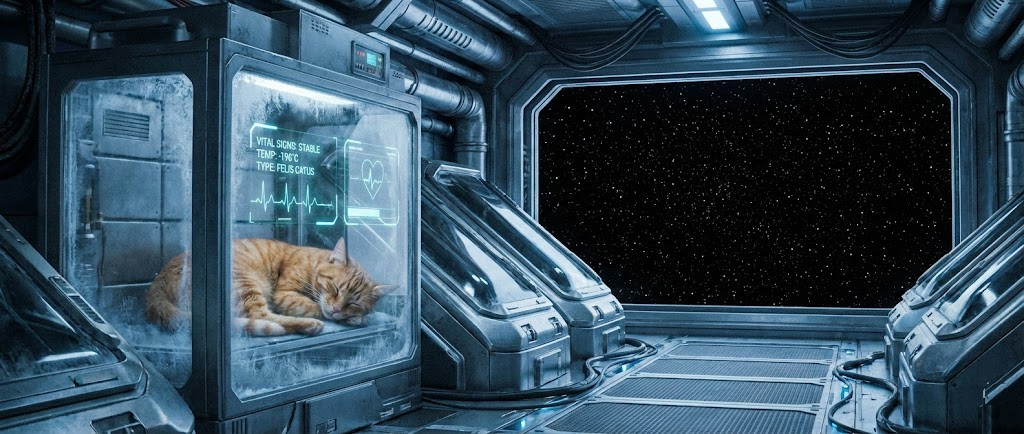
Bonny has been placed in a cryopreservation unit, which uses liquid nitrogen to freeze her entire body. Freezing a body essentially suspends it in time. Extremely cold temperatures — as close to absolute zero as possible — suspend cellular activity, including decay.

It’s called cryopreservation, and while the concept is most frequently invoked in science fiction, putting a body into cryostasis is real and within the technological capabilities of modern science.

The company McAuliffe paid to preserve his cat is Switzerland-based Tomorrow Bio, which is affiliated with the European Biostasis Foundation. The technology is used for several other purposes in the medical field, the food industry and in certain engineering applications.

McAuliffe is gambling on the future, or a version of it in which people and animals can be revived and repaired, like Lazarus in a lab. But it wouldn’t be much of a future for Bonny if her human wasn’t with her, so McAuliffe has reserved a spot for himself as well, hoping to meet her in better times.

“This cushioned the blow about Bonny’s death,” he said, “because I have got it in the back of my mind that it is not going to be the final goodbye.”
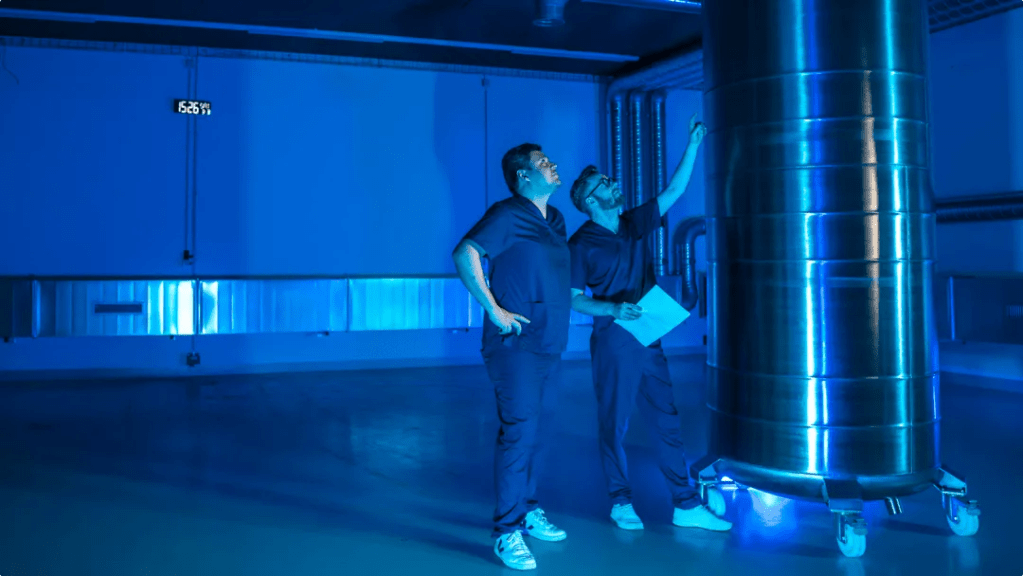
Employees of Tomorrow Bio inspect a liquid nitrogen pod. Credit: Tomorrow Bio

The European Biostasis Foundation runs the cryovaults where clients are kept. The organization told the Daily Mail that it has five “full body patients,” 15 preserved brains, two dogs and eight cats. In addition, more than 700 people have made arrangements to have their own bodies frozen upon death.

There is, of course, a hiccup.

While freezing a body is possible, thawing is not — not without destroying the body.

That’s because ice crystals form and rupture cell walls when the body is brought out of cryopreservation, no matter how slow the process.

The workaround involves using cryoprotectants, essentially a form of anti-freeze that would prevent the formation of damaging ice crystals despite the temperature.

That, however, introduces an entirely new set of problems, including the fact that cryoprotectant is toxic at the levels required for preservation.

Preserving the brain presents an entirely different set of problems, as our neurons and neural pathways begin to decay immediately after death. Our brain topology and neural connections are part of who we are, part of what makes our minds uniquely our own. Neuroscience and cryostasis technology each have a long way to go before scientists can even attempt to thaw a brain.

So by spending almost $22,000 to preserve Bony, and buying a plan to preserve himself (at a cost of $230,000), McAuliffe is banking on major breakthroughs in biology, as well as the ability to precisely control temperatures. To successfully thaw a body without destroying it, the entire body must be warmed at the same time, including all internal organs. That’s a significant technical challenge.

It’s also a gamble on the general shape of the future, placing hope that progress will continue. It assumes we won’t lapse into another dark age, that we won’t lose technology and expertise to devastating wars, plagues or other disasters that could set humanity back decades or centuries.

Finally, there’s a major hurdle that has little to do with science behind cryopreservation. It’s the simple fact that human lives are short, companies that promise centuries of operation can’t guarantee that outcome, and a lot can happen while a person sleeps away those years.

There’s a great short story by the Welsh science fiction novelist Alastair Reynolds about a wealthy man who wakes after centuries of cryosleep to find that the company who managed his crypt went bankrupt. From there it changed hands several times until it ended up in the portfolio of a corporate raider.

So the narrator, expecting to be woken to fanfare, deferential treatment and a bright technological future instead finds himself indebted and facing a reality much different and more depressing than he ever imagined.

I sympathize with McAuliffe, who obviously loves Bonny a great deal, and I see the appeal of becoming a refugee from the past, entering into a cryovault in the hope of emerging into a better future. But man, that’s a huge gamble.

In the meantime, there are plenty of cats who need homes and have a lot of love to give. Every shelter cat is a potential Buddy!

Review: Alien Romulus Is The Only Worthy Sequel To The 1979 Original

It took a fresh vision to prove there’s still cinematic life in the xenomorph and its ability to terrify audiences, but Romulus really shines where its affable characters are concerned.

Over four decades and six films — eight if you count crossovers — in the Alien universe, no one had been able to capture even a fraction of the terror, novelty or magic of Ridley Scott’s original 1979 science fiction-horror classic.

James Cameron turned the immediate sequel into a James Cameron movie, which means it’s packed with Velveeta one-liners, Spanish catch-phrases that no Spanish-speaking person would ever utter, and doesn’t exercise an ounce of the restraint Scott used to such cosmic effect.

In the third outing, David Fincher took on the impossible task of trying to reconcile the tone of the first two films and set the entire thing in a drab space prison, while Joss Whedon’s script for the fourth film was Firefly in Alien trappings.

Alien: Covenant
While the xenomorphs never looked better, Alien: Covenant felt like half a movie, ending on a cliffhanger that will never be resolved.

The titular monster had been stripped of nearly all its mystique by the time Scott returned to the franchise with Prometheus and Covenant, the fifth and sixth installments.

Both films were visually spectacular thanks to Scott’s efforts, but suffered from characters audiences couldn’t connect with, and in the case of Damon Lindelof’s script for Prometheus, characters the audience loathed. Instead of leaving the origin of the aliens ambiguous, Prometheus and Covenant offered a bizarre, nearly franchise-killing backstory involving alien-designed panspermia, artificial intelligence gone rogue and half-baked creationism given the veneer of science.

Prometheus
A space jockey chamber in the derelict starship, of the same kind seen in the first film, only this time the ship is powered up. Prometheus and Covenant tried to give us a backstory for the creatures, which only made them more pedestrian.

When Fede Alvarez presented his vision for an Alien film, he understood he had two do two things:

  1. Ignore everything that came after Scott’s original film
  2. Offer something more than the formulaic “monster stalks the cast deck by deck and kills them one at a time, leaving only the Final Girl”

Alien: Romulus sets off on that task by engaging in economical world building to give us more context than the five previous sequels managed together.

It’s tightly focused on our heroes, a group of five twenty-somethings who were born on a fiery world where lava perpetually flows, novel diseases spawn every year and a permanent atmospheric coat of soot and ash hides the sun and sky from the people who live there.

It’s a hellish place, and they’re there because multinational megacorporation Weyland-Yutani (“the company” in Alien parlance) wants the valuable ores within the planet’s crust. Like the crew of the Nostromo, the people are expendable in the company’s pursuit of profit.

Alien Romulus: Jackson's Star
The people who live in the colony at Jackson’s Star can’t even see their own sun as they slave for Weyland-Yutani corporation.

Our heroes work for the company, and they’re all orphans who lost their parents to work-related accidents or diseases from the mines.

Marie Rain Carradine’s (Cailee Spaeny) hope lies in the completion of her indentured servitude. With 12,000 hours of service to the company under her belt, Rain can finally take her brother to the colony world Yvaga, where the air isn’t toxic, people aren’t worked to death, and best of all in her mind, you can see the sun.

When Rain visits a Weyland-Yutani administrative center to formally separate from the company and relocate to Yvaga, a bureaucrat doubles her work requirement to 24,000 hours with the stroke of a key, damning her to another five or six years toiling on a planet that kills everyone eventually. Worse, the bureaucrat transfers her from farming to the mines, where her parents died.

“Know that the company is really grateful for your service,” the Wey-Yu representative says with an infuriating affect, dismissing the shocked young woman.

It’s in the depth of her despair that Rain gets a message from her friend Tyler (Archie Renaux) and listens to his pitch. Tyler and the others were working their orbital jobs miles above the colony’s surface when their computers pinged, alerting them to the approach of a massive starship.

Scans revealed a decommissioned Weyland-Yutani vessel that hadn’t been entirely stripped of its useful parts, slowly drifting through the system. Crucially, the ship still carried functional cryo pods, which would allow the group to sleep out the nine-plus year journey to Yvaga.

It’s freedom, there for the taking “before someone else does,” Isabela Merced’s Kay tells Rain.

When Rain balks at the dangerous and highly illegal plan, Tyler points out Weyland-Yutani will never grant them approval to leave the nightmarish world where they were born.

“I don’t want to end up like our parents,” he says, nodding toward the dead-eyed, soot-covered miners marching back to their utilitarian prefab homes after another shift toiling for the company.

You don’t need to guess that the plan does not go smoothly, nor the reason why.

What most people will need to know, in order to entrust two hours of their time to a franchise that has been beating a dead horse for decades, is that Alien: Romulus is the kind of sequel Scott himself would have made after the original, at the height of his directorial powers, if he hadn’t moved on to other projects.

Romulus replicates the magic of the original by taking things in exciting new directions, and by giving the audience a series of astonishing set pieces, including a gloriously nail-biting sequence that not only captures the beauty of space, but reminds us how hostile it is to our fragile human bodies.

It also takes care to give us reasons to root for characters we’ve just met, to sympathize with their plight and understand why they’d do something so desperate and reckless.

Alien Romulus: Cailee Spaeny
Cailee Spaeny is inarguably the best of the actresses who have tried to take the mantle from Sigourney Weaver’s Ripley in the last several films from the franchise.

Rain and her friends have one important thing in common with the characters from the first Alien film — they’re fighting for survival in more ways than one. There’s the immediate threat to their lives, and their eventual slow, agonizing doom if they don’t find a way off their colony world.

Unlike the characters from the previous sequels, they didn’t volunteer for a military mission, an archaeological expedition or to be pioneers on a world full of life. They’re desperate adults barely out of childhood who know life holds nothing but misery for them if they don’t succeed.

Like the best science fiction, Romulus doesn’t just entertain, it uses an imagined future to comment on our society. AI has now permeated our lives, but mainstream science fiction is still stuck on the same tired “AI evolves, turns on humans for reasons and tries to wipe us out” narratives.

Alien Romulus
Andy (Jonsson) in an airlock early in the film.

For those of us who are genre fans, it’s frustrating to see Hollywood clinging to ideas that were first kicked around many decades ago by science fiction novelists. Besides, the “AI turns on humans” thing has little to do with reality and everything to do with human anxiety that we’ll be judged for our behavior as a species the moment we encounter an intelligence capable of judging us.

Romulus eschews the formulaic stuff to explore a more interesting question: what separates biological intelligence from artificial intelligence, and can the latter really qualify as life? Can machines ever approximate human emotions, or are they limited to simulating them for our benefit? It’s still not the most original idea, but it’s a marked improvement from the same old Terminator and Ex Machina-inspired narratives.

As for the alien itself, it’s more menacing than it’s been since the first film, and it has a few tricks up its sleeve thanks to circumstances that tie directly into the original. To say more would be an injustice, because the twists here are well-conceived. They also make perfect sense given what we already know, and don’t require any great shift in franchise lore.

Lastly, as an admirer of retrofuturism, I can’t let this review pass without praising the set designers, special effects teams and Alvarez for reviving the utilitarian 1970s vision of the future from the original. This is a worn, lived-in universe, not a gleaming utopia. Alien’s aesthetics influenced virtually every science fiction effort over the last 45 years, and for good reason.

Alien Romulus sets design
Set designers at work on an interior for Alien: Romulus

There’s something anachronistic about a civilization that has mastered interstellar propulsion, cryopreservation and advanced artificial intelligence, but remains reliant on monochrome displays with vector graphics and tactile interfaces. And yet that visual shorthand signals to viewers that this is a return to the fundamental elements of the franchise, and a universe where space exploration is corporate and soulless.

Perhaps the best sign that Romulus has revived Alien is the fact that a sequel is already in the works. Spaeny and David Jonsson, who plays Rain’s brother Andy, are already on board for a second installment.

There’s certainly more story to tell, and if Alvarez can maintain the magic blend of homage and novelty that made Romulus such a strong entry, we’re in for another fun ride. To Yvaga!


Alien: Romulus is available to stream on Max, Hulu and Disney+. For a list of alternate sites where the film can be rented or purchased, or to check availability in regions other than the US, check out the movie’s listing on JustWatch.