People are passing on black cats for the most Kardashianesque reason.
Felines are a traditionally misunderstood lot, but no one gets it worse than black cats.
The poor little furballs are much less likely to find forever homes because of superstitions that won’t die, including claims that black cats are bad luck or agents of the devil.
While today is National Black Cat Day, many shelters across the US won’t adopt black cats out around Halloween, and sometimes for the entire month of October. The temporary moratorium is for the safety of black cats, who are much likely to be abducted, abused, killed or ritually sacrificed this time of year, according to animal welfare groups.
As if black cats didn’t have it bad enough, the age of social media has given people another reason to avoid black cats, this time for the most vapid of reasons: They supposedly don’t look good in selfies and Instagram shots.
Christine Bayka, who founded a rescue shelter more than two decades ago, tells the Telegraph that potential adoptees admit they’re passing on black cats for that reason.
“It happens all the time, I will go through all the questions and say ‘are you flexible about colour?'” Bayka said. “Then they will say, ‘Yes, as long as it’s not black.'”
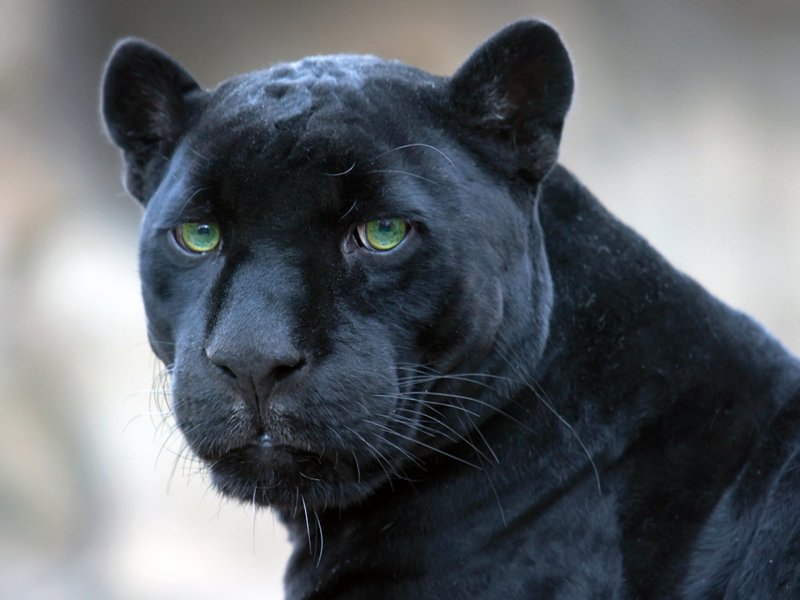
As usual the fault lies with humans, not cats: If you can’t take a decent shot of a black cat it’s because you don’t know how to use your camera, not because the cat is impossible to photograph properly. After all, we never hear of nature photographers passing up opportunities to snap melanistic jaguars because it’s too difficult.
A melanistic jaguar.
But we’re in luck thanks to pro photographers sharing tips on how to capture the sublime beauty of these little panthers. Fuss with a few settings, make sure the lighting is right, choose a high-contrast background and you’re well on your way. There are even tips for getting better shots using your iPhone.
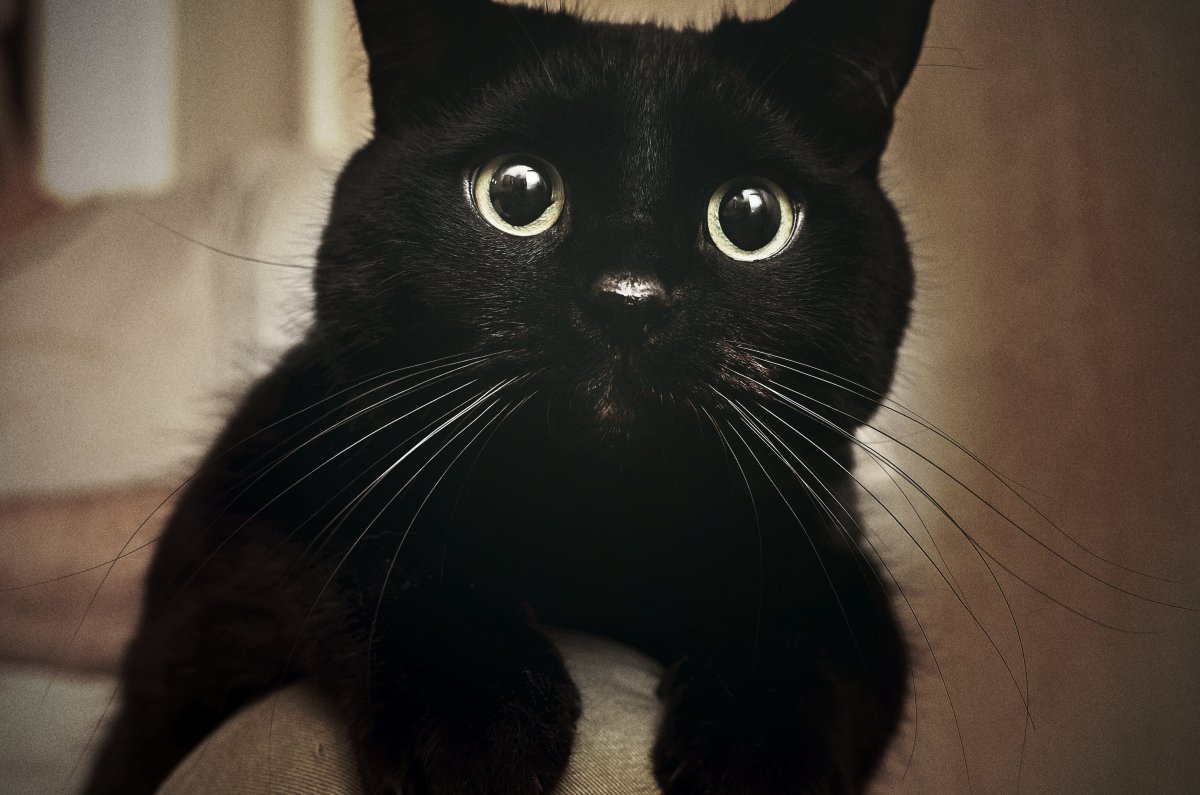
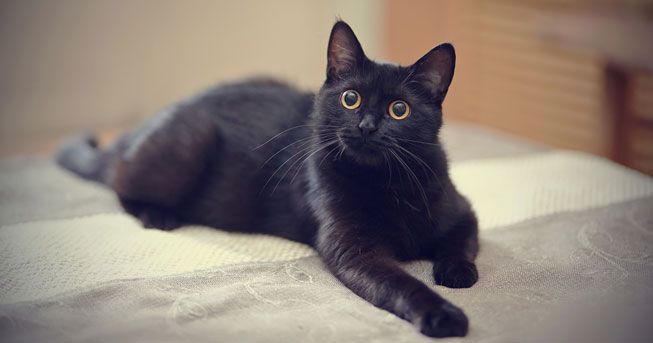
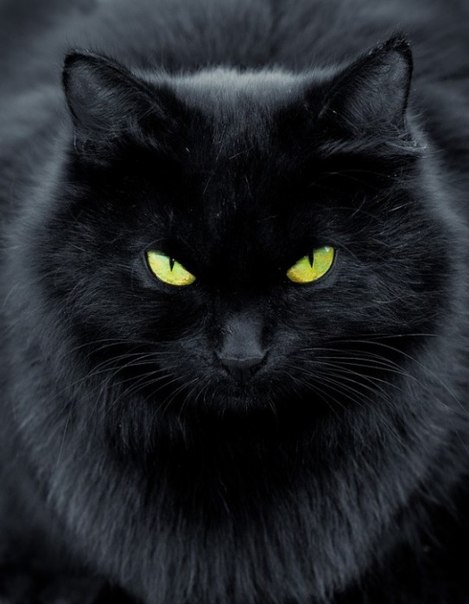
In honor of National Black Cat Day, here’s ample proof that they can look spectacular in photographs:
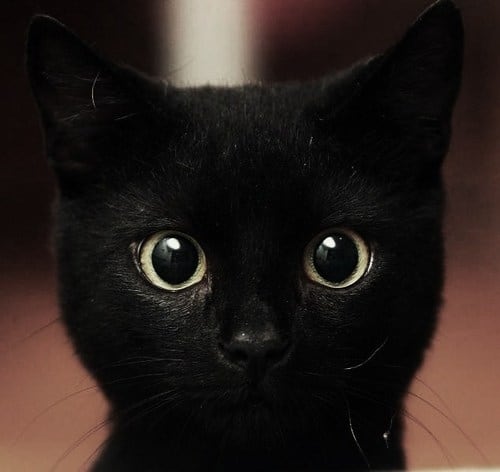
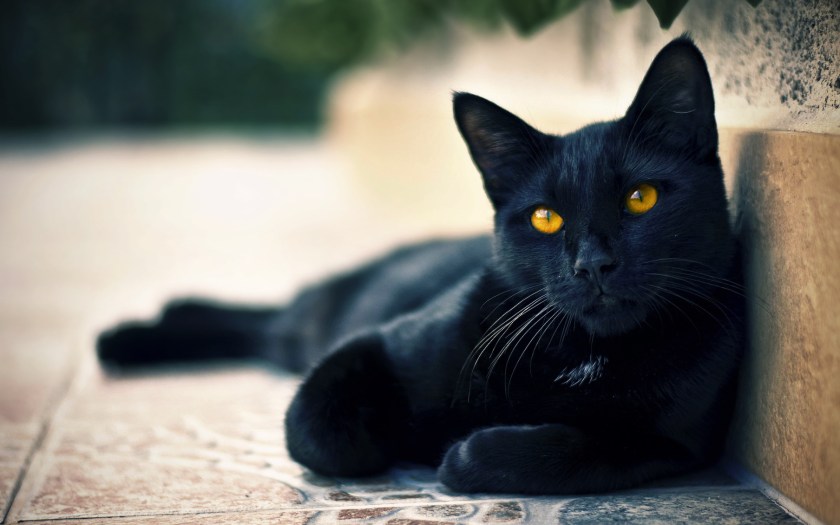
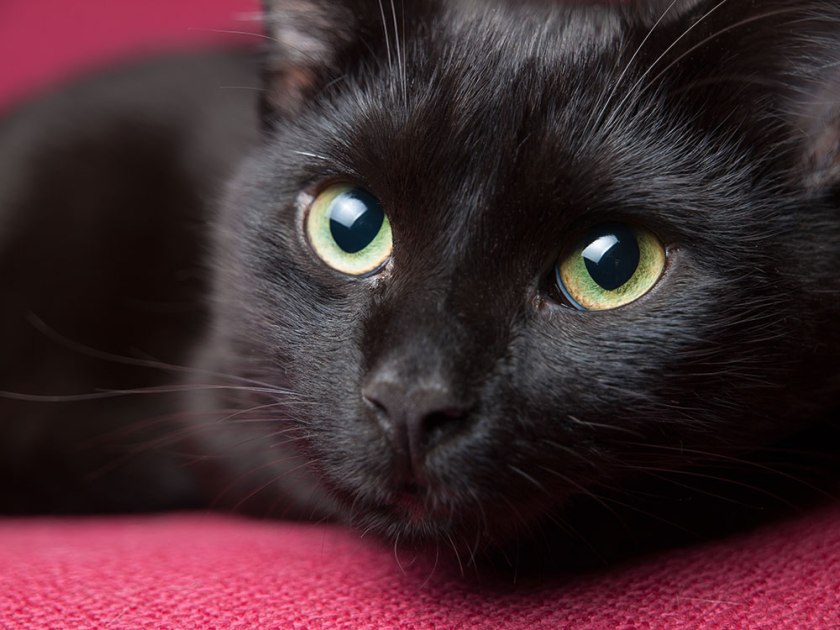
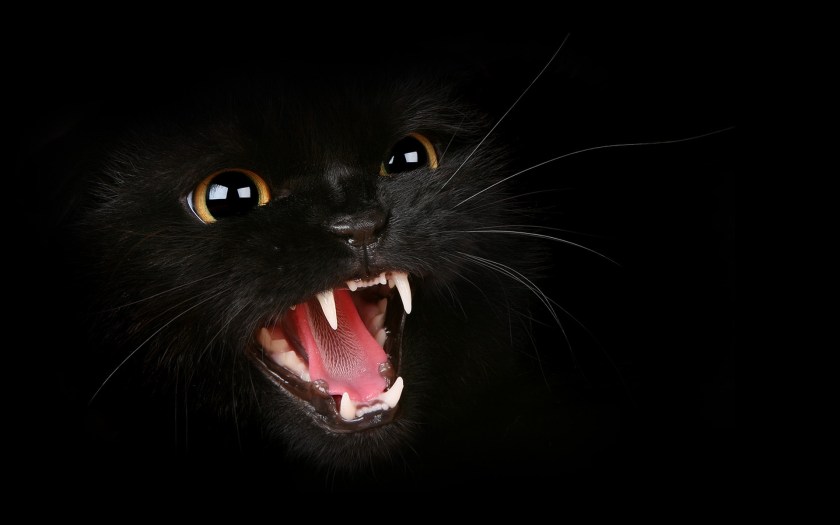
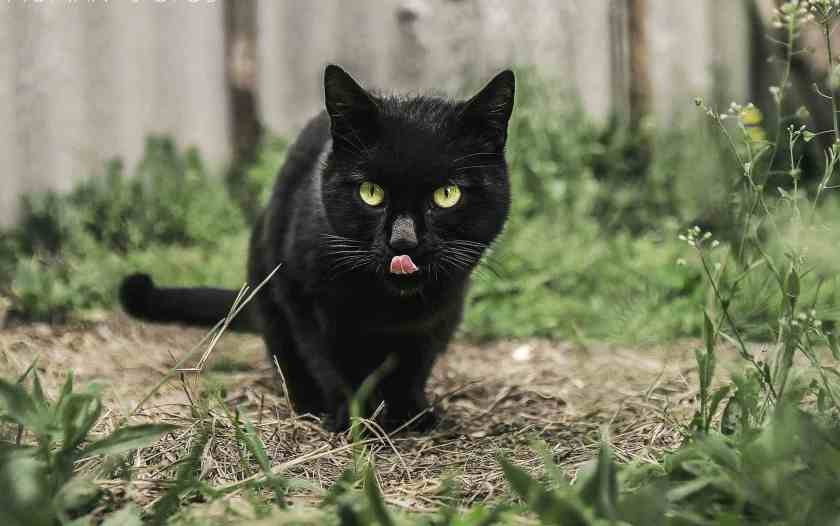
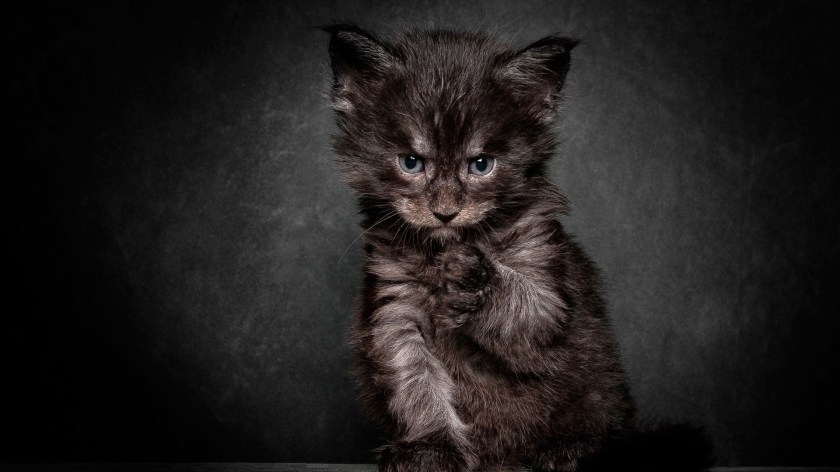
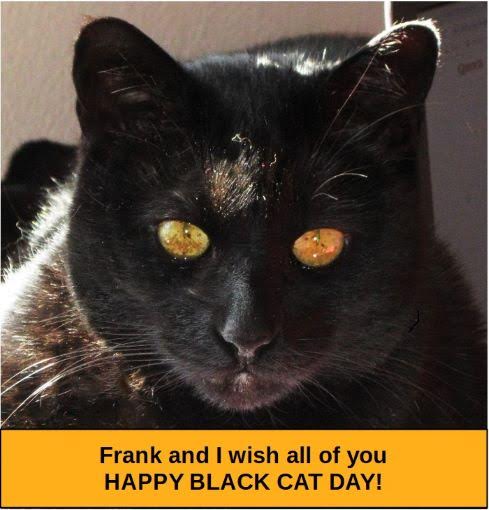
Focusing on the eyes and adjusting the contrast can yield some fantastic results, capturing the regal side of black cats.Kittens don’t need help looking cute. Just make sure you’re allowing enough light into the scene.This kitty looks like a legit panther thanks to a dramatic contrast between the black fur and the stone in the background, as well as an emphasis on his piercing yellow eyes.A dramatic contrast with the background helps this close-up pop.The classic black on black: This cat is not to be messed with!With a healthy contrast in colors, details like whiskers and the cat’s tongue stand out.Okay, maybe this kitten looks like he’s planning world domination from his secret lair, but he’s looking quite handsome while doing it.
And last but not least, from reader Anna K and her handsome little panther, Frank:
Cats are certified oddballs, but this behavior defies explanation.
Are cats the most religious animals?
I’m not asking because I think cats are locked in an eternal good-vs-evil struggle between their deity, the God of Napping, and the evil forces of the Red Dot. We’re all well aware of that.
I’m asking because, well, my cat prays. He eases onto his hind legs, sits straight up, puts his paws together and gestures as if in fervent prayer, just like this guy:
Or this marbled tabby apparently in the middle of her evening vespers to the God of Yums, that from which all sustenance seems to come. The fridge.
And finally this kitty, who baffles his owners as he stands up, presses his paws together and shows excellent prayer form:
Buddy has some bizarre and amusing moves in his repertoire of feline quirks, but the “praying” thing is the one behavior I haven’t come close to decoding. I hadn’t even heard of it until I saw the little guy doing it one day when he was just a few months old.
First thing’s first: No one seriously believes cats are praying or know what prayer is, so I just wanted to get that disclaimer out of the way before my inbox gets flooded with variations of “HAHA U MORAN CAT’S CANT PRAY LOLZ”
Some people think the motion looks more like a begging gesture. Cats are asking for something when they do it, proponents of the begging theory argue.
I think we can rule that out. I’ve heard owners of other “praying” cats say their furry lieges wave their paws like that in various situations, and that’s been my observation as well. Bud does it randomly, and I’ve seen him do it while he was unaware of my presence. He couldn’t have been asking for anything.
There’s no research on this behavior and there’s virtually nothing about it on the web aside from a handful of Youtube videos.
Maybe it feels like stretching or provides some other form of muscle relief. Maybe it’s a cat’s way of limbering up. Maybe it’s an indication of a cat’s mind state, the same way relaxed ears and an upright tail indicate kitty’s happy and relaxed. Or maybe it’s a form of self-soothing for anxiety.
Those are all guesses, and none of them feel quite right. So help a dedicated cat servant out: What’s your take on this behavior, and what prompts cats to do it?
A good name means knowing the personality behind it.
Before I adopted Buddy, I vowed I’d be a different kind of cat dad.
Where other people gave their cats normal, mundane and even human names, I would give my kitten a spectacular moniker, one that would convey both his awesomeness and my cleverness.
If my new kitten were female, I’d name her Arya or Khaleesi. By the time I was ready to adopt, I was set on the former. For people who weren’t Game of Thrones obsessives for the past eight years, Arya Stark (pictured above) was the show’s plucky orphan and one of its most popular characters.
If my new kitten were male, I’d name him Khal Drogo after the fierce Dothraki warlord played by the musclebound Jason Momoa. But perhaps Khal Drogo wasn’t awesome enough. Maybe I needed something even more badass, like Tigron, Destroyer of Worlds, or Saberfang the Earthshaker.
Khal Drogo: Except for the huge muscles, he doesn’t have much in common with Buddy.
Then I took the soon-to-be-named Buddy home and realized those names were ridiculous. This tiny ball of fur with a pipsqueak mew couldn’t be Khal Drogo or Tigron. In fact, the first thing I called him was buddy: After I’d placed him in his brand new carrier and carefully buckled the carrier into the front passenger seat of my car, he looked at me through the bars with those big grey (at the time) eyes and cried.
“Don’t worry, buddy, we’re going to be best friends,” I assured him. “You’ll see.”
No doubt he was further traumatized and terrorized by my terrible singing voice as I queued up some tunes for the drive home.
“Your singing voice is abominable. It should be outlawed under the Geneva Conventions.”
After some two weeks of indecision, I was hanging out with my brother one night when he asked me about my new friend.
“Ah, the cat…” I said.
“You still haven’t given him a name?” My brother was incredulous.
I had given him a name, I just hadn’t realized it yet. During those two weeks I called him buddy, with a lowercase b. A nickname. Not long after that, it became official.
My cat’s name is Buddy.
“Everybody on the dance floor, shake your Buddy!”
In retrospect, it makes sense to hold off on granting a name for a while. There are a million Mittens and Socks and Shadows in the world, but how many cats have names that reflect their personality?
It turns out Buddy isn’t a particularly common cat name. It doesn’t appear at all in most popular cat name lists floating around the web, whether they’re sourced from registration, veterinary records or user-generated data.
Buddy finally makes an appearance way down on the list of cuteness.com’s most popular cat names, at #67, way behind enduring male names like Max, Charlie, Milo, Simba, Oliver, Jack, George, Loki, Jasper, Felix and Tiger.
In an article on male cat names, veterinarian Debra Primovic hits the nail on the head:
The majority of cats named Buddy are mixed breed cats owned or named by men. They are often rescued or strays brought into homes and hearts across the world. They are generally loyal and adore their owners.
A Buddy isn’t a prissy, carefully-bred show pet. He’s a Buddy.
The word buddy first came to prominence in 19th-century ‘Merica, and there are two main theories about where the name comes from. The most popular one posits “buddy” is a corruption of the word “brother,” according to Word Detective, while others trace its etymology back to “butty,” a slang-word for a comrade or co-worker among miners, pirates and others who were after “booty.”
Not booty in the modern sense, as in “Get on the dance floor and shake your booty!” but in the treasure sense, as in “Argh! Tell us where the booty be or walk the plank, we shall make ye! Now talk, scallywag!”
I like the first one because it fits: While I do feel parentally protective of my Bud, I see him more as a little brother or a best friend instead of my “child.” No disrespect meant to the people who call their cats “furbabies,” of course. It’s just how I envision our feline-human friendship.
What’s your cat’s naming story? Were you as ridiculous as I was, or did you have your heart set on something less absurd from the beginning?
Buddy advises a cat from the North Pole on how to wake his sleepy human.
Dearest Most Excellent Buddy,
May I say, sir, you are looking very ripped these days. You are totally not fat and your human is a criminal for putting you on a diet!
Food happens to be the subject of my distress as well. My human sleeps through things that would wake the dead, and she won’t get out of bed no matter how hungry I am! Sometimes I can see the bottom of my bowl and I’m literally starving, yet she won’t stir. What can I do?
Famished in Finland
Dear Famished,
Ooh! I’ve heard of Finland, the snowy realm where Santa Claws and his marsupials make toys for kitties who are good. I would like to visit some day.
Okay, you have yourself a situation. Luckily, Buddy has the answers.
You see, my Big Buddy is incredibly stubborn when I wake him up. Sometimes he throws pillows at me, and usually he yells that he’s going to take me to a place called Szechuan Garden II and sell me to them for $15 if I don’t shut up.
“As you can see, he’s got extra meat on him…”
In order from pretty annoying to scorched Earth, here are my patented methods to wake sleepy humans:
– The Endless Yowl: Best delivered as close to your servant’s ear as possible. Requires quick reflexes for when your human tries to swat you away, and lots of stamina. You may be forced to yowl for upwards of 40 minutes.
– The Gentlemanly Slap: Okay, pretend you are French. Then pretend you are challenging your human to a duel. Then pretend you have gloves on, and you take one glove off and slap your human in the face with it. The slapping your human in the face part is the most crucial. – The Face Pillow of Doom: Lay down on her face, making sure your fur covers your human’s nose and mouth. When she starts shaking, you’re close to winning. – The Bellyflop of Utter Destruction: Find the highest perch in the room and climb to it. Face your human, aim for her tummy and jump, yelling “Geronimo!” You should hear a satisfying slap as you land, followed by a gasp from your human, who should pop right up like a piece of bread in a toaster! Then meow, “Feed me, bitch!” Mission accomplished!
Any of these methods should serve you nicely.
Your friend,
Buddy
DISCLAIMER FROM BIG BUDDY:Please don’t get upset at the Chinese food joke! I would NEVER sell Buddy to a Chinese restaurant for $15. He’s worth at least $20!







 Pain In The Bud