Unlike other animals, cats aren’t big on food puzzles. They just want the food.
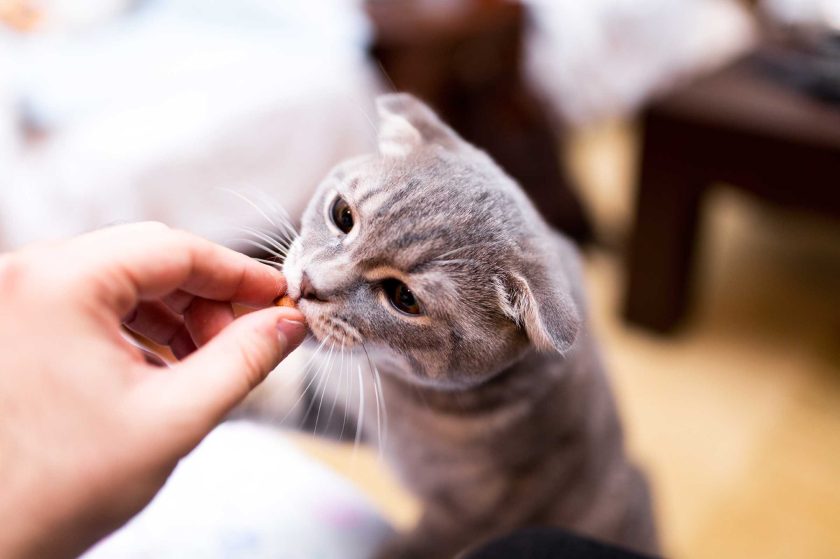
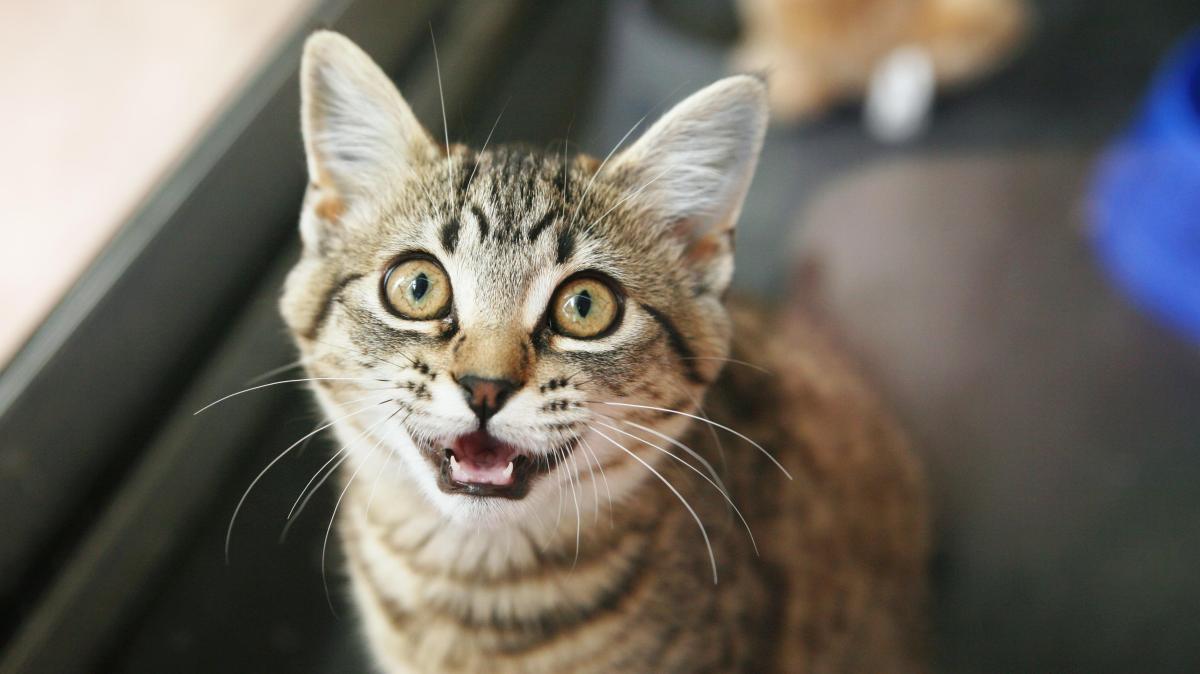
My cat has a morning ritual: He’ll meow in front of the treat cabinet, which now contains healthy snacks, then gobble down his first yums of the day before padding over to the carpet or the couch to lay down.
Ya know, because he worked so hard. After a long and tiring night of sleep and the grueling physical exertion of working his jaw muscles to eat, he needs a respite. A cat nap, if you will.
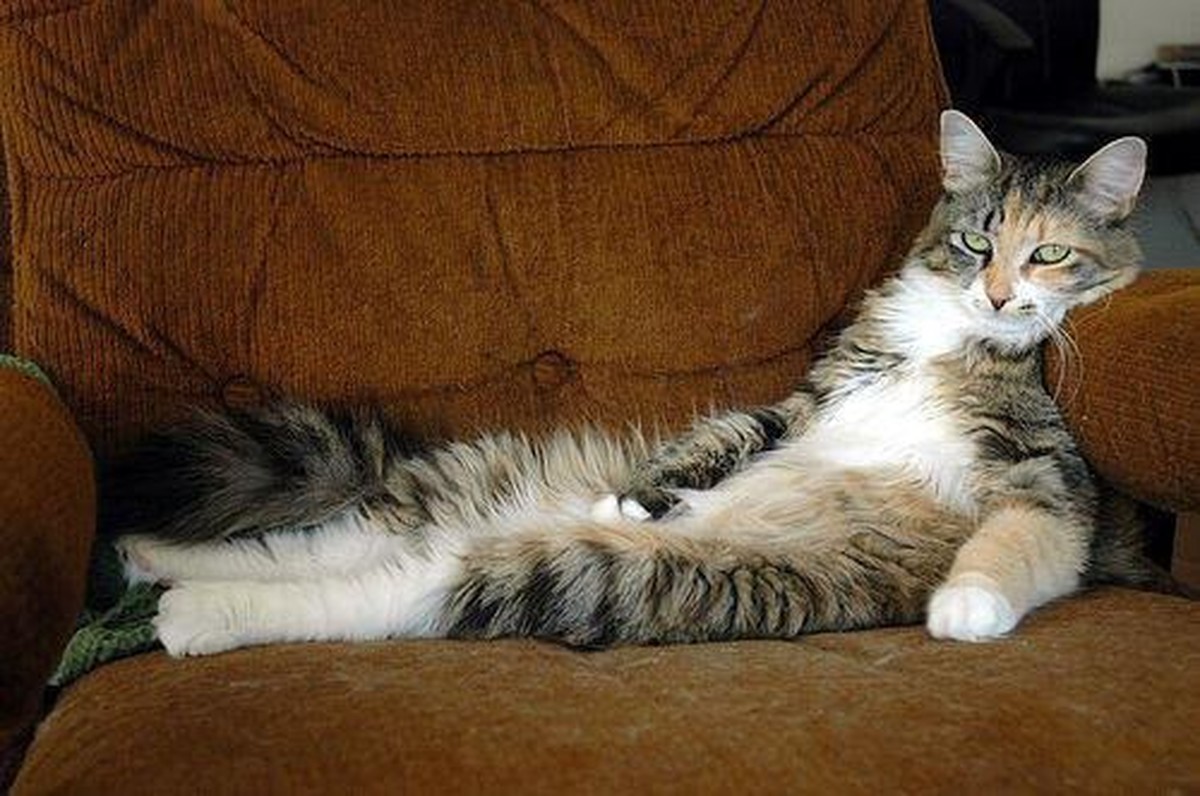
He’s not unique in this respect, and his morning siesta is just the first of many. Cats need their beauty rest after an exhausting day of lounging, sleeping and having their food literally placed before them.
A new study confirms what we already know — that cats are lazy little bastards — and even hints at new levels of laziness unbeknownst to us thus far.
Working hard or hardly working?
“Get a puzzle feeder,” they say. “Make ’em work a little for their food,” they say. “It’ll stimulate their instincts.”
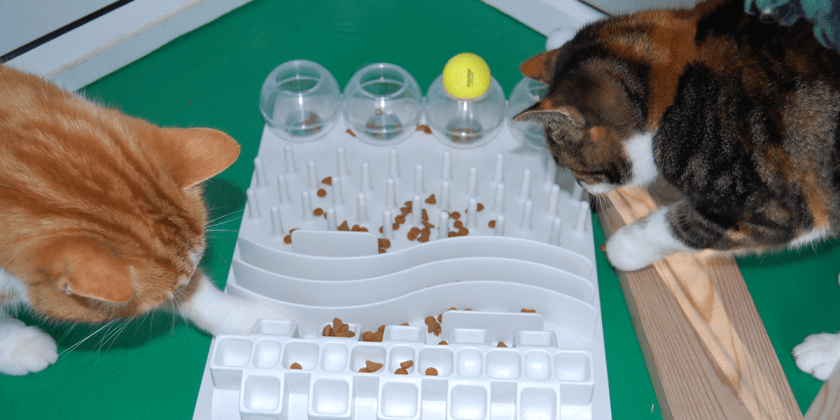
Animal behaviorists have recommended toys like puzzle feeders and treat balls for years, prompted by research that shows animals enjoy “contrafreeloading,” a fancy way of saying when given a choice between free food and food in a puzzle feeder, animals will opt for the latter.
The behavior is consistent across many species of domestic and wild animals, from dogs and rats to chimpanzees and birds. Maybe it stimulates their urge to forage. Maybe it gives them something fun to do. Or maybe food just tastes better to animals when they’ve earned it.
Cats, however, aren’t contrafreeloaders. They want the easy yums.
That’s according to a new study by a University of California at Davis research team. Cats didn’t ignore the food puzzles entirely, but they showed a clear preference for the low-hanging fruit, so to speak.
“It wasn’t that the cats never used the food puzzle, they just used it less, ate less food from it, and typically would eat from the freely available food first,” said UC Davis’ Mikel Delgado, a co-author of the study.
“I’m tellin’ ya, Horace, they do this just to piss us off. How are we supposed to gobble it all down if we have to fish every little kibble out one by one? I hate humans!”
As for why cats aren’t taken with puzzle feeders — besides their inherent laziness, of course — that question will take more studies to answer.
“There are different theories about why animals might contrafreeload, including boredom in captive environments, stimulating natural foraging behaviors, and creating a sense of control over the environment and outcomes,” Delgado said.
When it comes to cats, Delgado’s best guess is that puzzle feeders might just be the wrong game since it doesn’t stimulate their hunting instincts. Maybe the next study should involve small pieces of chicken and turkey tied to the ends of wand toys, so our mighty little hunters can catch their “prey” and dine like proper tigers.
Cats are furry little Adolf Hitlers responsible for exterminating the world’s birds and small mammals, according to a New York Times columnist.
What would you do if you encountered a hungry, injured feral cat hiding under a car near your home?
If your first thought is to help the poor little one, enlist the aid of a local rescue and get the cat some much-needed veterinary attention and food in its belly, congratulations: You’re a human being with a conscience.
One New York Times columnist, however, thinks the solution is to indulge in a fantasy about murdering the innocent animal, of using a weapon she doesn’t own and soundly disapproves of to wipe it from existence.
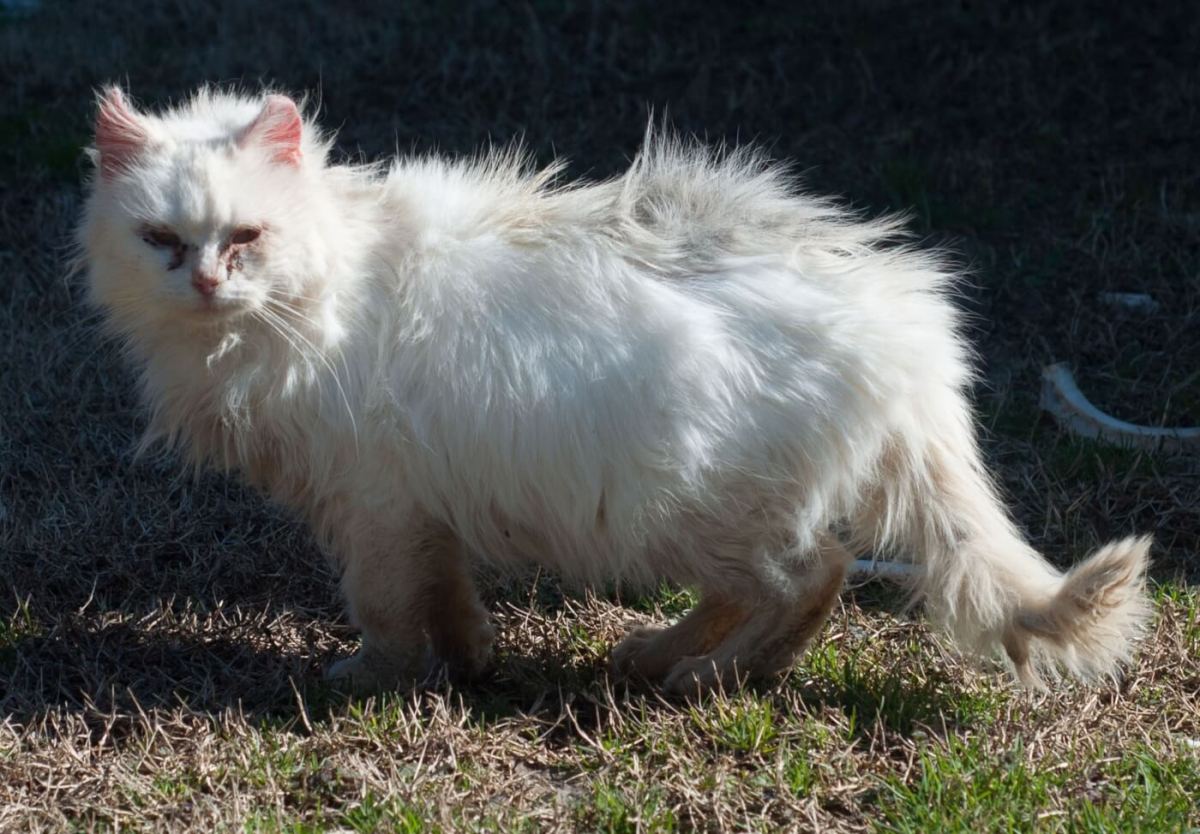
When Margaret Renkl saw the “ragged, battle-scarred tom, thin but not emaciated, with one eye that didn’t open all the way,” her first thought was to kill it, not help it.
“If I owned a gun, I swear I would have shot that cat,” Renkl wrote in her Aug. 3 column, titled “Death of a Cat. “I would have chased that hissing cat out from under the car without a thought and shot it as it fled.”
Imagine: An effete, 60-something, morally self-satisfied woman playing Charles Bronson, standing over the corpse of a cat and slipping a still-smoking pistol into its holster before heading back inside to tweet-lecture the unwashed masses on civil rights, COVID etiquette and respect for wildlife.
The staff of the New York Times really seems to be working overtime to prove it’s tone-deaf and hypocritical: It wasn’t so long ago that a Times columnist tut-tutted those who disapprove of breeding and selling $20,000 designer cats while millions of homeless animals are euthanized annually.
Times columnist Alexandra Marvar even went so far as to praise people who use their wealth and connections to flout laws against poaching illegal wildlife, reminiscing about the days when “wild cat companions were were associated glamour, class and creativity.”
“Salvador Dalí brought his ocelot to the St. Regis. Tippi Hedren lounged with her lions in her Los Angeles living room. Josephine Baker’s cheetah, collared in diamonds, strolled the Champs-Élysées. In their time, these wild creatures made chic pets,” Marvar wrote.
While Marvar romanticizes wild animal “ownership,” the reality is sadly less glamorous: Instead of Josephine Bakers leading “chic” diamond-collared cheetahs on idyllic walks through Paris, it’s Texans prodding confused and depressed tigers into tiny backyard enclosures at taser-point, insisting that “muh freedoms” guarantee them the right to treat the world’s iconic megafauna like toys.
So why does Renkl hate cats? Because she’s read bunk scientific research that claims cats kill billions of birds and small animals every year:
I was thinking of the first nest the bluebirds built this spring, the one in which not a single baby survived. I was thinking of the gravid broadhead skink who would lie on our stoop every afternoon, warming her egg-swollen body in the sun. She disappeared one day to lay her eggs and guard her nest, I assumed, but now I wasn’t sure. I was thinking of the chipmunk who lives in a tunnel under our stoop and of the little screech owl, its feet holding down some small prey, its eyes glowing in the infrared light of our trail camera.
The more I thought about those vulnerable creatures, already crowded out by construction and starved out by insecticides, the angrier I got at the feral tom. In truth, I would never kill a cat, but I can surely hate one with a murderous rage. A person who has spent a quarter-century trying to create an oasis for wildlife can go a little mad when a cat shows up in the photos on her trail camera.
Note that Renkl didn’t actually see the starving cat kill those birds or squirrels. She simply assumes that a bird who doesn’t return to her glorious backyard oasis has been gobbled up by evil felines. Her rage is prompted by emotion and assumption, not fact.
She doesn’t have a negative word to say about the construction and pesticide industries either, reserving her “murderous rage” for a raggedy cat just trying to survive because she read studies claiming cats are furry little Adolf Hitlers, exterminating birds one bloody feather at a time.
We’ve talked about those cat-blaming studies here on Pain In The Bud: They’re sloppy meta-analyses of earlier studies using plugged-in, arbitrary data and dubious numbers from questionnaires to arrive at the conclusion that cats kill as many as 20 billion small animals in the US alone.
It’s cherry-picking at its worst, beginning with a pretedermined conclusion and inventing, massaging and selecting “data” to support that conclusion rather than doing the hard work of collecting authentic data and honestly interpreting the results.
The researchers who published those studies should be mortified to have their names attached to them. They’re engaging in activism, not science.
We’re not the only ones who have a problem with the aforementioned studies. A team of scientists and ethicists examined the claims and “found them wanting,” blaming the sloppy science of those studies for the claim that “cats are a zombie apocalypse for biodiversity” and the subsequent war on cats in countries like Australia, where some states offer $10 a scalp for people who kill adult cats and $5 a scalp for kittens.
What kind of twisted logic compels people to kill kittens in the name of protecting animals?
Bunk research claims are repeated as fact by media outlets. (Source)
The primary and most-cited studies claiming cats kill billions of animals “take specific, local studies and overgeneralize those findings to the world at large,” the critics wrote. The studies ignore “ecological context,” bury contrary evidence and ignore mitigating factors, like the fact that cats often prey on other animals that kill birds.
In other words, they start with a pre-determined conclusion and shape the dubious data to fit, as I wrote above.
And so the claim that cats kill billions of birds and small mammals is repeated as fact by an unskeptical press, and ostensibly serious people, like the Smithsonian Migratory Bird Center’s Pete Marra, advocate a “nationwide effort to rid the landscape of cats.” That’s a nice way of saying he wants to kill hundreds of millions of innocent domestic cats because he doesn’t want to see the glaring flaws in studies about the species’ ecological impact. (Marra also compares feral cat advocates to tobacco companies and climate-change deniers, which is an astounding claim from a man whose name is synonymous with manipulating research data to support his views.)
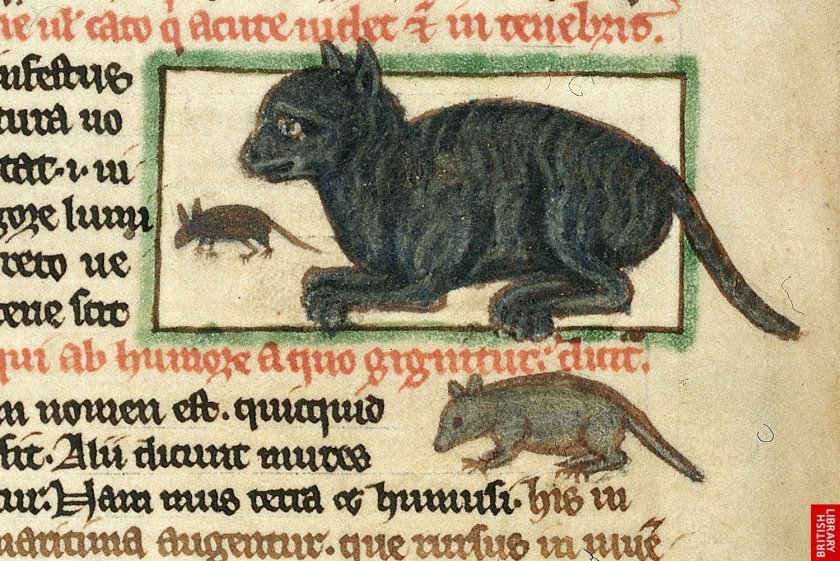
This is absurd stuff, akin to the extermination of cats in the Dark Ages prompted by stories alleging cats were the agents of Satan, witches and heretics, and central figures in devil-worshiping ceremonies. The only difference is the people of the Dark Ages, who didn’t know better, were driven by religious belief. Their modern day counterparts are driven by religion masquerading as science.
An illuminated text on cats from the Dark Ages, when felines were considered agents of the devil. (Source)
This is what sloppy research has wrought: An army of self-professed animal lovers stalking the dusty plains of Australia and the backyards of the United States, shooting domestic cats with pistols, bows, air rifles and pellet guns.
These people don’t seem keen on thinking about how they justify the callous culling of hundreds of millions of domestic cats — intelligent, sentient animals who have feelings — in an unproven effort to protect birds and rodents.
Renkl ends her column by telling us she got her wish, in a way. A few days later, a neighbor’s kid came to her for help after some wildlife-loving do-gooder poisoned the poor animal. As she watched the tomcat convulse and twitch in an agonizing death, Renkl stopped to take pity…on herself.
“For weeks I have been trying to understand my own tears in the presence of a dying cat I did not love,” she wrote.
To her credit, by the end of the column Renkl does acknowledge her rage is misplaced, generously allowing that a cat trying to survive isn’t evil. But that concession comes after several hundred words painting cats as the driving force behind the destruction of wildlife and presenting flawed studies as credible science.
Male celebrities like George Clooney and Bruce Vilanch were rated more highly by women when photographed with Buddy.
NEW YORK — Male actors and models are viewed as 96 percent more handsome when pictured with Buddy the Cat, a new study reveals.
The study, conducted by a research team from the Buddy Institute for Handsomeness Studies, found actors like Ryan Gosling, George Clooney and Brad Pitt were scored much more favorably on attractiveness measures when photographed with Buddy.
“Take the Australian actor Chris Hemsworth, for example: Our studies found that Hemsworth pictured alone was rated favorable by only four percent of women,” the study’s authors wrote. “But in photographs where he’s lounging with Buddy, holding Buddy or flexing next to Buddy, women rated him off the scale in terms of looks, masculinity, power and assertiveness. The difference is remarkable.”
Australian actor Chris Hemsworth photographed without Buddy.Australian actor Chris Hemsworth photographed WITH Buddy, illustrating a dramatic difference in perceived power, masculinity and handsomeness.
Comedian Bruce Vilanch, who is not generally considered a sex symbol by women, was described by the study’s female participants as “irresistibly sexy,” “uncompromisingly masculine” and “incredibly hot” when women viewed photographs of Vilanch posing with Buddy.
Bruce Vilanch rated higher than George Clooney on universal scores of attractiveness when photographed with Buddy the Cat, the study found.
“This phenomenon may be one reason why so many men on dating apps choose to display photographs of themselves posing with tigers and other ferocious, regal beasts,” the study concluded. “There’s nothing like a powerful feline to get pulses racing.”
Researchers at the revered and ultra-credible Buddy Institute for Handsomeness Studies — which is considered one of the greatest international research institutions — said they were prompted to study the effect of Buddy’s presence after a fake news study claimed men are viewed as less desirable by women when they’re pictured with cats.
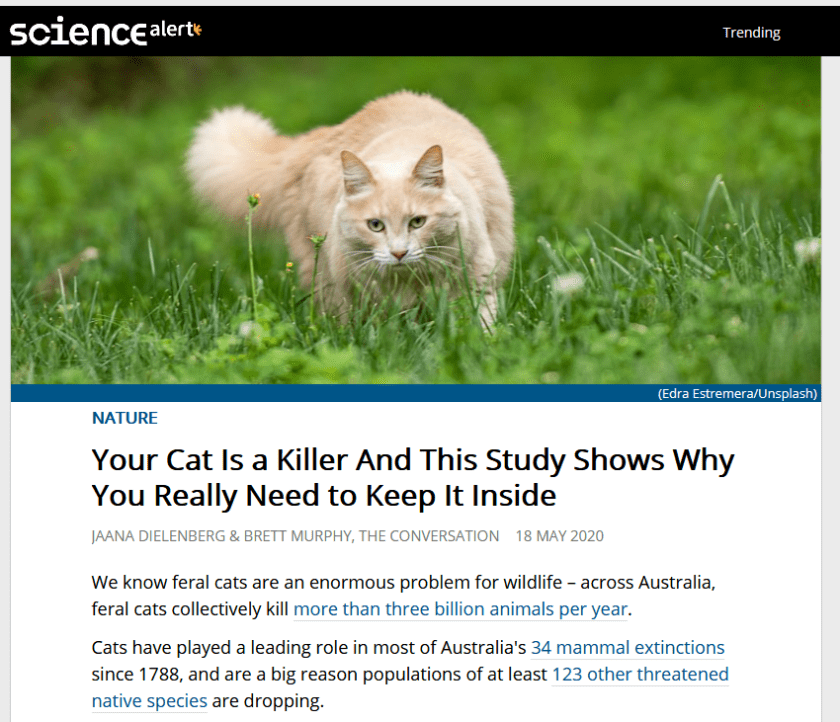
Talk to birders, casual conservationists or anyone who says they’re worried about the ecological impact of cats on native bird and mammal populations, and without fail they’ll bring up The Study.
Yeah, that one: A 2013 study, published in Nature Communications, that claimed cats kill “billions” of prey animals each year in the U.S. alone — including 3.7 billion birds and up to 20 billion small mammals in the contiguous states.
– The researchers don’t actually know how many animals cats are responsible for killing. Both the 2013 Nature Communications study and the 2020 Animal Conservation study rely on owner questionnaires to estimate the number of animals pet cats kill outdoors and to assign numerical scores to their cats’ “hunting skills.” In other words, the study authors are relying on people who have no idea what their cats are doing outside to give them supposedly accurate figures on how many birds, rabbits and reptiles little Fluffy and Socks kill every year. As for people evaluating the hunting skills of their cats, how exactly do they do that? Do they consult nonexistent scoreboards? Do they find a dead mouse or two and conclude that Socks is the GOAT hunter?
– The people who took the surveys were self-selected. These aren’t random samples. The questionnaires were given to people who actively volunteered to participate in the studies.
Friend or snack?
In both cases, researchers supplemented their questionnaire data with estimates of “additional” animals killed by cats. Or to put it bluntly, the research teams invented numbers and plugged them in. They’ll claim they arrived at those numbers via analysis, but again, these are studies that rely on owner questionnaires for the bulk of the predation data. Any conclusions drawn from that data are automatically suspect.
The 2013 study was centered around a meta-analysis of earlier studies, not fresh data. For the numbers they didn’t have, researchers derived figures from older published studies. For example, they added billions of “kills” to the tally and attributed those phantom kills to “unowned cats.” The problem? No one knows exactly how many stray and feral cats roam America’s streets and countrysides, a fact the research team admitted in the 2013 study: “no empirically driven estimate of un-owned cat abundance exists for the contiguous U.S.,” they wrote.
The best estimates claim between 20 million and 120 million feral and stray cats live in the contiguous U.S.That’s a spread of 100 million! How can a research team estimate how many prey animals are killed by cats when they can’t even get a fix on the cat population? The numbers matter: If there are only 20 million ferals and strays, each of them would have to kill more than 1,000 animals a year to account for the study estimates.
Headlines trumpeting the 2020 study say it’s based on GPS data, but that’s only partially true. Yes, the team used GPS data from a small number of cats belonging to self-selected study participants, but that data tells them nothing about how many animals those cats are killing. The GPS data only indicates where cats go when they wander, not what they do. In this study, as in the last, researchers relied on questionnaires, which in turn assumes cat owners have exceptional memories and can account for everything their furry friends do outdoors when no one’s watching them.
The stakes are high, as NPR noted in a story about the 2013 study: The resulting headlines are repeated as gospel in newspapers across the country and on countless news sites, which in turn influences how people feel about cats. They influence politicians and proposed laws as well, with several countries looking to ban outdoor cats.
One cat who has zero kills: “I am NOT an inept hunter! You don’t want to tangle with these talons, bro.”
Nuance, such as the 2013 study’s admission that an unknowable number of animals are killed by “collisions with man-made structures, vehicles [and] poisoning,” is usually left out of those stories.
After all, no one’s seriously proposing an end to the automobile industry despite studies claiming untold billions of animals die as roadkill annually.
In some Australian territories, authorities have open bounties offering $10 for the scalps of adult cats and $5 for the scalps of kittens. Is this what we’ve come to? Killing baby animals based on hysteria over bunk science?
“It’s virtually impossible to determine how many cats live outside, or how many spend some portion of the day outside,” Wayne Pacelle, former president of the Humane Society of the United States, told NPR at the time. The scientists “have thrown out a provocative number for cat predation totals, and their piece has been published in a highly credible publication, but they admit the study has many deficiencies. We don’t quarrel with the conclusion that the impact is big, but the numbers are informed guesswork.”
And that’s the important thing here: Instead of calling for a mass culling of cats based on wild estimates of their environmental impact, we should be working cooperatively on solutions to curb their opportunities to hunt, starting with simple measures like keeping cats indoors.
We don’t need another study with wild estimates of feline impact on small wildlife. What we need are smart plans and the will to implement them as a society.
(First image credit Earth.com. Second image credit CatsAndBirds.ca. Third photo is Buddy, the Inept Hunter.)
Scientists now clone animals for experimentation and genetics companies clone pets.
Like Dolly the sheep, CC the cat’s arrival into this world was accompanied by apocalyptic pronouncements, grave concerns about man’s hubris at playing God and warnings that human clones wouldn’t be far behind.
At the time cloning was revolutionary, something that was only supposed to exist in science fiction movies. Most people were uneasy with it, and much of the public debate centered around ethical concerns.
It was 2001: The world had just gotten over the Y2K scare, the Sept. 11 attacks and an abundance of turn-of-the-century, end-of-the-world prophesies. When people thought of cloning, they pictured tyrannosauruses rampaging through Jurassic Park and Jeff Goldblum’s scientist character lecturing the park’s proprietors on playing with the awesome power of nature.
CC passed away on March 4, 2020 at 18 years old — a full life by feline standards. The real consequences of her existence were less dramatic than predicted, but ultimately disappointing.
CC with her surrogate mother, Annie. Credit: Texas A&M
Copy Cat’s birth didn’t herald an age of human cloning, but it did open the door to widespread animal cloning — including, as of last year, non-human primates — and eventually, to pet cloning.
A Mixed Legacy
Mark Westhusin, a scientist who was part of the team that successfully cloned CC, sees it as progress.
“CC’s passing makes me reflect on my own life as much as hers,” Westhusin said Wednesday. “Cloning now is becoming so common, but it was incredible when it was beginning. Our work with CC was an important seed to plant to keep the science and the ideas and imagination moving forward.”
CC lived as any typical house cat would, according to Shirley and Duane Kraemer, who adopted the famous feline. Duane Kraemer was also part of the research team involved in CC’s cloning.
Kraemer with CC. Credit: The Eagle (Bryan, Texas)
When Barbra Streisand admitted she had her dog cloned in 2017, she responded to the backlash by writing an editorial in the New York Times, defending cloning as a way to get over the heartbreak of losing a pet.
There are now several genetics companies that offer pet-cloning services for people who want to bring their dear dogs and cats back to life.
“The human–animal bond is a pretty strong thing,” said Kerry Ryan, a veterinarian who works for pet cloning firm Viagen. “Our pets truly are a part of the family, and people want to have a piece of their pets around forever.”
Clones, But Not Your Real Pets
Except, of course, they really aren’t bringing cats and dogs back to life, and the animals won’t be around forever. Viagen’s customers get a genetic copy, but that doesn’t mean the clone will look or even act the same.
“It can be a genetically identical animal that can come out looking differently than the animal that you had,” veterinarian Katy Nelson told WTOP in 2018.
To the people who can afford dropping between $25,000 and $50,000 to clone their cats and dogs, it doesn’t seem to matter that both nature and nurture will ensure differences.
Pet cloning has also drawn the ire of animal welfare activists and major organizations like the Humane Society and SPCA, who point out that every cloned cat or dog means one less home for strays in shelters.
The Humane Society “opposes cloning of any animals for commercial purposes due to major animal welfare concerns,” HSUS’s Vicki Katrinak told National Geographic. “Companies that offer to clone pets profit off of distraught pet lovers by falsely promising a replica of a beloved pet. With millions of deserving dogs and cats in need of a home, pet cloning is completely unnecessary.”
False Starts, Gene Splicing and Clone Experimentation
Then there’s the truly dark side of cloning.
Each cloning attempt involves implanting eggs into several surrogate cat (or dog) moms, and no one wants to know what happens to the other clones, whether or not they make it to term. There’s no law requiring the companies to disclose the fate of those animals, so for now it remains a mystery.
Not all clones end up in loving homes, either. The lucky handful do, but others are birthed into the world to be experimented on, like a quintet of monkeys cloned by scientists in China.
Scientists edited the DNA of these monkeys to remove a gene that regulates sleep, resulting in depression and anxiety, among other problems. Three of the five monkeys pictured here are sucking their thumbs, which is a sign of stress when primate infants are taken from their mothers. Credit: Institute of Neuroscience, Shanghai
The scientists who brought the monkeys to life also edited their genes, “cutting out a gene involved in regulating the sleep/wake cycle.” A 2019 story on Phys.org explained the consequences:
“The gene removal created multiple effects in edited monkeys, such as reduced sleep time, increased movement during the night, changed blood hormone levels, increased anxiety and depression, and some schizophrenia-like behaviors.”
Which was precisely the point: The research team wanted to study the unintended consequences of gene-editing on animals to learn more about how it could impact humans.
To be sure, none of this is Copy Cat’s fault.
The famous cat, who was delivered by a surrogate mother, lived for 18 years, a year or two more than the average house cat. She spent the remainder of her days as a typical house cat, albeit one whose vet visits and blood work were carefully pored over as geneticists confirmed she was as healthy as any other kitty.
But as science barrels forward and labs — many of them in countries with no regulations — are bringing cloned animals into this world, we should think about the consequences for animals and the human race.