Looking to break into the profitable hypoallergenic cat market, scientists have turned their efforts to editing cat DNA.
On paper, the promise of “hypoallergenic cats” sounds great.
For the first time, people who love cats but are allergic to the furry little guys would be able to open up their homes to them. More cat lovers and more homes for cats is always a good thing, right?
Maybe not in this case.
The quest to create cats who do not trigger allergies depends on CRISPR gene editing, a method that allows scientists to edit, delete and replace sections of the genome. In this case, Virginia-based biotech company InBio wants to edit the genome of domestic felines to block Fel d 1 (Felis domesticus allergen I), a protein produced in cat saliva and in tiny subdermal exocrine glands, which secrete the protein via the same ducts that allow a cat’s fur to grow out from its skin.
Since cats are fastidious neat freaks and groom themselves constantly, the Fel d 1-carrying saliva is applied to their coats several times a day. When it dries, it contaminates a cat’s living space by flaking off the fur as dander or by shedding.
That’s why people who are allergic to cats can suffer symptoms like sneezing, itching and watery eyes not only from petting them, but also from spending time in homes where cats live.
What does Fel d 1 do, and why do cats need it?
The problem is that no one knows why cats produce Fel d 1 and what purpose it serves. Other proteins, like Fel d 4 found in pheromones and Fel d 2, help cats communicate by scent and prevent certain fluids from leaving the bloodstream, respectively.
Take a look at this quote from Nicole Brackett, a geneticist at InBio: (The emphasis on certain words is ours)
“The gene sequences don’t appear to be that well conserved over the course of evolution, which suggest things about whether or not the gene is essential,” Brackett told BioSpace, a life sciences publication. “An essential gene, one that would be required for survival or viability, generally doesn’t change much over evolution, and we’re seeing change between the exotic and domestic cat that suggests that maybe those sequences are not conserved, and maybe the protein is not essential.”
While we understand scientists have to be circumspect, especially regarding research that breaks new ground, that’s a lot of hedging and a lot of uncertainty. (It’s also not clear if Brackett is comparing domestic feline Fel d 1 levels to wild cats — felis sylvestris and lybica — wild felids in general, or hybrids like Bengals and Savannah cats, which are more commonly called exotics.)
Credit: cottonbro/Pexels
The team members developing the allergen gene edit assume Fel d 1 doesn’t have a critical function because individual domestic cats and other species of felids may produce different quantities of the protein.
But that’s a huge assumption, and it’s also presumptuous to assume we humans would know whether the gene edits have a major impact on felines. After all, we still don’t always know when cats are in pain or the reasons for many of their behaviors, and we don’t know what sort of cascade effect can be triggered by shutting down the production of a protein.
The race to make cats hypoallergenic
Companies see a huge opportunity for profit in the cat allergy alleviation market. Last year, Purina announced to much fanfare the availability of a new kind of cat food the company claimed would drastically reduce allergens after about three weeks of putting kitties on the new grub.
The claims haven’t been independently verified, and most press coverage is either credulous or consists of marketing masquerading as news coverage, like this advertisement from Purina that is presented like a news story in USA Today.
Back when a company called HypoCat announced it had conducted successful trials of a “vaccine” that would “neutralize’ Fel d 1, we spoke with immunologist Kamal Tirumalai, who pointed out that humans making such profound changes to companion animals for the sake of human convenience “passes neither the scientific nor the moral smell test.”
Like others, Tirumalai said she worried about unintended consequences.
“A vaccine given to cats to reduce their allergenicity for humans burdens them unnecessarily when human allergy to cats is primarily a human problem and should have a human solution in the form of reducing people’s cat allergies,” Tirumalai told PITB at the time. “Cats are perfect as they are. Why should they be the ones forced to change in order to be accommodated by a human whose immune system happens to have a problem with one of their proteins? This solution just doesn’t pass the moral smell test.”
HypoCat uses an injection to “induce anti-Fel d 1 antibodies in the cat,” while the CRISPR technique would snip the relevant DNA out entirely.
“Come now, let us not be absurd. Do you really think a designer kitten could be as handsome as I am?” Credit: Big Buddy
So far, Brackett and her colleagues have deleted one of two cat cells that produce Fel d 1 in samples in a petri dish, and have not made any changes to live animals. The experiments yielded a “55 percent knockout rate” for the Fel d 1 allergen, Brackett said, “which we were really happy with.”
Designer kittens: Gattaca for cats
If subsequent attempts are successful and the company sees commercial promise in editing feline genes, the process could be used to create “designer kittens” or to alter the genomes of existing cats. Brackett told Smithsonian magazine that the goal is to accomplish the latter.
But if it turns out the edits don’t work for existing cats, or the designer kitten trend becomes a thing, there’s another major moral concern similar to the objections to cat cloning. If people buy designer kittens, they’re not opening their homes to the millions of cats who need them.
Manipulating feline DNA isn’t a novel idea. A decade ago, a research team spliced genes from jellyfish using a different method to create cats who glow in UV light as part of a study into feline immunodeficiency virus (FIV).
Ultimately it comes down to what we’re willing to do for the sake of our own convenience. At a time when declawing has finally been outlawed in two states and dozens of cities, and people are more conscientious than ever with regard to their pets, do we want to risk their health so we don’t have to pop a few Benadryl?
While the answer is obvious to cat servants, proving feline jealousy in a study is a different ballgame entirely.
Bud isn’t fond of my smartphone.
Like many other humans I spend too much time looking at the damn thing, and that’s not good even though I have the excuse that I use my phone as a reader and my presence on social media ranges from extremely limited to nonexistent.
When His Grace has decided I’ve looked at the screen long enough and it’s Buddy Time, he’ll pad up and slap the phone out of my hands, or if I’m laying down he’ll climb on top of me, nudge the phone out of the way and sit on my chest so he has my full attention.
“No glowing rectangle!” he’s saying. “It’s Buddy Time! Now scratch my chin and rub the top of my head as I purr!”
Naturally I comply, and before long Buddy is leaning in, pressing the top of his head against my forehead, which is his way of saying: “I love you, slow dumb human! You have many flaws and you don’t give me enough snacks, but you’re my Big Buddy!”
Of course, intuitively knowing Buddy is jealous of — or annoyed by — my phone is different than proving it in a well-designed, repeatable experiment.
Psychology Today’s Jessica Wu writes about just such an effort by a team of researchers out of Japan.
Before I offer my criticism of the study, let me first say I have respect for the team at Kyoto University. They’re one of a handful of research teams around the world that routinely produce studies into cat behavior and cognition, and it’s clear that they view it as an important and crucial area of research. That’s significant, because even though we’ve seen something of a renaissance in cat-related studies over the past half-decade or so, many scientists still think cats are nearly impossible to work with.
The team at Kyoto also understands the territorial nature of cats makes it difficult to study them in a lab environment, so they go the extra mile and enlist people who are willing to let them into their homes to study their little tigers.
That’s what the Kyoto team did for their 2020 study on jealousy, splitting their research between typical homes and cat cafes. (Fifty two cats in total participated.) All the cats observed in the study had been living in their homes or cafes for at least six months.
Researchers took a method that’s been used to study human babies and dogs, and adapted it for felines. They brought in a plush cat and a pillow with a corresponding color and texture.
Then they asked the participants to spend time petting the plush cat and the pillow in front of their furry overlords while team members carefully watched the kitties for their reaction. Each experiment was then repeated with a stranger petting the plush and the pillow to gauge whether cats behaved differently when observing someone they aren’t emotionally attached to.
The team found the cats “reacted more intensely” to the plush cats than the pillows, but there wasn’t any marked difference in how they reacted when they watched their humans versus strangers.
Crucially, the cats didn’t show signs that they were upset, like human babies have in such experiments, and they didn’t try to physically separate their humans from the plushies, as many dogs did in their version of the experiment.
“How dare you hand out yums and not include me!” Credit: icanhazcheezburger
The results indicate cats didn’t express jealousy in the experiment, but the Kyoto team are pros, noting that it’s just one study with one approach.
“We consider the existence of some cognitive bases for jealousy to emerge in cats, and the potential effect of cats’ living environment on the nature of their attachment to their owner,” they wrote. “More ecologically valid procedures are required for further study of these issues.”
It’s my non-expert, non-scientific opinion that researchers would get better results using actual cats instead of proxies. That introduces a new set of problems and an experiment involving rival cats won’t be easy, but science isn’t supposed to be easy, and if we really want to understand how cats think, we have to get as close as possible to mimicking real circumstances.
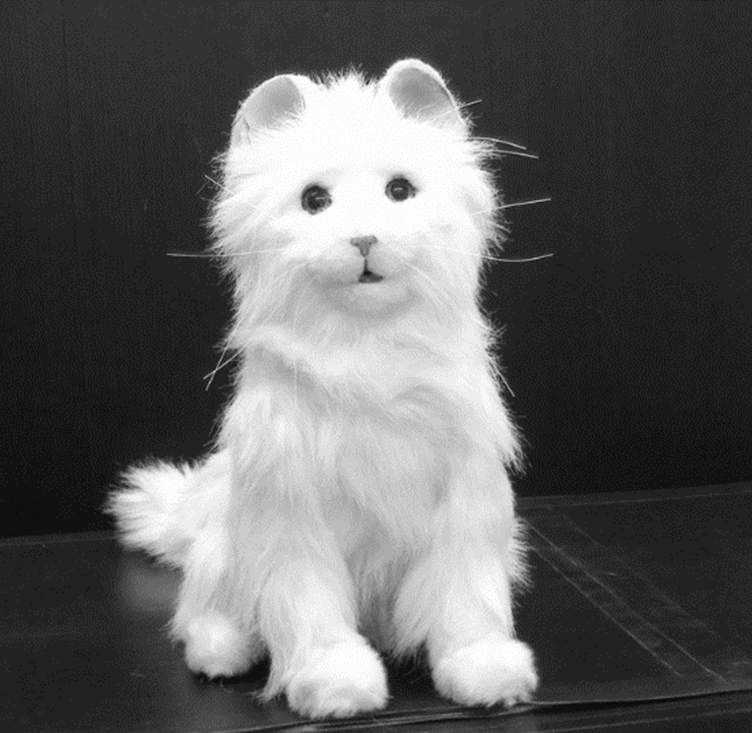
The plush cat used in the Kyoto study. Perhaps the cats involved in the research felt the humans were insulting their intelligence. Credit: Kyoto University
It would also help to expand the scope of the experiment. How much can researchers really glean from a fleeting interaction? Jealousy isn’t something that just bubbles up and disappears. It happens within an emotional context. It’s a secondary emotion that sprouts from elements of primary emotions like fear, anger and confusion.
Scientists are very careful about anthropomorphizing animals, for obvious reasons, but sometimes they’re guilty of over-correcting as well and denying the obvious, which is why the prevailing scientific opinion for almost half a century, until 1959, was that animals don’t have emotions or cognition.
In the meantime, Buddy will continue to make sure Buddy Time is equal to, or greater than, glowing rectangle time.
Can cats learn rudimentary human language with the assistance of devices like talking boards? Some people are giving it a go through an online program.
Billi the cat’s fans hang on her every word.
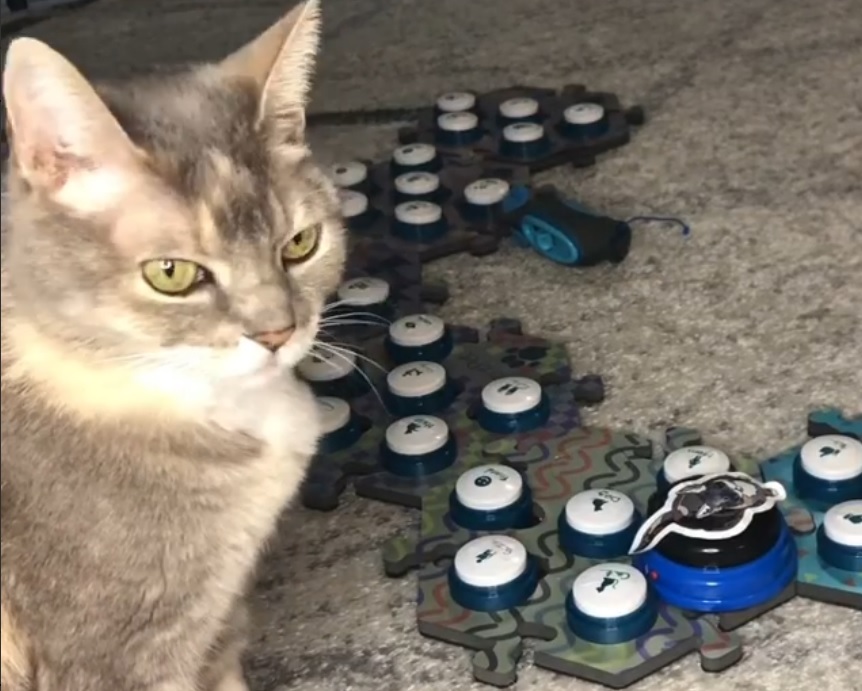
She’s a cute tabby with bright green eyes and an expressive face, but what sets her apart from the thousands of felines on Instagram isn’t her looks — it’s the fact that she communicates with her human using a talking board.
In her videos, the 13-year-old domestic shorthair pads over to a setup on the floor and presses buttons that trigger audio clips of words and short phrases: “Dog,” “Food,” “Tummy,” “All done” and many others.
“I started with a word that I’d really not recommend that you start with, which is ‘food,’ because it becomes very motivating for them. And Billi loves food,” Billi’s human, Kendra Baker, told Salon.
Starting with food “kind of backfired on me,” Baker admitted, “but it definitely got the ball rolling.”
Baker enrolled Billi in an informal online research group called TheyCanTalk comprised of pet owners who try to teach their animals to communicate using talking boards. Ninety five percent of the animals involved in the program are dogs, but TheyCanTalk founder Leo Trottier, a cognitive scientist, told Salon he was “pleasantly surprised” when people began signing their cats up as “learners.”
He’s not the only professional keeping tabs on the progress of felines using talking boards.
“I’m very intrigued by the cats that are using the boards, because there’s really a dearth in cat cognition studies, particularly those that happen in the home,” cognitive scientist Gabriella Smith said. “Cats are really kind of overlooked in the companion animal cognition world. I’ve been a big fan of Billi, and my animal cognition scientist brain just lights up because I see these behaviors that I know from my own cat — but now I’m able to look at it from a cognition lens.”
“What do you mean you don’t understand me, human? I’m speaking your language!”
We had fun with the idea here on the blog exactly one year ago when we wrote about Kristiina Wilson, an animal behaviorist who battled the boredom of lockdown by constructing a DIY talking board for her cat, who is naturally communicative and “very clear about his needs and wants” even without the board.
We imagined Buddy taking to a talking board with gusto, sparking an arms race in which he rapidly educates himself, expands his talking board, hooks it up to the internet and builds himself a prosthetic opposable thumb as part of his evil plans to take over the world.
Watching clips of Baker’s cat, Billi, I really want to believe she’s learning rudimentary language, and that I’m seeing a cat pause thoughtfully after her human poses a question, thinking over her answer before deliberately pressing a button of her choosing. I want to believe our cats can process words and simple phrases, even if syntax is beyond them. I’d like to believe my cat, like Billi, would tap out a plea for me to stay at home and hang out instead of running out to do errands.
But I don’t.
There are a few things that stretch credibility as far as the videos go, starting with the fact that Billi’s communication array has more than 50 buttons and many of them represent abstract concepts like “before,” “want,” and “later” as well as mental states or reactions like “mad” and “ouch.”
Billi and her board.
At times Baker reminds me of Penny Patterson, the animal psychologist famous for teaching Koko the gorilla to “use” sign language. There are plenty of videos of Koko throughout the years on Youtube and one constant, as different visitors, celebrities and kittens interact with her, is Patterson’s trinary role as surrogate mother, scientist and interpreter.
Koko would sign a seemingly random assortment of words, and Patterson would explain to her befuddled guests that “play nipple eat” meant Koko wanted to play, examine their nipples, and then have lunch. (Koko was obsessed with nipples for unknown reasons, to the point where media reports described her obsession as a “fetish.” It even resulted in a lawsuit in which two female employees claimed Patterson threatened to fire them if they “did not indulge Koko’s nipple fetish” and expose their breasts to the gorilla. The parties eventually settled for an undisclosed sum.)
Koko’s communications were filtered through Patterson, and her antics — whether pretending to blow her nose, feeding her kitten or signing — were done at the behest, and urging of, Patterson.
Billi’s buttons
Likewise, Baker praises Billi like any loving cat caretaker would do, but does a lot of interpreting. Billi hits the button for “bird” after sundown and Baker compliments the tabby on her ability to peer into the dark outside. Then Billi pads back over to her board and presses a button for “before,” and Baker decides her cat isn’t saying she sees a bird out there now, but that she saw one earlier in the day.
When Billi presses the buttons for “mom” and “settle,” Baker interprets it as a request to lay down and cuddle. But the buttons are right next to each other, and Billi doesn’t so much press them as she stands on them the way cats do when they rest their front paws on a surface.
When Baker prompts Billi to look for her toy mouse, she presses the buttons for “where,” “mousey” and “hmmm?” Billi looks around, scratches herself for a few seconds and looks around some more before Baker picks up the toy and gives it to her. Then Baker tries again, pressing the buttons in the same order.
Billi idles, glances at Baker and finally pads over to her toy. Baker sees it as confirmation that her cat understood the words, was able to string them together, understood the sequence was a request for information, and responded appropriately.
It’s a fun informal experiment, it’s neat to see a cat using a talking board, but I think there’s a significant burden of proof for anyone claiming it qualifies as science. Even the seemingly straightforward words and phrases — “food,” “catnip” and “love you” — are more likely conditioning than understanding.
Is Billi really saying she loves Baker when she presses the button for “love you,” or has she learned that pressing that particular button always rewards acknowledgment and attention? Does Billi know “love” corresponds to the feelings of affection she has for Baker? Does Billi understand that “food” means food, or does she know pressing that button results in Baker giving her a tasty snack?
Those of us in the audience aren’t watching in real time. Videos of Billi, like videos of “talking dogs” like Bunny the sheepadoodle, are heavily edited. Long stretches of inactivity are clipped or condensed. While almost all online influencers (Bunny has a million followers on Instagram alone) make heavy use of edits to satisfy the short attention spans of their viewers, communication has a crucial temporal context. There’s a chasm of difference between someone answering a question with “no” within a second, and an animal pressing a “no” button after three minutes have passed.
The videos also constitute editing by omission. Instagrammers who upload videos of their pets using talking boards are choosing the best ones, those that confirm their belief that their cats and dogs are genuinely learning human language. We don’t see the footage of pets banging on buttons randomly or activating them accidentally as they walk over the talking boards.
That’s not to say Billi doesn’t experience the emotions associated with her talking board buttons. Behaviorism fell out of favor in 1959 with the advent of the cognitive revolution, and experiments in recent years have removed any lingering doubt behaviorist diehards may have had about animals.
Animals think and feel
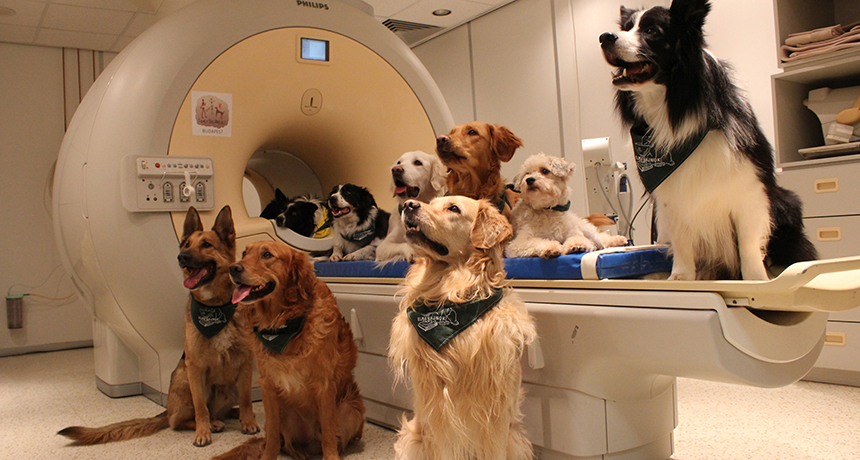
Our furry friends experience the full range of primary and secondary emotions. They feel pain, depression, excitement and joy just as acutely as humans do, and well-designed experiments — like the neurologist Gregory Berns training dogs to sit still in fMRI machines so their brains can be scanned — have confirmed animals have internal thought processes and rich cognitive lives. (Like all good science, Berns’ work is repeatable.)
Neurologist Gregory Berns trained dogs to sit still in MRI units. Berns got the idea and began to train his pooch, Bella, after watching a documentary about Navy SEALs and their dogs jumping out of helicopters. Credit: Emory University
The question isn’t whether animals think and feel, it’s whether we’re expecting them to do something they aren’t meant to do — and anthropomorphizing them in the process — by pushing them to learn human language.
They already meet us halfway, and in the case of cats in particular, more than halfway: The little ones communicate by scent and body language, but they’re smart enough to realize we humans are hopeless at learning those subtle languages, so when they communicate with us, they vocalize as we do.
We know that even great apes, our closest relatives in the animal kingdom, and dogs — who were the first animals to be domesticated and are born with the ability to parse human facial expressions — can’t get a handle on human language.
With Koko’s passing in 2018, the sun has set on the age of primate language experiments partly because funding has dried up, partly because the undertaking involves becoming a parent in a very real sense to an animal that can live for half a century or more, and mostly because it turns out gorillas, chimpanzees and bonobos weren’t really learning language at all.
Nim with Bill Tynan and Joyce Butler.
Nim Chimpsky as a baby.
Nim and Joyce Butler, working on communication.
Herbert Terrace, the scientist behind the infamous “Nim Chimpsky” experiment of the 1970s, set out to prove behaviorist B.F. Skinner right — and linguist Noam Chomsky wrong — and ended up admitting failure in a book that explains how he came to realize ape language experiments were unintentional exercises in the Clever Hans Phenomenon.
“Careful examination of videotapes revealed that the human trainers had inadvertently been cuing the chimp in advance of his signing,” the Wall Street Journal wrote of the Chimsky experiment. “To Mr. Terrace’s great credit, he acknowledged his error, and then went on to discover similar mistakes had been made in most—perhaps all—prior and subsequent claims of apes acquiring human-type language. He has, to some extent, been actively engaged as an animal-language myth-buster ever since.”
The horse who changed science
If a horse can pick up on unintentional body language cues, and fool tens of thousands of people into believing it can answer questions and perform calculations as a result, then it’s a certainty that primates and cats — our closest genetic relatives and domesticated animals who live with us as members of our family, respectively — can easily pick up on cues, especially when there are rewards involved.
“Clever Hans was hailed as the first and most famous ‘thinking’ animal,” the authors of a 2013 paper on the phenomenon wrote. “Except a few skeptics, the majority of biologists, psychologists, and medical doctors, experts of all kind, and laymen were rather convinced by this example that animals are able to think in a human way and to express human ideas in non-verbal human language. In 1904, the German board of education even set up a commission to determine if the claims made about Hans were genuine. After an extended period—a year and a half of study—they concluded that there was no hoax involved.”
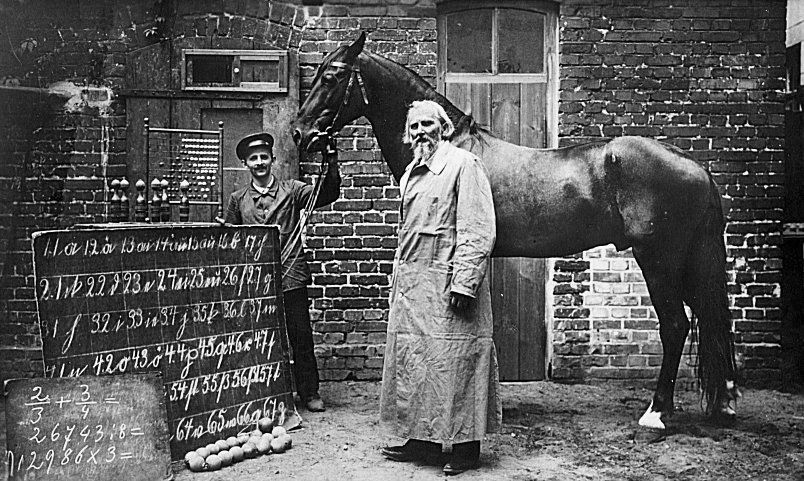
Clever Hans fooled lay people, scientists and animal behaviorists alike until finally, “by the meticulous examination of Professor Oscar Pfungst, a biologist and psychologist,” Pfungst realized Hans couldn’t answer correctly if the person asking him the question did not know the answer either.
In other words, Hans was reading the answers off the faces and via the body language of the people around him. In the end it turned out Hans wasn’t a math genius or a connoisseur of the arts, but he was clever. Hans showed the world just how closely attuned animals can be to human behavior.
The fact that a horse, and not a primate or a dog, revealed such an ability reflects the thousands of years horses have been taking subtle cues from their trainers and riders. An experienced horse can determine a rider’s intent by the slightest tension on the reins or shift in weight.
Clever Hans the horse with his human, mathematician Wilhelm von Osten. Credit: Wikimedia Commons
Clever Hans astounded crowds with his apparent ability to perform simple math and answer questions, but it skeptics eventually discovered the horse was picking up cues from the people around him. Credit: Wikimedia Commons
In fact, it was the Clever Hans Phenomenon that led to innovations like double blind studies and forced scientists to really think about how they design their studies, as even the most careful and well intentioned researcher can unconsciously convey information to study participants. When we’re close to our subjects, as pet caretakers are, it’s almost a guarantee that we’re giving our pets cues without awareness of what we’re doing.
Animals like cats and dogs may not think like people do — and it’s a mistake to expect that of them — but that doesn’t mean they’re not experts at gleaning information from our body language, facial expressions and tone of voice. In fact, that’s their natural way of communicating information.
Even though I can’t bring myself to believe Billi, or any other cat, is learning to use human language, there’s value because failure tells us just as much as success does. Any attempt to better understand cats is a worthy pursuit.
Regardless, it’s clear Billi likes pressing the buttons on her talking board, and the entire exercise is a stimulating game for her. Cats may not have the ability to use human language, but they do like to play, and they like anything that results in interaction and attention.
Maybe that’s the most important takeaway.
“I really believe that the majority of house cats are bored and depressed,” Baker said. “We don’t give them any stimulation . . . and if this pandemic has taught us anything, it’s that staying inside your house all day is terrible. So you know, anything that we can do for them that gives them a better life, I’m for it.”
All photos credit Wikimedia Commons and Pexels unless otherwise noted.
Anyone familiar with evolutionary biology has heard the oft-repeated idea that we’re hardwired to propagate our DNA, and every decision we make — from who we date, when we get married, whether we put career goals on the line to take care of children — is ultimately dictated by that goal.
If that’s true, then “parenting” pets doesn’t make sense. They aren’t our biological children. They won’t carry on our family names and history after we’re gone, they won’t go to college and have careers and take care of us when we’re old. In stark terms, we’re “wasting” resources on raising — and often pampering — the offspring of other species.
Yet we do it, so the question is: Why?
Shelly Volsche, an anthropologist at Boise State University, thinks the explanation can be traced back to our roots in pre-agricultural hunter-gatherer societies, when alloparenting — cooperative parenting — was key to raising children.
“If people evolved to alloparent, and our environment is now making caring for children more difficult or less appealing to some, it makes sense for people to alloparent other species entering their homes,” Volsche wrote. “Alloparenting companion animals can offer a way to fulfill the evolved need to nurture while reducing the investment of time, money and emotional energy compared to raising children.”
As readers of this blog know, I don’t refer to my cat as my “child” and I don’t see him as some sort of child replacement. He’s Buddy, my buddy. We’re best buds. Other people choose to “parent” their children, and that’s cool. Whatever works for you.
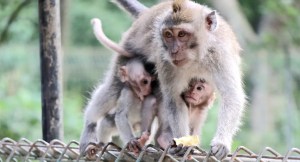
A female macaque takes care of two babies. Alloparenting is common in macaque troops.
I think Volsche’s ideas are interesting, especially in the context of our primate cousins and the way they raise their young. Orangutans are quasi-solitary, and children stick with their moms for about eight years because it takes that long for them to mature and learn how to survive in the jungle on their own.
But more social primates, like chimpanzees, Capuchin monkeys, macaques and vervet monkeys, live in groups and cooperative parenting is a major part of how they handle raising “kids” when there’s no daycare or schools.
A mother who goes out to forage, for example, might leave her baby with an aunt or a trusted female of the troop, and it’s common to see female monkeys caring for babies that aren’t theirs.
Human and proto-human hunter-gatherer societies were essentially upjumped primate troops, so it’s that ingrained behavior we’re talking about here.
Ultimately, Volsche says we’re driven by a “need to nurture.”
“Although the details may look quite different — attending training classes instead of school functions, or providing smell walks for dogs instead of coloring books for children — both practices fulfill the same evolved function,” she wrote. “Whether child or pet, people are meeting the same evolved need to care for, teach and love a sentient other.”
New research offers more evidence that despite their poker faces, cats do care about where their humans are and what they’re doing.
A new study from Japan found cats keep track of their humans even when they’re not looking at them.
A research team from the University of Kyoto conducted the experiments in a cat cafe and in individual cats’ homes. Each cat was placed in a room without their humans. Then the researchers tested the way felines reacted to hearing their people calling their names from outside the room, followed by their reactions to hearing them inside via speakers.
When the cats heard their humans calling them from inside the room the furballs were surprised, expressing their confusion with ear twitches, whisker movement and uncertain body language.
On the other hand, when cats heard “non-social stimuli” — scientist-speak for sounds other than familiar people calling to them — they didn’t react to changes in the location and direction.
Some people might shrug and wonder what the fuss is about, but the experiment actually confirms a great deal about feline intelligence. It’s a test of what scientists call “socio-spatial cognition,” meaning cats form a mental map of things that are important to them, and nothing’s more important to a house cat than the person who provides food, security and affection.
That’s significant because it’s confirmation that cats understand object permanence, and that they are more than capable of abstract thought. Abstract thought — the ability to picture and think about something mentally, without having to see it — is hugely important in intelligence, allowing everything from creativity to understanding that other animals and people have their own points of view. For context, it takes about two years for human children to develop rudimentary abstract thinking skills.
Cats “may be thinking about many things,” Saho Takagi, the study’s lead author, told CNN.
“This study shows that cats can mentally map their location based on their owner’s voice,” Takagi said, per The Guardian. “[It suggests] that cats have the ability to picture the invisible in their minds. Cats have a more profound mind than is thought.”
Things like object permanence and spatial awareness were necessary for cats to thrive as hunters for the millions of years they’ve existed on Earth.
The results aren’t surprising from an evolutionary perspective, biologist Roger Tabor said.
“That awareness of movement – tracking things they cannot see – is critical to a cat’s survival,” Tabor told The Guardian.
“A lot of what a cat has to interpret in its territory is an awareness of where other cats are. It is also important for hunting: how could a cat catch a field vole moving around beneath the grass if it couldn’t use clues, such as the occasional rustle, to see in its mind’s eye, where they are? A cat’s owner is extremely significant in its life as a source of food and security, so where we are is very important.”
The study is also another piece of evidence showing cats are just as aware of — and concerned about — their people as dogs are, even though the conventional wisdom says they don’t care most of the time. That has implications for the way people bond with their cats, and the decisions we make about caring for them — like, for instance, how long we’re willing to leave them on their own while planning a trip.
“This is a great example of elevating our expectation of the cat a little bit,” cat behavior consultant Ingrid Johnson told CNN, “and realizing that they do have the capability of having that bond in that relationship where they actually will take comfort in their people.”