

Just when it seems like the zombie genre has run its course, a handful of visionary Korean storytellers come along to remind us there’s still life left in the undead genre.
First there was 2016’s record-setting, multiple award-winning Train to Busan, a film about an overworked father taking his young daughter to her mother’s house in the titular city just as a zombie plague tears human civilization apart.
Together with a core cast of affable characters — including a pregnant woman and her overprotective husband, and members of a youth baseball team — dad and daughter try to survive in a uniquely claustrophobic setting where simply running from the undead isn’t an option. Train to Busan wasn’t just a hit for its horror and action elements — the film packs a surprising amount of social criticism into its one hour and 58 minute run time, turning its lens onto modern Korean society and, by extension, modern life around the globe.
The movie has a 94 percent fresh rating on Rotten Tomatoes and sparked a bidding war for its US rights. A remake set in the US is currently in production by New Line.
Then there’s Kingdom, a Netflix series also called Kingdom of the Gods in Korean, that takes a zombie plague and drops it over a story about political intrigue and power struggles in the Joseun feudal era.
The series picks up at the beginning of the 17th century, when the kingdom of Joseon is three years removed from the second of two brutal Japanese invasions. Poverty is rampant, the common people are starving and the queen consort’s Haewon Cho clan has consolidated power, effectively insulating the king from his closest advisers, friends and family.
The country is desperate for leadership, but the king has disappeared after falling ill with smallpox.
His son, Crown Prince Lee Chang, tries to intervene and find out what’s happened to his father, but he’s repeatedly stopped by the pregnant Queen Consort Cho, who refuses to allow Chang into the royal palace.
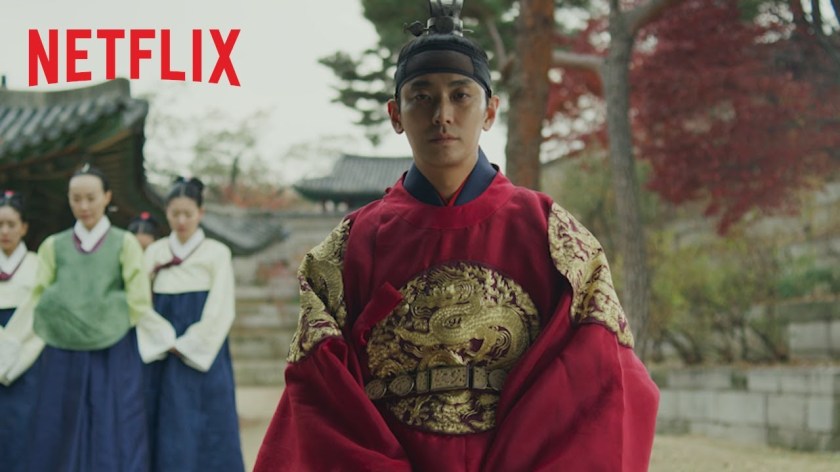
Chang is in an extremely precarious situation: Although he’s the Crown Prince and the king’s beloved only son, his mother was a concubine. If Queen Consort Cho gives birth to a son, the boy will be considered the true heir and Chang will be hunted down and executed so there can be no competing claims to the throne.
With the king missing, Crown Prince Chang knows his time is limited and if he doesn’t act, he could be arrested and put to death by the queen’s orders at any moment.
So Chang and his bodyguard/friend Mu-yeong devise a plan to steal the king’s patient journal from the royal palace at great risk to themselves. When they find bizarre entries about doctors administering a “resurrection plant” — and no subsequent entries about the king’s health — they set off south in search of the king’s physician, the one man who can tell them what really happened to the king.
What follows is a spectacular adventure fueled by gorgeous cinematography, an energetic cast of actors who go all-in on the premise, and a historically accurate look at Korea as it existed under a dynasty that lasted for half a millennia.
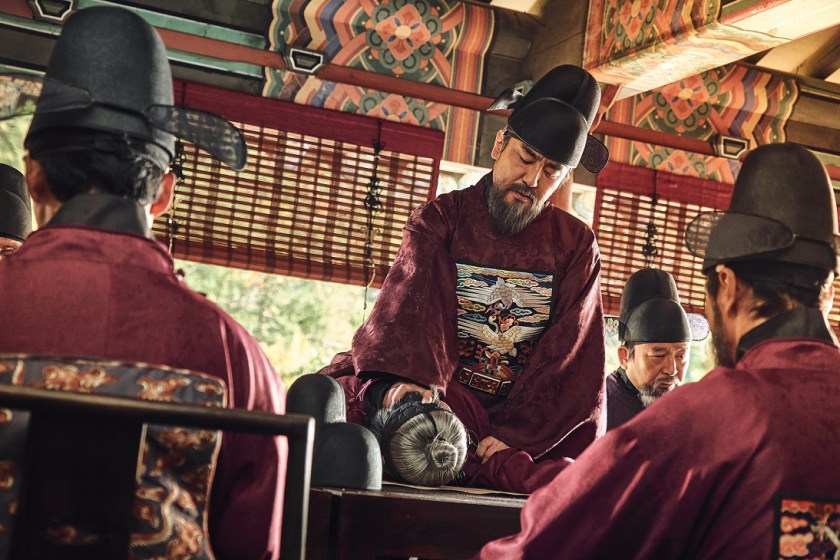
The zombie plague itself may be the stuff of George A. Romero’s nightmares, but the attention to historical detail in Kingdom is second to none, from the costumes to the historic palaces and the strict adherence to tradition among Joseon’s bureaucrats.
It turns out the real leaders of Joseon did have many of the same dilemmas their counterparts on the show do: Kingdom’s author was inspired by historical accounts of an unprecedented deadly plague that swept through the Korean peninsula after the second Japanese invasion, piling fresh misery onto a population already reeling from Japanese invasions and hunger.
The social order compounded the misery for those at the bottom. The Joseon dynasty was marked by strict divisions between social classes, making traditionally aristocratic societies in the west look almost like pleasant meritocracies by comparison.
Everything a person wore — robes, hats, embroidered designs on their chests and backs — were indicators of class, rank and occupation. Government ministers, who were nobles, dressed in fine silks with intricately embroidered rank badges in animal motifs.
Peasants wore rags and straw hats, while the more fortunate among them wore modest clothes.
Nepotism and corruption were rampant, and the nobles, ministers and administrators who held power saw their positions as conferring privilege, not responsibility.
When a group of aristocrats and government ministers of one region take the last barge out of a doomed city, leaving thousands of vulnerable commoners behind to be eaten and turned by the tidal wave of undead, it seems unspeakably cruel and cowardly until you realize that this is a feature of the society, not a bug.
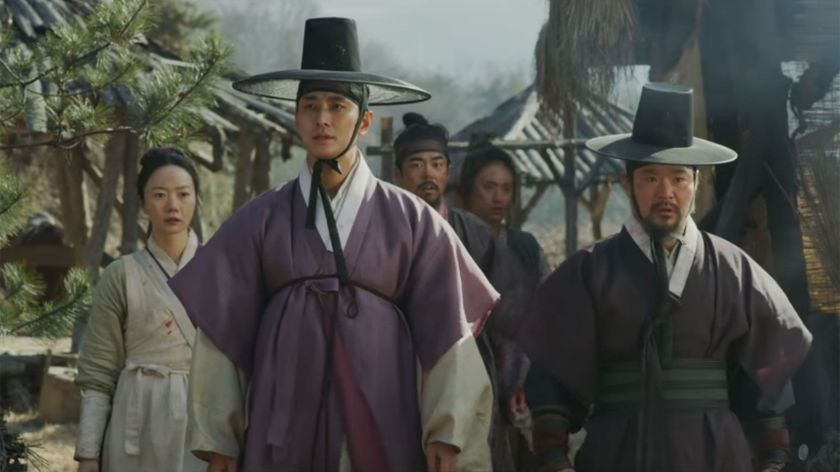
When the aristocrats abandon peasants to the zombies, Crown Prince Chang and Mu-yeong risk their lives gathering a small force to protect the people and usher them to the safety of a walled stronghold.
Later, when a group of villagers bury a group of undead, unaware that they’ll rise at sunset and trample the nearest towns, the Crown Prince and his followers head out just before dusk to stop them, knowing they’ll be outnumbered and may not return.
The Crown Prince’s many kindnesses to peasants and children, and his willingness to risk his own life to protect them, draw the notice of characters who become key allies — including a member of the legendary Chakho tiger hunters, and Lord Ahn, a military hero and governor credited with expelling the Japanese during the invasion three years prior.
Crown Prince Chang set off initially to solve the mystery of the king’s disappearance and to protect himself from the scheming Haweon Cho clan, but as he sees the poverty, desperation and vulnerability of his people first-hand, he dedicates himself to a more pressing and noble cause in protecting the people of Joseon from the seemingly unstoppable plague and starvation.
In that effort, he unites people of different classes and backgrounds who fight fiercely and loyally for him, seeing hope for a brighter future if he survives and becomes king.
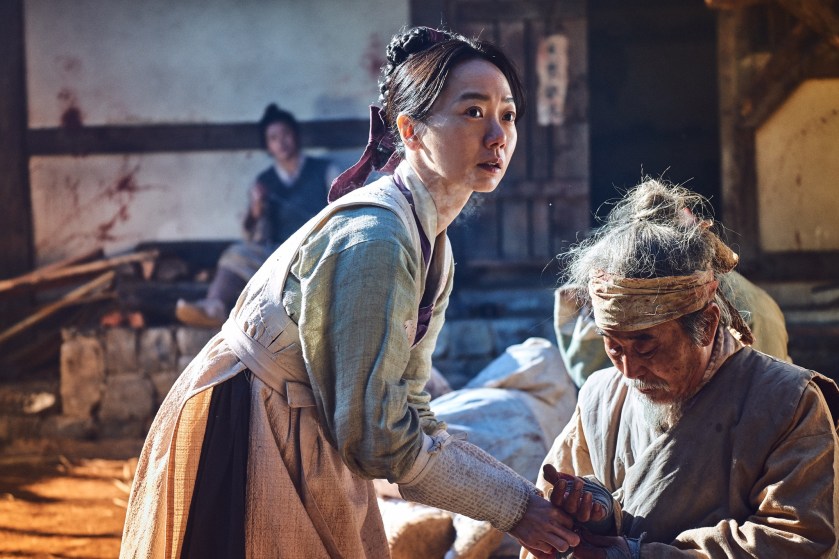
The show never misses a chance to show social disparities: The upper classes do everything they can to protect themselves, everyone else be damned. They hide behind walls and ignore thousands of commoners — including women and crying children — who pound on the gates, begging to be let in. They abandon the peasants, and in many cases count on the lower classes serving as a human shield to allow the upper classes to escape danger.
“Are you sure this is okay?” one minister asks his sycophantic assistant as they take the last barge out of a doomed city, leaving throngs of peasants on the docks.
“You and the other nobles are the backbone of the city!” his assistant assures him. “You must survive so you can rebuild.”
As a result, the first waves of undead are the people on the lowest rungs of society. As the virus spreads to another city, a group of confused aristocrats can’t believe what they’re seeing.
“Those peasants are attacking nobles!” one incredulous man in ornate clothing says as undead in rags storm through Dongnae (modern day Busan).
Peasants attacking the upper class was unthinkable in Joseon, and by the time the aristocrats in that scene realize there’s something very wrong, it’s too late.
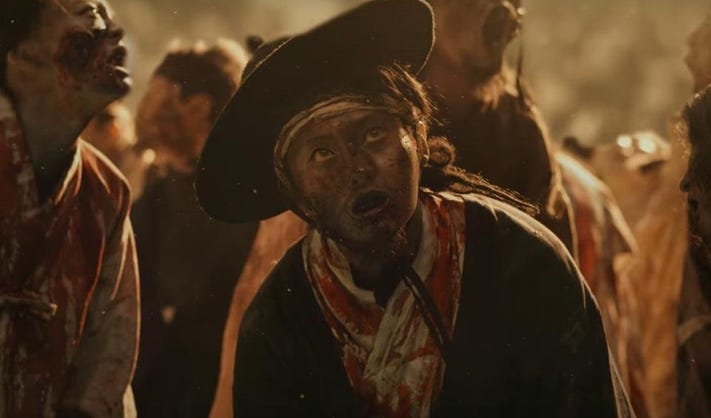
Before long, the legions of undead include just as many people in fine silks and ornate embroidery, finally uniting the classes of Korea in a state of undead purgatory, their reanimated corpses hungering for the flesh of the still-living.


Eventually, though, Chang must confront the Haewon Cho clan and its patriarch, the powerful minister Cho Hak-ju.
Of course the show wouldn’t be a hit if it didn’t provide something for action and horror fans, and it more than delivers on its promises.
The action sequences in Kingdom are spectacular, and the show gives viewers lots of them, from outnumbered warriors holding a narrow pass from the undead, to zombie hordes laying siege to citadels, to close-quarters sword fighting.
The beautifully-shot sequences put shows like The Walking Dead to shame. Whereas the latter show often gives the impression that the money men behind the franchise are counting pennies, Kingdom‘s lavish sets, epic set pieces and impeccable special effects are the kind of thing viewers would expect from a summer blockbuster, not a television show.
Kingdom isn’t all action, and it takes time to breathe with quiet character moments between the narrow escapes and thrilling battles. The series is a period drama just as much as it falls within the action and horror genres. We see the inner workings of a society markedly different than anything most Westerners are familiar with, but driven by the same human ambitions.


The story is also effective thanks to actors Hye-jun Kim and Seung-Ryong Ryu, who play the Queen and her father, high minister Cho Hak-ju. They’re villainous and power hungry without seeming one-dimensional, and both succeed in becoming focal points of the audience’s anger as they commit one despicable act after another.
Cho Hak-ju manipulates the court with the savvy of Game of Thrones’ Littlefinger and the brutality of Joaquin Phoenix’s Commodus in Gladiator. The other government ministers are terrified of him, and as the man who ostensibly speaks for the king, his word is effectively law.
The Queen, meanwhile, puts in motions schemes that would make Thrones’ Cersei look amateurish in comparison.
Kingdom’s got two seasons under its belt and a stand-alone special episode, Kingdom: Ashin of the North. Fans are eagerly awaiting the third season. It stands out as one of the best historical epics in recent memory.








 Pain In The Bud