Did Pope Francis Really Say Caring For Pets Is ‘Selfish’?

The pope’s comments were made in the larger context of an imminent “demographic winter” caused by an aging population and historically low birth rates.

Popes have a mixed record when it comes to cats.

Back in the 13th century Pope Gregory IX famously declared cats were at the heart of alleged Satanic rituals in Europe, relying on the account of one Konrad von Marburg, an author of massacres, church inquisitor and all-around idiot known for brutally torturing his victims to elicit “confessions” of heresy.

Von Marburg told the pope that Satanists had a ritual involving a black cat who would walk around backwards while the Satan-worshipers kissed its ass. The pope bought the risible story and believed von Marburg’s accounts of growing numbers of heretics, especially in Germany.

The resulting papal letter, Vox in Rama, did not declare cats were evil and didn’t ask Catholics to kill them, despite widespread claims to the contrary on the internet, but it did contribute to distrust of the animals a century ahead of the Black Plague, when people thought cats were carrying the disease.

The pope who loves cats

Then there’s the Pope Emeritus, Benedict XVI.

Pope Benedict
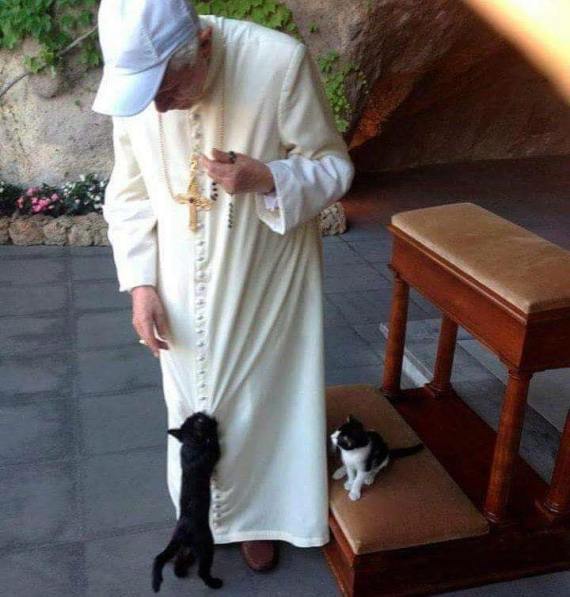
Pope Emeritus Benedict XVI with two kittens in 2017. Credit: The Joseph Ratzinger/Pope Benedict XVI Foundation.

Cat lovers around the world rejoiced when it was revealed Pope Benedict was a cat lover and had two pet felines of his own. Cardinal Roger Mahoney, the former archbishop of Los Angeles, said Benedict was wild about kitties.

“The street talk that the pope loves cats is incorrect,” Mahoney said in 2005. “The pope adores cats.”

Catholics petitioned Benedict to help with animal welfare causes and to lend his support to efforts to help the many stray cats of Rome.

Francis the Saint and Francis the Pope

That brings us to our current pope, Francis. The elevation of Francis was met with approval from animal lovers: His chosen papal name honors St. Francis of Assisi, a Radagast the Brown type figure who lived a life of luxury as a wealthy playboy and party-goer until he had a religious conversion, sold all his possessions and became a monk.

St. Francis believed true faith in God meant having a deep respect for animals. While it’s not clear what’s true and what’s apocryphal, there are stories of Francis preaching to birds, nursing various animals back to health and even convincing a wolf to stop attacking a village in Italy in exchange for the villagers feeding it. St. Francis was by all accounts gentle with animals and appreciative of nature.

St. Francis is revered in the Catholic church and beloved by groups like the Humane Society. He is the patron saint of animals, and on his feast day Catholics bring their pets to be blessed at church.

Pope_Francis
Pope Francis during a visit with former US Vice President Mike Pence. Credit: Wikimedia Commons

Pope Francis continued his namesake’s work with Laudato Si, a papal encyclical which endeared him to animal lovers all over the world.

The encyclical was notable for the church’s strongest language yet in advocating for protecting and respecting animals. PETA made Pope Francis its person of the year in 2015, and the pope was feted by many other animal welfare groups across the world.

In Laudato Si, Francis explicitly rejected the idea that animals are resources for humans to exploit, asserted the Catholic view that animal life has intrinsic value, and called on human beings to be stewards of animals and the Earth. Abusing and exploiting animals is “beneath human dignity,” he wrote, and the associated desensitization and heartlessness of practices like factory farming are a stain on the human race.

Animals, the pope wrote, not only have souls but will “take their place” in heaven, “resplendently transfigured” in the presence of God. He also pointed out the disastrous effects we’re having on wildlife by destroying habitats, carving up the remaining land, over-fishing the oceans, poaching and hunting.

What Francis said about pets

So why are people suddenly upset with the pope?

He made some off-the-cuff remarks about people choosing pets over children, said it was “selfish” to choose the former, and brought up the plight of the world’s orphans. He pointed out that people collectively spend hundreds of billions on pet food and products while humans in the third world lack basic things like clean water, food and medicine. He also said “denying” motherhood and fatherhood leaves us spiritually poorer, as the experience brings us closer to God.

As usual any time a pope speaks, his statements are taken out of context and rehashed in the media. That’s expected, especially in the age of clickbait, the 140-character tweet and the 15-second news segment. Pope Francis gets himself into trouble by sometimes speaking too candidly when he should know his message will be garbled by gatekeepers and information filters, leading to strong reactions to things he didn’t actually say.

The pope wasn’t condemning keeping pets across the board, and he wasn’t saying all pet owners are selfish. His comments were made in the context of a larger discussion on universally declining birth rates in developed countries, specifically Europe’s “demographic winter,” also called a “demographic time bomb.”

In simple terms, Europe’s population is rapidly aging and birth rates are historically low. Populations are dying off, there are fewer people to care for the elderly, and there aren’t enough babies to replace the dead. The average age in Europe is 43, which is 12 years older than the average in the rest of the world.

COVID has compounded the problem, partly due to social distancing and partly due to economic uncertainty as a ripple effect of the virus. Of course it isn’t all that simple, and the demographic winter’s wider effects are complex and well beyond the scope of this blog.

It also helps to remember the Catholic Church has a strong social justice streak. Not the kind that involves writing snarky tweets and first world problems, but real social justice through charity, schools, scholarships, food banks, shelters, soup kitchens, hospitals and innumerable other efforts.

The pope’s background as a native of Argentina, a former janitor and chemist who became the first Latin American pontiff, also colors his outlook. He doesn’t hesitate to call out the hypocrisy of first-world nations, and although we don’t like to hear it, most of the time we need to. After almost two thousand years of popes existing in or near the world’s seats of power, for the first time we have a pope who grew up from the outside looking in.

That’s not to say I agree with everything Pope Francis had to say on the matter, but I think it’s also important to recognize that he didn’t just take shots at people who care for pets out of the blue, and he didn’t condemn people for caring for animals.

Pa. Man Charged With Felony For Running Over Cat With His Truck

A former local councilman in Pennsylvania faces animal cruelty charges for allegedly running over a cat earlier this month.

A former councilman in rural Pennsylvia faces two animal abuse charges after trying to run down a group of cats — and hitting at least one — with his truck earlier this month.

Frank Pagani Jr. was charged with aggravated cruelty toward animals, a felony, as well as a misdemeanor animal cruelty charge, according to a story by Beaver County Times reporter Garret Roberts.

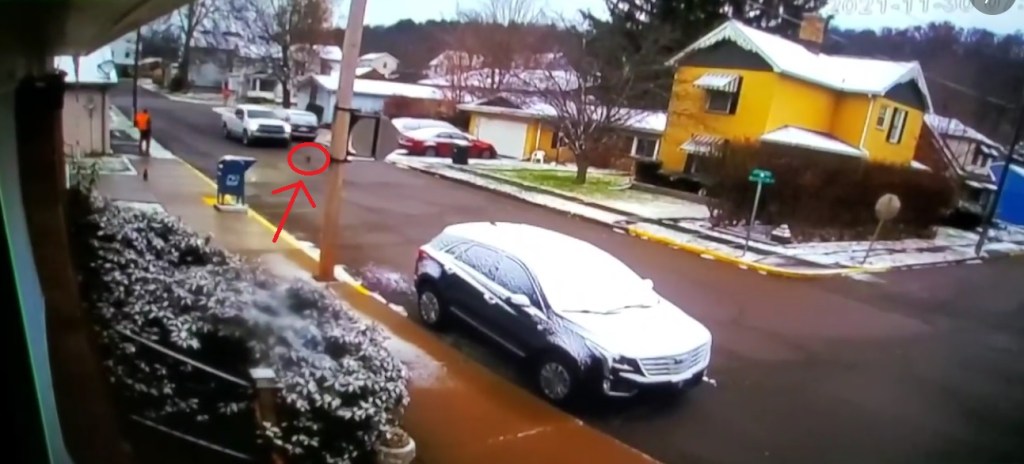
Neighbor William Bittner, who helps care for the neighborhood strays, captured the Dec. 1 incident on his home security camera. The clip (embedded below) shows Pagani’s truck speeding up on the residential street and swerving toward cats who were in the road before blowing through a stop sign. Pagani Jr. then made a left turn to a side street and pulled into his driveway a few hundred feet away.

The 31-year-old was behind the wheel of the truck and his father, Frank Pagani Sr., was in the passenger seat during the incident, according to the Times. The Paganis live in New Galilee, a town of 379 people in rural Pennsylvania about 50 miles north of Pittsburgh.

In this still from Bittner’s video, Pagani’s white pickup truck aims for a cat, circled, in the road. The cat hasn’t been seen since.

Bittner said last week that Pagani Jr. called him after he realized the incident was caught on video and said he’d resign his council seat.

“He thinks that’s the end of it,” Bittner said at the time. “You just can’t let an act like that go on without someone being charged.”

Bittner and his neighbors have been caring for the stray colony for years. In addition to feeding the strays, they’ve run a trap, neuter and return (TNR) program, fixing 28 cats, and have found homes for kittens who were born to the colony cats.

The Pagani family apparently panicked when they realized Bittner had captured the incident on video and posted it to Facebook. Per the Times:

“The police affidavit also details repeated phone calls were made to the homeowner who caught the incident on camera by Pagani, his father and his mother. Voicemails received by police detail the family asking for the video to be taken down.”

The video shows Pagani’s truck striking at least one of the cats, who immediately ran off with the other strays. It’s not clear how badly the cat was injured, and Bittner said “he’s not showing up” at regular feeding times.

“We’ve been searching and searching and we can’t find him,” he told WKDA, the local CBS affiliate.

Locals who reacted to the video on Facebook were horrified by the footage.

“I adopted one of those kittens,” one woman commented. “This breaks my heart.”

Iran’s Theocrats Want To Ban Cats, Dogs and Other Pets

Iranian clerics and lawmakers claim pets are dangerous, but observers say the country’s religious authorities see pets as a threat to conservative Islamic beliefs.

The Prophet Muhammad heard the afternoon call to prayer one day and was about to rise when he realized his favorite cat, Muezza, was sleeping on his sleeve.

Rather than wake the slumbering kitty, Muhammad cut off his sleeve, stroked her fur and headed off to pray.

That story — and accounts of Muezza regularly napping in the lap of Islam’s most sacred prophet as he preached to followers — make Muezza one of the most well-known felines in human history, and form the basis for Islamic teaching regarding cats. Muslims consider cats the cleanest of animals, worthy companions and, thanks to the way the Prophet Muhammad treated Muezza and his other cats during his life, animals worthy of respect and the protection of humans.

Why, then, do hardline Islamic lawmakers in Iran want to ban the keeping of cats as pets, along with other animals?

Animal lovers in the country of 84 million are alarmed after conservative lawmakers introduced a bill, titled “Protection of the Public’s Rights Against Animals,” that would ban people from “importing, raising, assisting in the breeding of, breeding, buying or selling, transporting, driving or walking, and keeping in the home wild, exotic, harmful and dangerous animals.”

The list of “dangerous animals” includes creatures domestic and wild including “crocodiles, turtles, snakes, lizards, cats, mice, rabbits, dogs and other unclean animals as well as monkeys,” according to Agence France Presse.

Cat in mosque
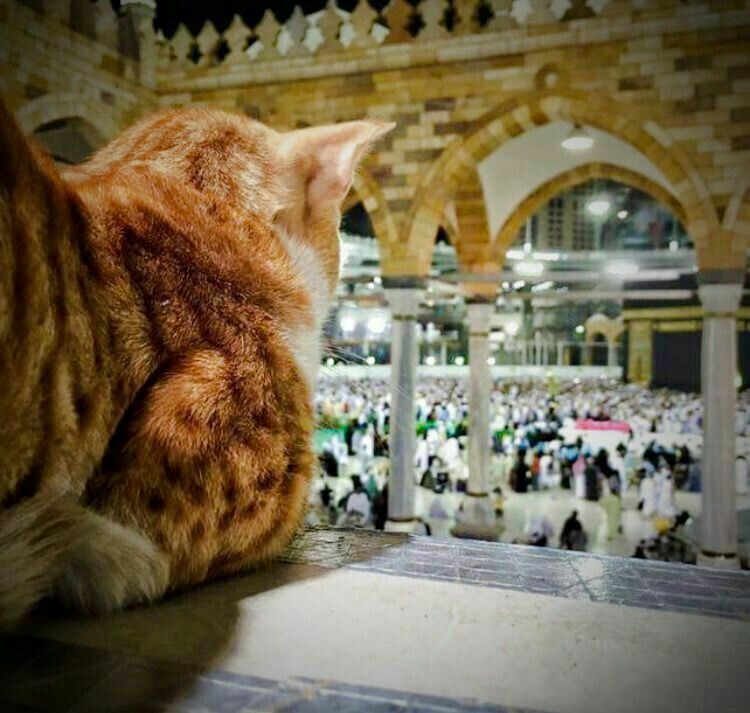
A cat loafs in Saudi Arabia’s Masjid al-Haram in Mecca, just a few hundred feet from the Kabah, the most sacred site in Islam. The fact that cats are allowed in such close proximity to the site reflects the Prophet Muhammad’s devotion to felines. Credit: Wikimedia Commons

Penalties for violating the ban would be steep:

“Offenders would risk a fine equivalent to 10 to 30 times the ‘minimum monthly working wage’ of about $98 or 87 euros and the ‘confiscation’ of the animal,” the report says. If passed, the law would also require landlords to ban pets on their properties.

The proposal has caused an outcry in Iran, where keeping pets has become more popular in recent years, especially because it’s not just one or two politicians introducing a long-shot piece of legislation: At least 75 of Iran’s 290 legislative representatives have already signaled support for the bill.

Officially, Iranian lawmakers who support the pet ban say they’re obligated to act because pets are “dangerous.” Mohammad-Taghi Naghdali, an Iranian MP, told Persian-language news site Didban-e Iran that dogs in particular can “cause nuisance and harm” to people, citing a recent incident in which a dog killed a child in a Tehran public park.

But observers say the real reasons have to do with the Iranian government’s interpretation of Islamic teaching, as well as fear that keeping pets is a western, liberal (in the classic sense) behavior that poses a danger to the Islamic theocracy.

In 2019, dog walking was officially banned in Tehran, and authorities warned residents to keep their pets out of public spaces.

“Police have received permission from the judiciary branch to crack down on people walking dogs in Tehran,” Tehran Police Chief Hossein Rahimi said in late 2019. “Carrying dogs in cars is also banned and if a dog is seen inside the car, police will confront the owner of the dog.”

In 2016, media reports said “officials were showing up at the homes of pet dog owners claiming that they were from a veterinary unit and these dogs needed vaccinations. The dogs were taken away, ostensibly for the purpose of vaccination and were never seen again.”

Dogs are considered “ritually unclean” according to Islamic hadiths, and some majority-Muslim countries, especially theocracies like Saudi Arabia, ban dog ownership completely with very few exceptions, such as seeing eye dogs for the blind.

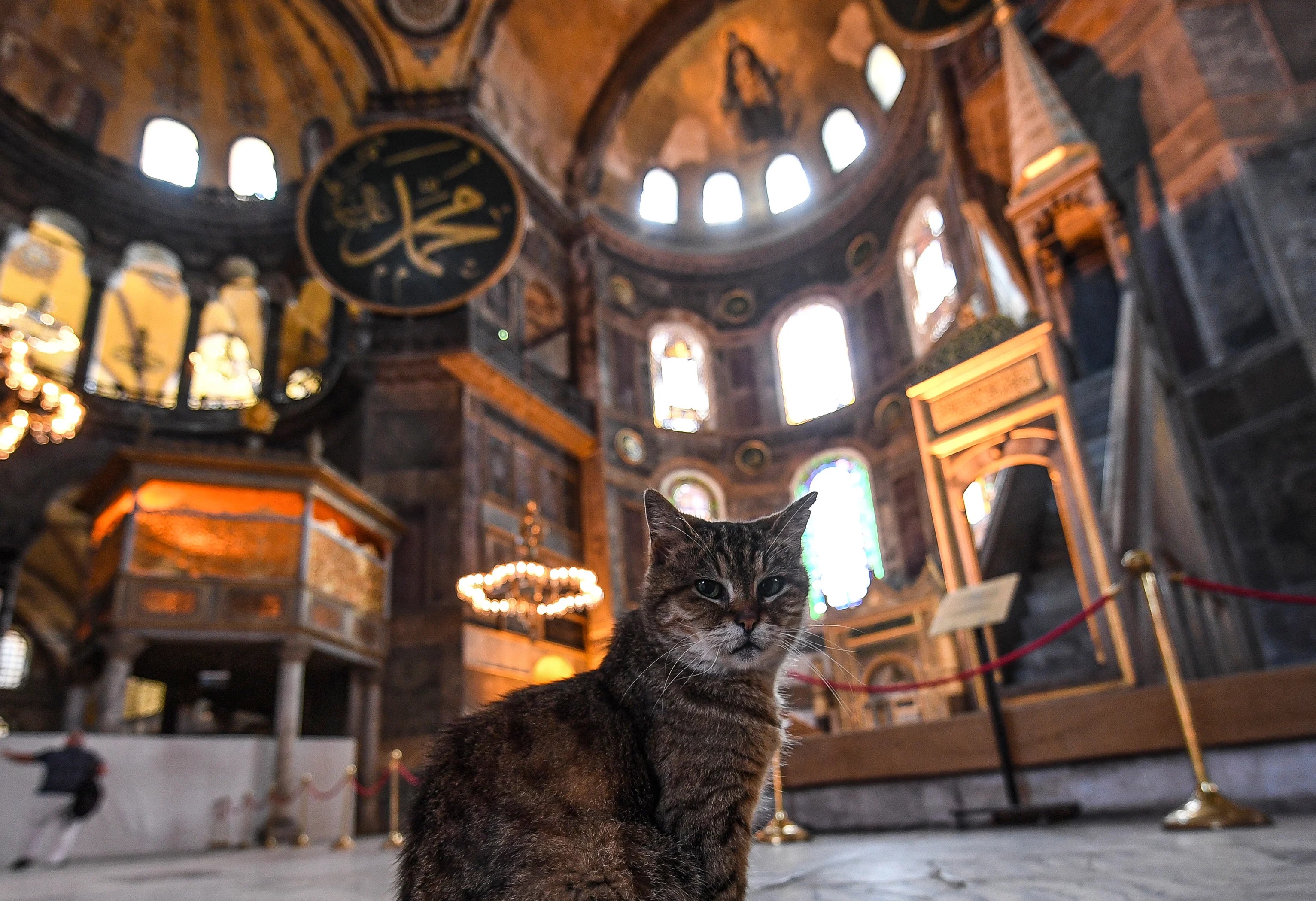
By contrast, cats are widely tolerated and even welcomed into holy sites in most Islamic countries. In Saudi Arabia it’s not uncommon to see cats lounging on the grounds of mosques, while Turkey is famously hospitable to felines, with Istanbul earning an international reputation for its well-treated and ubiquitous street cats. In Turkey, cats are welcome in mosques, shops and homes, and tiny shelters for strays can be found almost everywhere.

gliistanbul
The late Gli, the most famous feline resident of the Hagia Sophia in Istanbul.

The proposed law has not gone over well with the people of Iran, who are often at odds with the country’s theocratic leaders on almost every aspect of social life.

“I have renamed my cat ‘Criminal’ since I heard this proposed law,” one Iranian wrote on Twitter, while journalist Yeganeh Khodami tweeted: “How many times have cats sought to devour you so that you consider them wild, harmful and dangerous?”

A common refrain among animal lovers is that the country’s leadership is once again focusing on something ultimately unimportant and harmful to Iranians instead of working to fix real problems like a depressed economy, widespread droughts and nationwide belt-tightening caused by international sanctions.

“Why should I imprison him at home?” a Tehran woman walking a dog told Agence France-Presse. “The MPs probably assume that young couples today don’t have children because they have a pet dog, but that’s stupid. It’s not the dogs but the economic conditions that don’t allow us to have children.”

Someone Has To Rescue This Poor Cat

A real estate agent discovers a terrified, depressed cat left behind in a trashed rental home after the tenant vacated the place.

A real estate agent in Texas was filming video for his TikTok channel, sarcastically providing a voice-over in which he promises a “look at the beauty of rental houses when the tenants move out.”

As the agent, who goes by the name Felix Jaimes on TikTok, showed broken blinds, inexplicably removed wood floor panels, a cracked mirror, dirty bathroom and garbage left everywhere. Then he heard noise coming from another room.

“Honestly I got scared, I thought someone was in there because the house was pretty much empty,” Jaimes explained later in the comments.

But he didn’t find a burglar — just a terrified, depressed-looking cat huddling in the corner of a closet.

“He was obviously scared,” Jaimes wrote. “My heart broke” for him.

“Immediately I thought they left their cat behind. What kind of people do that,” Jaimes asked. “I thought they had just abandoned the place since they destroyed it.”

After calling and sending text messages to the tenant, she called Jaimes back and said she wasn’t finished moving out.

“When I came back, the cat was gone,” Jaimes said.

The video was posted on Dec. 7. It’s not clear from Jaimes’ profile exactly where he is — or where the home is located — in Texas, but perhaps some sharp-eyed Texan will be able to tell from the exterior shots at the beginning of the video.

Regardless, the video is distressing. It seems to me that organizations like county-level SPCAs — which employ animal welfare officers with law enforcement jurisdiction when it comes to animal abuse and welfare investigations — are made to handle cases like this, not just the “saving 50 cats from a hoarding situation” stories we hear all the time.

At the very least, the SPCA’s law enforcement division should locate the owner, interview her, check on the cat and have him brought in for a veterinary exam. If they don’t like what they see, they should confiscate the cat and take extra care to place him with people who know how to treat cats and will give him the love he deserves.

Maybe everything really is on the up-and-up and just looks bad, but someone who really knows cats — and loves them — would never leave their kitty in an empty apartment, cowering in a closet and believing he’s been abandoned. That’s why it should be investigated. Better safe than sorry.

Pa. Politician Resigns After Running Over Stray Cats With His Truck

“We don’t need his idea of animal control,” says one neighbor, who has been caring for the local cat colony for years.

Neighbors who live on a quiet street in rural Pennsylvania were horrified when a man in a white pickup truck intentionally tried to run over stray cats last week, hitting at least one.

Now, thanks to one neighbor who captured part of the attack on video, they’ve identified the man at the wheel, and he’s a local politician.

Frank Pagani Jr. resigned from his seat on the municipal council of Galilee, a rural Pennsylvania town with a population of 379. Video shows Pagani Jr. speeding up and swerving to hit one of two cats who were in the road at the time. He was going so fast he blew through the stop sign at the end of the street.

The brazen politician then made a left turn and casually pulled into his own driveway on a side street.

William Bittner, who captured part of the Dec. 1 hit-and-run on video, said Pagani called him afterward, admitted what he’d done, and said he would resign his council seat.

“He thinks that’s the end of it,” said Bittner, who takes care of the cats along with other neighbors on the street. “You just can’t let an act like that go on without someone being charged.”

The Beaver County Humane Society said its humane officers were investigating the incident, but Pagani Jr. hadn’t been charged as of Dec. 6. Neighbors told the Beaver County Times that police officers were going door to door on Dec. 3 to speak to witnesses. Pagani has not returned calls from at least two local media outlets.

Pagani works with his father in their family business, Pagani and Son Trucking LLC, which contracts with the United States Postal Service to shuttle mail in bulk to and from a processing facility to individual post offices in the area. The company has had three USDOT violations in 2020 and 2021, records show.

As for the cats, their fate remains unknown. The video appears to show Pagani’s truck hitting or running over the tail of one cat, who immediately bolted along with the other cat who was in the street at the time. Those two cats took off with a larger group that was on the nearby sidewalk. The injured cat hasn’t been seen since.

“He could have hit the undercarriage of the front, he could have had his tail run over, he could have been bruised,” Bittner told KDKA, the local CBS affiliate. “We’ve been searching and searching and we can’t find him.”

”And when I feed him in the morning and night, he’s not showing up. So we don’t know whether [he] ran off to die or…” Bittner said, trailing off.

In a follow-up post on Facebook, Bittner explained that the strays are part of a managed TNR colony, with neighbors pitching in to help feed the cats and adopt out kittens. So far, 28 cats have been trapped and fixed.

People in the neighborhood believe Pagani was taking matters into his own hands, which follows a disturbing trend of vigilantism toward cats by people who either hate them or think they’re protecting local wildlife by killing cats.

“We don’t need his idea of animal control,” Bittner wrote.