A bizarre new study concludes some cats are depressed because they live with men, among other questionable claims.
A Brazilian research team wanted to find out if cats experience separation anxiety when their owners aren’t home, so they visited the homes of 200 cat servants, wired them up with cameras and microphones, and conducted a rigorous study in which they first established a behavioral baseline, then compared the cats’ normal behavior with their actions when their humans weren’t home.
Just kidding.
In what might be the laziest, most assumptive attempt at conducting animal behavioral research thus far in 2020, the team from Brazil’s Universidade Federal de Juiz de Fora handed out questionnaires to 130 cat owners that asked, among other things, about the body language and behavior of their cats when they weren’t at home to witness it.
Did these cat caretakers have Palantirs that allowed them to spy, Sauruman-style, on their kitties at home? Nah.
“Since there weren’t any cameras observing the cats, the owners answered based on evidence from reports by other residents, neighbors or any signs the cat left in the home, such as feces, urine or broken objects, [study author Aline Cristina] Sant’Anna said.”
My neighbor’s friend’s Uber driver, who parked outside for 16 minutes, said my cat looked angry when he briefly appeared in the window, so I’m gonna go ahead and write in this here questionnaire that Mr. Socks has terrible separation anxiety. Yep.
But suppose the data was reliable, instead of fuzzy third-hand accounts from cat owners who quizzed their apparently nosy neighbors about what their cats do in their down time. How do we know a smashed vase is separation anxiety, and not the result of a cat with the zoomies just knocking stuff over?
How do we know a cat who misses the litter box doesn’t have a UTI, or refused to use a dirty box?
But it gets better, dear reader. This team of superstar scientists decided the reason some cats were supposedly depressed or destructive is because they live with male caretakers instead of women:
Cats with behavior problems also tended to live in households without any female adults or more than one female adult; households with owners ages 18 to 35 years old; single pet households; and households with no toys.
“Maybe, for different reasons, the animals raised in households with no female adults or more than one female adult were less likely to develop secure and mentally healthy types of attachments with their owners in the sampled population,” [study author Aline Cristina] Sant’Anna said.
Or maybe the authors are getting paid to make wild, unsupported assumptions and combine them with worthless data.
The CNN version of the story doubles down by quoting a self-appointed expert who expounds on the cats-and-females theory:
Additionally, female cat owners tended to be more affectionate and doting, said Ingrid Johnson, a certified cat behavior consultant for more than 20 years.
Cats might be a little more distressed in the absence of their owners if they are younger adults who are busy and not focused on the fact that they have a pet, the researchers theorized.
“They’re happy to have a pet, but they’re going out, being social, [going on] dates and having parties,” added Johnson.
Right
For those who aren’t keeping score, we now have an academic and a certified behaviorist telling us cats who live with men or adults younger than 35 are more likely to be depressed because they, like, totally heard we don’t scoop the litter boxes as frequently or something.
That’s because all men refuse to be affectionate with their cats, and people under 35 are party animals who snort cocaine off the posteriors of strippers when they should be feeding Fluffy, according to our experts.
Johnson’s credentials include working at a hospital for cats and running her own “cat behavior house call and toy business.”
It’s worth noting that there are dozens of organizations that certify people as cat behaviorists. Sometimes the difference between a certified behaviorist and one without certification is the former simply paid dues to a member group that issues the certificates.
“Where’s the jabroni who claimed men aren’t affectionate with their cats?”
By now my opinion on this study is abundantly clear. The methods and conclusions wouldn’t pass muster in most undergraduate classes, let alone a research paper published in an academic journal. (The researchers published their work to PLOS ONE, an open access journal.)
What I don’t understand is, why bother? According to the study, 13.5 percent of the cats demonstrated at least one behavior consistent with separation anxiety, but for reasons I elaborated on earlier, the data is worthless. I’m not a fan of questionnaire studies in the first place, let alone questionnaire studies asking people what other people told them about difficult-to-interpret animal body language.
And lastly, I’m not a fan of this idea that there’s a certain “type” of person who is the best kind of cat owner.
We should be dispelling crazy cat lady stereotypes, not perpetuating them. Maybe men are in the minority when it comes to adopting cats, but nothing other than unfounded assumption suggests we men aren’t loving and affectionate with our little buddies, just like there’s nothing but anecdotal evidence to suggest caretakers younger than 35 neglect their pets.
The past few years have seen an authentic boom in research into feline cognition, behavior and emotion, and for that I’m grateful. But we can do better than this.
Humans home too much lately? Buddy’s got a solution!
Dear Buddy,
There’s a dire situation we need to urgently bring to your attention: Our humans are not leaving the house! We meowed to the other cats on our block, and their humans aren’t leaving their homes either. Abe the Abyssinian from across town wandered into our neighborhood and said the same thing is happening in his neck of the woods.
WHAT IS GOING ON?!?
Don’t get us wrong, it’s nice to have a little extra service now and then, but this is really putting a cramp on our lifestyles. We can’t sit on the Warm Pads because our humans are always at home using them. Our beds, which we generously allow our people to use every night, are now constantly claimed by these suddenly-lazy humans.
Worst of all, we can’t steal food because our humans are right here.
Do you know why this is happening?
– Perturbed in Pensacola
Credit: Instagram/marugadesuyo
Dear Perturbed,
I hadn’t noticed, but then again my human is a loser who works from home and doesn’t have a social life, so I queried some feline amigos, and sure enough their humans are staying indoors too.
Usually this only happens when it’s really cold and snowing, but it’s pretty nice outside, sunny and getting warmer.
I strongly suspect this has to do with the Corona Virus, the one spreading through beer, as I learned through my own investigation last week. (Detective work comes naturally to me.)
Perhaps we can solve this by bringing the infected beer to them! Think about it: They’re doing something called quarreltineering to avoid Corona, but if they open up the fridge and find Coronas right there, they’re no longer safe at home!
That means they will go back outside and we can have our naps and steal food in peace.
I really should sell these ideas instead of giving them away for free. I’d be rich!
Nekorepa’s homes and apartments are designed with cats in mind.
Proving once again that their country is home to some of the most enthusiastic cat-servants, Japan now has a real estate agency that lists only cat-friendly homes and apartments.
Actually, cat-friendly might be an understatement. Nekorepa Real Estate (neko is Japanese for cat) aims to hook people and their furry buddies up with homes built with cats in mind.
What does that mean? Bathrooms that have built-in cat doors, for example, so renters and homeowners can keep litter boxes there, and presumably put a permanent end to the never-ending feline freak-outs when cats are left out while their humans occupy the throne.
Others have custom-built alcoves in less-trafficked areas where litter boxes can be tucked, with ventilation fans built into the spaces. Almost all of them have an array of perches and comfortable cat-size window spots.
A home earns Nekorepa’s official seal of approval if it meets three criteria, Japan Today reports: “[A]bundant natural sunlight (to facilitate cozy cat naps), floors and walls with scratch-resistant surfaces (so your pet can run and play to its heart’s content), and a design that ensures your furry friend can’t slip out of the apartment and get lost while you’re away from home.”
Click on the images below for larger versions. These are some sweet cat digs:
Pretty much every Nekorepa home has built-in feline-friendly features, like easy-to-reach window perches, plus platforms, bridges and walkways for when cats feel like viewing their kingdoms from above.
It’s worth noting that there’s a legitimate need for a service like this in Japan. Space is at a premium, rental prices are sky high, and it’s not easy to find landlords who allow pets. That’s one reason cat cafes were born in Japan and continue to enjoy success — they cater to people who love cats but can’t have them in their homes.
If you’re living in Tokyo you’ll have the most options, but the company says it’s expanding throughout the country. As for the rest of us, let’s hope a few cat-loving real estate agents read this…
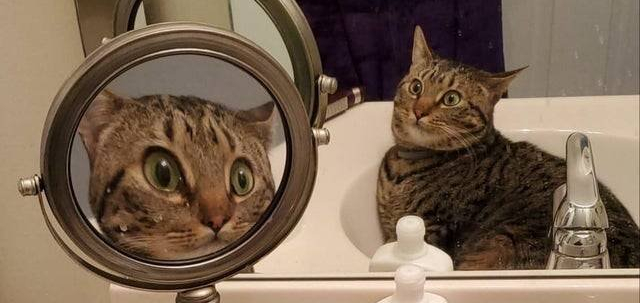
“I saw his reflection in the magnifying mirror and I started laughing hysterically,” Roscoe’s owner said.
Meet Roscoe.
The year-old tabby and his human are enjoying viral fame after the latter snapped this shot of Roscoe catching his reflection in two mirrors at the same time, prompting a hilarious look of shock:
Roscoe catches his reflection in two mirrors. Credit: Katie B.
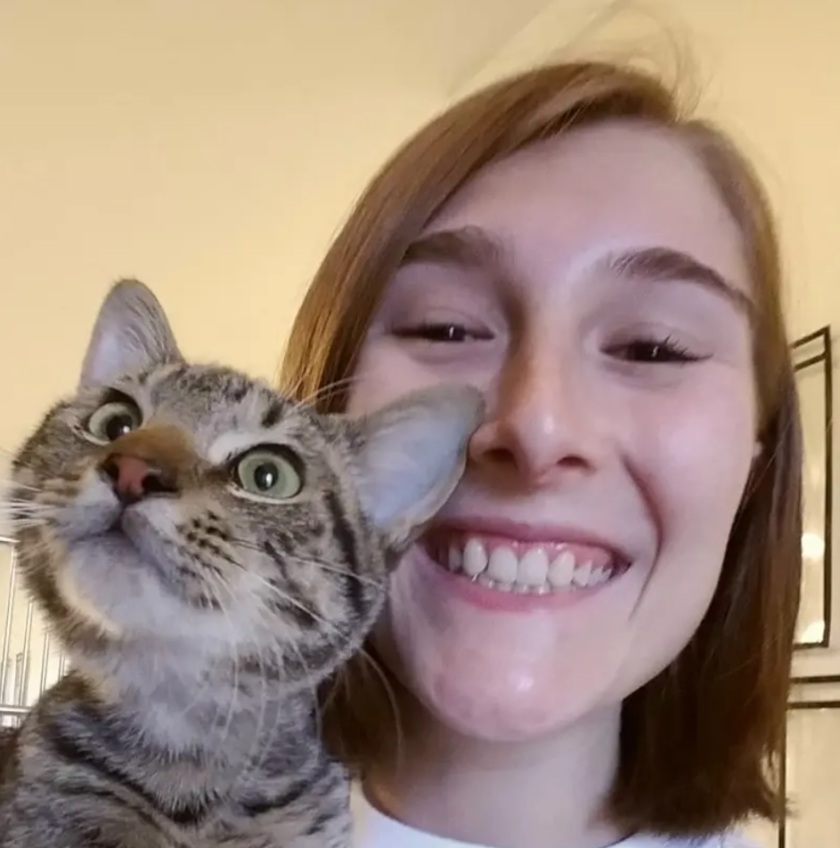
Roscoe’s human, Katie B, explained how she got the shot.
“I was just going about my business when I looked down and saw his reflection in the magnifying mirror and I started laughing hysterically,” said the 24-year-old PhD student, who lives in Chicago. “It was hilarious, and thankfully I was holding my phone. So I quickly took a picture and sent it to my friends on Snapchat.”
Roscoe’s bewildered look has reignited the debate about feline self-awareness, a topic that still hasn’t been settled by science. It’s a subject we’ve explored here on Pain In The Bud, detailing Buddy’s “long and tumultuous history with mirrors” and his reactions to seeing himself — and me — reflected back at him.
Katie calls Roscoe “a funny little dude” and her “furry best friend.” She’s started an Instagram account for Roscoe where she documents the little guy’s antics for his followers.
“It’s been really fun seeing how much people love it and all the memes and drawings people have done of Roscoe,” Katie told Buzzfeed. “He has brought so much joy into my life, and I’m glad he’s bringing joy to others too!”
Roscoe and his human servant, Katie B. Credit: Katie BPhotos of Roscoe capture the little guy’s amusing personality. Credit: Katie B





 Pain In The Bud