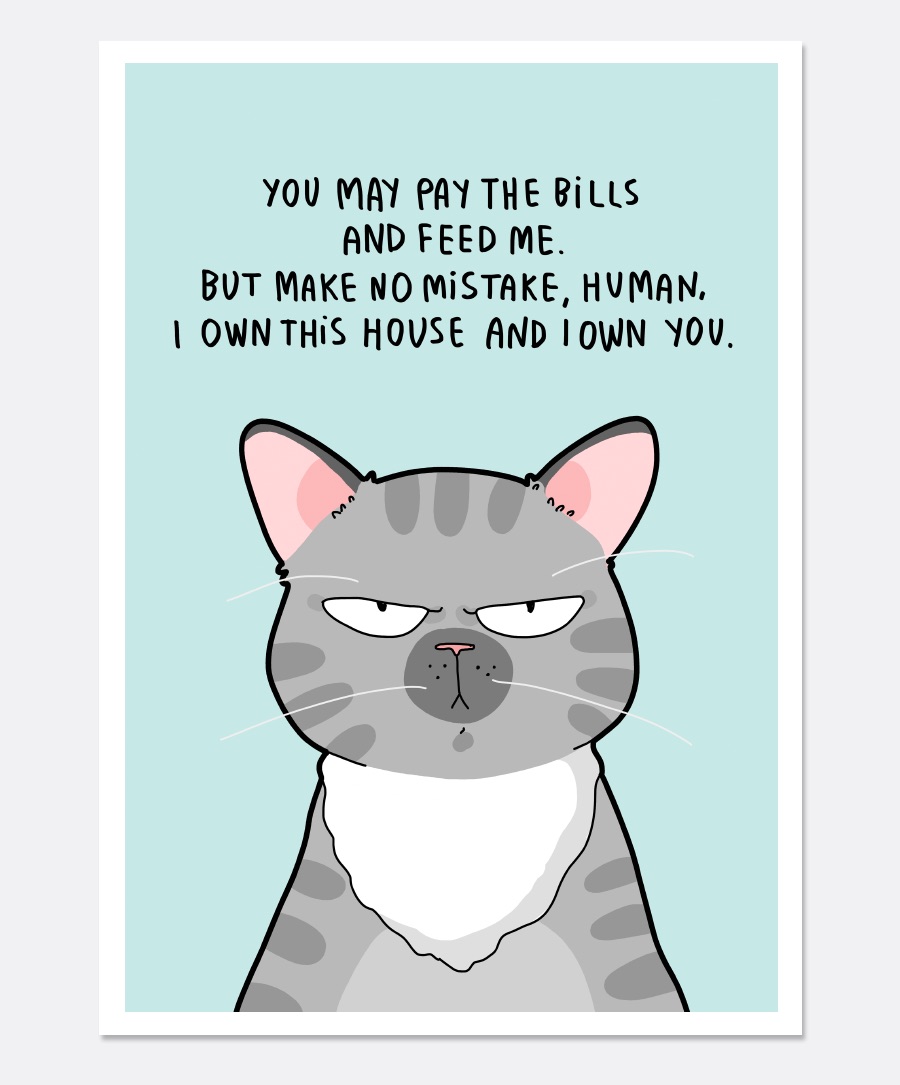
Study: Cats Really Do View Us As Parents

Cats are furbabies after all.

In a discovery that won’t surprise most feline servants, scientists have concluded cats really do get attached to us even if they have a funny way of not showing it.

The internet is abuzz this week with news of a study that indicates a cat’s bond with his human is much like a child’s bond with a parent.

The research, conducted by a team at Oregon State University, sought to gauge how attached cats are to their owners by putting them in a strange situation and seeing how they react with their humans present and without.

In the study a cat is led into a strange room accompanied by his or her human. After two minutes the human exits and the cat is left alone in the unfamiliar room. Another two minutes later, the cat’s servant returns.

It’s the way the cat acts when its human is away — and how it adjusts when the owner returns — that interests researchers. And sure enough, domestic feline behavior followed a familiar pattern:

  1. With owner/servant in the room: “What is this strange place? What are we doing here?”
  2. Human exits: “Oh no! Don’t leave me in here! I don’t know what this place is! Come back! Hey, come back here! This place looks, smells and feels funny. I’m scared!”
  3. Human returns: “Ah! Okay, much better. I’m just gonna rub up against you so I feel better. You know, this room isn’t so bad after all, is it? You look pretty calm. That means I should be calm, right?”

Although it might seem strange that scientists can learn so much from such a simple experiment, the result is important because the way cats react is precisely the way small kids and dogs react to strange situations.

Cat Hugs His Human
“I love you, furless human, and I’m not just saying that ’cause you feed me!”

It’s all about what psychologists call secure attachment: When a child is bonded with her parent, the mere presence of that parent lends calm and comfort in a strange situation.

Without mom or dad present, the kid is unsure, cautious and maybe even frightened. But with mom or dad in the room, the child feels comfortable and safe enough to go exploring and isn’t intimidated by the new environment. Psychologists call it a “secure base test” because it means kids use their parents as a safe “base” from which to explore.

Two decades ago, researchers broke new ground when experiments showed dogs behave the same way, drawing comfort and feeling more secure with their owners nearby.

“Like dogs, cats display social flexibility in regard to their attachments with humans,” study author Kristyn Vitale said. “The majority of cats are securely attached to their owner and use them as a source of security in a novel environment.”

Another Cat Enjoying A Hug
Must be nice to have a cat who enjoys hugs!

It took another 20 years for scientists to try the same experiment with cats, mostly because felines have a reputation — not undeserved — of being very difficult to work with.

That is, cats don’t always feel like playing nice and participating in a study because, well, they’re cats.

This latest study isn’t the first time researchers have tried to gauge feline attachment to their humans, but it’s the most expansive study of the phenomenon to date: The Oregon State University team conducted the test with some 80 kittens younger than eight months, then repeated the same experiment with adult cats.

The idea was to determine if cats grow out of their emotional attachment. The results suggest they don’t, which lends credence to the theory that domestic cats under the care of humans are, in some respects, kittens for life.

“Once an attachment style has been established between the cat and its caregiver, it appears to remain relatively stable over time, even after a training and socialization intervention,” Vitale said. “Cats that are insecure can be likely to run and hide or seem to act aloof. There’s long been a biased way of thinking that all cats behave this way. But the majority of cats use their owner as a source of security. Your cat is depending on you to feel secure when they are stressed out.”

For those of us currently employed as cat servants, that last bit is important: Cats most definitely do pick up on our moods even when it seems like they don’t.

To read more, check out a 2015 study by Italian scientists that found cats look to their owners for emotional cues about how to respond to new situations, and a 2017 by the same Oregon State University team that found cats value human interaction just as much as they value food.

Buddy Angry
“Buddy doesn’t do hugs, okay? Buddy speaks in the third person, Buddy meows insistently for dinner, but Buddy does not do hugs. Deal with it, human.”

Mirror Mirror On The Wall, Are Cats Self-Aware After All?

The traditional mirror test might fall short when it comes to determining the self-awareness of cats and other animals.

The mirror test has been the de facto gauge of animal self-awareness since it was invented in 1970 by psychologist Gordon Gallup Jr., mostly because no one’s figured out a better way to determine if animals understand who they are.

The procedure is simple: When the animal is asleep or sedated researchers will add a smudge of red paint, a sticker or some other visible mark on the animal’s face. Then they place a mirror nearby.

If the animal wakes up, looks in the mirror and tries to probe or wipe away the new mark, it passes the self-awareness test. It means the animal understands the image in the mirror is a reflection of itself and not another animal, according to researchers.

The list of animals who have passed the self-awareness test is quite short: It includes great apes like orangutans, bonobos and chimpanzees, as well as elephants, dolphins, orcas and crows.

Cats, who are notoriously difficult to work with in controlled studies, have never passed the mirror test. Dubbed “the world’s most uncooperative research subject,” cats are a challenge even for the most seasoned animal cognition experts.

“I can assure you it’s easier to work with fish than cats,” one scientist told Slate magazine. “It’s incredible.”

81528907-99B0-404A-8EAA-F41784FDAE97

It’s not clear if cats don’t recognize themselves or simply can’t be bothered. Indeed, one of the primary criticisms of the mirror test is that, like most measures of animal cognition, it employs a human perspective to gauge non-human intelligence. It assumes that animals use vision as their primary source of information, as humans do, and it assumes that animals will be immediately driven to touch or remove an unfamiliar mark.

Buddy has a long and tumultuous history with mirrors. As a tiny kitten he once pulled down a thick, heavy wood-framed mirror from a wall, smashing the glass on impact. Thankfully he avoided injury.

As he got older, Buddy graduated to his boxing phase: He’d stand in front of a mirror, put his weight on his back legs and “box” the Buddy in the mirror with a series of quick jabs. Even from another room I knew instantly when he was boxing his reflection thanks to his high-pitched trills and the THWAP-THWAP-THWAP!! of his little paws against the glass.

The boxing phase eventually gave way to the narcissism phase, when Buddy would park himself in front of the mirror and stare at his reflection, occasionally raising a paw to the glass or waving at himself.

Was this evidence of self-awareness? Did little Bud now realize he was staring at his own reflection? After all, even humans don’t pass the mirror test until they’re two years old, so it’s entirely possible a cat can come to understand what it’s seeing in the mirror just like kids can.

So ripped.
So ripped.

Then one day I was shaving with the bathroom door open when Buddy padded up behind me and meowed to get my attention. Instead of turning to face him, I kept shaving, locked eyes with him in the mirror and gave him a slow-blink of recognition. He blinked back.

Finally, yesterday the roles were reversed: Buddy was sitting in front of the mirror while I was reading a few feet away.

“Hi, Bud!” I said, putting my tablet down.

Buddy, still staring into the mirror, met my gaze and blinked at me. Then in a moment that might have been confusion or dawning comprehension, he turned from the mirror-me to the real me, then turned back to the mirror. He blinked at me again.

Is that evidence of self-awareness? If Buddy still thought that the images in the mirror were different animals, wouldn’t he freak out upon realizing there are now two Big Buddies? Or would he meow with joy at the serendipitous development of a second Big Buddy to do his bidding?

He didn’t do any of those things. He took it in stride and reacted to mirror-me the same way he always reacts to regular me.

Skeptics will say this little anecdote proves nothing. It is, after all, just an anecdote, and it’s a far cry from a well-designed, controlled study with a few dozen feline participants.

That’s all true. But maybe we’re onto something here. Maybe instead of the traditional mirror test, which cats don’t seem to be interested in, a new mirror test could gauge how cats react to their owners as seen in a mirror.

Cats are never satisfied with doing things the “normal” way. Why should the mirror test be any different?

28D7AC72-FC82-4152-ABA1-37791C91378C

Groom Makes His Cat His Best Man

Best man, best cat, what’s the difference?

Dear Buddy,

Did you hear about Aaron Benitez, the guy who made his cat, Prince Michael, the best man at his wedding? What do you think of this story?

Curious in Colorado

918FE852-AFD1-4879-94CB-BF31EB82190E
Prince Michael, who doesn’t rock a tux as well as King Buddy.
EC0C303B-36B9-4738-998F-43313B71A00B
The remarkably tolerant bride poses with her new husband and his best man.

Dear Curious,

What a heartwarming story! Mr. Benitez obviously loves “Prince” Michael, and the bride seems pretty chill if she’s cool enough to allow that kind of distraction on her big day.

Do you know who also looks suave in a tuxedo? I’ll give you one guess: His name starts with King and ends with Buddy.

8F602B96-1C26-445D-9FFC-13348FA83B42
Dapper and devastatingly handsome!

I’ve sent a copy of this story to Big Buddy, telling him to hurry up and get married so I can spend the night dancing with bridesmaids. Best buddy, best man!

Buddy

Cat Servant Quarterly Performance Review

His Grace outlines several areas of concern where his human servant can and must improve.

Office of His Grace, Buddy I

Quarterly Performance Review, Summer 2019 for Big Buddy, human servant in the king’s employ

Food:

Meal selection remains satisfactory. You are to be commended for serving a rotation of delicious yums, including turkey, chicken, salmon, beef, whitefish and occasionally more exotic dishes like duck.

Service itself could be improved: On one occasion dinner was served 82 seconds late, and on another occasion the meal was tardy by an unacceptable 113 seconds. That’s almost two minutes!

In addition, the King wishes to remind his servant that His Grace prefers when his servant mixes the pate up to soften it, shaping it in a neat pile in the center of the bowl.

Treat quality and variety are satisfactory. The frequency with which treats are dispensed, however, is not. We’ve mentioned this on your last 12 quarterly reports.

Sleeping situation:

Big Buddy performs an essential function, serving as His Grace’s mattress. There was a moment of concern earlier this summer when Big Buddy had lost several pounds upon returning from Japan, threatening the integrity of His Grace’s cushion, but after written reprimands and several bites, the weight was restored. See that it remains.

Litter box maintenance:

Satisfactory.

Toy selection:

Satisfactory. His Grace prefers Da Bird and the fishy wand toy. Also, he likes it when Big Buddy sprinkles treats in his cat tunnel. Those are always a delightful surprise.

Visitors:

There was one week when His Grace was forced to endure the presence of miniature humans, otherwise known as Big Buddy’s nieces. The miniature humans were well-behaved for the most part, although His Grace would remind Big Buddy to remind the miniature humans not to appropriate His Grace’s toys.

Overall evaluation: 6.5/10

His Grace feels that Big Buddy could improve his quarterly score by addressing areas of concern, especially the aforementioned treat frequency issue.


Ode to Spot: Nerdy Appreciation for Cats

In Star Trek, cats are along for the ride as humans explore the galaxy.

People who hate on Star Trek think it’s all technobabble about tachyon fields and Starfleet officers shouting things like “Captain, shields are at 60 percent and falling!” during yawn-inducing battle sequences.

Au contraire, my feline-loving friends! Star Trek is not only awesome, it’s written by people who love cats, and kitties have always had a place on the USS Enterprise.

Perhaps the most famous of those cats is Spot, a ginger tabby who belonged to Lt. Commander Data in Star Trek: The Next Generation.

Even in space, it appears, cats are still picky and want attention on their own terms — Data famously tried 221 different types of cat food “formulas” before finding one Spot approved of, and when Spot wasn’t wandering the corridors of the Enterprise 1701-D, he was hanging around his human android, demanding attention and affection.

In season six of the iconic TV show, much to the chagrin of his fellow crew mates, Data read a poem about how much he loves his cat. The poem is called “Ode to Spot”:

Felis catus is your taxonomic nomenclature
An endothermic quadruped, carnivorous by nature
Your visual, olfactory, and auditory senses
Contribute to your hunting skills and natural defenses
I find myself intrigued by your sub-vocal oscillations
A singular development of cat communications
That obviates your basic hedonistic predilection
For a rhythmic stroking of your fur to demonstrate affection
A tail is quite essential for your acrobatic talents
You would not be so agile if you lacked its counterbalance
And when not being utilized to aid in locomotion
It often serves to illustrate the state of your emotion
Oh Spot, the complex levels of behavior you display
Denote a fairly well-developed cognitive array
And though you are not sentient, Spot, and do not comprehend
I nonetheless consider you a true and valued friend


“Ode to Spot” has become a favorite of Star Trek fans who also happen to be cat lovers. Perhaps unsurprisingly, there’s quite a bit of overlap.

I do, however, feel the poem is in need of an update on those last two lines:

Because you are sentient, Spot, I know you comprehend
That I consider you a true and valued friend

The episode aired in 1991, but in 2019 there are still people who don’t know cats are sentient. Cats think, they feel, they’re aware of the world around them. They have a full range of emotions, experiencing things like happiness, sadness, anger, excitement, anticipation, anxiety, jealousy and contentment.

71280ec861512a2d1275de16e97ac657ee19b488_00

Most people who share their homes with cats and dogs would say it’s obvious that animals have emotions, but thanks to the efforts of modern scientists, we now have evidence.

Perhaps Star Trek’s writers simply got their terminology wrong. After all, in one episode, Data needs to find a cat sitter and settles on Worf, the Klingon chief of security on the Enterprise. Data is clearly worried about how Spot will get on in his absence, rattling off a list of things Worf needs to do to take care of the cat.

“And you must talk to him,” Data adds, worry creasing his forehead. “Tell him he’s a pretty cat, and a good cat.”

Worf, already looking uncomfortable as he holds Spot, glares at Data and deadpans: “I will feed him.”

Data, who realizes he’s pushing his luck, takes one last look at Spot and nods.

“Perhaps that will be enough.”

tumblr_p1sv4uV2aF1u501aoo4_400

4094c82068ff268f91c1c8e3d6a54d32
Data and Spot. Originally, Spot was a lighter orange and was played by a male cat. In later seasons he was replaced by a female with a darker coat.