
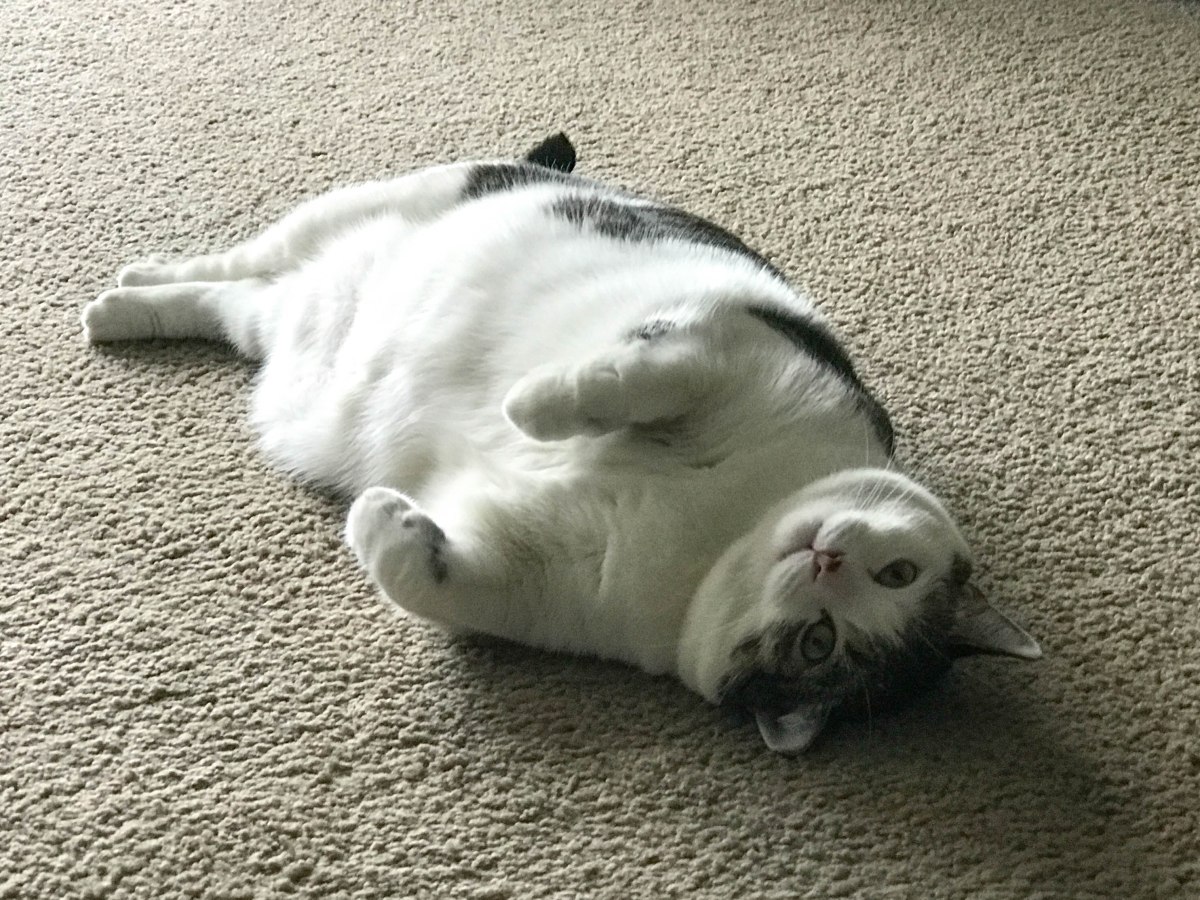
If cats could read newspapers, chances are they’d be gripped by a cold terror right about now, wondering if they’re among the unfortunates to have their yums curtailed by the same weight loss drugs their humans have been gobbling.
As the New York Times reports, a biopharma company headquartered in San Francisco, Okava Pharmaceuticals, is about to begin a trial to determine if GLP-1 drugs can help our chonksters slim down. More than 60 percent of American pets are packing extra pounds, the Times notes, while consequences like diabetes are shortening the lifespans and reducing quality of life for felines and canines.
“It is our belief that the condition of obesity, the condition of being overweight, is by far the number one most significant preventative health challenge in all of veterinary medicine,” Okava founder and CEO Michael Klotsman told the paper.

The upcoming study will include 50 cats. Most will receive a GPL-1 medication while a control group — about one third of the cats — will be given a placebo.
Since cats aren’t exactly known for being cooperative when it comes to taking oral medicine and weekly injections at a veterinary office are impractical, Okava has developed a system with a patch about the size of a microchip that will dispense the weight loss drugs over six months before a tiny cartridge needs to be replaced.
If all goes well with the trial, Okava will seek FDA approval and address other obstacles like convincing caretakers that their little pals can benefit from the feline version of Ozempic, Mounjaro and Wegovy.
That may be easier said than done considering our relationships with our furry friends and the role food plays in things like training, bonding and every day life
For lots of cat caretakers “their main way that they interact with and show their love to their pet often revolves around food,” Dr. Maryanne Murphy, a veterinary nutritionist at the University of Tennessee, told the Times.
How could the dynamic between cat and human change if the flow of yums is reduced to meals only? Will training — for everything from walking on a harness, to entering a carrier and fun tricks like high fives — still work if the reward is just a bit of encouragement or a scratch behind the ear?
An earlier weight loss drug developed for dogs, Slentrol, did not catch on because, as one veterinarian noted, “the main way [people] interacted with their pet was by feeding them, and seeing their excitement and happiness when they were eating the food.”

There’s also the not-so-small matter of cost. GLP-1 drugs are in high demand, and they’re expensive. One in eight Americans has taken Ozempic or one of its competitors. At times, the demand has threatened availability for diabetics, for whom the drugs were developed in the first place.
If the trials are successful and the GLP-1 drugs for pets gain FDA approval — which would require a series of much larger scale, more rigorous studies — the company hopes to offer them to consumers at a cost of about $100 per month per pet.
Even if this iteration of the drug fails, it’s unlikely to derail the larger effort. Vets have been prescribing tiny doses of the human version to cats with diabetes, and perhaps most telling of all, pet obesity continues to rise despite years of efforts by the veterinarian community to get people to play with their pets more and feed them less.
As Dr. Ernie Ward, a veterarian and founder of the Association for Pet Obesity Prevention, told the paper: “We haven’t moved the needle.”
And now we check in with our correspondent, Buddy the Cat. Buddy, what do you think about the possibility of GLP-1 for your species and the end of the proverbial gravy train?
Buddy? Bud? Are we having technical difficulties?
I’m sorry, ladies and gentlemen, we can’t find Buddy the Cat. We’ll resume this segment if and when we manage to locate him.
 Pain In The Bud
No doubt the malevolent FDA will approve it even though Ozempic has shown to have disastrous side-effects. It’s up to pet owners to perform their due diligence and not subject the felines to something that’s going to be of great detriment to their heath. But then again, I’m dreaming aren’t I?
LikeLiked by 1 person
IDK, none of the cats here are particularly overweight. Probably just as well. $500/month is not going to happen.
LikeLiked by 2 people
I think that’s gonna be a big obstacle, along with the issues the veterinarians raised. Whether we like it or not, cats are often food motivated. It’s written into their DNA and not something we can magically undo.
LikeLiked by 3 people
As an aside, but perhaps a side effect (LOL), there’s an intense push in the corporate takeover of veterinary practices. No doubt this coincides with the equally-intense push towards medicating our pets. $$$$$$$$$$$$$$$$$$$$$$$$$$$$$$$$$$$$$$$$$
https://x.com/WallStreetApes/status/1974528183103066622
LikeLiked by 1 person
I think the corporate takeover of vet practices is more like a corporate restructuring/raiding thing, where money men come in and see opportunities for “efficiencies” that veterinarians don’t employ because they would compromise care.
They’re looking to squeeze value out of the practices and destroying them as a result. It sucks. So many industries are preyed on by those parasites.
The pharma thing, I’m mostly indifferent to. Until someone can come up with a better way, the unfortunate truth is that it takes billions to do R&D, tests, clinical trials, etc, and only 5 to 10% of drugs get FDA approval and make it to market, for lots of reasons.
So a company might make a killing on drug A, but they take a beating on nine other potential medications for every successful drug.
If there’s no way to recoup the costs of R&D et al, what’s the alternative? Crowd sourcing? Or God forbid, only government agencies in the industry and no competition? There are no easy answers.
LikeLiked by 1 person
Remember, EVERY drug the FDA recalls they once approved. Every one. To trust the FDA is to trust…well…Death?
LikeLiked by 1 person
I really don’t get these arguments. The FDA is the regulating agency, so only drugs approved by the FDA can have their approvals withdrawn. The vast majority of withdrawals (90%) are due to small issues like defects with packaging or the manufacturing process, problems with non-medical bonding agents and things like that.
But more importantly, the fact that drugs are recalled is a good thing. It means the FDA keeps a close eye on drugs that make it to market, and it means the system is working.
It means the FDA keeps drugs on a probationary period of close evaluation for 10 years, which is what we want, isn’t it?
So many of these arguments boil down to “the system isn’t perfect.” No system is. We’re human. And like all things, then drug approval process reaches a point where getting more information through trials has diminishing returns, and things like extremely rare side effects won’t appear until millions of people take the approved medications.
More importantly, what is the alternative? I have never heard anyone offer a reasonable or workable alternative to the current process.
So that leaves us with what, exactly? Freezing all medical research and living in the dark ages because we cannot guarantee perfect knowledge of complex biological processes and the ways compounds interact with our biochemistry? I don’t think someone suffering from cancer or even a perfectly treatable disease wants to hear that nothing can be done because we can’t guarantee five people in a million won’t have adverse side effects. Even Tylenol and Advil have rare adverse side effects and not-so-rare inconveniences.
We are trying to make sense of a complex world. We’ll make mistakes. We’re human.
LikeLike
And cats don’t have the ability to tell their humans if there is something wrong if they do take it
LikeLiked by 2 people
Yikes… Buddy will never come out of hiding now until you offer him treats.
I’ve heard that GLP-1 comes with very nasty side effects. I’d hope this is only used in extreme cases, even so, this is too much to put on a cat who doesn’t know what’s happening.
LikeLiked by 1 person
But if the FDA recalls a drug, doesn’t that mean that they were unreliable to begin with?
LikeLike
Just so we know we’re talking about the same thing, a recall means the company voluntarily pulled a drug, which is obviously different than the FDA ordering a drug be taken off the market.
Anyway, it depends on the individual case. The much more common result is not a recall or the FDA revoking approval, but a change to the way the drug is sold, prescribed, packaged, administered, etc, and there are potentially thousands of reasons for changes.
Sometimes it’s because the instructions on the package aren’t clear, sometimes the manufacturer adjusts the dosage recommendations, sometimes it’s a problem with the manufacturing process, sometimes it’s a problem with a bonding agent or some other component that has nothing to do with the active ingredients, sometimes it’s because new data shows ingesting yields better results than topical application, and sometimes it’s because of side effects.
It’s impossible to generalize, especially when so many changes to a drug’s status have nothing to do with danger or efficacy.
I didn’t want to veer off topic because the story is about expensive weight loss drugs for pets, but I’m not gonna be drawn into “Big Pharma Is Evil” either because the situation is a lot more complex, generalizations aren’t helpful, and this is a pet blog.
Just like with politics, sometimes cat-related stuff is tangential (declawing bans, animal welfare laws, etc) but when it comes to political itself, there are tons of other sites dedicated to those discussions. I hope to remain focused on the unifying factor here, which is that we all love cats.
LikeLiked by 1 person
This is sick. Insane you would give a pet a drug like this when there are other ways.
LikeLike