
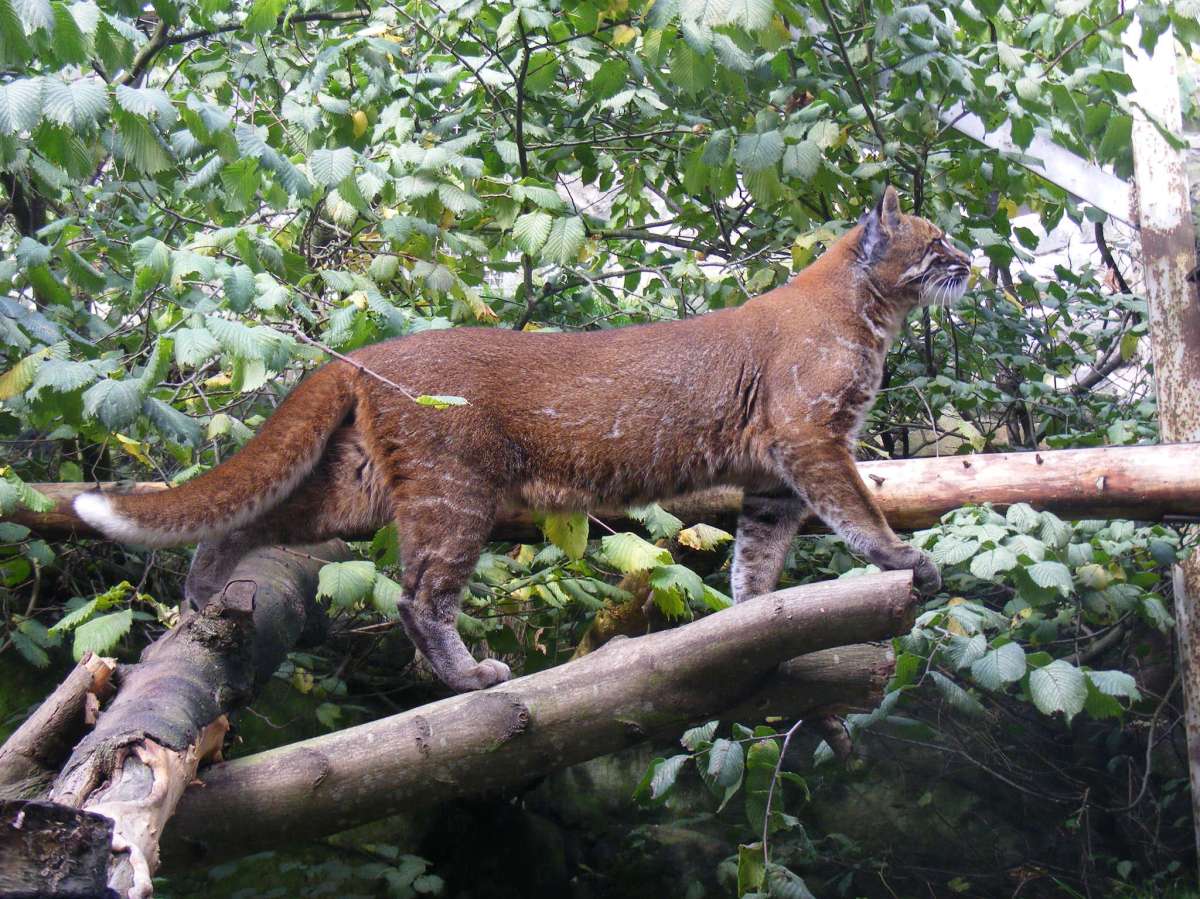
It’s extraordinarily elusive, moves with a grace superlative even among fellow felids, and enjoys mythical status in many of Asia’s cultures.
It is the Asian golden cat, a medium-size feline that calls a diverse range of places home, from the mountains of rural China to the jungles of Sumatra.
Known officially as Catopuma temminckii, the species is about three times the size of domestic cats but extremely adept at taking down much larger prey, including young water buffalo and other ungulates several times the cat’s body weight.

Asian golden cats inspire legends in many Asian cultures in part because of how difficult they are to find. Even the appearance of one on a trail camera in Thailand’s Khao Luang National Park this summer spawned news headlines, so rarely are they seen.
Often, as was the case with the recent sighting, they’re fleeting, just glimpses before the animals melt back into the jungle. The fire tiger seen in the June 20 trail camera footage pads across a clearing, clearly unhurried, before disappearing back into the ground cover.
In some places it’s good luck to catch a glimpse, while in other locales — like parts of Thailand — people believe a single strand of Catopuma fur is enough to protect the bearer from their larger cousins, panthera tigris. (I wouldn’t rely on that personally, but it does show how large tigers loom in the imagination in areas where they still roam the wild, even as low as their numbers are these days.)
While the Asian golden cat is known as the fire tiger in some places, it’s not a close relative of true tigers, at least not in terms of the cat family.

Catopuma is a feline, meaning it can meow and purr, but cannot roar. That puts the species closer genetically to domestic cats, pumas, ocelots, servals and other members of the feline subfamily. True big cats — tigers, lions, jaguars and leopards — are part of the pantherinae subfamily. Aside from their size, they are distinguished by their ability to roar, but they cannot purr or meow.

Even though catopuma is genetically closer to small- and medium-size felines, its gait, substantial tail and head shape are reminiscent of big cat features.
The ferocious medium-size cats also have a melanistic color morph that makes them look like smaller versions of jaguars and leopards.

The fire tiger is classified as threatened as its habitats are destroyed to make way for more palm oil plantations, among other agricultural and industrial facilities.
Header image via Wikimedia Commons
 Pain In The Bud
WOW- What a great article by Big Buddy, a real treat to read and see the pictures of these magnificent cats. Thank you for this and also how did a picture of Bella on her evening garden patrol get into this article? !! – wonderful
LikeLiked by 1 person
Thanks, John. I’ve done at least five or six “Amazing Cats” features over the last two years or so, but I should do more.
There are some really interesting species, and some that are very rare or exist in hard to reach locations, like the Sunda clouded leopard, have been reclassified into two or more subspecies after studies revealed distinct differences in populations.
Even those of us who are cat enthusiasts can be surprised by lesser-known types.
It’s funny that you say that about Bella, because when I was reading about the melanistic color morph and saw some of the photos, I wondered if lesser known medium-size wildcats like catopuma could be responsible for “big cat” sightings in certain places.
I use Wikimedia Commons for most of the photos on PITB because they’re public domain, but if you do an image search for melanistic catopuma, you can see how they could easily be mistaken for other cats, especially at a distance. National Geographic has some stunning photos of black catopumas.
LikeLiked by 2 people
What a glorious cat! I love seeing the smaller wild cats of the world. I hope they will be successfully protected. I avoid palm oil like the plague.
LikeLiked by 2 people
The companies that make and buy palm oil should be penalized in criminal and civil courts for destroying irreplaceable old growth jungles, the incredibly biodiversity within those jungles, and the resulting damage to the Earth, which is incalculable.
We’re all on this planet. No one should be allowed to sow that kind of destruction, let alone soulless shareholders and CEOs.
The harm they’ve visited on orangutans is heartbreaking, and that’s only the most visible species impacted by it.
I do my best to avoid palm oil as well, assuming food companies are even honest about their ingredients.
LikeLiked by 2 people
My dietitian said that palm oil and coconut oil are awful for your heart and should be assiduously avoided. They will clog your coronary arteries. Trust me, you don’t want that happening.
LikeLike
Love that melanistic specimen.
LikeLiked by 1 person
This one was taken by a pro photographer and is much better than the trail camera photo:
https://www.joelsartore.com/ani019-00539/
LikeLiked by 1 person
The fire tiger has eyes like Ringo Starr
LikeLiked by 1 person
What a beautiful animal. And smart enough to avoid humans.
LikeLike