
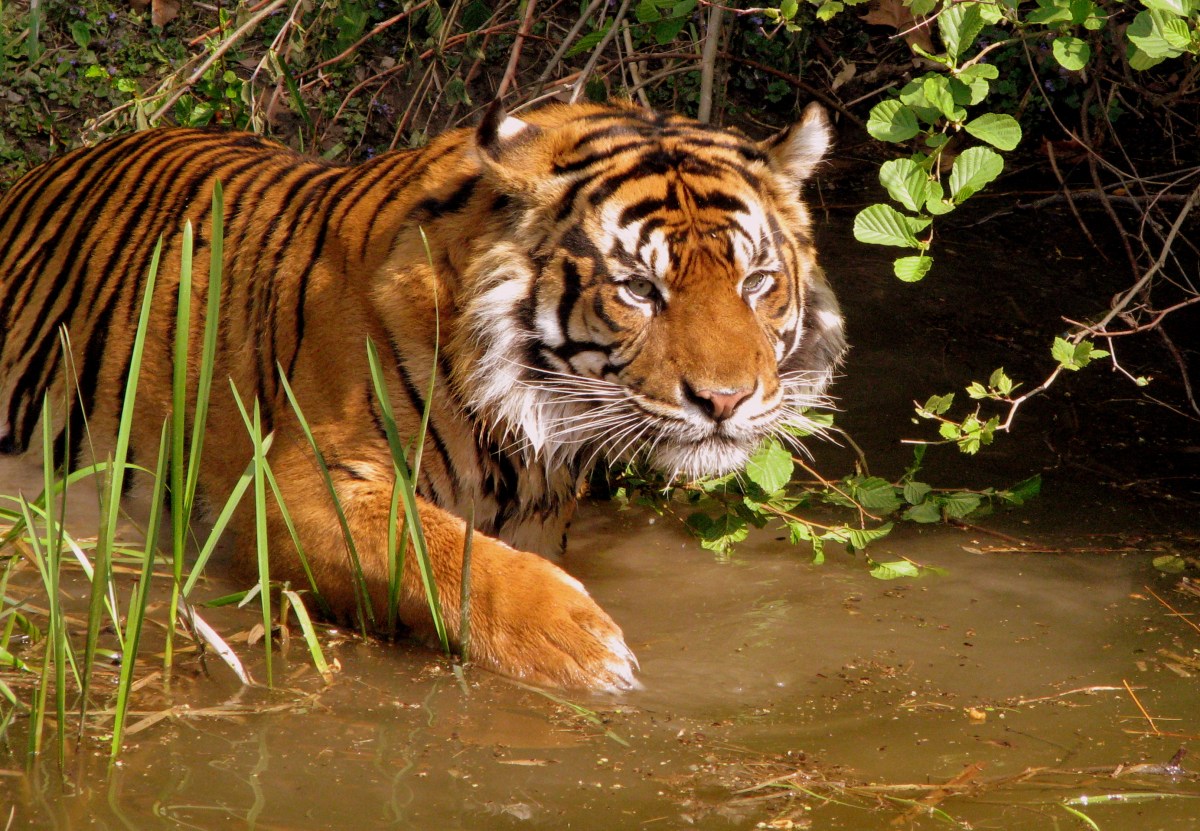
In his memoir, Man-Eaters of Kumaon, legendary tiger hunter (and later staunch conservationist) Jim Corbett described how he and his men arrived to find a ghost town when they tracked a man-eating tiger to a rural village.
Every door was closed and locked, shutters were closed tight, and despite the fact that it was harvest time, not a single person was working the nearby fields.
The people who lived there had good reason to be petrified. The infamous Champawat tigress had killed more than 430 people by that point, including a young woman from the village just a few days earlier. Usually the tigress would vanish from an area after a kill, frustrating locals and hunters by popping up virtually anywhere in a 50-mile radius, but for some reason she stuck around the village and sat on the outskirts at night, keeping the local people awake with her calls.
Corbett’s famed hunt of the “demon of Champawat” happened in 1907, and although it might sound like a problem from the past, it’s current reality for people in parts of India, Nepal and, to a lesser extent, the sparsely populated mountain forests in eastern Russia.
In Garwha and Ranchi, two towns in eastern India about 215km (133 miles) apart, “villagers have stopped using forest routes to reach markets and are reluctant to leave their homes for work,” the Times of India reported on Monday.
That’s because hungry tigers have been on the prowl, demonstrating little fear of people as they help themselves to livestock. Between Jan. 1 and Jan. 6, the tigers killed and ate three cattle and a buffalo.

So far they’ve eluded camera traps, but forest rangers say they believe there are two tigers because of the distance between Garwha and Ranchi, which is almost three times the typical tiger range.
In places where big cats live in proximity to humans, especially farmers, the government pays compensation to the owners of livestock killed and eaten by the predators.
There’s also a separate, more controversial compensation program for the families of people killed by tigers. Recent court cases in the country have hinged on the cold calculations of attaching monetary value to human life, and whether families are owed compensation if their relatives knowingly entered tiger preserves.
For India, it’s part of a delicate balancing act between conserving the country’s national animal and one of nature’s most beloved species, and avoiding the ire of people who are impacted by their presence. When big cats prey on livestock, if the government does not address the situation, locals will eventually take matters into their own hands and try to kill the apex predators. That usually doesn’t work out well for either side.
On average, about 60 people are killed each year by tigers in India, according to government statistics. There’s been a sharp increase in victims in recent years, with tigers taking 110 human lives in 2022 and 83 in 2023, although it’s not yet clear why.
As for livestock, a 2018 study by wildlife biologists with the Corbett Foundation documented 8,365 reported instances of big cats killing cattle, buffalo and other animals between 2006 and 2015. That works out to about 830 per year, with tigers responsible for 570 livestock kills on average and leopards responsible for the rest.
To reduce the number of inter-species conflicts, the government of India has relocated thousands of families away from the country’s 27 tiger preserves in addition to compensating farmers for their losses.

On a tangential note, this is another reason why the persistent claims of big cats stalking the British countryside strain credulity.
To paraphrase wildlife conservationist Egil Droge of the University of Oxford, when big cats live in an area, you know it because the signs are everywhere — massive and unmistakable pug marks (paw prints) on the ground, trees left with deep gauges by males marking their territory, and dung also serving as a territorial marker.
“I’ve worked with large carnivores in Africa since 2007 and it’s obvious if big cats are around. You would regularly come across prints of their paws along roads. The rasping sound of a leopard’s roar can be heard from several kilometres,” Droge wrote in a 2023 post about alleged big cat sightings in the UK.
Last but not least, big cats eat. A lot. A reliable supply of large prey animals is necessary to support even the smallest of breeding populations, and felids of all species are known to go for easy meals — in this case livestock — when the opportunity presents itself.
Still, the idea refuses to die, and there are still regular reports from people who have seen large cats and insist they’re not our domesticated friends.

 Pain In The Bud
When I lived in rural Oregon, I found the pug marks of a large mountain lion right outside the cabin. Evidently the big cat would rather take the footbridge over the creek than wade through the water.
LikeLike
That’s a smart cat. Can’t say I’m surprised either, as I don’t remember reading anything about pumas having a jaguar- or tiger-like fondness for swimming.
LikeLike
Thanks for the info. I have saved it for further use.
LikeLike
Cheers, Susan. I think it’s a fascinating situation over there.
LikeLike
I think the biggest reasons why Tigers are becoming more opportunity hunters is the fact that people exist and we’ve given them no other options. Humans have stripped these animals of their habitats, which means all the animals they would’ve hunted on that land are gone. What do people think these animals are going to eat? Rocks?
Stories like this really piss me off Humans think we can do whatever the hell we want and there’ll be no consequences for our actions. And when there IS a price to pay, we stand there and act surprised. Like we never thought that was coming. Humans don’t like taking responsibility for endangering and extinguishing other species. “They don’t matter, we’re better than they are, and so we’ll do whatever we want”. The single worst mistake ever made was creating Humans.
It may be heartless, but I really don’t feel sympathy for the farmers at all. 60-100 people a year being killed in a country of how many millions of people is a small price to pay for having Tigers living in your backyard. They should be glad they have these beautiful cats in their lives. Yes, I would be pissed if my family member were to die this way. But you know what? I’d think, people pushed them to it. They have no other choice but to do this or die.
I will side with the animals EVERY time, hands down.
LikeLike
I think all loss of life is tragic, and trying to sell the general population on the idea that a few deaths are okay is a losing battle in the west anyway. If a person goes to a zoo and ignores every safety rule on the books, ignores all the signs, and hops several layers of barriers to enter a tiger or gorilla enclosure, and they get hurt, what happens? We shoot the tiger or gorilla, regardless of how recklessly the person acted.
The first thing I thought of when I read about the number of people killed and the compensation program is that the people and government of India are remarkably tolerant.
We all know if even a handful of people were killed by pumas in a single year here in the US, people would be out in force with their guns, slaughtering them. Heck, it already happens now when pumas are spotted on the edges of civilization or attack the occasional pet.
Although it should be noted that pumas rarely ever attack humans, and always flee. The exception is when people threaten their cubs, knowingly or not.
So India has tigers, which are very much apex predators and can become man-eaters, while we have pumas who run when they see people, and yet we are far more aggressive when it comes to killing our wild cats.
That’s why it’s best to keep people away from the preserves as much as possible.
Still, some people won’t listen. One current problem in Yellowstone is people walking right up to bison to pet them and take selfies with them. These people are treating animals that weigh up to 2,200 pounds as cuddly pets. That’s asking for tragedy, and several people have been gored in recent years.
LikeLike
Unfortunately, the human population has outstripped the land available. I can’t imagine being afraid to go outside because I might be eaten by a large cat.I have no doubt that if the little ones were that big, they would behave the same way. It’s a survival instinct. And cats are better hunters than we are.
LikeLike
There’s an interesting quote from Jim Corbett in the book I mentioned, Man-Eaters of Kumaon, in which he says for every tiger attack there are thousands of times people practically trip over tigers without knowing they’re there, and the tigers leave them alone,
It’s the same in the Amazon, where naturalists say jaguar eyes are on people from the moment they venture into the jungle. We’re simply not aware because they stay hidden and have no interest in bothering us.
Big cats don’t understand the concept of ownership, so they don’t see anything wrong with going after livestock. Heck, even little cats don’t recognize ownership…my bed has been my cat’s bed since the day I brought him home.
LikeLiked by 1 person