
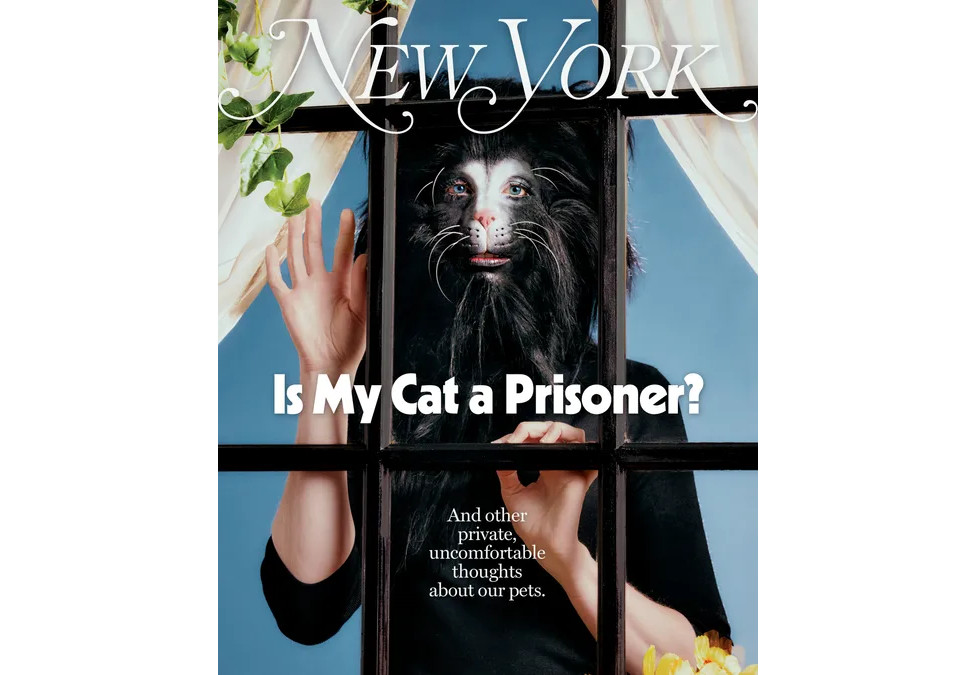
Almost the entirety of New York magazine is devoted this week to what its editors call “an exhaustive exploration of the ethics of pet ownership.”
The magazine treads a minefield with articles like “Why Did I Stop Loving My Cat When I Had A Baby?“, “Am I a Terrible Pet Parent?“, and “Was I Capable Of Killing My Cat For Bad Behavior?”
There are also articles about what veterinarians really think of “pet owners,” whether runaway dogs deserve to be free, and even a story asking whether the word “owner” is appropriate to begin with. (You’ll notice PITB almost always avoids that word, unless we’re quoting others. I refer to myself as Buddy’s servant and his caretaker, words that feel more honest than owner.)
The stories are worth reading. Some are free for a limited time, others can be read as part of the weekly article limit. And if you can afford it, supporting a magazine or two during these brutal times for the publishing industry is a good way to help quality publications survive, so we’re not all drowning in a sea of clickbait garbage tuned for algorithms instead of human readers.
Regular readers of this blog are likely familiar with the story of Bud’s one and only “escape” as a kitten. When I found him, this cat who hates being picked up leapt into my arms, holding onto me like a terrified toddler, and his relief was palpable as I felt him purring into my neck. We were both relieved.
He’s had the opportunity to leave since, but he won’t. He’s got a good thing going here, living like a little king with his personal servant. He gets tons of attention, he’s allowed to do pretty much anything he wants as long as it isn’t dangerous for him, and he loves his Big Buddy.
I know he does from the way he approaches me, purring and meowing happily as he bunts his forehead against mine. I know it from the way he makes biscuits on me and falls asleep in my lap, feeling content and secure. And I know it from his refusal to leave my side the two times I was so sick I could barely move.

We shouldn’t feel guilty for giving cats a home.
I think we tend to forget that as domesticated animals, cats don’t have a natural habitat. The process of domestication made them friendlier, more trusting and more capable of reading human body language, facial expressions and tone of voice.
But those changes came at a cost, as they always do in domestication. Felis catus looks like its wild relatives and retains many of the amazing abilities of wild cats, but compared to them the species has lost a step. Domestic cats are not as quick or agile, they’re too trusting, and they’re not well suited to providing for themselves. The statistics on life expectancy reflect that, with ferals and strays living short, miserable lives.

So if felis catus has a habitat, it’s our living rooms. When our ancestors welcomed them into human settlements ten thousand years ago, they formed an indelible bond and made a pact, even if they didn’t realize it at the time.
Consider it a debt we owe for the survival of our species, when nascent civilization would have likely been snuffed out were it not for cats protecting the grain stores over long, cold winters.
Without cats, rodents would have eaten their way through the season’s rations, starving out the early settlers before the next harvest. The great agriculture experiment would have been over as quickly as it began with people returning to the nomadic life of hunter-gatherers, and it’s likely that everything after — from the first cities, to the birth of western civilization in Greece, to the remarkable achievement of putting a human being on another world — would have been jeopardized or taken radically different paths otherwise.
So you can thank your cat for your house, your car, the medicine that keeps you tip top, all the comforts of modern civilization, and all the stories and songs of humanity. Without cats and their heroic willingness to eat their way into our good graces, we wouldn’t have gotten here. Thank them often. You can’t go wrong with treats.
 Pain In The Bud
Why Did I Stop Loving My Cat When I Had A Baby? One. I think something is wrong with that person and NEVER loved thier cat in the first place. Two. Most people do not feel that way who had kids when they had a cat. Two. Like my MALE client just told me a week ago, my two cats and dog are my babies just like my human baby. That is one reason his wife fell in love with him.
LikeLiked by 3 people
It’s an adjustment for the pet and the family, but lots of people make it work. I think it’s good when kids grow up with animals and, when they’re a little older, take on some responsibility in caring for them.
LikeLiked by 2 people
Yes. And three. Middle finger to the bs that cats are prisoners.
LikeLiked by 2 people
New York magazine is owned by Vox Media who is a purveyor of lies and disinformation.
LikeLiked by 1 person
I’m not a fan of Vox’s pointlessly ideological site, its vertical that poisons discussions about movies and gaming with politics, and some of the content from The Cut, like allowing people to anonymously accuse others of sexual harassment, but New York magazine has an old and storied history and still produces some good stuff, like the Anna Delvey story that became a Netflix series.
That’s not to say I like all or most of what they publish, but I do appreciate quality content in this sea of clickbait re-aggregated garbage written by machines and/or teams of marginally literate producers from content mills.
As for the cat stuff in the newest issue, I found some of it to be the usual hand-wringing, navel-gazing sort of thing that needlessly complicates the simple joy of having a cat, but some of it was thoughtful too. I will continue to avoid calling myself Bud’s owner in favor of calling myself his servant.
LikeLiked by 1 person
Couldn’t easily access the articles but have seen some of these issues raised and agree with you, we’d be hunter-gatherers and maybe also herders without cats. The domestic cat, even when feral, is drawn towards areas with humans now for food and shelter, not wilderness. We lived in a forest. One visitor, seeing our cats were indoors only, told them to “run for your freedom”. The cats said, “Are you nuts? There’s coyotes out there.” Though domestic cats retain many wild traits, they, and domestic dogs, do differ from their wild relatives.
LikeLiked by 1 person
That is why cats deserve all the snacks and their lofty positions in our homes.
Of course we all know Buddy stays indoors because he’s a fierce jaguar who can’t be allowed on the mean streets, and not because he runs screaming at the rustle of a leaf in the wind or the squeak of a truck’s breaks.
LikeLiked by 1 person