Mars, The Pet Food Company, Claims There’s A ‘Treat Gap’ Between Cats And Dogs

The makers of Temptations want you to feed your cats more snacks, as if they don’t get enough!

In yet another indication that some people don’t seem to pay attention to their feline masters, the Wall Street Journal reports on Mars and its internal operation “Cattitude,” which as far as I can tell amounts to a few people within the company realizing they haven’t squeezed every last dollar of revenue from people who have cats.

That’s a problem, the company realized, because more people are adopting cats, younger generations are more likely to adopt felines, and anyone who hasn’t had their head in the sand knows the little ones rule the internet with their cuteness.

Through “Cattitude,” which apparently involves everything from executives walking around the office wearing cat ears, to handing out “I Love Cats” decals and consulting with “cat parents” on products, the company says it’s identified a “treat gap” between felines and canines, with dogs as the far more frequent beneficiary of yums:

“Feline insecurity can be self-fulfilling. If you think your cat doesn’t care, you might be less likely to shower them with perks. That may be why dogs get way more treats. 

Mars launched a campaign in May that spotlights the “treat gap” by the numbers: Dogs are nearly 32% more likely to get daily treats than cats in dogs-only and cats-only households; in homes with both, 38% of parents said they don’t give the same number of treats.

The story does not say how the company arrived at those numbers. Probably market research in the form of surveys. Not exactly scientific, as these things go.

This is one of those stories that makes me wonder if these people actually have cats.

From the moment I wake up until the second I settle into bed, Bud shrieks at me for snacks. He won’t even let me stumble into the bathroom before the first shrill reminders. He demands snacks before dinner, after dinner, after he’s had snacks, and sometimes while he’s eating them.

If he could speak English and hold a bull horn, I have no doubt he’d spend the majority of his day blasting the demands into my ears: “MOAR SNACKS, BIG BUDDY! MOAR! MOAR!”

Mars should know this. One of its most popular products, Temptations, turns cats into slobbering addicts. I had to wean the Budster off them, then stupidly bought them again months later and had to wean him off the Temps again because he has a one-track mind when they’re in his bloodstream. Two are not enough. Six are not enough. Ten are not enough.

One time, I left a big tub of the damn things unattended for a minute and he managed to pop the top off by knocking it off the coffee table. When I walked back into the living room, he was dragging his jaw along the floor like a bulldozer, inhaling as many as was felinely possible into his little mouth.

Frantically, I shooed him away and began picking them up, but the damage was done. He threw up a few minutes later. Then he shrieked for more!

He always looks innocent, doesn’t he?

Interestingly, the WSJ notes that if you type “Does my cat” into Google, the first two auto-complete suggestions are “Does my cat love me?” and “Does my cat know I love her?”

And that brings us to a point on which I agree with the people at Mars: cats still aren’t well understood.

Dogs happily slobber over their people. Cats show their love in subtle ways, like proximity, head bunting and momentary contact.

Just like the whole “cats love milk” thing is half myth, half misunderstanding, so is the idea that your cat doesn’t love you unless he’s leaping into your arms to hug you as saccharine orchestral music swells in the background.

While there are always outliers, most cats don’t like being hugged or picked up, and most have hard limits when it comes to the amount of physical affection they’ll tolerate. It’s not because they don’t care for us, but because they’re semi-domesticated carnivores who still retain the skittish tendencies of their wild brethren, and because they get easily overstimulated, among other reasons.

If Mars’ Cattitude is an ongoing thing, I hope the decision-makers in the company come to what I believe are two of the most important conclusions to keep in mind when it comes to cats. Giving them your love means giving them your time and attention, and treating them like the sentient, emotional creatures they are.

The best piece of advice I ever got was to always take your cat’s emotions into consideration.

It really is that simple.

Now if you’ll excuse me, I have snacks to dispense.
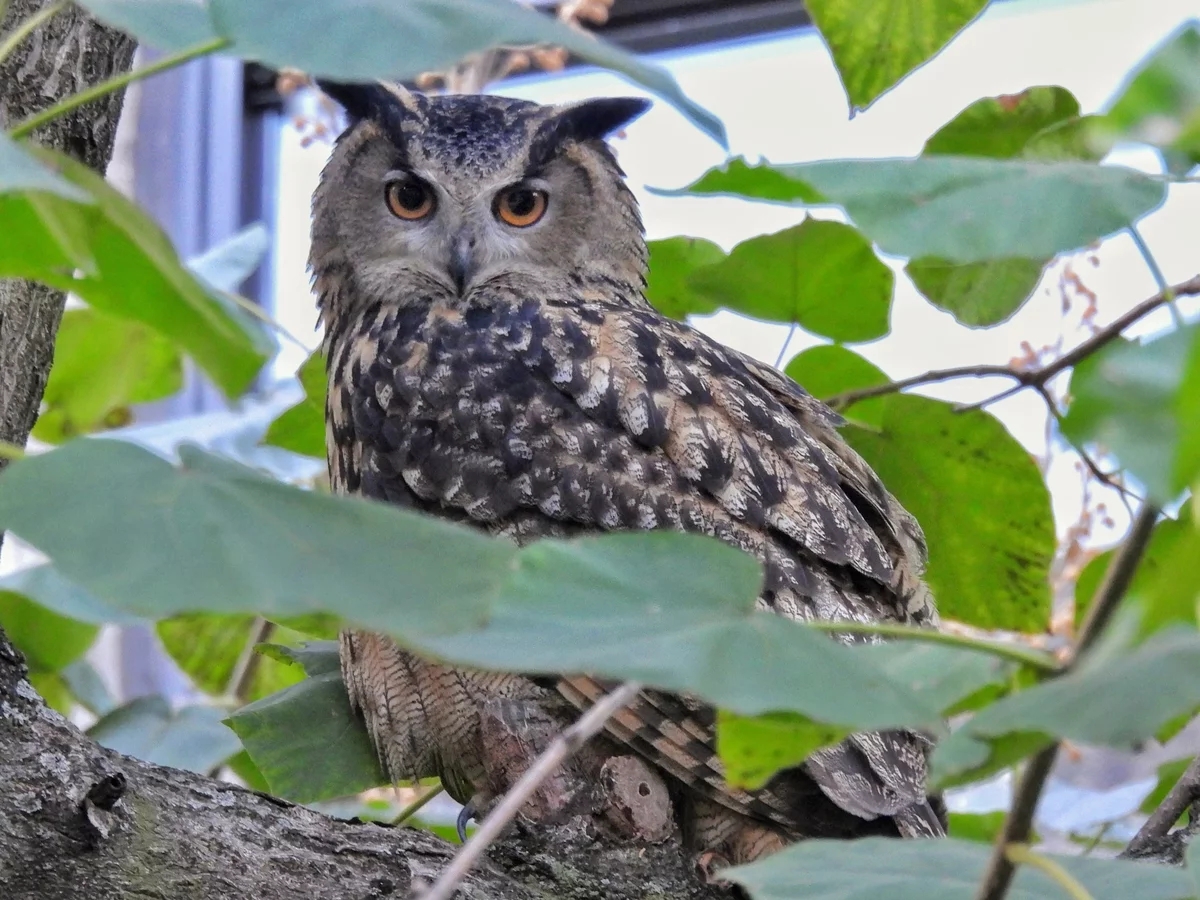
Owl’s Well That Ends Well For Manhattan’s Most Famous Wild Animal

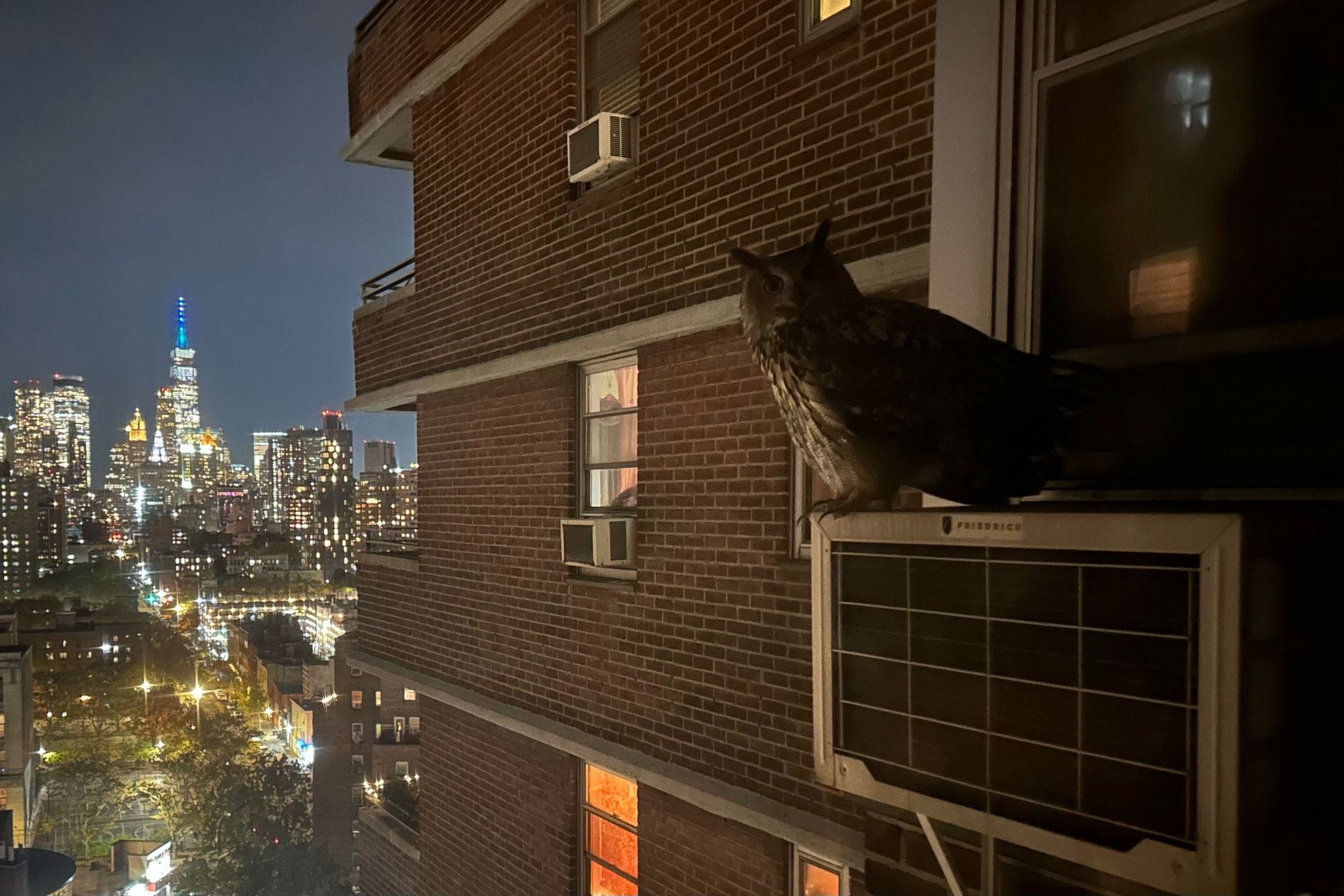
Flaco the Eurasian Eagle Owl has become a New York celebrity since he escaped his enclosure at the Central Park Zoo early in 2023.

He’s been spotted flying through the concrete canyons of midtown, perched on fire escapes on the upper east side and ridding New York of its vermin — but he’s not your friendly neighborhood Spiderman.

He’s Flaco the Eurasian eagle-owl and New Yorkers have been rooting for him ever since he escaped from a small enclosure in Central Park Zoo and decided the entire park and its environs would be his domain.

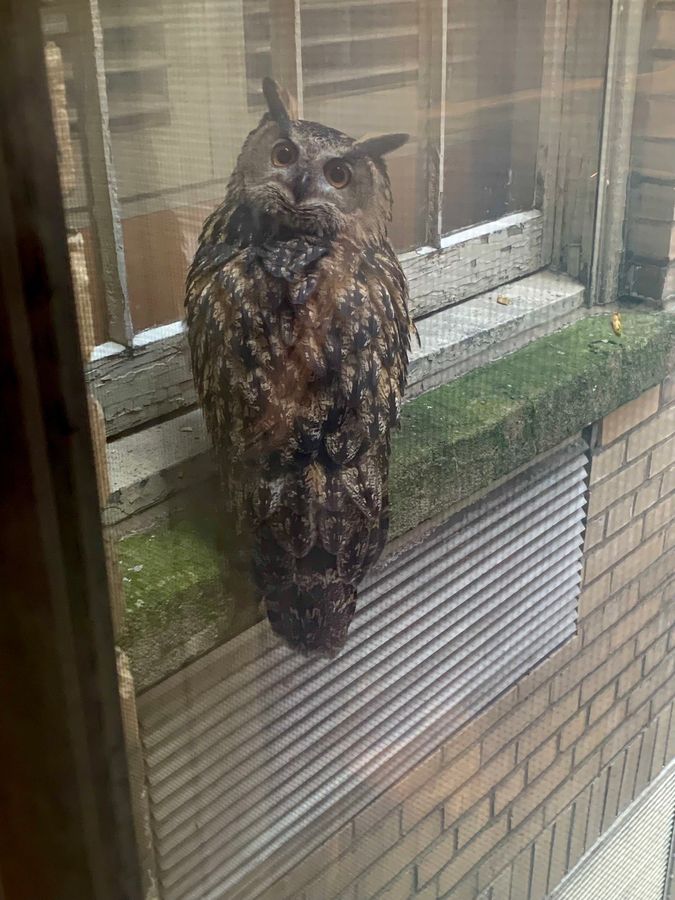
Since then, Flaco has evaded capture, put aside concerns that he’d be able to survive in the big city and shocked the hell out of New Yorkers who have seen the curious little guy’s face pressed against the glass of their apartment windows, watching them intently.

“I audibly gasped,” 24-year-old Matt Sweeney told the Wall Street Journal after he realized something or someone was watching him through the window of his upper west side apartment.

“It absolutely scared the you-know-what out of me,” 31-year-old actress Reilly Richardson told the paper after she woke up one morning to find the peeping predator watching her from outside. “It’s New York City. It’s the last thing you expect to see.”

Flaco escaped Central Park Zoo in February after his enclosure, where he lived for 12 years, had been “vandalized,” according to zoo staff. It turns out someone sliced an opening in the mesh, giving Flaco an out which he quickly took advantage of.

For the next few months zookeepers chased him around Central Park, trying to lure him back with food and the recorded sounds of other owls, but Flaco wasn’t having it. In the meantime he became a celebrity, New York’s version of the famous mountain lion P-22, with crowds of birders and curious onlookers assembling to watch and photograph him.

Flaco NYC
Credit: New Yorker Robin Herbst-Paparne, who spotted Flaco outside her apartment. Via WSJ

Social media accounts tracking the raptor’s movements sprung up online, and all the attention became too much. Even though zookeepers gave up on returning him to his enclosure, Flaco apparently decided he was done being watched and became the watcher.

Since then he’s popped up all over Manhattan, delighting New Yorkers and giving others a scare as they noticed the two-foot owl tracking them from a fire escape or a window perch. In early November he left the comfy confines of Central Park — possibly spurred by the crowds and commotion of the annual NYC Marathon — and began exploring the city proper, popping up in random places each day.

Initially people were worried Flaco, who had spent his entire life in captivity, wouldn’t be able to feed himself. The owl quickly put those concerns to rest as he proved adept at feasting on New York’s abundant rodents, earning himself the nickname “New York’s Rat Czar” at a time when Mayor Eric Adams has declared war on the vermin.

Experts are divided on why Flaco is spending so much time watching people. As the only known Eurasian eagle owl living “wild” in North America, the little guy may be looking for a mate. They say he won’t find one of his species, but he could find an unpaired female of another species if he’s lucky.

Others say Flaco, who was raised by humans and isn’t afraid of our species, may believe a human could be his mate. That’s another way his predicament mirrors that of P-22, who settled in Los Angeles’ Griffith Park and became a local celebrity, but was cut off from potential mates by busy highways and miles of human-inhabited land.

Flaco
Nan Knighton, whose apartment faces Central Park, snapped this shot of Flaco outside her apartment.

Regardless, people in New York are enchanted by the unusual resident and delighted to see him. Nan Knighton, who took the above photo (via WSJ) told the paper she had an intense encounter with Flaco. After realizing a pair of intense eyes were tracking her inside her home, she made friends with the curious owl:

He stuck around for three hours. 

“I talked to him,” says Knighton, recalling telling Flaco he’s beautiful and gorgeous, and that she couldn’t believe she was speaking to an owl. When she walked into another room, Flaco’s head swiveled to follow her. 

Flaco stayed quiet until Knighton got within 6 inches of his face. “He just let out this little tiny hiss,” she says. “It was kind of like, ‘OK, I like you, but I don’t want to be beak to beak.’”

She turned her back to the owl to write something down. When she looked back, Flaco was gone.

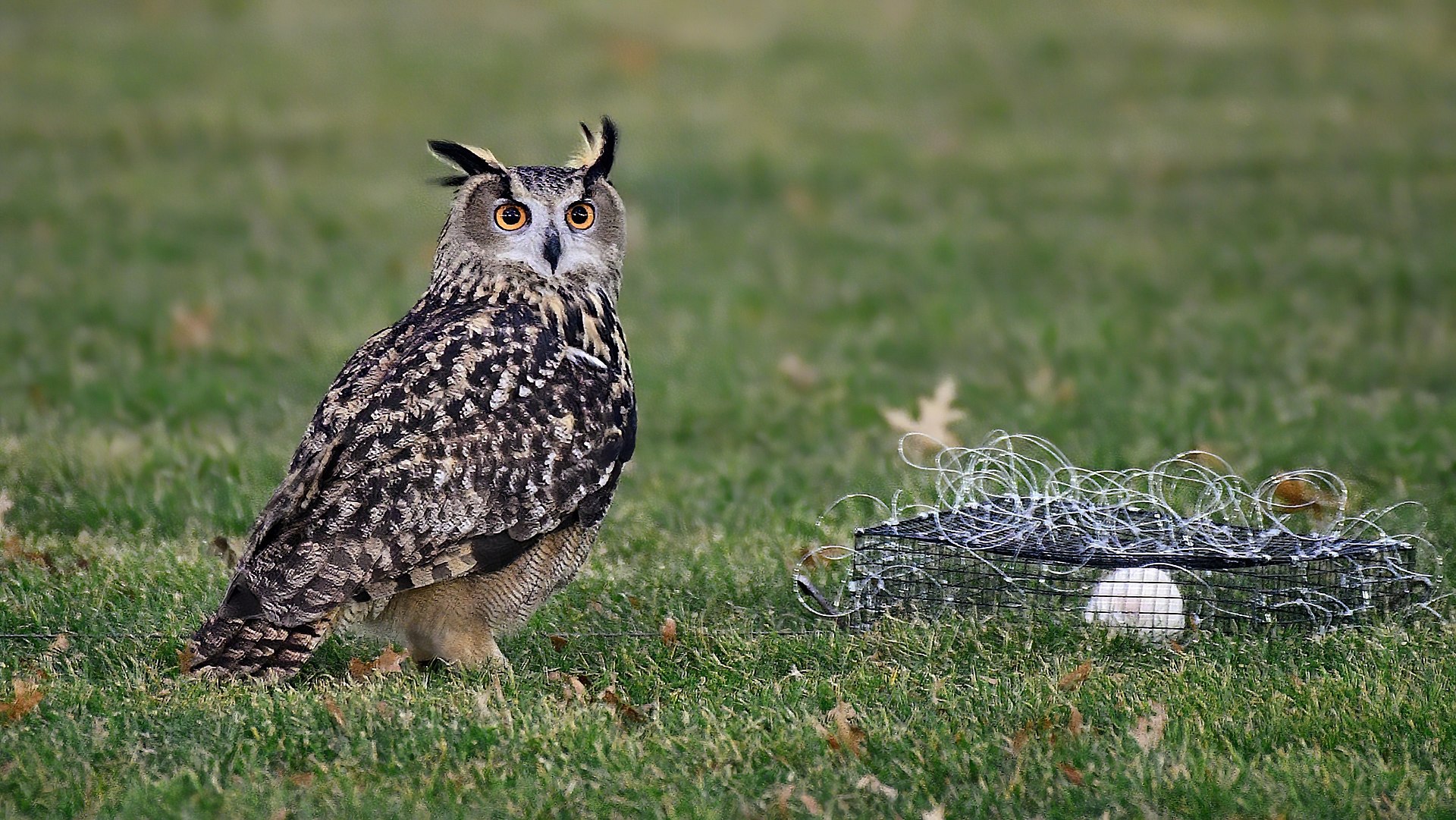
Flaco_with_trap
Flaco proved too smart for zookeepers who tried to entice him with traps like the one above. Credit: Wikimedia Commons

Cat Guys Get No Respect

Data from Match.com suggests being photographed with cats hurts single straight men’s chances of connecting with female users.

Remember the study from this past summer that claimed single men with cats are perceived as “less masculine” and are less likely to score dates than their cat-less counterparts?

Now Match.com has some bad news for us as well, saying their internal data shows men who have cats are less attractive to women on the popular online dating platform. From the Wall Street Journal:

‘If you’re a heterosexual man looking for love this Valentine’s Day, here’s something you probably don’t want to do: include a cat in your online dating profile.

“Chicks don’t want a guy with a cat,” said Rachel DeAlto, chief dating expert for Match, an online service that promises to connect compatible romantic partners.’

The Match.com data mirrors the data from the earlier Colorado State University study, which showed women photos of men with and without cats. When the authors asked women whether they’d consider dating those men, the female participants said they were less likely to date the cat servants by a margin of about five percent. Match.com’s data says men with cats are five percent less likely to receive “likes” than men without cats.

“Men holding cats were viewed as less masculine; more neurotic, agreeable, and open; and less dateable,” said study authors Lori Kogan and Shelly Vosche, who titled their paper “Not the Cat’s Meow? The Impact of Posing With Cats on Female Perceptions of Male Dateability.”

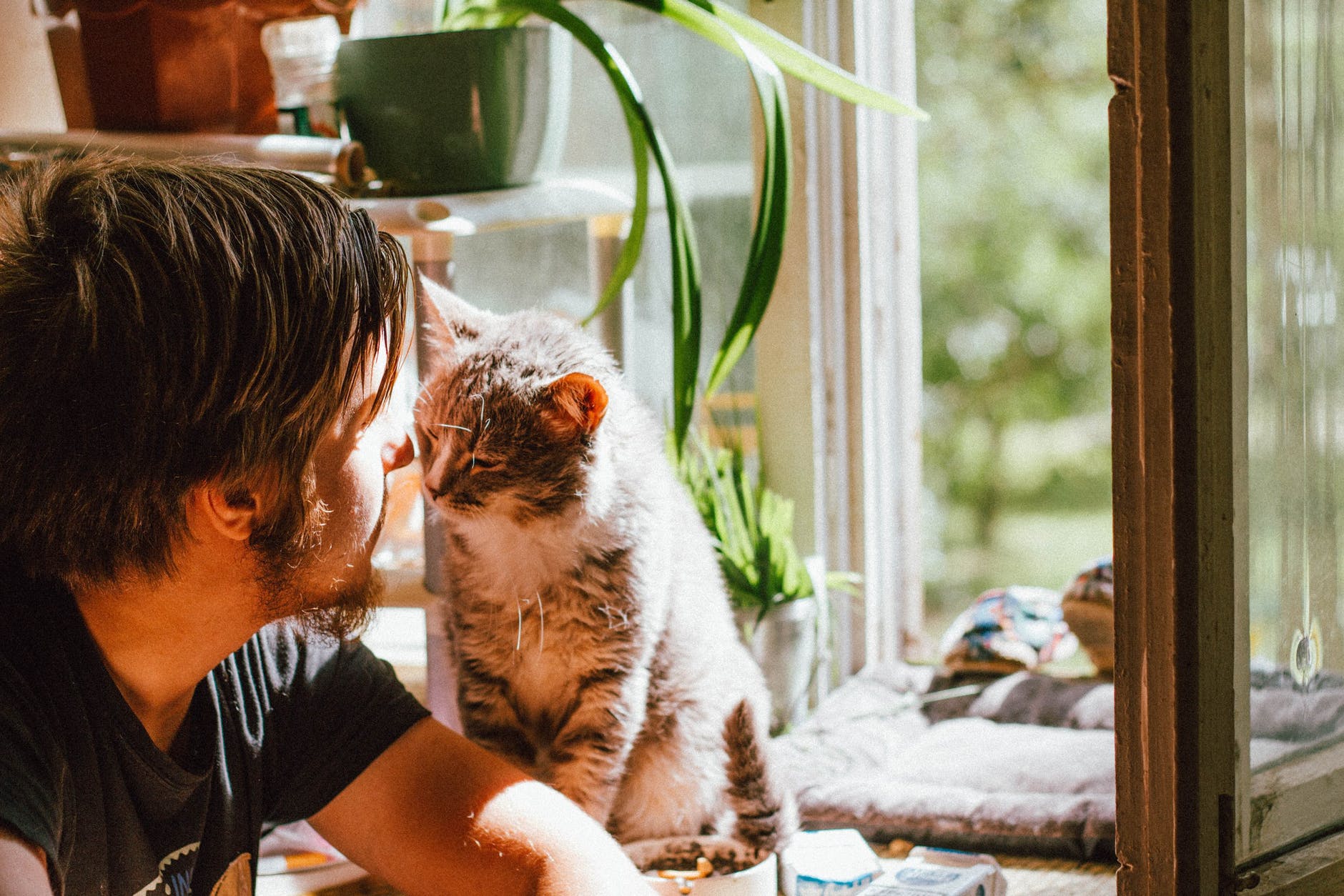
cute cat smelling unrecognizable bearded man on windowsill at home
Photo by Yuliya kota on Pexels.com

That study was limited: The authors worked with about 700 female participants who were all between the ages of 18 and 24. At the time, we speculated that the anti-cat bias would probably be negligible among women in older age brackets, but there were worrying signs, including the idea that men who care for cats aren’t as manly as men who haven’t discovered the joys of hanging with a miniature tiger.

“Women prefer men with ‘good genes,’ often defined as more masculine traits,” they wrote. “Clearly, the presence of a cat diminishes that perception.”

The results, they said, indicate “women are more likely to seek masculinity first, then consider other components of the potential mate.”

The findings were “influenced by” whether the women self-identified “as a dog or a cat person,” although it wasn’t clear just how much that impacted their responses.

Vosche and Kogan speculate “that American culture has distinguished ‘cat men’ as less masculine, perhaps creating a cultural preference for ‘dog men’ among most heterosexual women in the studied age group.”

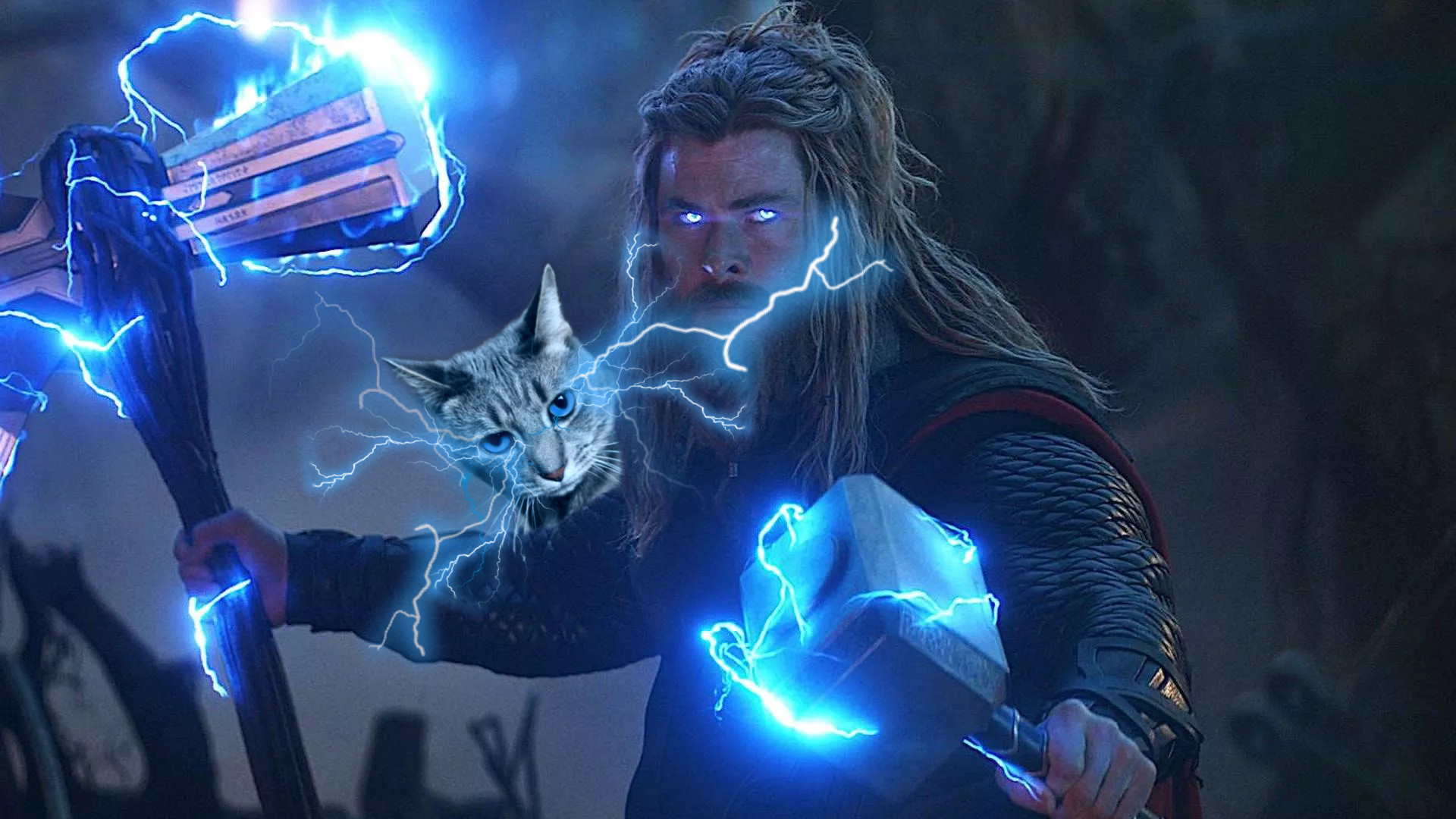
That study also prompted us to write a fake news post headlined: “Study: Male Actors, Models Are 96% More Handsome When Pictured With Buddy,” alongside the “proof”: A photograph of actor Chris Hemsworth in a fat suit, sans Buddy, and a photo of Hemsworth playing Thor the god of thunder, pictured with Buddy and looking heroic. Haha!

Thor with Buddy
Australian actor Chris Hemsworth photographed WITH Buddy, illustrating a dramatic difference in perceived power, masculinity and handsomeness.

It’s worth pointing out the difference is in perception. There’s nothing to indicate men who care for cats don’t have “good genes” any more than there’s evidence that men without cats have supposedly superior genes. Rather, as the study authors note, the perception is reinforced by cultural biases, at least here in the US.

Likewise, both the Colorado State University study and the Match.com data are looking at first impressions based on photographs, which means women are evaluating the men in question based only on limited visual information, to the exclusion of everything else that factors into whether one person views another as attractive.

We don’t know if the same biases hold true in other situations. For example, how would women respond to men who are out and about walking their cats on harnesses? How would they respond to a man who casually mentions he’s got a cat back home?

The Match data also cuts both ways, to the detriment of women. While straight men with cats receive five percent fewer “likes” than other men, straight women with cats suffer an even larger perception penalty, receiving seven percent fewer “likes,” probably due to the “crazy cat lady” stereotype.

Some people think that makes perfect sense:

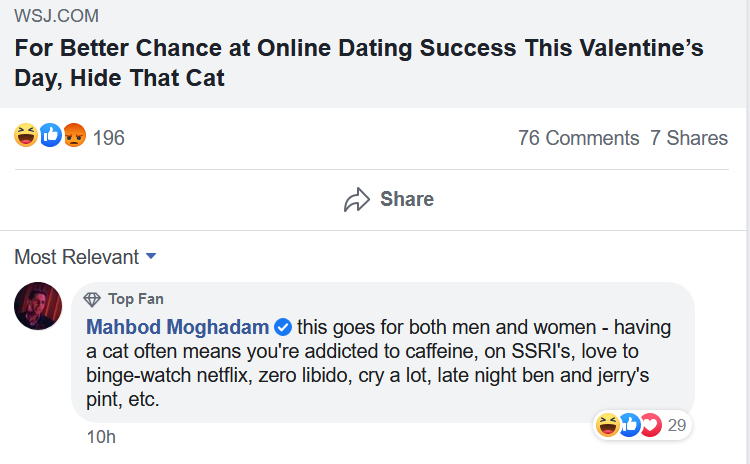
Screenshot_2021-02-12 The Wall Street Journal(1)

“[T]his goes for both men and women – having a cat often means you’re addicted to caffeine, on SSRI’s [sic], love to binge-watch netflix, zero libido, cry a lot, late night ben and jerry’s pint, etc.,” Mahbod Moghadam wrote in a Feb. 12 Facebook post in response to the WSJ story.

Mahbod Moghadam. I know that name. Where do I know that name from?

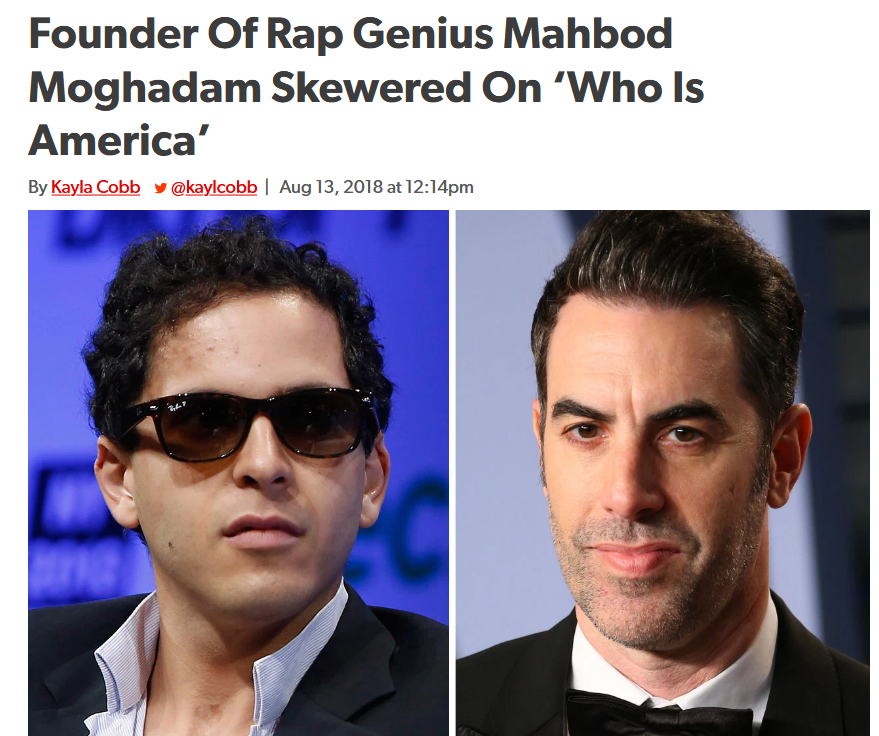
Oh, right. He’s the Rap Genius (Genius.com lyric site) co-founder who was thoroughly clowned by Sacha Baron Cohen on his Showtime series, Who Is America?

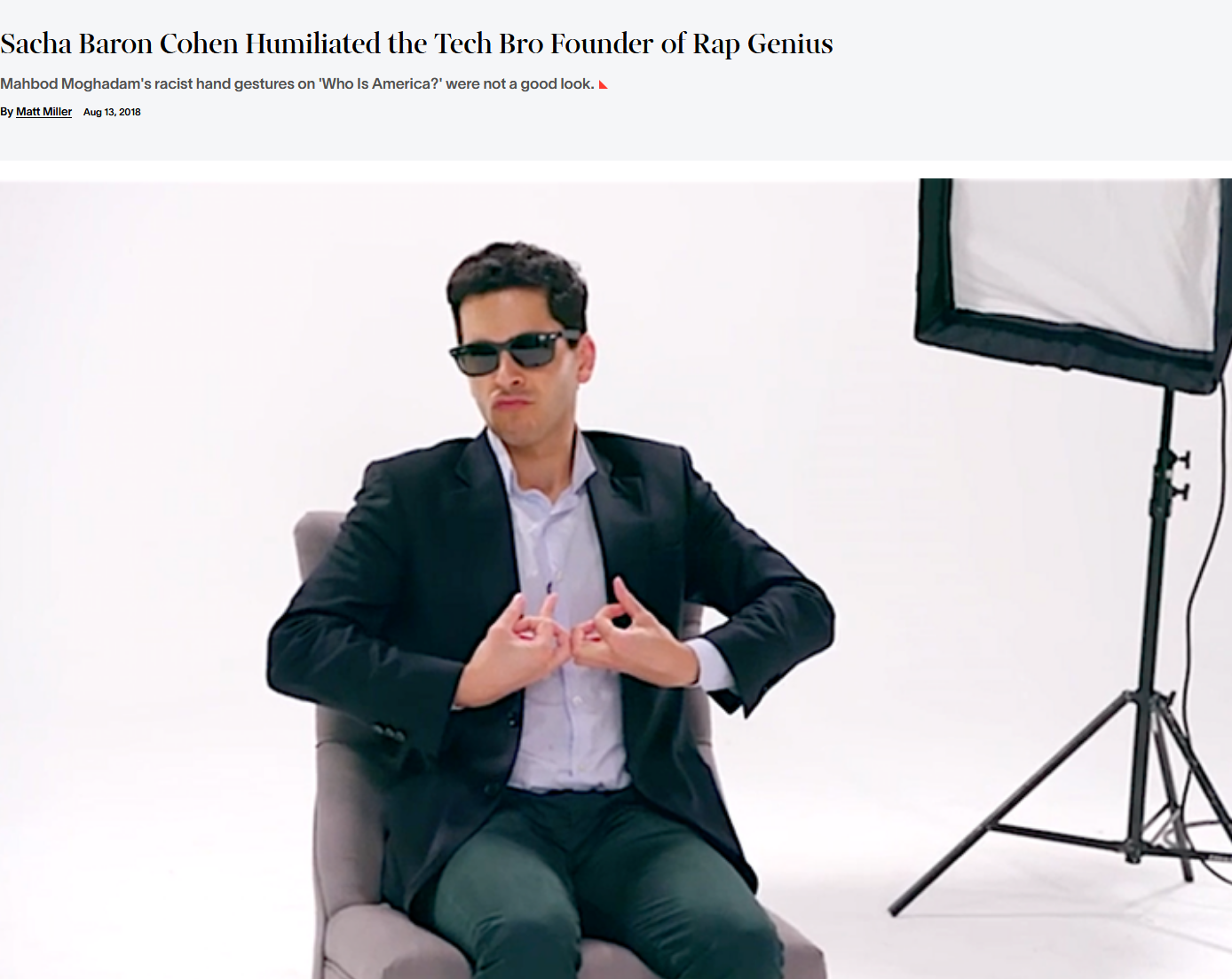
I say “clowned.” Esquire says “humiliated.” In reality, neither word captures Moghadam’s so-cringeworthy-it’s-hard-to-watch appearance on the show. Believing he’s there to be photographed and interviewed by an Italian fashion photographer named Gio Monaldo (Baron-Cohen in disguise), Moghadam is legendarily awful in the segment:

In the middle of the photoshoot, Gio compliments Moghadam repeatedly, calling him cool. He then asks he to “do something like a black guy.” Seemingly without missing a beat, Moghadam makes the Blood sign and mimes shooting a gun at the camera while saying “pop, pop.” Of course a lot of editing goes into Who Is America?‘s segments, but there’s really no excuse for that.

Much like with the Olympios interview, Cohen then persuaded Moghadam to pose with a green screen so he can photoshop the founder feeding starving children. In the middle of the shoot, Gio stops, convincing his muse that he needs to make his penis look bigger. Naturally the only solution to this is to stuff the arm of a babydoll down his pants. Moghadam never seems to protest any of this, not even when an intentionally racist Gio swaps out the white babydoll arm for an African-American one.

I’d link the footage, because there’s no way I can do justice to how awful it is, but miraculously it looks like it’s disappeared. Indeed, Moghadam comes off looking so bad in the segment that it looks like he’s gone to incredible lengths to get every clip of it removed from sites like Youtube and DailyMotion. If that guy is the kind of person who thinks men with cats are less masculine, then we’ve got nothing to worry about.

Screenshot_2021-02-13 Founder Of Rap Genius Mahbod Moghadam Skewered On ‘Who Is America’

Mahbod Moghadam
Mahbod Moghadam on ‘Who Is America?’