First, thanks again to everyone for their well wishes and for advice on how to get a cat to take medication. I was finally able to get Bud to take his meds by crushing them and mixing them into a small amount of pate, so he had to take the meds in order to eat. When he ate the first small bit with the crushed medication, I added a little more food.
The little guy still isn’t eating much, especially compared to his usually bottomless appetite, but the fact that he is eating is an encouraging sign. I’m making sure he’s eating wet food and frequently replacing the water in his bowl so it’s fresh and he stays hydrated.
He has also vocalized a bit, which is very encouraging! He’s not offering the usual Buddesian play-by-play of his activities and he’s not yelling at me for snacks/better service/etc but I’ll take what I can get.
Today is very encouraging because he was still lethargic yesterday and he got sick again last night. Thankfully it was only once.
That’s about it. At times like this we all wish our cats could talk. Failing that, I’ll take a raised tail, a meow here and there, awareness and seeking affection/comfort.
Strangely, Buddy is still not really purring. I felt a small vibration at one point yesterday when I was scratching his head and talking to him, but nothing like the buzz of his usual purr. Hopefully that starts to come back too.
When he feels well enough to terrorize me again, I’ll throw a party!
We are at the emergency vet. Buddy got sick early this morning and threw up, then threw up some more, and some more, most of it yellow bile.
He was vocalizing in obvious pain and distress and while I was able to soothe his stomach a bit with some catnip — enough that he eventually climbed on top of me and slept for a while — I got really worried when we woke up a few hours later, I got out of bed and he didn’t budge. He stayed there for almost two hours.
He never does that. He follows me to the bathroom first thing, always, and then starts meowing for food.
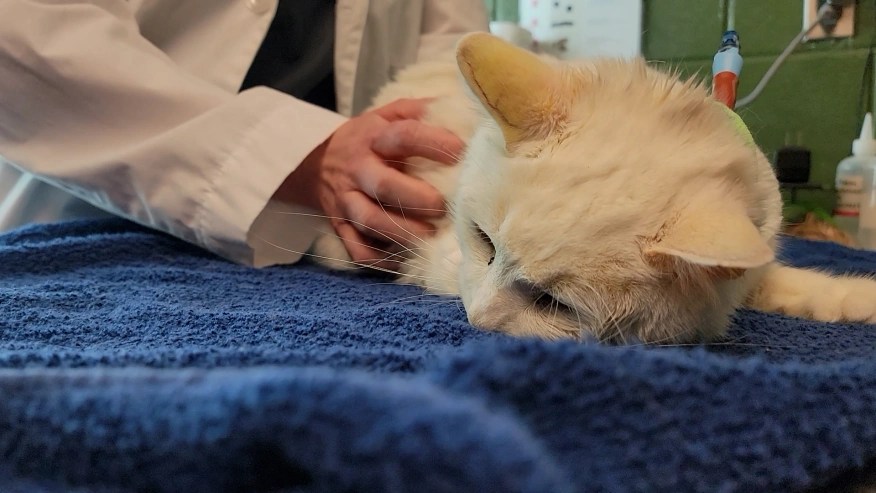
When he finally left the bed he was extremely lethargic, not at all like himself. He wouldn’t eat. His eyes were half closed, he didn’t respond when I rubbed his head, and I couldn’t feel him purring. The local vet couldn’t see him, so I took him to an emergency vet.
The good news is that it doesn’t look like he has anything obstructing his digestive track, a UTI or any of the usual culprits.
He doesn’t have a fever, which is also good, but he’s significantly dehydrated and there were some concerning signs in his blood work.
I knew he really wasn’t doing well when the nurses took blood and gave him the anti-nausea injection and he didn’t even bother to object. Normally he’d try to tear their faces off but this time he didn’t raise a paw. I’m not even sure it registered with him that there were large dogs and other cats in the open floor plan space, where staff hurried between stations with equipment and animals cradled in blankets.
This is not how it ends, not here and now. For that I am grateful. I’m taking him home after the vet gives Bud some sort of subdermal hydration treatment and meds to hopefully get him eating and drinking again.
The bad news is that the visit cost an eye-watering amount, more than three times what I expected in the worst case scenario, and that was without x-rays. Absolute madness.
On the other hand I realize I have a lot to be grateful for. I just watched a young girl crying and holding onto her mother as a veterinarian worked on her cat, who was severely injured and looked like she’d been hit by a car. In one of the private rooms, a family was saying goodbye to their dog.
All this is a reminder to be grateful for the time we have. I will update soon, hopefully with good news.
Veterinarians tried their best to save Juliet, but noted “even with the best care, not every animal makes it.”
Juliet the cat and her two feline siblings were unceremoniously dumped outside their former home when their humans moved out of state a few weeks ago.
A Good Samaritan realized the trio had no one taking care of them and nowhere to go, and brought the cats to the Charleston Animal Society in South Carolina. After some time, Juliet stopped eating. A scan revealed why: The cream-and-white cat had an amorphous mass inside her stomach, a “seemingly endless bundle of strings” in the words of one veterinarian, which blocked Juliet’s stomach and prevented her from being able to eat or process food.
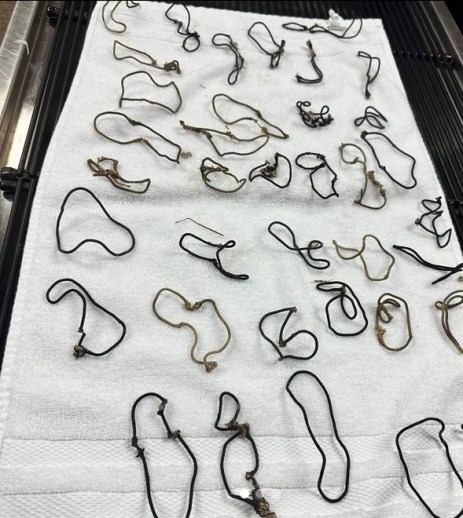
A vet performed emergency surgery on Juliet earlier this week and removed 38 hair ties.
“I’ve never seen anything like it,” said Leigh Jamison, the shelter’s associate director of veterinary care.
Hair ties removed from the stomach of Juliet the cat.
Vet techs monitored Juliet closely and fed her carefully, making sure she got the nutrients she desperately needed without overwhelming her shocked system, which had suffered a buildup of fat in her liver.
They thought Juliet would pull through, but the ailing kitty took a turn for the worse on Friday and died a few hours later, the shelter announced.
“Our expert veterinarians and lifesaving team perform what we think are miracles every single day. Unfortunately, even with the best care, not every animal makes it,” staff wrote in an Instagram post. “Even though Juliet was loved and was not suffering during her last days, she did succumb to this tragic accident. We are all heartbroken.”
Pica, an eating disorder that affects humans, also occurs with cats. Defined as the consumption of items which are not food, pica can manifest in cats as a predilection for things like paper, plastic bags, rubber bands, small pieces of plastic and, as was the case with Juliette, items like hair ties that are made of fabric, wool or synthetic materials.
While there are medical reasons pica can present in felines, it’s also sometimes brought on by environmental stress, and it wouldn’t be a stretch to imagine the kind of people who would abandon their pet cats may not have been good caretakers. No one except her former caretakers know what Juliet’s been through, and they’re unlikely to come forward.
Likewise, adoption isn’t a part time, halfway or temporary thing. Adopting a cat means committing to taking care of the animal for his or her entire life. Despite the stubbornly persistent idea that cats are aloof, solitary animals who are indifferent to companionship, research studies show felines are just as sociable as dogs and form strong emotional attachments with their humans. They care deeply, but they express affection in different and less overt ways. That doesn’t mean they suffer less when they lose their homes and the people they’ve grown to love.
An experimental new drug offers hope for cats infected with FIPV, which is almost always fatal.
Anae Evangelista was reeling from the deaths of two close friends when she saw Parsnip in a local shelter’s online post.
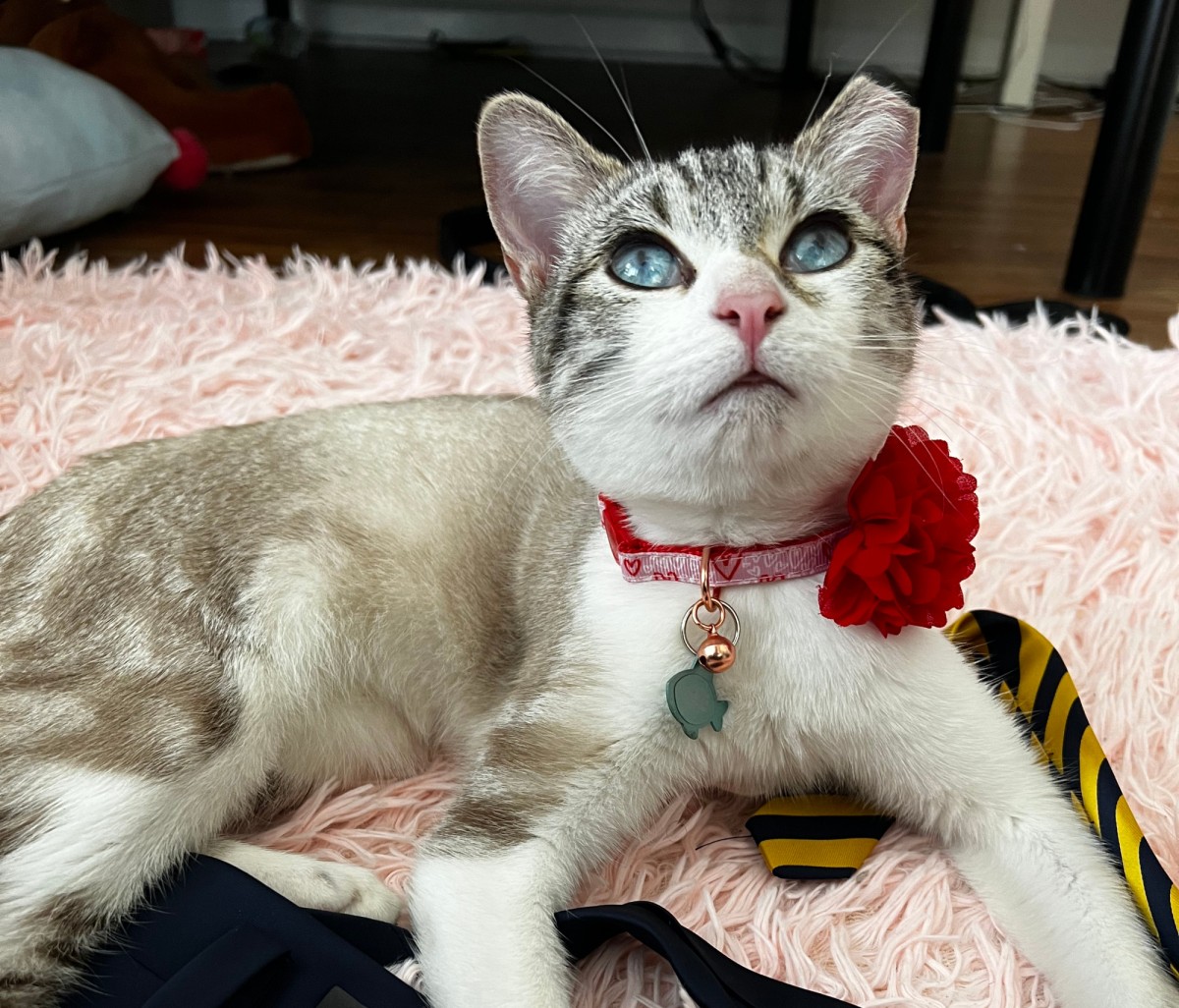
The 21-year-old college student had been thinking of getting a cat for weeks after accompanying a friend to a local shelter. After checking the shelter’s adoptable pets again, she fell in love with an adorable tabby with a clipped ear and sky blue eyes and immediately made plans to see her in San Diego.
Parsnip took to Evangelista immediately.
“She was so affectionate, pushing her head into my hand for pets, and I knew she was the one,” Evangelista told PITB.
Although many cats take days or weeks to adjust to their forever homes, Parsnip “strutted into my apartment as if she owned it from day one, zooming all over the place [with] enough energy to bounce off the walls,” Evangelista said.
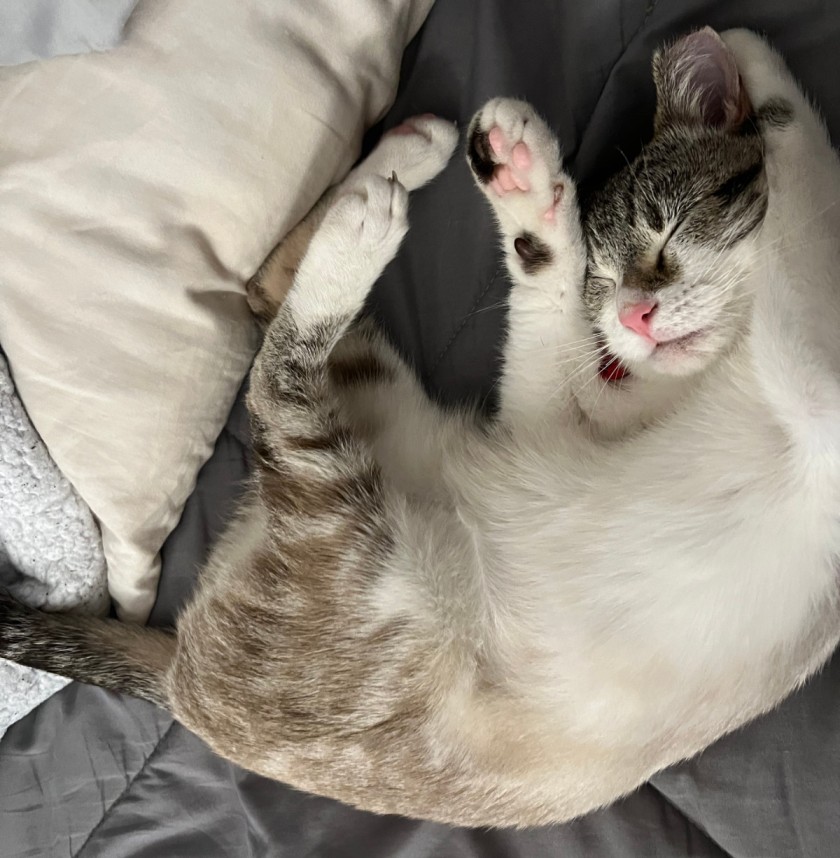
Parsnip enjoys a snooze with toe beans on display.
Although she had a rough start to life and was rescued from a hoarding situation, Parsnip was friendly, affectionate and warmed quickly to her new home. As human and kitten became fast friends, Parsnip’s presence was an immediate boost to Evangelista’s mental health.
‘She’s been my rock,” she said, “and although she can’t talk, I feel as if she’s constantly encouraging me to stay strong.”
But after about six weeks Parsnip’s energy level took a distressing dive. She was weak, slept a lot and wouldn’t eat much. A vet visit didn’t yield any answers, and the next day Parsnip displayed more telltale signs of a seriously sick cat — she stopped eating and drinking entirely, and began eliminating outside of her litter box.
After consulting another veterinarian, Evangelista finally had an answer. Little Parsnip was suffering from Feline infectious peritonitis, a more virulent strain of feline coronavirus that infects white blood cells resulting in dangerous inflammation, per the Cornell Feline Health Center.
“An intense inflammatory reaction to FIPV occurs around vessels in the tissues where these infected cells locate, often in the abdomen, kidney, or brain,” according to Cornell. “It is this interaction between the body’s own immune system and the virus that is responsible for the development of FIP.”
The disease is “usually progressive and almost always fatal without therapy.”
But there’s hope for Parsnip: With the help of her veterinarian and an online group for people whose cats have FIPV, Evangelista was able to get her kitty accepted for experimental treatment with GS-441524, a nucleoside analogue antiviral drug that has proven effective at treating all types of FIP in several trials in recent years. (It’s been so effective, in fact, that Chinese pharmaceutical manufacturers have been supplying GS-441524 on the black market to cat caretakers who haven’t been able to get their cats into trials.)
Since starting the treatment, Parsnip’s responded well: She’s eating again, the swelling has been in retreat, and she’s once again interested in play time, exploring and other things cats love to do. She’s even able to hop up on the couch again.
That’s a far cry from her condition just three weeks ago when she had a 105-degree fever, no interest in things around her and couldn’t get up under her own power.
The 84-day treatment, subsequent vet visits, monitoring and blood work is expensive: Evangelista estimates it’ll cost her about $5,000 in total. She’s looking to raise half that amount via a GoFundMe. It’s a huge expense, especially for a college student, but for Evangelista, spending the money is without question.
“She’s been my foundation and she deserves the world,” she said, “so I want to give her the chance to live to see it.”





 Pain In The Bud