
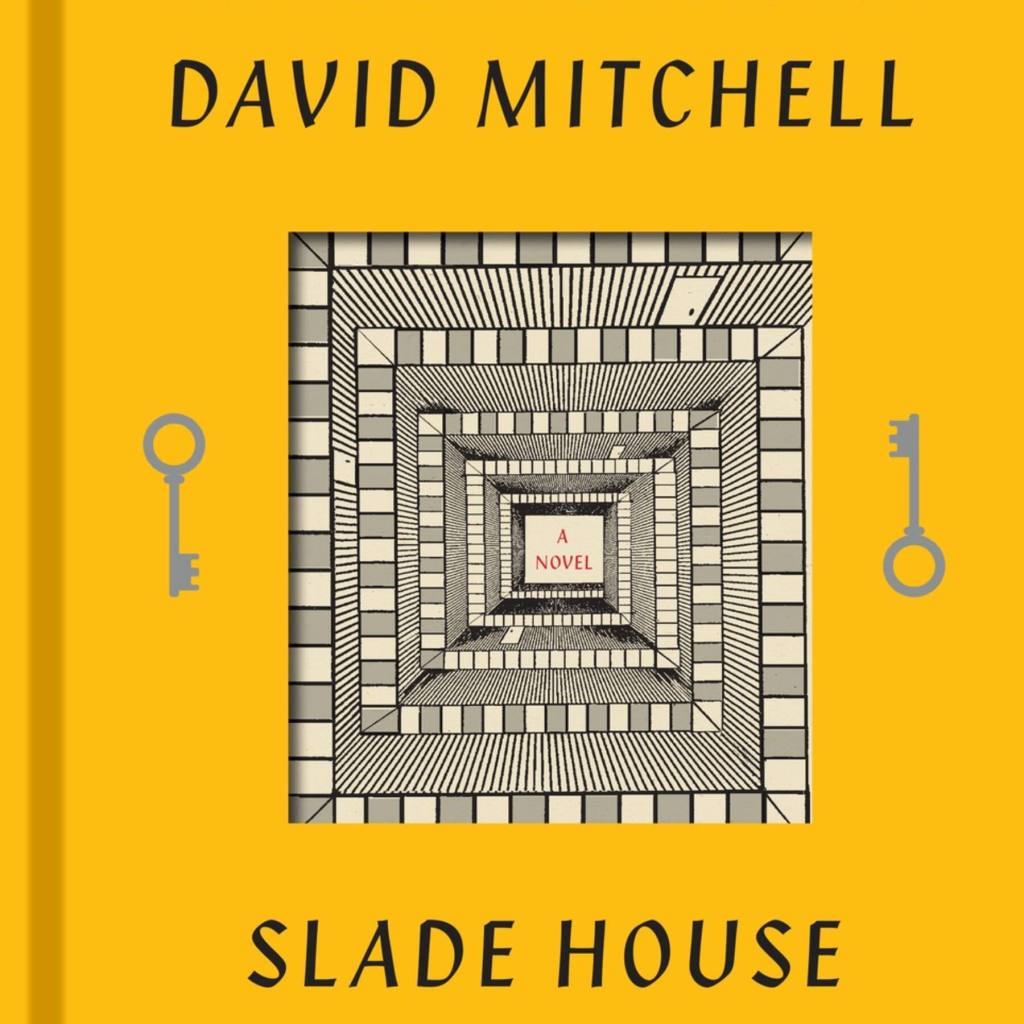
Slade House isn’t your typical David Mitchell novel.
For one thing, it’s a slim volume, about 240 pages depending on the format and edition. You can mainline it in four or five hours, and it’s such a page-turner that many people have.
It’s not concerned with making any particularly grand statements about life and is engineered for one goal – to entertain the reader with a satisfyingly spooky story.
Slade House is the name of the mansion at the heart of the book, a grand aristocratic structure that once sat on a sizeable estate but is now crammed between houses and shops in a working-class neighborhood of London. It’s accessible by walking down a shabby, narrow alley fronted by a pub called The Fox and the Hounds. The gloomy lane takes a turn, and if you know precisely where to look, there’s a slim iron door leading to something unexpected in such a neighborhood – a verdant, picturesque garden surrounding a small pond. A path winds through the garden and under a series of trestles, leading to the ivy-choked home sitting on the crest of a low hill.
Most interestingly, it exists for exactly one day every nine years, when someone is lured inside and is never seen again.
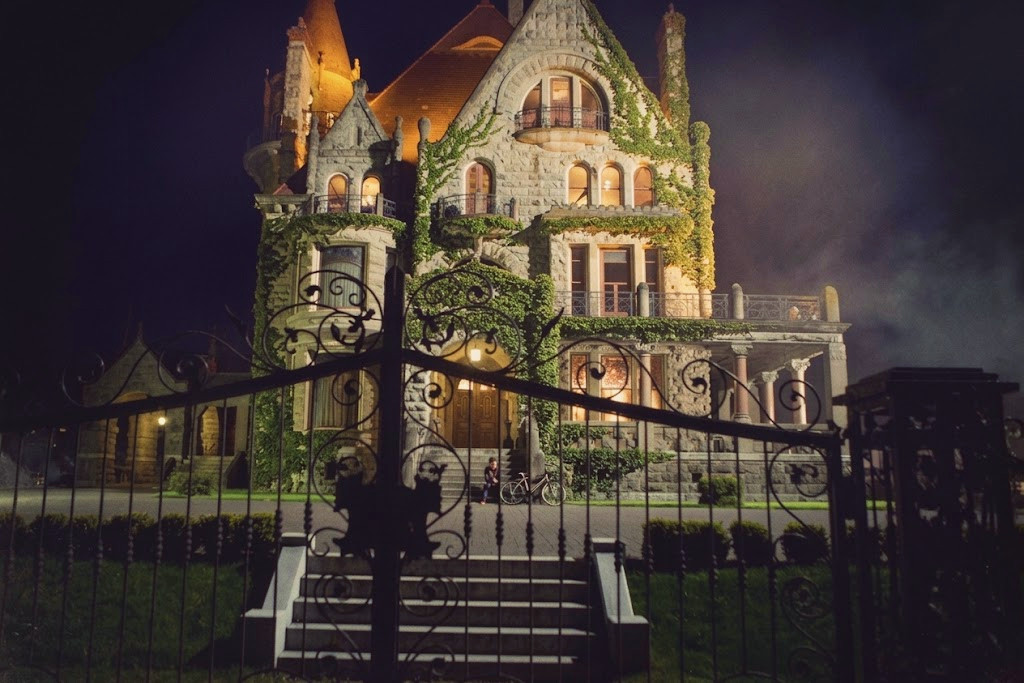
Mitchell shows us Slade House through the eyes of its many victims: an awkward, autistic pre-teen boy who is enticed inside along with his mother. A police detective and wannabe lothario dispatched to investigate the house and the fate of people who have gone missing there over the decades. Members of a local university’s extracurricular paranormal research club who think they’re in for a ghost hunt only to find a debauched Halloween bash packed with undergrads. The journalist sister of one of the college students who went missing there in the last nine-year “cycle.”
And finally, a Canadian psychologist with a clinical interest in people who buy into conspiracy theories, stories of alien visitations and other strange phenomena.
To describe what each of them finds inside would be to spoil the novel and rob the narrative of its punch. Besides, nothing I can say could possibly do justice to the yarn Mitchell spins here.
What I can say is that Slade House reinvents itself so it appears to give its victims exactly what they want, and the forces behind the spectral structure aren’t there to play nice. I found myself thinking of their malevolent tricks and shuddering long after I finished the last chapter.
Since then it’s become something of a Halloween tradition to dive back in. I don’t read Slade House every year, and knowing how few books we read in our short lives even when we make a serious effort, I’d much rather push myself to discover new novelists and worlds.
Yet Slade House is the rare book that deserves and even demands to be read again. Not only is it an exceptionally well-crafted story, it’s got the same quality as films like The Big Lebowski when every time through the narrative yields new revelations and additional connections become apparent. It could be something as simple as a callback to a seemingly unimportant piece of dialog early in the book, or recognizing a certain character is someone you’ve met in a previous Mitchell novel making a cameo in this one.
Or it could mean finally recognizing a bit of symbolism that’s been staring you in the face the entire time, like the discovery of a dead cat in Slade Alley in the book’s opening pages. The feline in question is the legendary Moon Gray Cat, an entity that appears in almost every Mitchell novel at critical points. When the Moon Gray Cat shows up dead almost immediately in Slade House, that’s Mitchell signaling to the reader that there will be no magical help for the characters in this novel. They’re on their own. (Fellow cat lovers, please note: Mitchell is on record saying the Moon Gray Cat is not really dead, and in fact cannot be killed. He appeared in the very next Mitchell book, and I’m sure we’ll spot him rubbing up against a character or napping in the background during a key scene next time around as well. Viva la Moon Gray Cat!)
As for the book, it’s something different built on the bones of the classic haunted house story. The horrors inside Slade House persist even when the home itself vanishes.
The police, for their part, think they’re spinning their wheels at the behest of jokesters. They know the disappearances are real, but every time someone goes missing not only are detectives unable to locate Slade House, they find it cannot exist. There’s simply not enough room in the jumble of buildings housing shops and flats. Satellite photos confirm what they can surmise from the ground, though municipal records do turn up a Slade House that formerly existed there until it was destroyed during a German bombing raid on London during World War II…
The detectives rationalize the disappearances. One family may have simply fled, leaving behind outstanding debts and complications in London and finding refuge with relatives in Canada. A woman who vanished half a century ago may have ditched her husband and ran off with her lover. There are plenty of reasons people abandon their lives, and maybe the fact that they were last seen entering Slade Alley is just coincidence.
Only one group of people have begun to assemble the facts, and those are the victims. “Pass it on,” the echo of a previous victim tells a person freshly lured into the phantasmagorical property at one point. The recipient doesn’t know it’s already too late for her, but if she can add to the small packet of information, perhaps some future target can be warned off before Slade House slips the handcuffs on.
For his part, when Slade House was published in 2015, Mitchell took some fire from the literary establishment for taking a detour and deciding to play in a genre sandbox for a while. Some critics argued that his talents are too great to waste on lowly genre fare when he could be writing Serious Literature™.
I was proud of him when he made it clear to one interviewer that he doesn’t care. He had fun writing the novel and he hopes readers enjoy spending time in its odd little world. Besides, he argued, the idea that genre fiction is less worthy of attention is itself a flawed premise.
I wholeheartedly agree with that assessment, as well as Mitchell’s contention that genre fiction gives us a safe place to explore fantasies, ambitions and anxieties that would normally be dismissed as childish. Science fiction, one of my favorite genres, is often criticized on the aforementioned terms as if speculating on the very nature of our existence – and whether we share our vast universe with other sapient entities – is somehow out of bounds, and we should all aspire to the kind of writing favored by MFA factories.
Insisting that there is only one valid way to create is close-minded. Opening yourself to possibilities you haven’t grappled with is the precise opposite.
Now if you’ll excuse me, it’s been a few years since I last visited Slade House, and I have a date with a reality-shifting entity that wants to consume me, at least for four or five hours.
Header image via Pexels

