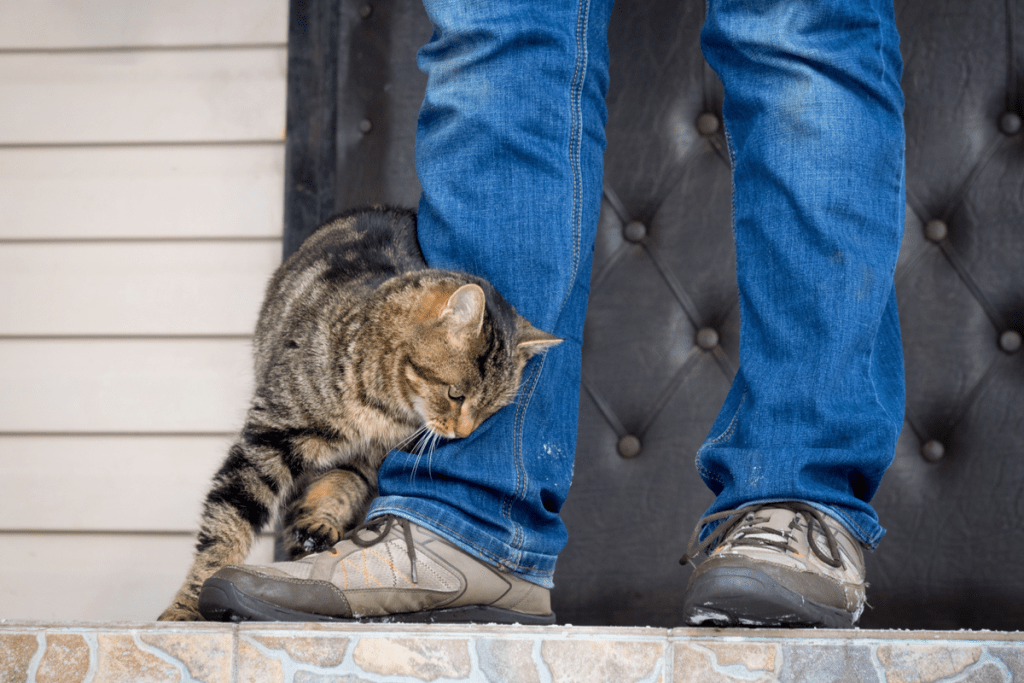
Cats May Be Able To Help Detectives Solve Crimes

An Australian team decided to look for DNA evidence in a novel place: cat fur. Their findings could give law enforcement a powerful new tool to identify crime suspects.

Check out our newest feature, catwire!

When you think of a crime scene, you probably picture uniformed officers manning the perimeter, crime scene tape cordoning off the room where the deed was done, detectives trying to reconstruct what happened, and techs collecting evidence.

Those techs might swab surfaces for traces of a suspect. Drinking cups and water bottles might be dusted for fingerprints, stray hair might be bagged and sent back to the laboratory for analysis. Discarded cigarette butts, door handles, buzzers — they can all yield evidence, to say nothing of cell phones, USB sticks and smart appliances.

But what about the pets? If a suspect was especially careful not to leave prints or touch anything at the crime scene, could the fur of a cat harbor DNA?

A team comprised of scientists from Australia’s College of Science and Engineering at Flinders and the Victoria Police Forensic Services Department wanted to know if cat fur could indeed hold critical evidence at crime scenes, so they conducted a study involving 20 pet cats from different homes, and what they found could provide an important tool for law enforcement. Their findings were published in the journal Forensic Science International.

If detectives are trying to piece together the identities of robbers who, say, broke into a home, brutalized the people there at gunpoint and stole their valuables, they can’t interview the victims’ pet cats about what they saw, but it turns out they can swab the kitties’ fur and have an excellent chance of retrieving useful DNA.
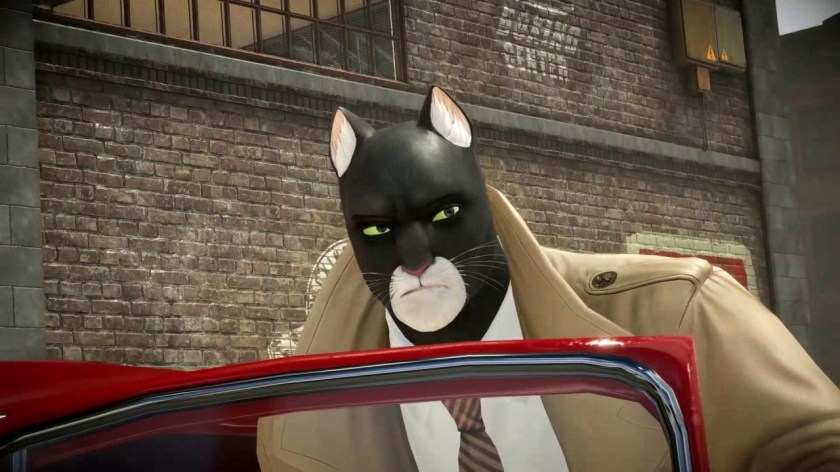
Blacksad
Blacksad is a famous feline detective in his own series of comic books. He may have to be careful not to leave his stray fur all over his own crime scenes.

The research team swabbed the fur of pet cats in their test households, took DNA samples of the adults living in those homes — who were the stand-ins for victims — and asked the human participants to fill out surveys asking about their cats, what they do on a typical day, and whether or not they have interaction with people outside the home.

After the team conducted DNA analysis on the fur swabs “[d]etectable levels of DNA were found in 80% of the samples and interpretable profiles that could be linked to a person of interest were generated in 70% of the cats tested,” the study authors wrote.

While most of the samples matched the DNA of people who lived in the homes — as expected — samples from six cats revealed the presence of DNA from other people. The research team didn’t take DNA samples of minors, and two of the positive fur swab samples came from cats who lived in a home with a child and slept in that child’s bed most evenings. But four other samples turned up “mystery” DNA even though no one else had visited those homes for at least several days.

For DNA from pets to have any real evidentiary value, prosecutors have to prove a “chain of custody” of sorts, establishing that suspects could not have had contact with the animals in question unless they were inside a home where a crime has taken place. If the cat is allowed to roam outdoors every day, for example, it becomes much more difficult to prove a suspect’s DNA was transferred to a pet inside a home rather than on the street.

That’s why the research team is hopeful, but also cautions that their study is a first step toward understanding more about how human DNA is transferred to fur, whether it requires a person to be physically present (as opposed to their DNA being passed along secondhand in stray hair or skin cells), how long a cat’s fur can harbor human DNA, and other questions prosecutors will have to answer.

“This type of data can help us understand the meaning of the DNA results obtained, especially if there is a match to a person of interest,” said study co-author Mariya Goray, a DNA transfer expert. “Are these DNA finding a result of a criminal activity or could they have been transferred and deposited at the scene via a pet?”

The team recommends more research “on the transfer, persistence and prevalence of human DNA to and from cats and other pet animals and the influences animal behavioral habits, the DNA shedder status of the owners and many other relevant factors.”

If they do answer the aforementioned questions and prosecutors believe they can establish a suspect’s presence at a crime scene thanks to feline-provided evidence, it might not be too long before we see a cat-centric episode on future seasons of Law & Order or CSI, both of which are scheduled to be revived as police procedurals enjoy a resurgence on TV.
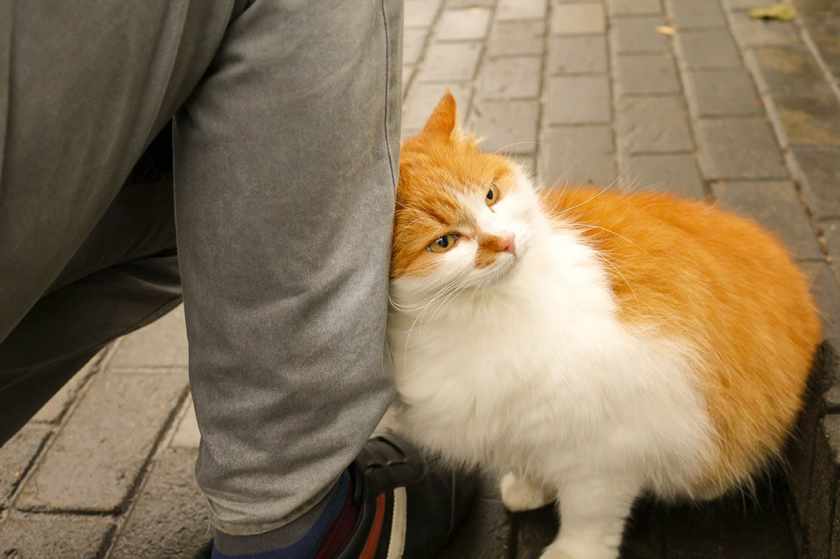
Must rub on person!
As dedicated cat servants know, cats rub against everything and everyone. The behavior is instinctual, and cats have pheromone glands on their faces, sides and paws, which they use to transfer their scent..and fur.

‘It’s Gonna Get Ugly!’: Brave Police Officers Arrest, Cuff Women, Ages 60 And 84, For Criminally Feeding Cats

Despite the obvious threat posed by the retirees who were defying the law to feed dangerous beasts, the valorous cops administered justice.

Whatcha want, whatcha wanna do? Whatcha gonna do when they come for you?

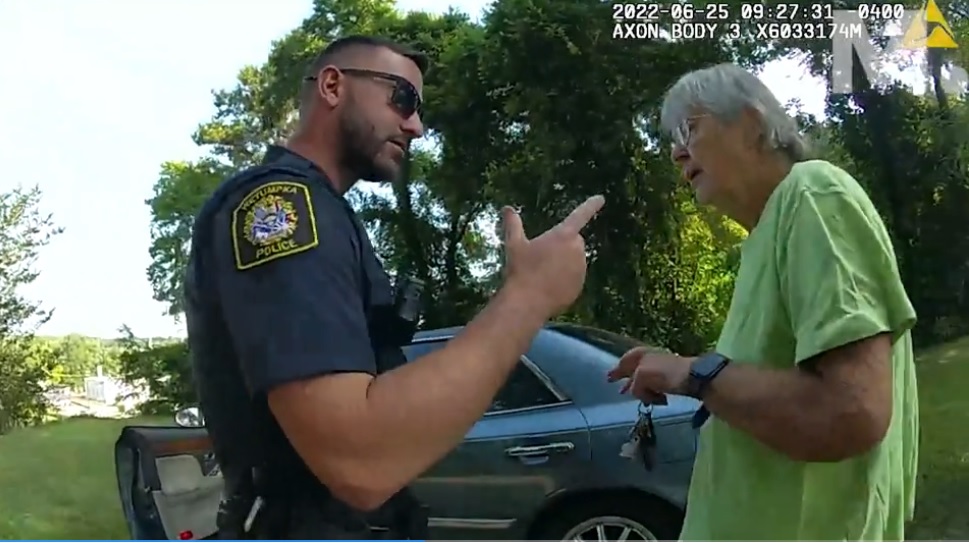
Two vicious criminals were caught by the long hand of the law and face justice for the community-destroying act of…trapping and feeding cats. The heroic police officers responsible for meting out justice were from the Wetumpka Police Department in Wetumpka, Alabama, about 20 miles north of Montgomery.

Fearless cops arrived at a public park on June 25 and immediately took up tactical positions after receiving intelligence that two seasoned criminals were trespassing on public land and defying the law by feeding the dangerous beasts. Even worse, the alleged lawbreakers were conducting their brazen activity in broad daylight!

After they were satisfied that 84-year-old Beverly Roberts and 60-year-old Mary Alston were not hiding weapons in the bags of cat food they’d brought with them, and could not repurpose their cat traps to harm officers, the intrepid lawmen courageously confronted the pair of malefactors, telling them to cease their illicit activity and vacate the premises.

The officers approached Alston first, warning her that she was breaking the law by feeding stray cats who were “becoming a nuisance.”

A flabbergasted Alston said she was trying to help the situation by trapping the cats and bringing them to shelters, pointing out she had a trap already deployed and had other trapping equipment in her car.

But the officers noted such specialized work is the domain of trained professionals — in this case the town’s absent animal control officer — and told her to leave.

“I’m teetering on going to jail for feeding cats?” the hardened alleged criminal asked, bristling with obvious disdain for authority.

bravecop3
“Bad girls, bad girls, watcha gonna do? Whatcha gonna do when they come for you?”

The clearly dangerous woman thought she could retrieve her traps and pack up her belongings, but the resolute police were having none of her defiant attitude.

“She’s still sittin’ here after we done told ’em to leave already,” an officer complained to a dispatcher during an aside filmed in his patrol car.

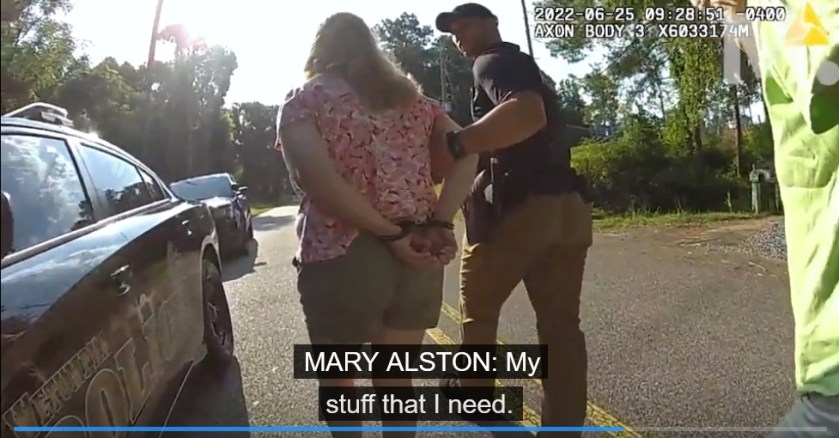
When Alston expressed surprise that police were cuffing her, the officers explained they had already emptied their vast reservoir of patience after telling her to leave the park.

“You aren’t doin’ it fast enough and now you’re going to jail!” an officer said after literally yanking Alston out of her driver’s seat with both hands. (An act completely justified, we’re sure. You don’t last long as a lawman in a depraved town like Wetumpka if you can’t quickly spot possible danger.)

Meanwhile, Roberts demonstrated clear contempt for authority when she questioned why an entire shift’s worth of cops were present, and went to hand her car keys to Alston before the officers arrested her. She explained she was handing off her car keys because she didn’t want the vehicle sitting in a public park unattended, not yet realizing the police would do her a favor by impounding her car.

“It’s gonna get ugly if you don’t stop!” one officer said, warning the incredibly dangerous woman, who further insulted the valorous public servants by questioning their use of time and resources on a cat-feeding complaint.

bravecop4
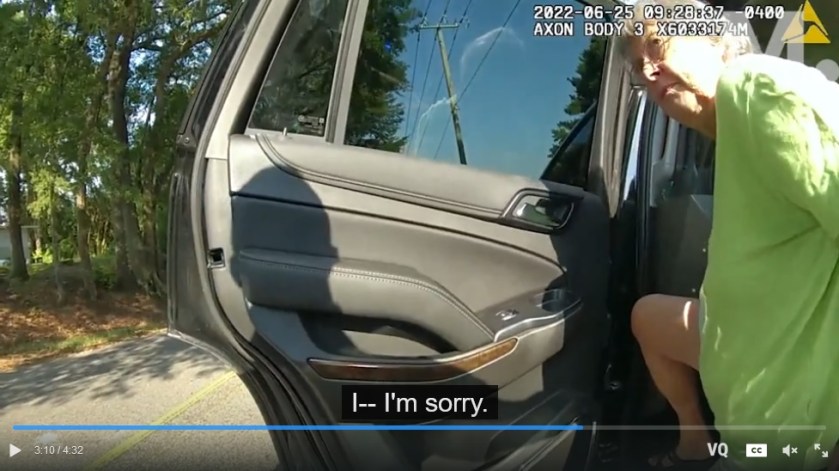
Roberts apologizes as, with her hands cuffed behind her back, she’s unable to hop up onto the back seat of a police SUV.

Knowing the 84-year-old could be deceptively strong, the officers cuffed her with her hands behind her back, then expressed skepticism when she couldn’t physically get into the back seat of a police SUV while restrained.

After both women were restrained and under control in the back of a patrol cruiser, the cops reflected on a tense situation that could have gone wrong at any moment.

“I’m glad nobody recorded, because [it’s] a bunch of police officers beatin’ up on a couple old ladies,” an officer said while another laughed off camera.

bravecop2
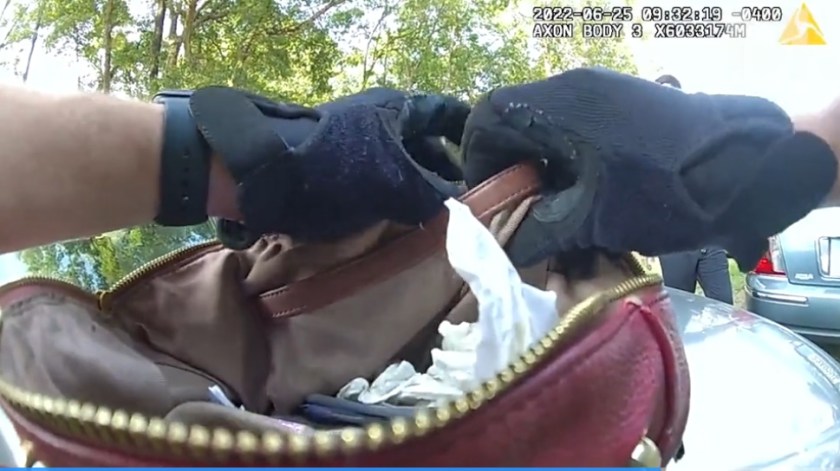
A police officer searches the pocketbook of an 84-year-old woman for drugs and contraband, presumably including catnip.

We here at Pain In The Bud commend the Wetumpka Police Department for showing no mercy to their town’s seasoned criminal element.

Recent examples of cowardice in high-profile policing situations (Uvalde, Texas, and Marjorie Stoneman Douglas High School in Florida) may have shaken the public’s confidence in our normally intrepid police, but the officers of Wetumpka valorously charged into this situation despite great risk to themselves, clearly understanding the immediate danger Alston and Roberts posed to the community with their allegedly law-breaking acts.

After righteously fighting attorneys for both women and refusing to release body and dash cam footage of the tense encounter, Wetumpka police could no longer drag their feet after three months of stalling and were finally forced to hand the video over due to clearly anti-American laws supposedly meant to guarantee “freedom of information.” Obviously, such laws were created to benefit cat-feeding terrorists and other dangerous criminals.

The attorneys believe the footage will vindicate their clients, but any reasonable person who views tape of the encounter will certainly come away with nothing but admiration for the police officers, who wisely prioritized using their resources on such a brazen and community-destroying crime.

The town of Watumpka, and all of America, owes a debt to these fine men.

assorted color kittens
Alston and Roberts were feeding vicious beasts like the ones pictured above Credit: Pixabay/Pexels

SPCA Offers $6k Reward After Shooter Kills NY Woman’s Beloved Cat

Stella’s shooting is the latest in an inexplicable trend of people targeting cats with pellet guns.

When Margaret Oliva’s husband died eight years ago, her cat Stella helped her through her grieving.

“She was my sanity, you know?” the Long Island woman said.

Oliva’s beloved tortoiseshell went outside on Sept. 1 and didn’t come back that night. Oliva enlisted the help of relatives to find Stella but wasn’t able to locate her until she heard “whimpering cries” on her Ring system’s audio.

Stella had collapsed near a bush on the front lawn. Oliva rushed her badly injured cat to an emergency veterinarian, where the fading feline fought for her life but succumbed hours later. The vet told the shocked Hicksville woman that someone had shot Stella twice, likely with a pellet gun.

“To have her taken like this…No, I can’t accept that,” Oliva told a local TV news station.

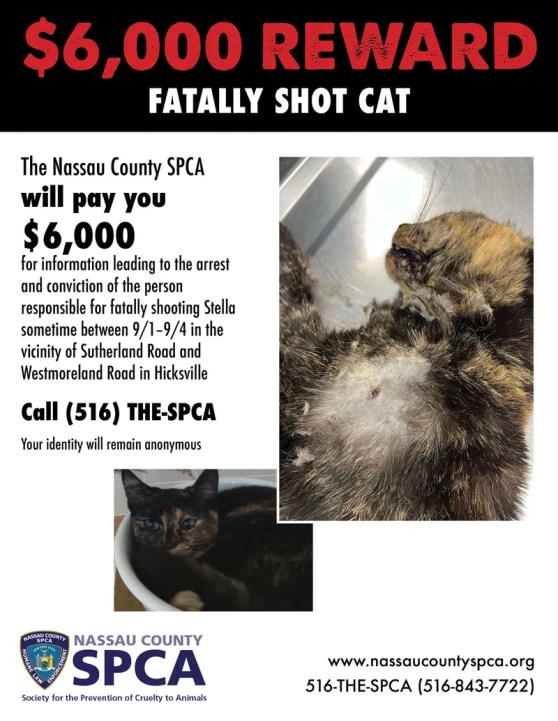
Now the SPCA is offering a $6,000 reward to anyone who provides information leading to the arrest and conviction of Stella’s killer. Matt Roper, a detective with the Nassau County SPCA’s law enforcement division, said he believes Stella was shot by someone in the immediate neighborhood.

spcastella
The SPCA is offering a $6,000 reward for Stella’s killer.

Studies have shown that house cats who are allowed to wander outside during the day rarely go far. In a paper published in Scientific Reports earlier this year, a team of scientists from the Norwegian University of Life Sciences tracked 100 indoor/outdoor cats by equipping them with GPS collars. The data showed cats spend almost 80 percent of their time within 50 meters — or about 164 feet — of their homes, and a handful of statistical outliers who traveled a longer distance didn’t exceed more than a quarter mile.

The SPCA’s Roper said Stella suffered one projectile to her chest and one to a leg. Her killer is likely nearby and almost certainly knows about the anguish caused to Oliva. If caught, the killer could face a felony charge.

“This could be a high powered pellet gun,” Roper said. “This could be something that could be shot a couple of houses length, a couple of yards in length.”

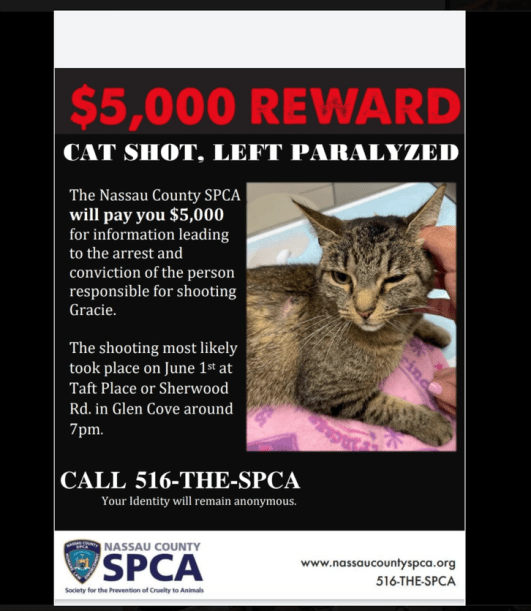
Oliva’s home in Hicksville is about 10 miles from Glen Cove, where a cat named Gracie was shot and left paralyzed last summer when one pellet hit her stomach and another hit her spine. Poor Gracie was in a neighbor’s yard, dragging herself toward her home while her back legs hung limp. A woman found Gracie after hearing her crying out in pain, Newsday reported.

“What happens is a woman takes her kids for a walk,” said detective Lt. John Nagle of the Glen Cove Police Department. “When she returns to the house she hears an animal crying and goes to investigate. She finds this cat, just beyond the neighbor’s chain link fence, and the animal is crying and it can’t walk. Another neighbor, who happens to be a vet, comes over. She gets a cat cage, places it in the yard — and the cat immediately crawls over to it … She takes the cat to her vet, where she works, thinking maybe it’s been hit by a car. That’s when she finds out it’s not damage from a car, but that there’s two bullets.”

There’s a $5,000 reward for Gracie’s shooter.

In October of 2021, a young cat the rescuers named Abraham was shot with a pellet gun in Suffolk County on eastern Long Island. Like Gracie, Abraham was struck in his spine. The SPCA of Suffolk County, which called Abraham’s shooting “a horrific act of animal cruelty,” is offering a $4,000 reward for information leading to the arrest and conviction of his shooter.

graciecatreward
Gracie’s shooter hasn’t been found yet either.

‘Guard Cat’ Helps Stop Armed Robbery

A Mississippi man was jolted awake by his cat when two armed men tried to break into his home overnight.

Fred Everitt woke at 2:30 a.m. to his cat’s “loud guttural meows” coming from the kitchen.

The retiree didn’t think much of it until the cat, Bandit, came running into the bedroom, leaped onto Everitt and began tugging his comforter off. Then she clawed at his arms, trying to communicate how urgent the situation was.

“She had never done that before,” Everitt said. “I went, ‘What in the world is wrong with you?’”

Bandit was trying to alert her human to the presence of two men outside — one carrying a handgun, the other trying to pry the back door open with a crowbar.

Everitt, a 68-year-old retiree, said he ran to his bedroom and retrieved his own gun after getting a look at the men through his kitchen window, but by that point the would-be robbers had either been scared off by the noise Bandit was making — and the probability that someone was awake inside — or they split to find easier pickings.

Either way, Everitt credits Bandit for preventing an armed robbery and possibly saving his life. The incident happened on July 25.

“It did not turn into a confrontational situation, thank goodness,” Everitt said. “But I think it’s only because of the cat.”

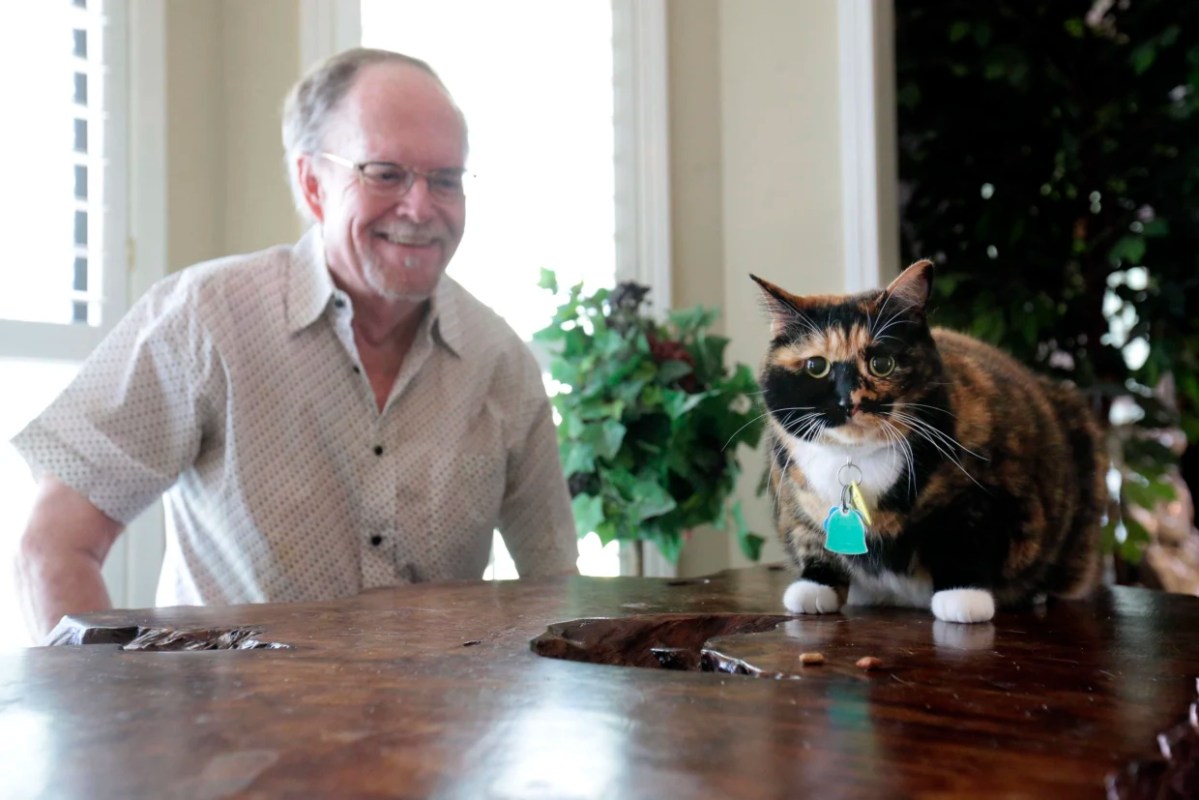
Everitt welcomed the delightfully chonky Calico into his home four years ago after he went to the Tupelo Humane Society in Tupelo, Miss., about 115 miles southeast of Memphis, Tenn. He was writing a donation check when shelter staff introduced him to Bandit. Even though he hadn’t planned on adopting a cat, Bandit came home with him and she’s been his companion ever since.

He said he’s telling his story because it’s important for people to know pets can give back to their humans.

“I want to let people know that you not only save a life when you adopt a pet or rescue one,” Everitt told the Northeast Mississippi Daily Journal. “The tides could be turned. You never know when you save an animal if they’re going to save you.”

It’s nice to know some cats are just as good as dogs when it comes to alerting their humans to potential danger. Given Buddy’s long track record of hiding behind my legs and moaning nervously when something scary happens — and the fact that he literally slept through a mouse encounter in July — I wouldn’t hold out much hope for the Budster heroically raising hell to wake me up if armed men ever tried to break in.

It’s more likely he’d watch the burglars break in without raising the alarm, and satisfied that they have no interest in the turkey pate and treats in his Buddy Food Cabinet, return to my bed to stretch, yawn and go back to sleep.

Uvalde And Buffalo Mass Shooters Both Had History Of Killing Cats

The revelations about the shooters underscore the link between animal abuse and violence toward people.

One of the takeaways from the 2019 documentary Don’t F*** With Cats: Hunting An Internet Killer is the connection between violence toward animals and violence toward humans.

The 30-year-old who killed college student Jun Lin previously announced himself to the world with a series of videos in which he killed cats and kittens, then led online groupies on a years-long goose chase, parceling out crumbs of information to keep them interested until he finally “graduated” to humans and murdered Lin.

If police had taken the cat-killing videos more seriously, some of the documentary’s subjects believed, detectives could have caught the killer before he set his sights on a person. Of course, this blog’s position is that animal life has intrinsic value and animal abuse should be investigated for its own sake, but if police are more motivated out of fear that animal abusers could commit violent crimes against people, that helps cats and other animals too.

Now we’ve learned that the 18-year-old gunman responsible for the Texas school shooting and the 18-year-old who gunned down 10 people in a Buffalo, NY, supermarket were both cat killers before they were murderers of human beings. The former murdered 21 people, including 19 children and two teachers at a school in Uvalde, Texas, on May 24 while the latter took the lives of 10 people, all black, in a hate-motivated massacre on May 14.

The Texas shooter filmed himself grinning while holding “a bag of blood-soaked dead cats,” the New York Post reported on Sunday. David Trevino Jr., who knew the shooter, said he was “known for hurting cats.”

“He liked hurting animals,” Trevino told the Post. “I’m told he killed the cats and carried around the bag of bodies for s–ts and giggles The video shows he was not right in the head. He’s not all there. The video raises all sorts of red flags.”

The Buffalo murderer told online acquaintances he’d beheaded a cat, and wrote about it in a journal as well. Like the Texas shooter, his animal abuse wasn’t a secret. His mother knew, and gave him a box to bury the dead animal.

brown tabby cat lying down on gray bed sheet
Credit: Mark Burnett/Pexels

The shooters both fit the profile of animal abusers who move on to hurting people: Most animal abusers are men younger than 30, according to the Humane Society, and studies have found men who abuse cats often target them as an emotional proxy for women. More than 70 percent of women who have companion animals and were in an abusive relationship reported their significant others harming their pets.

Classmates of the Texas shooter described him as “eerie,” “scary” and quick to lose his temper. He was known for physically threatening girls and women, and for harassing them online. One classmate, 17-year-old Keanna Baxter, said he got “super violent” when he dated her friend.

“He was overall just aggressive, like violent,” Baxter said. “He would try and fight women. He would try and fight anyone who told him no — if he didn’t get his way, he’d go crazy. He was especially violent towards women.”

The Texas shooter spent a lot of time creeping on women on social media and in group chat services, which brings us full circle back to Don’t F*** With Cats. In a conversation with a teenage girl on group video chat app Yubo, he told her he “wanted his name out there” like the deranged killer at the center of that documentary.

The shooter, who lurked in group chats uninvited, also showed off the guns he bought after he turned 18 on May 16.

“He would be active every day and join our lives, repeating girls’ names until they paid attention to him,” the girl said.

Rolling Stone
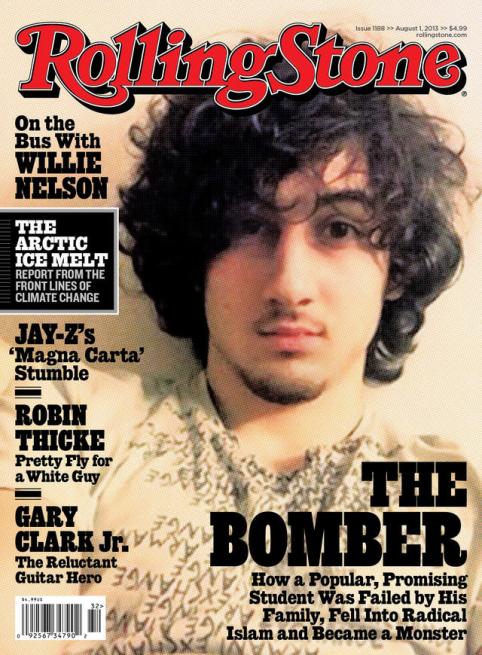
Rolling Stone was widely condemned for putting one of the Boston marathon bombers on its cover as if he were a rock star, but the issue was its best selling of the year.

Although the blame game begins while the bodies of the victims are still warm, as shrieking heads speculate on cable news, no one ever talks about the obvious and uncomfortable truth, which is that these disaffected young loners desperately want to show people they’re important, that they matter.

If they can’t find fame, infamy is a second prize they’re happy to embrace, and they’re motivated in part by the notoriety that previous members of their grim brotherhood “achieved” by massacring fellow human beings.

Major media figures aren’t merely willing to grant that wish. They’re wholeheartedly, enthusiastically in on it, filling hours of airtime looping the same short bits of footage, breathlessly reporting every nugget of information, and holding court over panels of “experts” who are happy to speculate on motivations regardless of how little they know. They blame video games, society, the lack of nuclear families, the lack of male role models, white supremacy, bullying, guns — everything but their own role in turning the killers into household names.

After all, almost everyone who was alive in 1999 can name the two trenchcoated murderers who perpetrated the Columbine massacre, back when things like that still shocked the country. But how many of us can name a single one of the 13 victims?

That’s why I won’t name the killers on this blog. It’s just one blog, in one small corner of the internet, and it won’t make a difference. But if everyone stopped naming them, stopped making them household names and the stars of obsessive crime porn, stopped turning them into objects of fascination whose faces are plastered on magazine covers like rock stars, maybe it would change things.

If would-be killers knew infamy was off the table, that if they survive they’ll remain anonymous nobodies without prison groupies begging for face time, journalists begging for interviews, and grief vampires discussing them for years in “true crime” books and on podcasts, would they go through with it?