The police are looking for the public’s help in identifying and tracking down a man seen in a disturbing video.
Cops are looking for the public’s help identifying a man who abused a cat, injuring the feline so badly it had to be euthanized.
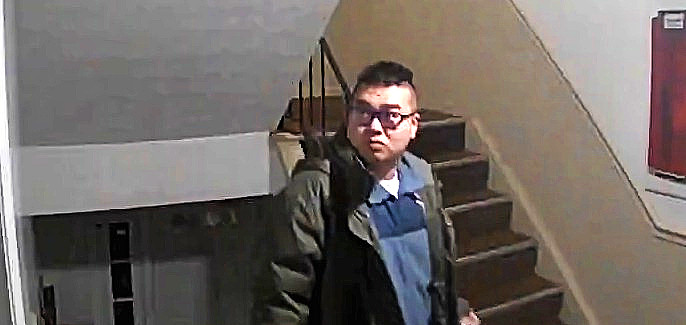
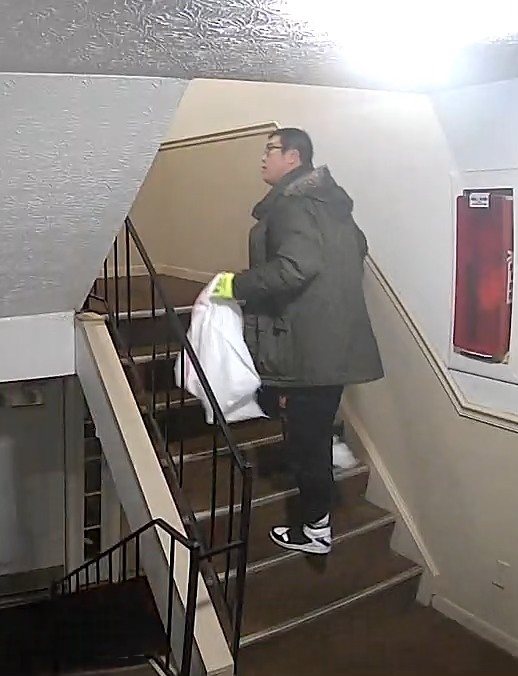
The man chased the cat into an apartment complex in Hamilton, Ohio, on Jan. 24 at 9 p.m. He caught the cat, forced it into a plastic bag and then slammed the bag down hard on the stairwell, according to footage from security cameras the complex. He dumped the cat, still alive and suffering, behind the apartment complex and fled.
The cat was found by deputy dog wardens, according to local media, but had a fractured pelvis and spine and had to be euthanized.
A still image from Jan. 24. Police say the suspect returned last week to scope out security cameras. Credit: Butler County Sheriff’s Office.
In addition to being shockingly cruel, the suspect isn’t the sharpest tool in the shed. Cops say he doesn’t live in the complex, but returned there last week to look for surveillance cameras. In doing so, he gave the police a better look at his facial features and more images to release to the public.
“In the new photos of the suspect, he is wearing the same coat and shoes, but has a recent hair cut, according to the BCSO.”
For those of you living in the Ohio area, details on how to contact the Butler County Sheriff’s Office are in the post below. Help them find this cruel man so he can be prosecuted and convicted.
A Nebraska family is heartbroken after a woman stole their cat right off their porch in broad daylight.
Mr. Kitty was taken under duress, and her absence has left a cold spot on her human’s bed — and in her family’s hearts.
Despite her name, Mr. Kitty is a female calico Manx rescued about eight years ago by Benjamin Strimple, who found Kitty with her leg caught in a racoon trap.
“When we got this cat, it just became my everything,” Strimple said. “Became like my best friend. Every single night I sleep with her.”
Now he’s worried for her safety and hoping for her return after his Ring doorbell caught a woman walking directly up to his porch in Omaha, NE, and taking the unwilling Mr. Kitty by force in broad daylight on Oct. 20.
The video shows the woman approach and hold out a hand. The friendly cat sniffs her hand at first, but pulls away as she leans forward. Mr. Kitty fights back as the woman tries to corral her, but a close look at the video shows the woman using what appears to be some sort of spray device before picking the cat up with both hands.
A screen shot of the Ring doorbell footage showing the suspect stealing Mr. Kitty from her family’s Omaha, NE, porch.Click here to view the video.
She carries Mr. Kitty back to a silver Chevy Malibu and drives away. The suspect is a black female with long hair who was wearing an orange skirt, a brown or black shirt and dark sneakers in the footage. Strimple says he doesn’t know the woman but she looks familiar and he may have seen her in the neighborhood before.
Mr. Kitty does not venture off his property, he said, and spends most of her time indoors or on the family’s porch, where neighbors are accustomed to seeing her.
“I feel like it was like their plans. You know, they seen my cat,” he told KETV Omaha, an ABC affiliate. “I’m pretty sure everyone on the street knows that cat belongs to this house.”
Omaha Crime Stoppers and the Nebraska Humane Society are offering a $1,000 for information leading to the arrest of the woman and the return of Mr. Kitty. Anyone with information on the theft can contact Omaha Crime Stoppers at 402-444-STOP or www.omahacrimestoppers.org. If you know anyone in the Omaha area, please share the story and encourage them to share it on social media.
The theft is not only traumatic for the family, but for Mr. Kitty too, pointed out Nebraska Humane Society’s Pam Wiese.
“I’m sure that [s]he’s probably like, what? What just happened?” Wiese said. “I was just loving up on someone and now I’m no longer home.”
Strimple said the only thing he cares about is getting his furry friend back.
“There’s a lot I want to say, but I would just say, just give her back,” Strimple said. “You know, that’s pretty messed up. We have a lot of family, a whole family sad. Just give her back.”
Through a new resequencing technique, forensics can yield more information from a single cat hair than ever before, with major implications for crimes in places where felines are present.
Last year a forensic study broke new ground by proving there’s usable human DNA in cat fur which can prove a person was in a home or interacted with a particular pet.
Now a new study looked at the opposite situation, establishing that a single cat hair on a person’s clothes can tie them back to an individual cat — and the scene of a crime.
The general public, criminals included, are more aware of DNA and forensic techniques than they’ve ever been thanks to ubiquitous police procedurals, some of which focus heavily on the investigation and evidence-gathering aspect of police work.
But even the most fastidious criminal who is careful not to leave a single print or strand of his own hair at a crime scene can be undone by cat fur clinging to clothes. In fact it’s almost impossible for a person to spend more than a few minutes inside a cat-occupied home without picking up at least some fur, the research team said.
“Detective Inspector Buddy, at your service. Now tell me about the missing turkey…” Credit: Pain In The Bud
The paper, published this month in Forensic Science International: Genetics, outlines a new method for sequencing genetic information found on strands of cat fur.
“Hair shed by your cat lacks the hair root, so it contains very little useable DNA,” said Emily Patterson, the paper’s lead author.
Previously it wasn’t possible to narrow down with certainty whether a strand of hair belonged to a particular cat, but the research team found a new way to resequence DNA in a way that can link it to individual felines. The team’s new method doesn’t require any additional hair or roots, solving the original problem.
To prove their method works, they extracted fur from the body of a deceased cat and were able to match it to her surviving brother.
“In criminal cases where there is no human DNA available to test, pet hair is a valuable source of linking evidence, and our method makes it much more powerful,” said Mark Jobling, a geneticist at the University of Jobling and co-author of the new study. “The same approach could also be applied to other species — in particular, dogs.”
While dog hair can potentially be used in the same way, cat hair may have more forensic value from a prosecurorial standpoint because cats are territorial and many don’t leave their homes. It’s much easier to prove a suspect was inside a home if he or she is linked to an indoor-only cat than if the suspect’s clothes have fur from a dog who is walked around the neighborhood a few times a day.
Prosecutors dropped charges against Mary Alston and Beverly Roberts 10 months after their arrest for caring for a local cat colony.
Prosecutors in Alabama have dropped their case against two women who appealed after they were convicted for feeding and trapping cats in their hometown.
Mary Alston, 61, and Beverly Roberts, 85, were arrested on June 25, 2022 after a bizarre confrontation in which four police officers pulled up in three squad cars and treated the longtime stray caretakers like hardened criminals.
The women were convicted of related charges in December and vowed to appeal the ruling, with their attorneys calling it a case of retributive and petty small town politics.
On Wednesday, Elmore County Circuit Court Judge J. Amanda Baxley accepted a motion by prosecutors to drop the case against Alston and Roberts.
It took their attorneys four months to get the body camera footage from the Wetumpka Police Department, but when they finally obtained and released it to the public in October, Wetumpka became the subject of national scorn for the way its police treated the women.
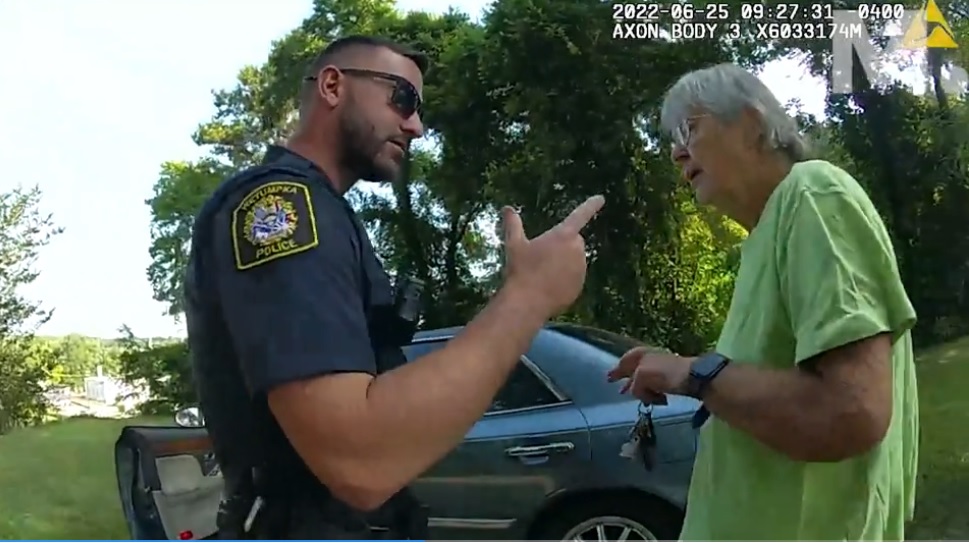
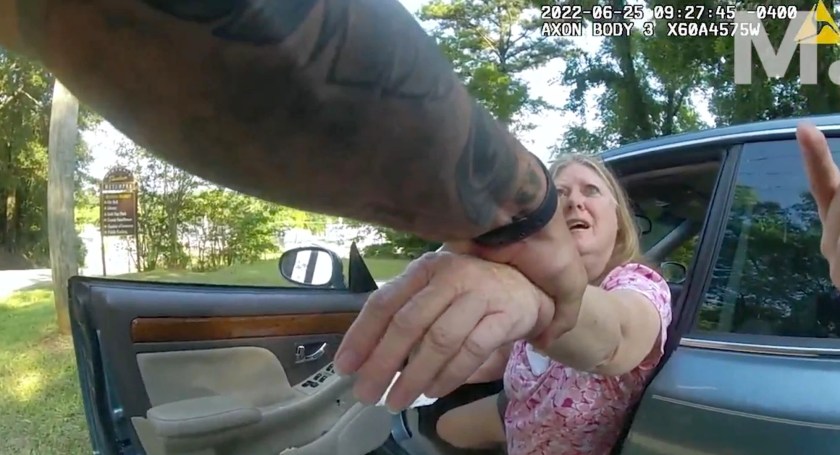
The footage showed the officers grabbing Alston by her wrists and pulling her out of her car, cuffing Roberts and berating the women for not moving fast enough when they were ordered to collect their traps and leave a wooded area on public land.
A police officer pulls Alston from her car on June 25 before arresting her for trespassing.
When Alston and Roberts expressed shock that police were hassling them, much less threatening them with arrest for managing a cat colony, one officer yelled at Roberts.
“It’s gonna get ugly if you don’t stop,” the cop said, jabbing a finger in Roberts’ face before cuffing her.
One officer told the women they were “too old to be acting this way,” and the footage captured audio of the officers laughing after one of them remarked that it was good there were no witnesses because they would have seen “a bunch of cops beatin’ up on some old ladies.”
There are no laws on the books against feeding cats in Wetumpka, so police charged the women with two misdemeanors each for disorderly conduct and resisting arrest.
Roberts and Alston argued that they were performing a service for the town by caring for the colony of strays. They were conducting TNR (trap, neuter, return) operations in cooperation with local shelters, often at their own expense, to stop the cats from continuing to breed.
Despite the fact that TNR is widely accepted as the most humane and effective way to manage stray cat populations, Wetumpka officials stuck to their allegations that the women were exacerbating a nuisance.
Wetumpka Mayor Jerry Willis doubled down after his department received overwhelmingly negative feedback over the arrests, and in a December trial witnesses described an ongoing argument between Willis, Roberts and Alston over the stray cat issue.
During the trial it was revealed that it was Willis himself who called the police when he spotted Alston’s car near the wooded area. Willis claimed he did not tell the police to arrest the women, but Officer Jason Crumpton testified that he was indeed told to arrest them.
Despite that, municipal Judge Jeff Courtney — who was appointed to his position by Willis and was not elected — found Alston and Roberts guilty of all four charges.
Prosecutors did not say why they dropped the charges on Wednesday, and it was not immediately clear if Roberts and Alston will be allowed to return to caring for the cats, who live in a wooded area on public land not far from the same municipal courthouse where they were earlier convicted. PITB has reached out to the women for comment.
“We are very worried about them,” Roberts told PITB in December. “A few animal lovers have said they would help, but we are not sure this will happen. I’m not sure there is enough food available to hunt. The weather is getting colder, and they need protein.”
Prosecutors are taking an animal abuse case in Maine seriously and have charged the suspect with a felony under a federal animal welfare law passed in 2019.
Although the story is more about her gradual acceptance that her boyfriend was inconsiderate — and didn’t put as much effort as she did into their relationship — Business Insider’s Anne Jarret writes about how his carelessness with her cat led her to end a two-year relationship.
Jarret describes how her boyfriend would do things like leave wet towels on her side of the bed, leave dishes around their home and show disregard for her sleep schedule when he knew she had to rise at 6 a.m. every morning as a teacher, but the final straw was his cavalier attitude toward losing her 15-year-old cat, who was on her last legs and needed meds to survive:
“Where’s the cat?” I asked my boyfriend as I walked into the kitchen. The sun had set, and it was time for us to give her a steroid to ease her pain.
“I don’t know,” he said with a shrug. We searched, but we couldn’t find her anywhere. Then I saw the patio door was wide open.
Guerrilla, the dying 15-year-old cat, loved spending time outside on a leash and would beg us to take her exploring.
“I guess when I took the dogs out earlier I forgot to close the door,” he said. “I’m sorry.” My heart broke.
Unfortunately, Jarret never found her cat and didn’t get closure on her fate, which is a horrible thing for anyone who loves their feline, especially after spending 15 years together.
Prosecutors use 2019 federal statute to charge teen with cat abuse
A 17-year-old from Maine has been charged with a felony under 2019’s Preventing Animal Cruelty and Torture (PACT) Act after a video surfaced on Facebook showing him brutalizing a kitten.
The teenager is accused of picking up a stray cat by his tail and repeatedly slamming him into the ground on Nov. 4. The kitten, named Harlow by the local Humane Society staff, will “likely” lose an eye as a result of the head trauma the teenager inflicted, Humane Society shelter director Katie Lisnik told the Sun-Journal.
Despite that, Harlow doesn’t hate people and seems to crave affection.
“He just loves to cuddle,” Lisnik said. “He just wants to be on you.”
This story is heartbreaking and hard to even think about. How could anyone do such a thing to an innocent animal, much less a kitten less than a year old? And the fact that Harlow is so loving and trusting despite all he endured and suffered just underscored how innocent cats are, as animals who have the intelligence and emotional capacity of three- or four-year-old children.
Usually we don’t note stories like this on PITB because animal abuse is a difficult topic, it’s upsetting and stories like this are so numerous that reading all of them can even make misanthropes out of people who believe the best of humanity. But we’ve written quite a bit about law enforcement taking animal abuse seriously, and the need for animal cruelty laws with more teeth, and this is ultimately a hopeful case because the prosecutors are taking it seriously enough to invoke the bi-partisan PACT Act.
On the other hand, some laws clearly need to be amended. The suspect hasn’t been named in media reports and his identity will likely remained sealed because of youthful offender laws, which allow minors convicted of crimes to strike convictions from their permanent records before they turn 18 if they meet certain conditions set by the court. Usually they’re straightforward: Stay out of trouble, attend psychological counseling, check in regularly with a probation officer and complete community service.
That’s fine for offenses involving drugs, theft and other relatively minor stuff. But when crimes are associated with high recidivism and/or are strong indicators of future violent crime — as animal abuse has proven to be — convicts shouldn’t be allowed to apply for youthful offender status. This kid shouldn’t be allowed to own pets or interact with animals, and this kind of crime shouldn’t be stricken from his record because if, for example, he attacks a woman he’s dating when he’s 19, it shows a pattern of violent behavior that strongly correlates to escalating violence.
At a time when school shootings are common and people commit senseless crimes like pushing strangers off subway platforms into the paths of oncoming trains, law enforcement could use all the help and information it can get in identifying people with violent histories before they do more harm.






 Pain In The Bud