Help Catch This Portland Cat Thief And Get Kitty Returned To His Family

New videos show the entire sequence of events when a woman stole a family’s cat right off their front porch on Sunday morning.

We’re putting out a call to our readers and all cat lovers to help identify a woman who brazenly snatched a family’s cat off their front porch in Portland, Oregon, on Sunday.

The woman was wearing a pink jacket with a white scarf, black jogging pants, white sneakers and green socks.

Cat thief suspect
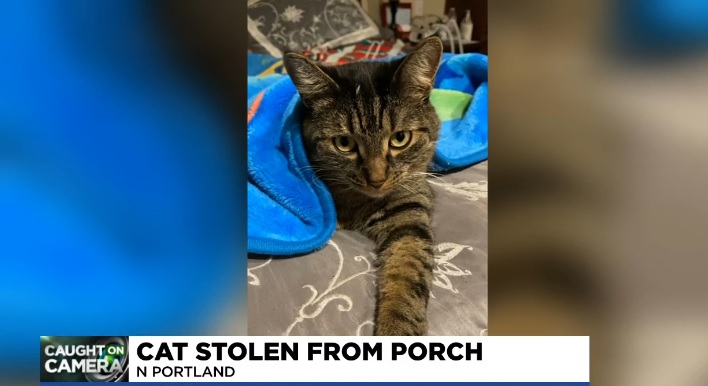
The thief was caught snatching KiKi off his family’s front porch on Feb. 20.

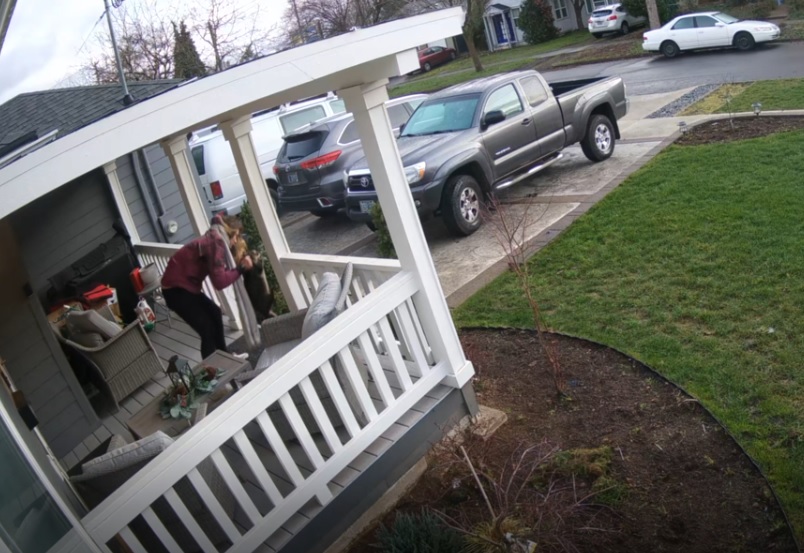
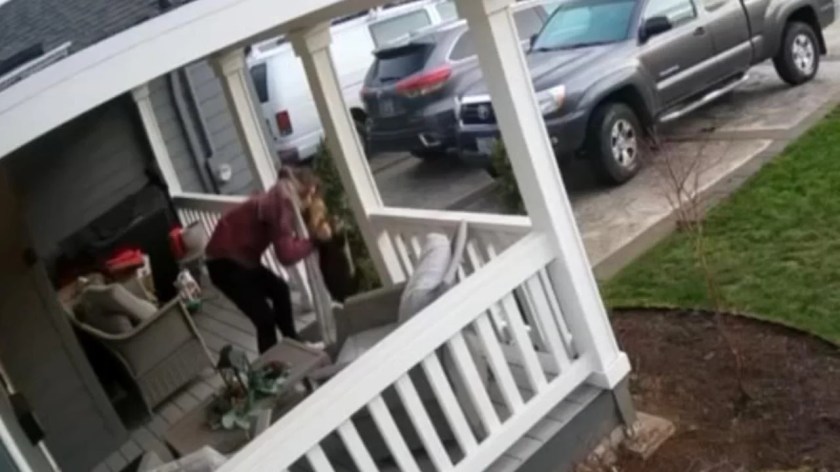
Home security footage shows that at 7 a.m. on Feb. 20, the woman approached the Autar family’s home and tried to get their cat, KiKi, to approach her. KiKi wasn’t having it and turned toward the front door several times, refusing to approach the woman, but she slowly made her way onto the porch and snatched the well-loved kitty.

It’s clear from the way she holds KiKi that she’s not familiar with cats: Footage shows her holding him by the scruff of the neck, which is extremely painful for adult cats. Here’s a video of the entire sequence courtesy of Karina Autar:

And here’s a video from a second camera overlooking the driveway. The thief is clearly holding poor KiKi by the scruff with one hand as she briskly walks off:

The woman leaves in what looks like a black or dark blue Chevy suburban, quickly fleeing the neighborhood with the trunk still open. The SUV did not have a front license plate:

Earlier footage shows the same woman on a bicycle stopping in front of cars on the block and checking their doors. It appears she tossed the bike in the back of the SUV and drove off quickly, perhaps after someone spotted her.

Anyone who recognizes the woman or has information about the theft can call the Portland Police Department’s non-emergency number at 503-823-3333 or email Karina Autar directly.

Reason #31 To Keep Your Cats Indoors: Actual Cat Burglars

A Portland family’s cat was stolen by a woman who brazenly grabbed him off their front porch on Sunday morning.

A Portland family is looking for help getting their cat back after a woman snatched the moggie off their porch and ran off with him.

Home security footage shows the woman approaching the Autar family’s home early in the morning on Feb. 20 and crouching down next to the porch where she beckoned the tabby, KiKi, to approach her.

Portland cat stolen
The woman grabs KiKi off the porch of his family’s home in Portland. The family hopes someone recognizes the suspect so they can recover KiKi.

When that didn’t work, the woman walked right up to KiKi and scooped him up.

Karina Autar and her brother, Akash, are students at the University of Oregon and described their parents as “empty-nesters” who dote on KiKi like a child.

“When my dad takes a nap, when my dad goes to sleep, he has to get KiKi on the bed with him,” Karina told KPTV, a Fox affiliate in Portland.

Karina, who adopted KiKi when she was in middle school, said it feels “like a family member is gone.”

With Karina and Akash living on campus 110 miles away in Eugene, Oregon, their parents have turned to neighbors and friends for help. The suspect was wearing a long sleeve pink jacket with a white scarf around her neck, along with black jogging pants and white running shoes. She’s got dark hair highlighted with blonde and while it’s difficult to estimate her age based on the pixelated footage, she may be in her 20s.

Akash Autar spoke directly to the woman in the KTPV segment.

“What you did was really wrong,” he said. “You took someone’s family member. You took someone’s love and joy. I just hope you haven’t done anything mean or bad or harmed him in any way.”

Pa. Politician Resigns After Running Over Stray Cats With His Truck

“We don’t need his idea of animal control,” says one neighbor, who has been caring for the local cat colony for years.

Neighbors who live on a quiet street in rural Pennsylvania were horrified when a man in a white pickup truck intentionally tried to run over stray cats last week, hitting at least one.

Now, thanks to one neighbor who captured part of the attack on video, they’ve identified the man at the wheel, and he’s a local politician.

Frank Pagani Jr. resigned from his seat on the municipal council of Galilee, a rural Pennsylvania town with a population of 379. Video shows Pagani Jr. speeding up and swerving to hit one of two cats who were in the road at the time. He was going so fast he blew through the stop sign at the end of the street.

The brazen politician then made a left turn and casually pulled into his own driveway on a side street.

William Bittner, who captured part of the Dec. 1 hit-and-run on video, said Pagani called him afterward, admitted what he’d done, and said he would resign his council seat.

“He thinks that’s the end of it,” said Bittner, who takes care of the cats along with other neighbors on the street. “You just can’t let an act like that go on without someone being charged.”

The Beaver County Humane Society said its humane officers were investigating the incident, but Pagani Jr. hadn’t been charged as of Dec. 6. Neighbors told the Beaver County Times that police officers were going door to door on Dec. 3 to speak to witnesses. Pagani has not returned calls from at least two local media outlets.

Pagani works with his father in their family business, Pagani and Son Trucking LLC, which contracts with the United States Postal Service to shuttle mail in bulk to and from a processing facility to individual post offices in the area. The company has had three USDOT violations in 2020 and 2021, records show.

As for the cats, their fate remains unknown. The video appears to show Pagani’s truck hitting or running over the tail of one cat, who immediately bolted along with the other cat who was in the street at the time. Those two cats took off with a larger group that was on the nearby sidewalk. The injured cat hasn’t been seen since.

“He could have hit the undercarriage of the front, he could have had his tail run over, he could have been bruised,” Bittner told KDKA, the local CBS affiliate. “We’ve been searching and searching and we can’t find him.”

”And when I feed him in the morning and night, he’s not showing up. So we don’t know whether [he] ran off to die or…” Bittner said, trailing off.

In a follow-up post on Facebook, Bittner explained that the strays are part of a managed TNR colony, with neighbors pitching in to help feed the cats and adopt out kittens. So far, 28 cats have been trapped and fixed.

People in the neighborhood believe Pagani was taking matters into his own hands, which follows a disturbing trend of vigilantism toward cats by people who either hate them or think they’re protecting local wildlife by killing cats.

“We don’t need his idea of animal control,” Bittner wrote.

With A Three-Fold Increase in Cat Thefts, UK Chooses Microchip Mandate

With breed cats commanding prices in the thousands, thieves see pet theft as a quick score. Lack of prosecution has made it an almost zero-risk crime in the UK.

Mandates in the wake of COVID-19 haven’t been especially popular with a weary public, but surveys show one proposed directive has almost universal support in the UK: Requiring all cat owners get their pets microchipped.

Cat thefts in the UK have tripled in the last five years, with the pandemic contributing to the increase since early 2020, police say. Authorities say they hope compulsory microchipping — and consolidating the many chip ID databases into one — will help discourage people from stealing while making it easier to reunite felines with their families.

Thieves mostly target pedigreed kitties over moggies, with Bengals as the most commonly-stolen cats, followed by British Shorthairs and Persians, according to police statistics. Thieves try for breed cats because of resale value, police say.

Dog thefts have skyrocketed as well, with thieves targeting Chihuahuas, Jack Russell Terriers and German Shepards, among other popular breeds. The price of breed dogs has ballooned by as much as 89 percent since the beginning of the pandemic, when demand for new pets and a slowdown in breeding created a boom market.

For context, an estimated 3.2 million British families welcomed new pets, mostly cats and dogs, into their homes since the first lockdowns in late winter and spring of 2020, the BBC reported. Like their counterparts here in the States, UK shelters experienced unprecedented adoption rates as people battled loneliness and depression during the initial COVID waves and last year’s long winter when the virus came back with a vengeance.

“The number one reason behind pet theft is because the prices for pets have gone up drastically,” Becky Thwaites, spokeswoman for UK pet charity Blue Cross, told SWLondoner. “This happened exponentially over lockdown, as responsible breeders stopped breeding due to social distancing guidance, but more people were wanting pets.”

Despite the spike in animal thefts, only about one percent of all such crimes have led to an arrest, according to a public information request by a UK animal welfare group. 

Police have been reluctant to pour resources into those cases, partly because the law lacks serious consequences for people who steal animals. While the maximum sentence for stealing a pet is seven years in jail, under current UK law sentences are pegged to the value of the stolen item. (Unlike the US, the UK does not make a distinction between prison and jail.)

But for people who love their cats, it’s not about the monetary value — it’s about sentiment, love and the distress to human and animal when they’re separated.

Abductions instead of thefts

To change that, a new pet theft task force — set up earlier this year to study the growing problem — recommended a change in the law. Instead of treating pet thefts as property thefts, under the proposal they would be treated as abductions, with all the increased charges and consequences that come with the classification.

Treating animal thefts as abductions “acknowledges that animals are far more than just property and will give police an additional tool to bring these sickening individuals to justice,” UK Home Secretary Priti Patel told the BBC.

Advocates say treating pet thefts as abductions makes sense not just as a legal adjustment, but also as a reflection of the way cats and dogs are stolen. While some thieves stalk dog parks and lure pets away with treats, others have taken to more brazen and violent means like taking animals by force and jumping people while they’re walking their dogs.

The change would require owners to have their kittens chipped by 20 weeks and adult cats chipped upon adoption from a shelter or rescue.  Failure to microchip a pet would result in a warning and a three-week grace period. After that, cat owners would face a steep fine of £500, equal to $660 in USD.

Consolidating chip databases

There are about 10.8 million pet cats in the UK, although widespread chipping alone won’t solve the problem of pet thefts and lost pets flooding shelters. There are currently 16 different microchip databases in the UK. They don’t always share information and scans don’t cover each of the databases, so even if a cat is recovered, brought to a shelter and scanned, there’s no guarantee the kitty will be returned home.

The existence of so many non-cooperating databases operated by private companies “can pose a huge barrier to successful reunification of pets” said the British Veterinary Association’s Malcolm Morley.

UK authorities and the animal welfare groups pushing for the change are cognizant of the problem and want to streamline the 16 existing database into one central repository of cat microchip registration. That will take time and will have to include compromise on the part of the various private companies running the existing fractured databases.

“Every day, we see how important microchipping is for cats and for the people who love them,” said Pet Protection’s Jacqui Cuff, “whether it’s reuniting a lost cat with their owner, identifying an injured cat, or helping to ensure an owner can be informed in the sad event that their cat has been hit and killed by a car.”

Going To Asia? Leave Your Pets At Home, Plus: Aussie Former Soldier Pleads In Shelter Assault

Authorities in some countries are killing pets as a precaution against spreading COVID even though virologists say there’s no evidence humans can contract the virus from their pets.

The coronavirus pandemic hasn’t been kind to pets, but the virus itself has done little damage to animals compared to the actions of scared and misinformed people.

After finally admitting it had a human-to-human transmissible virus on its hands — months after it knew privately about the virus outbreak — the Chinese government waged a war on pets in the first few weeks of 2020 as the world watched in horror.

People abandoned pets en masse in empty homes and apartments, while government authorities shot dogs and cats on sight to prevent the spread of the virus even though there was no evidence they could be infected, much less pass the virus to people. As paranoia and misinformation spread, people even resorted to clubbing pets to death on the streets.

Now we know cats can get the virus, but there’s still no evidence they can transmit it to humans, which makes the practice of killing COVID-infected pets even more infuriating in addition to pointless.

The latest incident is from Vietnam, where authorities killed 15 dogs and a cat belonging to a local bricklayer who returned to his home province after work dried up. Authorities seized his pets and “destroyed them” last week in what a government official is now calling a mistake prompted by “COVID prevention pressure and local coercion.”

danchoonghung83871633869679-16-5401-4445-1633923236_680x408
Pham Minh Hung, 49, with his dogs as he returned home to Ca Mau, Vietnam. Credit: Pham Minh Hung

That story follows an incident in the Chinese city of Harbin, where three cats were euthanized in late September — over the owner’s objections — by authorities who said they were worried the pets would “re-infect” their owners.

Pet ownership and respect for animals among the public has increased in countries like China and Vietnam in recent years, prompted by an increase in disposable income and the influence of the internet. Both cases caused widespread backlash in their respective countries, with users defying laws prohibiting criticism of government to complain about the pet killings.

“It doesn’t seem very realistic that the cats would contaminate the environment so badly that they would be a risk for their owner to re-contract COVID,” Rachael Tarlinton, a virology professor at the UK’s University of Nottingham, told Reuters.

He REALLY Wanted His Cat Back

Meanwhile in Australia, a former soldier has pleaded guilty to reduced charges after he “stormed” a pet shelter in Melbourne’s suburbs to recover his cat in January.

Prosecutors say 45-year-old Tony Wittman was outfitted with a fake but real-looking rifle and full military gear when he went to the Lost Dog’s Home in Cranbourne West late on a January night, holding a female employee at gunpoint while demanding to know where the cats were kept.

Wittman had called the shelter 10 minutes before it closed earlier that night, Australian media reported at the time, and was told the shelter had recovered his cat, but that he’d have to wait until morning to claim her.

Wittman, who threatened to shoot the employee if she didn’t comply with his demands, told the court he suffers from PTSD and felt he needed to retrieve the lost feline immediately because he “loves his cat and relies on his cat for support.”

Wittman got spooked and left the shelter before taking his cat. He dumped his tactical vest and other gear in bushes not far from the shelter.

The incident was captured on the shelter’s security cameras, and Wittman was caught when he dropped by the following morning to pick up his cat as if nothing had happened.

“The victim and her work colleagues are absolutely traumatised by what’s happened,” a detective told the court in an earlier hearing. “He’s aware of their workplace. He lives close by. He has shown a complete disregard for the safety and wellbeing of the general public.”

Wittman’s lawyers were able to negotiate a deal with prosecutors in exchange for a guilty plea to lesser charges