
Fresh off reading a fiction novel and highly amused by the author’s tendency to go on bizarre tangents, I wrote a few hundred satirical words mimicking his style and shared it to a subreddit.
I expected like-minded people to respond. Hopefully they’d find it amusing. At the very least, it should spark a conversation.
Instead I checked back the next day to find my post hidden by downvotes.
The top comment: “AI slop, f— off loser.”
The second-highest rated comment was simply “ChatGPT.”
I should have cut my losses and moved on, but it bothered me that something I wrote could be so easily and thoughtlessly dismissed as the product of AI. So I responded explaining that I had in fact written the post, slapping it together during some downtime because I thought fellow readers might get a kick out of it.
I have many deficiencies as a writer which frustrate me to no end, but I do have a modest talent for literary mimicry that I’ve deployed at various times to make observations about novelists like George R.R. Martin, popular essayists like Mitch Albom, and people like Donald Trump, whose speech patterns are practically emblazoned in neon.
No, the commenters told me. You didn’t write that post, you used ChatGPT, you are a loser, and you need to f— right off with your AI slop.
Apparently it is now inconceivable that human beings with even moderate talent exist, that anyone would spend 15 minutes jotting down a satirical take on a popular book or TV show, or put any effort into anything at all when we can cognitively offload everything.
It just happened to me again twice in recent weeks, bringing the total to probably half a dozen times since January. It doesn’t happen here because readers know me, and the blog has been around for seven years. If I’ve been using a large language model to write this blog, then I must have a time machine that allowed me to access the tech at least two years before its first crude incarnations were tested in-house at OpenAI.
Plus there’s no other idiot out there who writes absurd stories glorifying his pet cat for fictional adventures like running a criminal catnip empire. It’s not as if there’s a line of people trying to emulate what we do here, nor is there profit in it. It’s a labor of love not just because I love cats, but also because I love my cat. He’s changed my life for the better and I enjoy writing about his antics.

There is also a strong argument for not caring. Social media and general forums are not lacking for miserable cynics and people who work through their real life frustrations by vomiting bile in every direction.
I don’t need to justify myself to every cynic and malcontent, nor do I want to take on the burden of proving a negative.
The real-life impact of AI on the news and publishing industries
Unfortunately it’s becoming more difficult to ignore because it’s beginning to impact more than just online dialog.
Generative AI has put the editors of genre magazines and periodicals on their back feet. Editors, already overworked, find themselves trying to navigate “a swamp of slop.” Some have shut down general submissions entirely. Others have adopted convoluted processes or require known writers to vouch for the submitter, as if they’re applying for membership in an exclusive social club.
Generative AI is also destroying what’s left of the news industry, and the damage is now so widespread that it isn’t only impacting people who used to crank out simple daily stories. When entire publications fold and companies like Gannett turn formerly excellent broadsheets into little more than AI-generated shells for advertising inserts, investigative journalism jobs disappear and government employees at the municipal, county and state level operate without anyone keeping watch.

I think about some of the stories I wrote: A series about an unusually high number of suicides on particular bridges in New York that led to major changes in safety features on those bridges. A comprehensive account of extensive fraud in the state jail system. An investigation into New York-based charities guilty of outright corruption or abysmal program spending, run by people who paid themselves well and held glitzy charity galas, but actually raised very little or nothing for the causes they claimed to represent. An interview with the traumatized dad of a mass shooter who kept blaming himself and asking “Where did I go wrong as a father?”
And the story I’m most proud of, an 11th-hour rush job about an abducted girl, an article I scrambled to get done by the print deadline and submitted just minutes before pagination files were sent to pre-press. The story ran in one of our sister papers in New Jersey, leading to a reader recognizing the kidnapper the same day it was published. The reader called police, who found the man with the young girl he’d abducted.
I helped save a kid from a horrific, life-altering trauma! I don’t say that to toot my own horn, but to emphasize the value of real journalism, of human beings prioritizing a story and making every effort to get it done and published when there are real stakes. The story wasn’t anything special, it didn’t stretch my abilities or win any awards, but it impacted the lives of a real family for the better.
A machine could not have taken a call from a panicked mother, reassured her every effort would be made to get the story out, driven to the detective bureau after hours to verify the details, found out where the abductor had roots, and made sure the story ran in the newspaper covering the area where the abductor likely fled with his victim.
That kind of journalism cannot be replaced by AI or bloggers. It takes training, strong news judgment, the ability to navigate bureaucratic circles of hell, and lots of patience in dealing with people who consider reporters irredeemable bottom-feeders.
At least as it stands now, generative AI can’t replace a thoughtful interviewer, a true investigative reporter, or honest analysis of important stories. An investigative reporter can use AI to help scour thousands of documents for a needle in a haystack or to search for hidden patterns, but that is an example of incorporating the tech into a workflow, using it to make drudge work easier, not using it to replace a human. Human consciousness and judgment is still the guiding force behind the effort.
Still, I’d be lying if I said it didn’t bother me that this is happening as often as it has been recently. We may be living in an age of algorithmic AI, of simulated intelligence instead of AGI and true machine cognition, but this is not what I envisioned while imagining the ways AI could impact society.
It’s also frustrating that my writing is now automatically dismissed as “slop” because it doesn’t have some arbitrary lack of polish to it, or because people are cynical in general.
My writing is the closest thing to my consciousness, to my mind, to me.
Obviously I format and attempt to copy edit my own posts. A replica of my stream of consciousness wouldn’t make for coherent, entertaining reading. But when I write a post about an issue impacting animals, my feelings for my best Bud, or something else that I’ve got an opinion on, you’re reading my thoughts on the subject.
That is a direct result of who I am. To offload that to a machine seems insane, an abdication of my mind, personality and voice to a fancy bit of code.
AI-generated content is even more ubiquitous than we realize
When I finish my novel — a narrative that weaves elements of space opera with themes about species conservation and appreciation for our one and only home planet — will I run into skeptical editors? Will some people dismiss it out of hand if they deem it too polished or they’ve been inundated with submissions from people who see AI as a shortcut to getting published? Will there still be a book publishing industry?
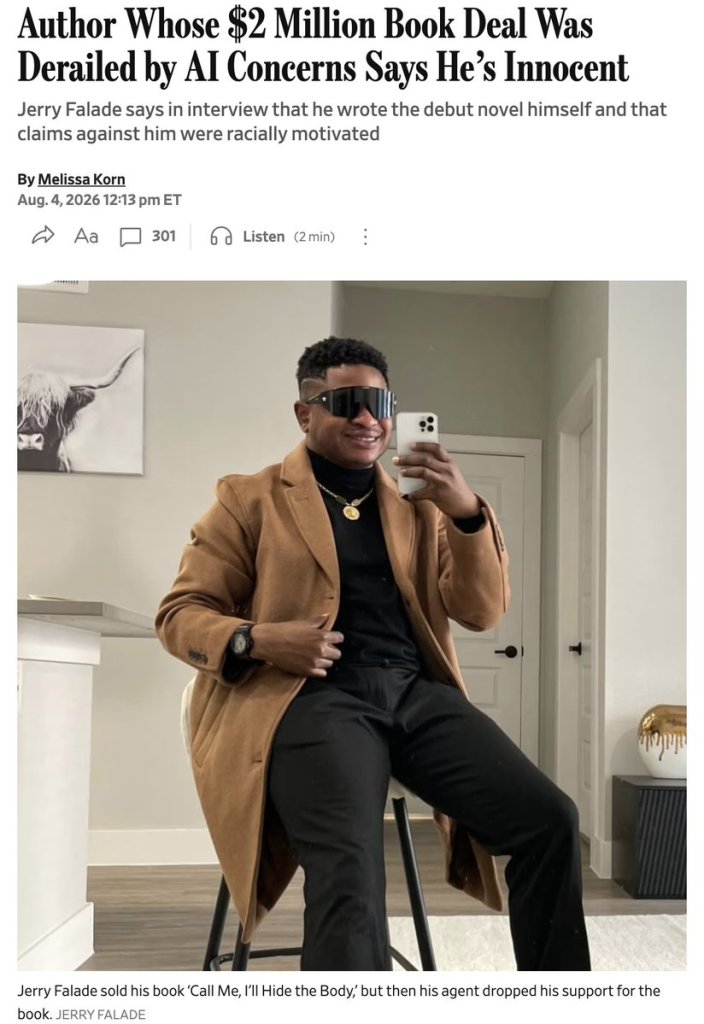
The doors are already closing. In the latest scandal, a publishing company withdrew a multimillion-dollar advance to an author whose debut had sparked a bidding war because he used AI to write the novel. (The claimed author, Jerry Falade, says he did not use AI and argues he’s a victim of racism targeting black novelists, though it’s worth pointing out that it wasn’t just the publishers who bought the rights in the US and UK who cancelled the book. His agent dropped him too, saying she “could no longer substantiate” Falade’s insistence that he wrote the book.)
Given the fact that they’re voluntarily shelving a novel that was likely to move copies and make them a tidy profit, it’s difficult to believe the publishers and agent made the decision lightly.
The fact that Falade is an academic does not shield him from suspicion. The writer Sam Kriss has called out several people in higher education for using AI, including Narges Bajoghli, an assistant professor of Middle East Studies at John Hopkins University. Kriss cited this passage, which screams “I wrote this with ChatGPT”:
“Not a ceremony. Not a transition. A series of viral moments. A missile arc across a pale sky, and below it, the world already changed.”
Indeed, that precise sentence construction appears in another bit of AI writing highlighted by Kriss, and you can find it in AI-generated writing all over the internet. “Not an X. Not a Y. A Z,” followed by a bit of purple prose that sounds vaguely poetic but says nothing. Why the large language model likes to phrase things that way is a mystery, but it must have appeared in annotated data sets used by OpenAI to train the algorithm, and now it’s popping up with alarming regularity in essays, news stories and fiction writing “authored” by people who have suddenly and miraculously transformed into prolific, polished writers.
Not an accident. Not a happy coincidence. A blaring klaxon forged in ones and zeroes, summoned by prompt engineers communing with the machine gods.
That’s just one example, but AI’s penchant for using certain phrases and rhythmic structures has led to an unsettling, self-reinforcing homogeneity. The more AI uses these constructions, the more we’re hammered over the head with them, the more they leak into our own conversations and writing. It’s like going on vacation with a friend and coming back two weeks later to realize you’ve picked up on their favorite exclamations. Except that friend is now everywhere at once, and half your work colleagues have incorporated his -isms into their everyday dialog.
I use AI for images, which makes me a hypocrite
This has, of course, led me to reevaluate my use of generative AI images on this blog.
I’ve justified it by telling myself there was never going to be a situation in which I’d commission a professional artist to paint images of my cat dunking over NBA players in a summer league game, looking comically ridiculous in a powdered wig as a captain aboard a 17th century ship of the line, or riding through the jungle on the back of a jaguar 10 times his size.

There’s also a crucial difference in that I’m using AI images to illustrate humor stories on a blog, not submitting them to galleries or publications as my own work, then accepting payment and plaudits for them, which is what many people are doing with AI-authored writing.
While that’s true, it’s also true that I’m participating in the devaluing of art on some level. More recently I’ve made a conscious effort to limit its use here, but that still makes me a hypocrite. I relied on it too heavily in the past and now routinely see blogs that use it for every post. I’m not judging those bloggers, merely observing how much we’ve all come to rely on the technology.
The improbably prolific new masters of prose
On the writing side, there’s also been a deluge of new “storytellers” who write generic stuff in a punchy style, with minimalist sentences and formatting that is unmistakably the output of a large language model. They blog under names like “Stories from the Mind Of…” or “Weekend Stories With…” and they always seem to have the right anecdote to illustrate some generic societal ill.
Many of these new, astonishingly prolific writers are publishing their AI-generated stories on platforms like WordPress, WebNovel, Royal Road and Youtube, and people are eating it up despite the fact that it’s machine-generated, generic content. It’s not coincidence that Amazon suddenly has three times as many book titles for sale, or that there are entire YouTube channels dedicated to genre stories — horror, science fiction, romance — that contain all the hallmarks and language quirks of AI, including nearly identical plots, recycled character names, and recycled phrases. Nor is it happenstance that they’ve all materialized out of nowhere in the last year or two.

Some publish stories of 8,000 to 10,000 words several times a week or even daily! As a writer who came up in a daily news environment, I’ve learned to pump out accurate, polished posts with regularity. It is a requirement of the job.
If you can write in a busy newsroom with phones ringing, police scanners buzzing, and more than 100 coworkers in an open office plan chatting away, you can write just about anywhere.
And yet I cannot dream of dropping polished 8,000-word fiction stories every single day. No human being can do that. Even if you can keep that pace for a short while (and very few people can), before long you’ll be derailed by burnout, a lack of new ideas, stories that just don’t come together the way you envisioned. Or maybe life just gets in the way.
The hidden physical cost of AI

While I don’t want to come off as one of those people who reflexively condemns new forms of tech, the more I learn about the infrastructure behind AI, the less I like it.
AI requires massive data centers that rival or exceed cities in power consumption. While it’s true that data centers have existed for decades, the centers that power AI are a new breed, orders of magnitude more power-hungry than their predecessors.
Advanced processors require cool ambient temperatures but they also generate lots of waste heat, meaning data centers are also a huge drain on water reserves. That’s the second law of thermodynamics. With summers getting hotter, what happens when there are droughts? If you think the government will tell big tech to ease up on data center water consumption, you’re probably not aware that our government doesn’t even protect cities and states from overwhelming water consumption by foreign-owned industrial farms.
There are communities in the southwest that have become endangered because, for example, Saudi-owned alfalfa farms consume so much water that there’s none left over for the people who live there. Politicians listen to the people who have the deepest pockets and a town of 10,000 in Arizona can’t compete with the vast wealth at the disposal of Saudi Arabian interests, even when those constituents have been reduced to frantically filling gallon containers in the brief interludes when new rainfall temporarily replenishes reservoirs.
Don’t like it? Go to Costco and stock up on spring water. No, the congressman cannot take your call. He’s got a meeting on data center expansion this afternoon.
If our elected representatives side with foreign investors over their own voters, we have little chance of them siding with us over deep-pocketed technology giants, headed by tech oligarchs who cut checks to lawmakers in every election cycle and already have their tendrils deep in government at every level.
Finally, about that cognitive offloading we talked about earlier: the mind and brain depend on keeping skills sharp. If we don’t use it, we lose it. It’s very easy to see how capabilities and intelligence may regress in our society if everyone uses AI for virtually everything.
Maybe all this is pointless. Maybe I am, in the words of Kriss, merely expressing “the rage of a rapidly obsolescing ape.”
I’m not condemning anyone who uses AI and I’m not saying I’ll never use AI again. That would make an even bigger hypocrite out of me, and it would be an act of self-harm not to keep up with such a rapidly-evolving technology. But I am going to make an effort to use it sparingly, hopefully only when absolutely necessary, and never to write a single word for me.
As a one-man band without a budget, for example, I rely on free-license photos from Wikimedia Commons and Pexels to provide visuals for my posts. Which is fine for the majority of topics, but sometimes there are obscure stories that cannot be illustrated with existing free photos.
For the other stuff, I’ll go back to the simple charms of bad Photoshops of Buddy as a Godzilla-size cat stomping around Manhattan in search of similarly massive turkeys.
And let’s hope services like Pangram, which claims 99 percent accuracy in detecting AI-generated writing, stay ahead in the arms race. Already people determined to use AI to become authors and storytellers are using so-called “humanizers” in an attempt to fool those apps. I suspect the next few years will look an awful lot like the unending battle between hackers and security companies in their own arms race to stay ahead of exploits.
 Pain In The Bud
Now you get in trouble when you write well.
I’ve also been kicked off a couple of social media platforms, one of them permanently, because they deemed one or more of my posts as “inauthentic.” The joke is, AI decided this. They couldn’t tell me which were in violation of Community Guidelines, they just sent me the long list of those guidelines to review. Ugh.
LikeLiked by 1 person
There’s a data center planned for a location upstream from the creek that runs through our land, as well as many other local waterways. Lots of people are unhappy about it, but not enough. I’d hoped to preserve it as a natural Appalachian foothill area stream.
LikeLiked by 2 people
Has anyone done a petition for this? I see them a lot for other locations.
LikeLiked by 1 person
People are complaining, it’s just very difficult to stop tech oligarchs and their companies from doing what they want. There’s also that NIMBY element that pops up with wind farms, nuclear reactors, etc.
LikeLiked by 1 person
Not sure at this point as I’m having trouble keeping up with everything (I’m unwell) but apparently the small city just accepted or okayed it before announcing it to the community … I’ve been reposting everything …
LikeLike
They’re required by law to hold public hearings and to announce them, but shady town boards will try to get around that by posting tiny print ads buried in weekly newspapers, and if there’s no legitimate local media, they might get away with essentially doing this stuff in secret.
LikeLiked by 1 person
I’ve been looking today and don’t see a petition but there’s lots of discussion to go through … There wasn’t really much public notification … And, the area is near or over some long-wall coal mines, which also makes it hazardous …
LikeLike
This is a fascinating, but deeply troubling essay. I knew the AI situation was bad, but not that bad.
Two observations. Firstly, when you write that due to the growth of AI “investigative journalism jobs disappear and government employees at the municipal, county and state level operate without anyone keeping watch” you are right to raise the concern. Good investigative journalism is one of the hallmarks of a well-functioning democracy, though it’s not just “government employees” who need to be watched…unfettered capitalists also have a lot to answer for, and – just like government employees – need to be actively monitored!
Secondly, I applaud your observation that “the mind and brain depend on keeping skills sharp. If we don’t use it, we lose it. It’s very easy to see how capabilities and intelligence may regress in our society if everyone uses AI for virtually everything.” This feels scarily true. And if our intelligence regresses, our society will be even less capable of asking the right questions and thereby detecting where AI is misleading us. This is a wormhole that could ultimately lead to the destruction of human society.
On a more positive note, well done to you for helping to save that abducted girl. I’m sure you will say you only did what any decent human being would do, but you did a good thing when – I guess – it would have been much easier to keep your head down and do nothing. Well done, sir!
LikeLike
You’re right. I have always been on public watchdog reporting and editing beats, so I don’t have experience covering business, but it’s absolutely true we need watchdogs for that. The tech press seems to do a pretty good job of it. Just this week WIRED has run a series of stories on the disturbing Flock AI camera system rolled out by police departments across the country, which goes beyond crime solving and well into monitoring regular people going about their daily business.
As for the way cognitive skills atrophy without writing, here’s a New York Times article on that very subject via Archive so you don’t have to deal with the paywall:
https://archive.is/20260817095100/https://www.nytimes.com/2026/08/17/us/student-writing-essays-ai.html
It deals with a lot of what we’ve said here, but it also makes interesting points about metacognition and the less obvious reasoning skills developed and sharpened by writing.
The atrophy has already begun and is accelerating, according to educators, and I wholeheartedly agree with your observation that this is potentially existential for society.
As for the kid and the story, I value that more than my Associated Press awards and the handful of national awards I have for investigative work. Sometimes you get so much grief for being a journalist, and people aren’t wrong to distrust the industry, but that was a moment that showed real good can come of the work as well. Thanks for your kind words!
LikeLiked by 2 people
Fascinating article, thank you for sending me the link. It reminded me that when I went for an interview for my first job after leaving university (at which point I thought I wanted to be an accountant – silly me!) the interviewer asked something like “So what was the point of studying history for three years, and writing all those essays”. I told him that studying history and writing about it taught me to think, and it’s my ability to think that would make me an asset to his business. I still firmly believe that today – yes, writing essays is can be hard, but hard is good. It helped make me who I am today.
One little question: “Public Watchdog Reporting” – is that a recognised name for the sort of thing you do? I’ve never come across it, but of course it’s not my area of expertise. Or maybe it’s a bit of North American terminology? As a job title it does make sense.
LikeLike
It’s just a term for investigative journalism, particularly involving government agencies, non-profits, public institutions and that sort of thing. Anything involving power in the public sector.
I was fortunate enough to see the very end of newspapers as institutional powers when I graduated, and even more fortunate to be paired with a mentor who was one of the best investigative reporters in the country.
Thanks to her, I’m able to do things like this:
Man, that job question is a red flag! I admire the idea of the “classical education” and it’s too bad there’s really not a modernized version of it today with elements of often-untaught eastern history mixed in.
Someone who asks you what the point of studying and writing about history is, is probably the kind of person who thinks slavery happened once in human history and would be shocked to discover it was widespread in antiquity.
Who are we if we don’t even know our history?
LikeLiked by 1 person
Wow, looks like your mentor did a good job knocking you into shape! Impressive piece of investigation on an important topic. As a guy who spent almost his entire working life in the public sector, I would just say in our defence that in my experience the vast majority of people working in that sector are decent and well-meaning. Honest!
Regarding my “classical education” I feel increasingly like a dinosaur. I worry that before long I’ll be shot, stuffed and put on display in the local museum!
LikeLike
Excellent piece/observations.
I’m a freelance editor (and sometime writer), and a recent contract renewal with one of my clients added a bit forbidding copy editors from using LLM or any generative AI tools to complete their work — included not because the client suspected that of anyone, but just as a matter of doing business these days. I’ve noticed that most of the writing and editing jobs that pop up on my LinkedIn feed pertain to training AI — I guess so that professional writers and editors can train AI to take their jobs?
Oh, and apparently the above paragraph makes my writing suspect because AI loooooves em dashes?
It’s hard not to feel like AI has got its grubby little fingers in everything.
LikeLike
I’ve read the stuff about EM dashes as well, and words like tapestry, intricate, transformative, etc.
While formatting can give it away and I suppose overuse of certain words can, I think the people focusing on specific words are missing the biggest giveaway, which is the structure and rhythm of the language along with its low calorie information value. AI writes in a way that tries to impress and strives for sentences that seem poetic but say absolutely nothing.
“As for the rhythm, it’s like this.
Short. Punchy.
Not obvious. Not subtle. Something hidden in the lacuna between the tangible and sublime, buried deep in the vibrations of reality.
It doesn’t have to make sense. It doesn’t have to convey information. It’s a tapestry of intent. It balms the soul.”
There are innumerable people posting slop like that all over the internet and then taking a bow when others reward them with vaporous superlatives like “It was just so chef’s kiss!”
I agree with you on both counts, AI has its grubby little fingers in everything now, and people are taking short term, low paying jobs to train the machines who will replace us.
LikeLiked by 1 person
These data centers are even more nefarious. Catherine-Austin Fitts discusses how the mathmatical data-crunching needed by AI will probably be used. Chapter 4 of this video (which starts at around 37:40.
https://tuckercarlson.com/live-show-august-12-2026
LikeLike
Thanks for the link. I can’t watch it right this moment, but I’ll check it out tonight.
LikeLike
OK I was actually able to give it a listen but she’s talking about privatization, pirating public resources and the investor class looting public coffers. It’s interesting, but I’ve listened for 16 minutes and haven’t heard any AI talk. Is it possible it’s a different link or something?
LikeLike
An article by a favored author/blogger which speaks to individualism in the sphere of writing and writers. I think you’ll enjoy it.
https://edwardcurtin.com/the-benefit-of-not-reading/
LikeLike
A couple years ago, I posted on Craigslist a cellphone that I wanted to get rid of. It was a new phone, however the Idiot Queen (i.e. me) forgot to write down the whatsis number – the number you enter to wake the phone up – so I couldn’t figure out how to use it. I tried to describe in a humorous fashion why I wanted to get rid of it. The sole reply I got claimed that my photograph of the phone, which I shot outside on my front porch, was an AI- generated pic, and my posting to sell the phone was a scam.
LikeLike
Well, they can claim that and as long as Criagslist doesn’t bother you, you’re good. Sounds like that person was targeted or fell for a scam and mistook you for another scammer.
Unfortunately AI does make it easy to scam people, whether targeting lonely single retirees with romance scams or gullible men who throw money at accounts featuring AI-generated women they think are real. Or fake merchandise. Or fake apartment rentals. Or cloning people’s voices and calling up their relatives late at night in a panic, begging for “bail money.”
I don’t know how people who run these scams can sleep at night after taking advantage of other people’s kindness and willingness to help others.
LikeLike
When AI first started coming up, I remember thinking positive things, like we´re living in the future or even laughing at those videos of Will Smith eating spaghetti. But then I started noticing things like how the prices of items such as laptops and cell phones have gone way up, and the reason is that they now need better processors to run AI applications. Then I heard about things like how a company no longer hires artists to draw because AI can do it. And I started to become disappointed with AI. Especially when I found out about all the resources it needs to function. I can’t blame anyone or call them a hypocrite for using AI, I’ve used it myself for things like asking for help to improve the writing in this paragraph or looking up information. I’m not a writer, and I truly think people who can actually do it have an admirable talent. Stay strong Big Buddy, when people tell you that you use AI to write, it just shows how much of a loser THEY are, not you.
LikeLike
The price hikes are troubling. Do you remember when so many people were snapping up GPUs to mine crypto that you couldn’t get a decent graphics card for less than $500?
The current AI boom is doing something similar, but to all hardware. It’s not even necessary, which is the sad part. The first thing I did on my new desktop was disable Co-Pilot and AI integration in my browsers.
Thank you for your kind words. At this point I’m no longer worried about what randos think of my work on Reddit or wherever, but I do hope the book publishing, periodcals and what’s left of newspapers/magazines survive the AI bubble.
Might not be long now anyway. All the big AI companies are hemorrhaging cash and have valuations that do not resemble reality. The crash is going to be brutal.
LikeLike
So true, it seems like most of the things offered to the public are useless nonsense, and you’re right, at some point, the AI bubble is going to burst. I honestly don’t know what the consequences might be, but I don’t think they’ll be anything pretty.
LikeLike
Data centers are becoming a flashpoint in the midterm elections. It seems like most people aren’t reading much. Without critical analysis, the slop will stand
LikeLike
That’s the unseen problem here. People aren’t factoring in the atrophy of essential cognitive skills by outsourcing the task to AI.
Although I do believe there is a reckoning on the horizon as AI writing becomes even more ubiquitous and people begin noticing the homogeneity. Everyone who thought they were being exceedingly clever by presenting AI output as their own writing will have diminishing returns as they fool fewer people, and the people who have been duped will not be happy with the writers who misrepresented themselves.
That’s part of the reason our friend Trishik is particularly egregious. Not only does he use AI to write his stories, he basks in the praise of readers who are fooled and writes at length about the “struggle” and “journey” of writing his stories. (Well, the LLM writes at length, at any rate.) He presents himself as some sort of writer-philosopher communing with the muses and takes full credit for a machine’s labor. And then he sells collections of the slop as original work, even though AI generated content cannot be copyrighted.
That’s grotesquely dishonest, and he’s not the only one.
LikeLike