
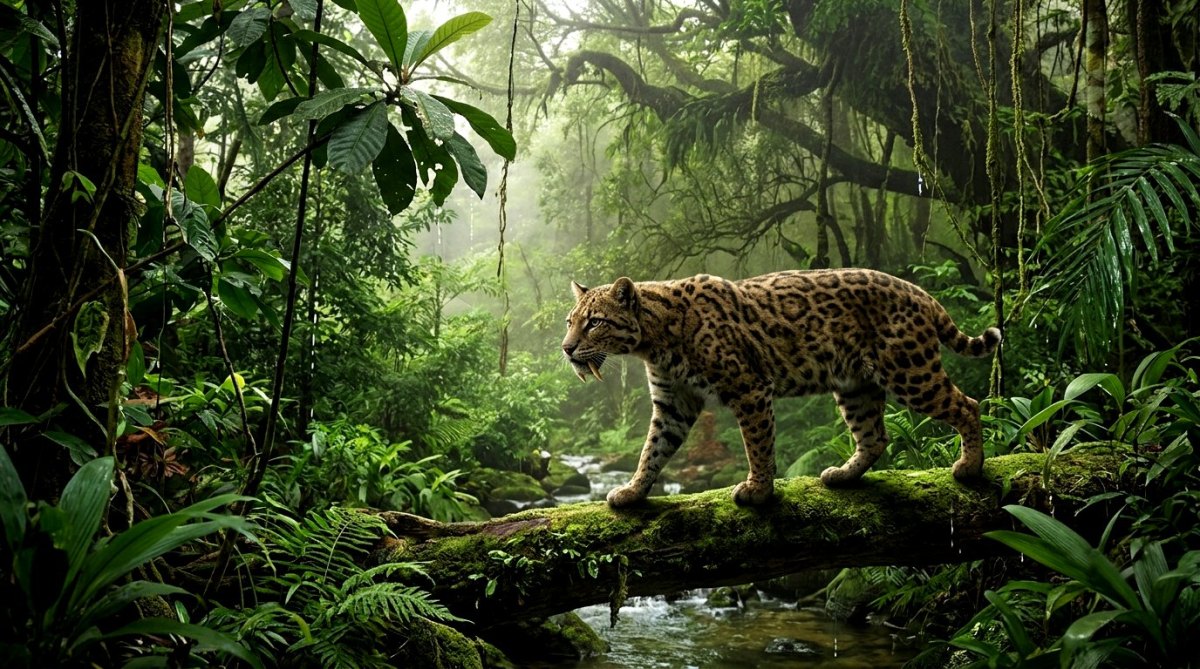
Saber-toothed cats — an umbrella term for a wide variety of felid species with massive, scimitar-like teeth — are some of the most terrifying prehistoric predators, carnivorousness incarnate.
But it turns out the teeth that give them their name and their fearsome reputation were also their greatest weakness.
The problem? While the oversized upper canines were optimal for delivering kill bites and tearing into flesh, they could break if the teeth met bone with force.
“Slicing and crushing are basically the two main things a carnivorous mammal’s teeth can do,” said Narimane Chatar, a postdoc at UC Berkeley studying carnivores. “But for saber-toothed animals, there’s a clear trade off. Those upper canines were extremely efficient but also break very easily.”
As experts on extant big cats are well aware, a hypercarnivore with broken or damaged fangs can struggle to take down their typical prey. That’s what often turns tigers, leopards and lions into man-eaters. (Interestingly, there are no documented accounts of man-hunting jaguars. Jaguar attacks on humans are exceedingly rare, and while they have killed humans, there’s no jaguar equivalent of the Chamapawat Tiger or the Leopard of Rudraprayag.)
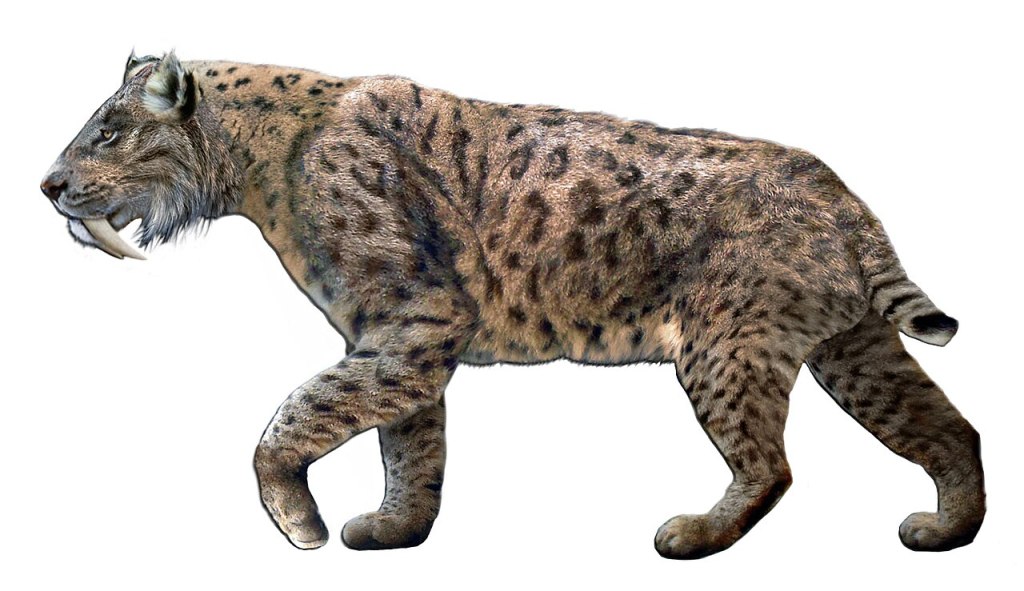
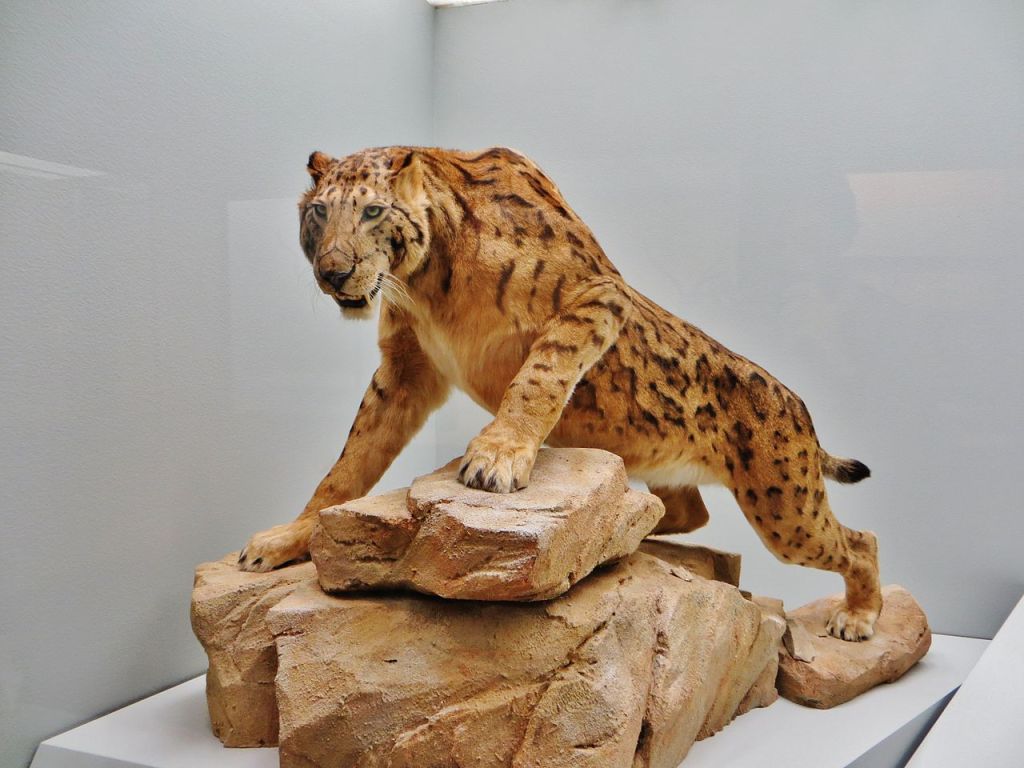
During her research, Chatar found the skull and teeth of a saber-toothed cat in Berkeley’s archives and realized it was not the same species associated with saber-toothed cats in the Americas.
Although Smilodon and Homotherium are the most well-known species, “there was a crazy variety of saber-toothed cats,” Chatar said.
Her research has confirmed the prehistoric cat’s sword-like fangs were double-edged, literally and figuratively. Per UC Berkeley:
“In simulations, 3D-printed saber teeth from various species proved ideal at penetrating a gel with the consistency of flesh but fractured easily against simulated bone. In the former tests, Smilodon came out on top. In the latter, Smilodon fared the worst.“
Smilodon lived in the Americas and went extinct about 8,200 years ago. Los Angeles’ La Brea Tar Pits have yielded a number of preserved skeletal remains, making Smilodon and its three sub-species among the best-known prehistoric felids.
Smilodon and Megantereon images via Wikimedia Commons.


No picture of Buddy as a sabertooth?
LikeLike
That would be terrifying lol.
LikeLiked by 1 person
I thoroughly enjoyed this, Big Buddy! Great information.
LikeLike
Thanks, Kymber!
LikeLiked by 1 person
I also enjoyed this article. What i would not give to see one of these fascinating creatures in a museum. But how will this information help us? Even if the saberteeth broke off could they not chew thier prey?
LikeLike
I’d love to see one too. As far as learning from this, the saber-toothed cat species went extinct. A lot of people assume that they are the distant ancestors of modern big cats, and it makes sense that people would think that, but they actually split off from a common ancestor.
So the saber-toothed cats of the family Machairodontinae (modern big cats are Pantherinae) went extinct and we don’t fully understand why.
This new research shows that huge teeth, while fearsome and dangerous, were also likely an evolutionary dead end.
Of course there could also be other reasons, like competition for their preferred prey, or prey animals becoming more scarce. We don’t know for sure, but this is another piece of the bigger puzzle that hopefully shows us the big picture.
LikeLike
I actually assumed they were ancestors of todays big cats.
LikeLike
Prehistoric animals are so fascinating. Sometimes I feel bad for the animals that went extinct, and other times I think they were lucky because they don’t have to deal with us.
LikeLike
More than 99 percent of all species that ever existed on Earth have gone extinct, and we’re looking at almost a billion years of evolutionary history when multicellular animals evolved into the first animals.
I have no definitive proof, but I think there have probably been some incredibly bizarre forms of life. Even now there are creatures in the ocean that are alien in appearance and behavior, living at depths that are extremely difficult for us to reach.
LikeLike
It’s truly fascinating to think about all the forms of life that have ever existed.
LikeLike
Well, dang! Every advantage has its disadvantage. Gotta keep nature balanced, I guess!
LikeLike
Indeed. And when situations change, species adapt or die.
LikeLiked by 1 person