
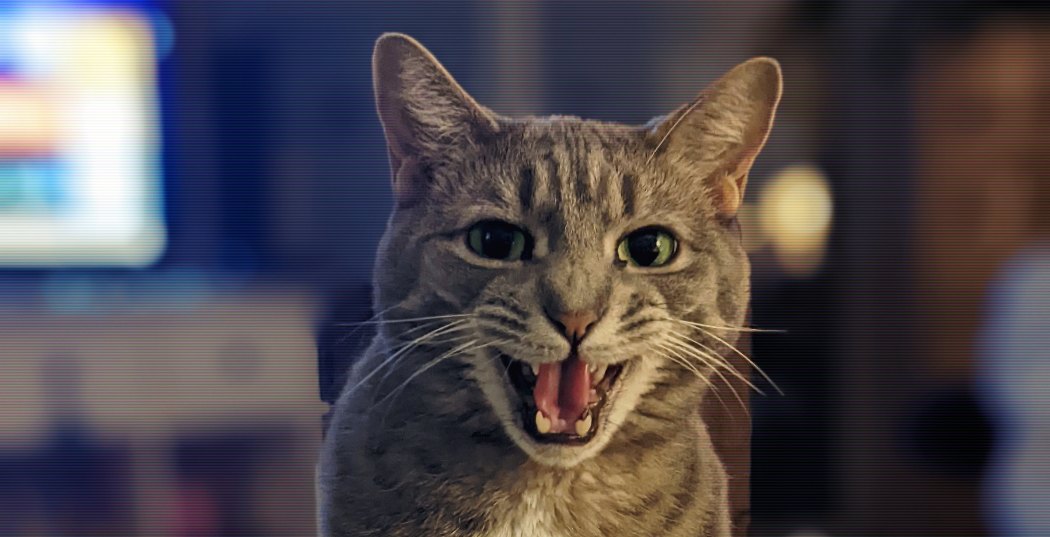
A few years ago when MeowTalk made a minor splash in the startup world, I was pretty bullish on its potential to help us understand our cats better.
Sure, the app had an unhelpful habit of attributing improbably loving declarations to Buddy, but I thought it would follow the trajectory of other machine learning models and drastically improve as it accumulated more data.
More users meant the app would record and analyze more meows, chirps and trills, meaning it was just a matter of time before the AI would be able to distinguish between an “I want attention!” meow and a “My bowl is dangerously close to empty!” meow.
Obviously that didn’t happen, and what I personally didn’t take into account back then — and should have, given how obvious it is in retrospect — is that cats don’t just communicate via vocalizations.
In fact, cats don’t normally incorporate vocalizations into communication at all. Pet kitties do it entirely for our benefit because they know we’re generally awful at interpreting body language and we are completely useless when it comes to olfactory information.
It’s actually amazing when you really think about how much of the heavy lifting cats do in our efforts to communicate with each other. They recognize we can’t communicate the way they do naturally, so they try to relate to us on our terms. In return, we meet them less than halfway.
No wonder Buddy sometimes looks frustrated as he meows at me, as if I’m the biggest moron in the world for not understanding the very obvious thing he’s trying to tell me.

Now the Chinese tech giant Baidu is throwing its hat into the ring after filing a patent in China for an AI system that uses machine learning to decode animal communication and “translate” it to human language.
Machines are designed to process things from a human viewpoint according to human logic, so if Baidu wants to succeed where MeowTalk has not, its engineers will need to take a thoughtful approach with the help of animal behavior experts.
This is a hard problem that encompasses animal cognition, neuroscience, linguistics, biology, biochemistry and even philosophy. If they approach this strictly as a tech challenge, they’ll set themselves up for failure.
Without the information and context clues provided by tails, whiskers, facial expressions, posture, eye dilation, heart rate, pheromones and even fur, an AI system is only getting a fraction of the information cats are trying to convey.
Trying to glean meaning from that is like trying to read a book in which only every fourth or fifth letter is legible. There’s just too much missing information.
Even if we can train machines to analyze sound visual, tactile and olfactory information, it may not be possible to truly translate what our cats are saying to us. We may have to settle for approximations. We’ve only begun to guess at how the world is interpreted differently among human beings thanks to things like qualia and neurodivergence, and the way cats and dogs see the world is undoubtedly more strange to us than the way a neurodivergent person might make sense of reality.
“He grimaced. He had drawn a greedy old character, a tough old male whose mind was full of slobbering thoughts of food, veritable oceans full of half-spoiled fish. Father Moontree had once said that he burped cod liver oil for weeks after drawing that particular glutton, so strongly had the telepathic image of fish impressed itself upon his mind. Yet the glutton was a glutton for danger as well as for fish. He had killed sixty-three Dragons, more than any other Partner in the service, and was quite literally worth his weight in gold.” – Cordwainer Smith, The Game of Rat and Dragon
 An animal’s interpretation of reality may be so psychologically alien that most of its communication may be apples to oranges at best. Which is why I always loved Cordwainer Smith’s description of the feline mind as experienced via a technology that allows humans with special talents to share thoughts with cats in his classic short story, The Game of Rat and Dragon.
In the story, humans are a starfaring civilization and encounter a threat in the void between stars that people don’t have the reaction speed to deal with. Cats, however, are fast and swift enough, and with a neural bridge device, teams of humans paired with cats are able to keep passengers safe on interstellar journeys.
The narrator, who is one of the few people with an affinity for teaming up with felines, hopes he’ll be paired with one of his two favorite cats for his latest mission, but instead he’s assigned to partner with an old glutton of a tomcat whose mind was dominated by “slobbering thoughts of food, veritable oceans of half-spoiled fish.”
The narrator wryly notes that the last time one of his colleagues was paired with that particular cat, his burps tasted of fish for weeks afterward. But the cat in question, despite being obsessed with fish, is a badass at killing “dragons,” the human nickname for the bizarre entities that attack human ships in space. (The software that allows felines and humans to link thoughts also portrays the “dragons” as rodents in the minds of the cats, stimulating their ancient predatory drive so they’ll attack instantly when they see the enemy.)
We can’t know for sure if Smith’s interpretation of the feline mind is accurate, but another part rang true when he wrote that cat thoughts were all about the moment, filled with sentiments of warmth and affection, while they rapidly lost interest in thoughts about human concerns, dismissing them “as so much rubbish.”
If the mind of a cat is that relatable, we’ll be incredibly lucky. But in reality we’re dealing with animals who evolved in drastically different ecological niches, with different priorities, motivations, and ways of looking at the world — literally and figuratively.
That doesn’t mean we shouldn’t try to understand our furry friends. Research has yielded interesting information about the way animals like whales and elephants communicate, and AI is at its best when it augments human creativity and curiosity instead of trying to replace it.
Even if we don’t end up with a way to glean 1:1 translations, the prospect of improving our understanding of animal minds is tantalizing enough. We just need to make sure we’re listening to everything they’re saying, not just the meows.
 Pain In The Bud
Yawn… AI is the latest fad to hit the tech world. Like all fads, it will fade in time to become a nominally useful tool.
LikeLiked by 1 person
I’m not impressed with AI either. Seems short on “I” and big on “A”. Another annoying fad.
LikeLike
Because it’s not really AI, it’s algorithms trained via machine learning. I understand why people think it’s a fad, because people are using it to do dumb shit like their homework, or auto-generating articles and blog posts, but there have been incredible developments: Self-driving cars, digitally unraveling 2,000 year old scrolls that can’t be physically unraveled without destroying them, major advances in medical diagnoses.
Heck, the Chinese successfully sent drone swarms through bamboo forests, and they were able to navigate it through on their own without any problems.
That should terrify people. Imagine drone swarms armed with thermal cameras and weapons systems, dispatched to intercept infantry.
In the meantime, the holy grail is AGI, artificial general intelligence, which is a conscious and cognitive machine. In other words, a machine that can truly think instead of simulating thought.
If that happens, it will change everything. It will be a new form of life, more intelligent than the smartest humans by orders of magnitude.
We don’t know if it can be done and I won’t even speculate on the disposition of an intelligence that does not exist yet, but considering the stakes, there is nothing we can do to stop it. Even if we announce that we’re halting all AGI research, China and its allies will keep going, and I’m not to keen on a communist dictatorship birthing the first AGI, no matter how corrupt and morally bankrupt our own politicians are.
LikeLike
Ugh, now I’m scared.
LikeLike
Well, on the bright side, no one knows if AGI is possible, and we don’t even understand what consciousness is, let alone know how to replicate it in a machine.
So Terminator ain’t happening any time soon, and there’s no reason to think a conscious machine would be hostile, considering it won’t have to evolve in a deadly biome with limited resources and predators stalking beyond the fire light, like we did. We are the dominant monsters on this planet, sadly.
LikeLike
As far as people using it to do homework, auto generate blog posts and that sort of thing, yes. But it’s already had a profound impact with medical, research and data mining applications, and it has automated tasks that previously required hundreds or thousands of hours of labor.
Like I wrote in a previous comment, AGI is a completely different thing and will change everything. At that point, we will be dealing with a new form of life, not algorithms.
LikeLiked by 1 person
I think cats are always communicating in so many ways that we don’t detect immediately. The Game of Rat and Dragon is one of my favorite stories ever!
LikeLiked by 1 person
The way Cordwainer Smith described the feline mind, what is important to cats and what they can’t be bothered with, really rings true to me.
I may have mentioned this, but when I took a science fiction writing course a few years ago, it turned out we were all cat lovers, so our instructor assigned The Game of Rat and Dragon, Space-Time for Springers and a few other cat-centric stories for reading and discussion. I really appreciated that.
LikeLiked by 1 person
Will have to check out the space-time story one day. For awhile my blog was getting lots of views from China via a referrer called Baidu. Though the posts are all based on serious observations of cats, I do goof around there alot. So lol if they’re using AI there to learn something.
LikeLike
Space-Time for Springers is about a smart kitten named Gummitch, and it’s simultaneously very funny, dead on in its portrayal of cats, and sad. It’s one of the greats, for sure.
If you had traffic coming from Baidu, it was probably linked out by a user.
LikeLiked by 1 person
This past Halloween I adopted three little kittens. Since then, I’ve heard a total of maybe 5 meows, but a great number of… well, I’m not even sure how to describe the noise they make. It’s somewhere between a chortle and a harmless growl. Sort of. Years ago I had a cat whose vocalizations sounded more like quacks. There was one noise she would make that made it VERY clear she was either happy to see me, or happy to see the toy I was holding up, or happy to see that I was about to comb her. That needed no translation.
There’s simply NO way AI is gonna be able to translate mews, meows, chortles, quacks, and growls – harmless or otherwise – into English. It’s a total waste of time, money, and effort to even try.
LikeLike
Have you read about AI finding patterns in fingerprints that we had no clue existed? Or how AI was able to take scans of ancient scrolls buried in Pompeii for 2,000 years and digitally “unwrapped” them, then translated the passages? Or AI translating elephant rumbles and finding that elephants have specific names for each other?
Unfortunately all the stupid stuff like deepfakes and students using GPT to cheat is what makes the news the vast majority of the time, and as humans we have a knack for using tech to do dumb things (myself included, I’m a pro at that), but it can also do amazing things when used as a supplement to human intelligence and creativity.
The advantage of machine learning is that it allows an algorithm to gorge itself on data, learning not images, sound, video or other input, but the data patterns beneath those things.
Our brains are pattern recognition machines, which is how we make sense of the world, but we’re looking at different “data”: visual, olfactory, sound. Our brains are also wired to filter information in a very specific way, because if they don’t, we’d be overwhelmed with sensory input.
So AI can be used to analyze things in a way that our brains just don’t allow us to, as well as analyze data we can’t detect, such as the aforementioned elephant rumbles, which are at a frequency so low that we can’t hear them.
Anyway, I’m not sure translating animal communication will work across the board either, but I do think it’s worth trying. Even if the companies fail, we’ll still learn something.
LikeLike
I’m guessing that if we were able to do 1:1 translation, we probably would find that they think we are lacking in several areas. 🙂
LikeLike