The proprietors say they wanted to create a space that “calms and relaxes” guests and gives Athens’ street cats a chance to find forever homes.
Natalie and Dimitris went all in on their dreams for a cat cafe.
After experiencing similar places overseas and falling in love with the concept, they quit their jobs in tech and hospitality, found a nice spot in the Athenian neighborhood of Thissio — known for its prime views of the acropolis and Parthenon — and established the first cafe in Athens’ 3,000-year history.
Guests film their favorite cats as the little ones play on a network of walkways and cat trees. Credit: Greek City Times
When I visited a cat cafe in Tokyo, slots were segmented into 30 minutes at 2,000 yen (about 13 bucks) per and coffee was from a vending machine. (To be fair, Japan’s vending machines are excellent and many of them brew fresh coffee internally.) Cat cafes in New York tend to operate in a similar manner, although without the vending machines and with strict separation between food prep areas and the sections where the cats roam, lounge and poop.
But Natalie and Dimitris wanted a cafe that reflected the pace of Greek life, so appointment is by reservation, there aren’t any limits on how long people can hang out, and half the cafe’s space is a fenced-in yard where people can enjoy the cats and the Mediterranean weather.
People can even serenade the kitties, who are all former strays by sitting down and playing a piano inside the cafe.
But ultimately, the couple told the Greek City Times, they opened the cafe — called simply Cat Cafe — because they love cats. Unlike their Turkish neighbors across the Aegean, Greeks aren’t known for caring for street cats despite many of them eking out a living in Athens and other cities.
In Greece, Natalie and Dimitris said, cats are “very misunderstood animals.”
“From the beginning, our goal was to bring people who don’t have cats into contact with cats,” they told Greek City Times. “To interact with them and get to know them. And decide to adopt one.”
Note: The original interview was in Greek and translated to English for the Greek City Times, so there’s some funky phrasing. Readers who are fluent in Greek can read the original here. Top image credit: Pexels
A man in Guam now has two cats after his little buddy adopted his own little buddy.
Last year we wrote about Youtuber Estefannie and her attempts to DIY a sophisticated artificial intelligence-enabled bathroom for her cat Teddy and her “cat’s cat,” Luna, after the former racked up a $3,000 vet bill prompted by an incorrigible plastic-munching habit.
One of the problems, Estefannie explained in her entertaining video on the building and coding process, was that Luna was “technically not my cat, this is Teddy-Bear’s cat.” Luna “uses the same litter box as Teddy,” so Estefannie had to train a machine learning algorithm for the high tech bathroom’s cameras to distinguish between felines.
I’ve always been fascinated by the phenomenon of “cat’s cats,” meaning stray cats who are adopted by la vida loca-living kittypets to share in their warmth, yums and human servantry.
“You gotta move in, Stripes,” I can imagine a well-fed moggie telling a stray buddy. “The service is great, the food is out of this world and the ambience? Oh, the ambience!”
In those cases, the stray usually follows the housecat right into their new home, which is what happened when Christian Fleming’s cat, Little, came back with a friend.
“I was surprised the cat came inside, initially,” said Fleming, who lives in Guam. “But if he’s hungry enough to be that brave, I wasn’t going to begrudge the food.”
Little, left, and his new friend Tedo. Credit: Christian Fleming
Little, left, and his new buddy Tedo. Credit: Christian Fleming
Fleming named the new cat Tedo and told Newsweek he’s “90 percent sure he used to be someone’s pet or they left him, which is largely the case with friendly strays out here.” Guam is a US territory in the Pacific, about 1,450 miles east of the Philippines, and to say it’s got a stray cat and dog problem is an understatement, with tens of thousands of homeless animals.
One local veterinarian called the problem “astronomical” in an article for the Pacific Daily News, pointing out there more than 60,000 dogs alone on the 210 square mile island. By contrast there are 168,000 people living in Guam, meaning there’s more than one dog per three people. Cats similarly run rampant, although estimates of their population are harder to pin down.
There’s been a strong effort to spay and neuter in recent years, but local veterinary groups have a massive job in front of them to get the Micronesian island’s domestic animal population under control and reduce the suffering of unwanted cats and dogs.
Tedo is one of the lucky ones and has settled down nicely in his new digs. He’s adjusted to indoor life, regular meals and feeling protected with Little and Fleming, who says he now has “a small herd following me around” in his home.
“He has since gotten braver and more comfortable,” Fleming said. “When he jumped on me to snuggle with Little, I knew he had decided to live here.”
RIP Nacho
I’m not a fan of gastronomical fetishism, the concept of celebrity chefs or the idea that watching someone else eating food on television counts as entertainment, but I do respect Bobby Flay for two things: he’s a cat guy and he had a hilarious cameo in HBO’s Entourage in which he enraged high-powered agent Ari Gold by dating Mrs. Ari while the two were separated.
Flay, who has been the star of more than 20 cooking shows (not including specials) on the Food Network and Cooking Channel, saw the potential for profit in the pet food market and launched Made By Nacho in 2021, naming the food line after his little buddy.
Sadly the photogenic Maine Coon died this week, Flay announced in an Instagram post. Nacho was only nine years old and while that may seem a tragically young age for a cat to die — and it’s tragic any time someone’s beloved pet passes away — Maine Coons lose in lifespan what they gain in size, living an average of 10 to 13 years compared to the 13 to 18 year life expectancy of domestic felines in general.
Flay used the occasion of his cat’s death to hawk his outrageously expensive pet food line, which is weird. In his goodbye post, Flay wrote that “Nacho’s inclusiveness in our home inspired me to create something that would nourish cats everywhere.” Everywhere meaning houses where people don’t mind paying $3 for a 3oz can. (We don’t endorse any particular brand at PITB but Bud’s wet food, which always has real meat as the first ingredient and doesn’t include grain or fillers, costs 51 cents per meal when bought in bulk from Chewy.)
Cat food issues aside, Flay’s undoubtedly grieving his well-loved little friend, and although he recently adopted two more cats, that’s little consolation for losing a feline you’ve loved and bonded with. Best of luck to the Flay family and RIP Nacho.
Australia announced the plan after a new report called cats the greatest driver of extinction in the country.
While their neighbors in New Zealand called for “woah on feeral kets” earlier this year, Australia is planning its own nationwide effort to wipe out free-roaming cats in an attempt to prevent the extinction of local wildlife.
The “war” announcement, made on Wednesday by Australia’s Environment Minister, Tanya Plibersek, comes on the heels of a report that calls “invasive animals” like cats the primary force behind species extinction in most of the world, including Australia. The report was released by a group of academics from 143 countries who make up the Intergovernmental Platform on Biodiversity and Ecosystem Services (IPBES), which advises the UN and sovereign states on wildlife policy.
“They played a role in Australia’s two latest extinctions … they are one of the main reasons Australia is the mammal extinction capital of the world,” she said.
In addition to targeting felines on the mainland, Plibersek said Australia’s government would attempt to completely purge Christmas and French islands of their cat populations.
I have not had the opportunity to read an advance of the report, which was just released, and it will require careful reading as well as additional research before I’d feel comfortable commenting on the claims. That said, the numbers bandied about in press accounts (which claim cats kill more than 2.6 billion animals a year in Australia) are similar to the claims we’ve heard before, so unless there’s original research here and not a rehash of the same meta-analyses frequently cited in stories about cats and their impact on biodiversity, it doesn’t change the simple fact that it’s bad policy to act without reliable data.
I’m talking about an actual effort to count the feral and stray cat population in defined areas, as the Washington, D.C. Cat Count did using trail cameras, monitors and other methods. Obviously that can’t be applied to an entire country, but it can be done in different locations and provide a baseline to work with. Without that effort, the estimates of feline impact are nothing more than guesswork by professors sitting behind desks often entire continents away from the locales in question, plugging invented numbers into formulas intended to extrapolate totals for birds, mammals, lizards and insects killed by felis catus.
While similar studies estimated the number of cats in the US at between 25 and 125 million, Australia’s federal government says there are between 1.4 and 5.6 million cats in the country. If that’s true, it means each free-roaming cat in Australia kills between 500 and 1,850+ animals a year. It’s also difficult to accept estimates of predatory impact when the corresponding estimates of total cat population are so vague.
A “feeral ket.” Credit: Ferhan Akgu00fcn/Pexels
Still, as I’ve written in earlier posts, government intervention was inevitable without proactive measures. Australia’s cat lovers and caretakers would do well to voluntarily keep their pets inside, and to double their efforts to catch, spay/neuter and find homes for as many strays as they can.
If you live in Australia, you have until December to provide feedback to the federal government, and it’s probably a good idea to check with your local animal welfare groups, which are undoubtedly composing their own responses to the plan.
Cats are blamed, to the exclusion of almost all other factors, for the decline in native bird populations in New Zealand.
A New Zealand group canceled a cat-hunting competition for kids after receiving massive backlash for the plan, but one Kiwi journalist told a national audience he thinks the cat hunt is a great idea and doesn’t go far enough.
“When it comes to feeral kets, I’m on the soide of the kea, the kākāpō and the kiwi ivery sangle doy of the week and my missige to [the organizers] is ‘Git the competition back on, git the keds back out thea,'” said the vowel-desecrating morning show host Patrick Gower. “If thea gonna hunt and thea’s feeral kets in the way, then we hif to woipe them out. Feeral kets need to be shot, they need to be run ovah, they need to be trepped, they need to be woiped off the foice of Aotearoa and I imploah the school to git it back on, and look, I’ll put up some rewoade as well foah any kets these kids git down theah as well.”
English translation: “I think the cat-killing contest is a wonderful idea, cats need to be shot, run over and exterminated from New Zealand, and I hate cats so much that I’ll put up some of my own money as prizes for the children who bag the most kills.”
You’ve got to wonder what cats have done to Patrick Gower for him to hate them so much, and fortunately dear readers, PITB has the answer!
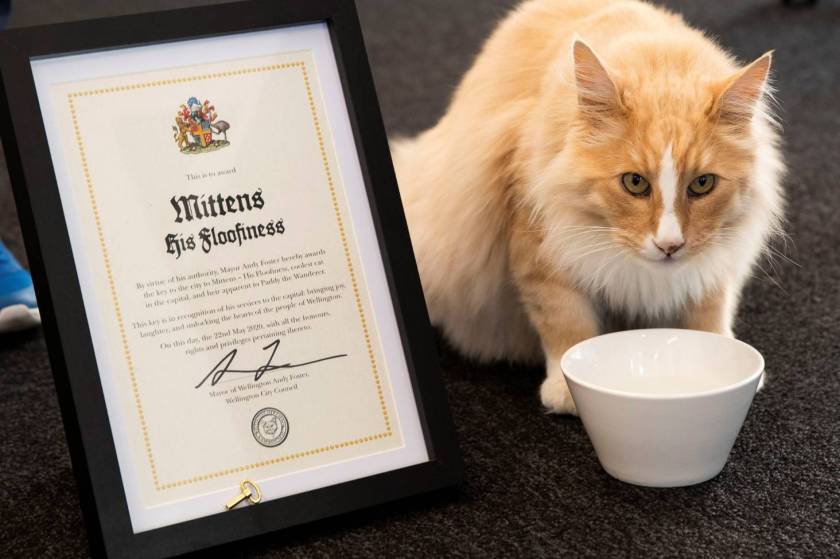
Gower lost the New Zealander of the Year competition of 2020 to a cute orange tabby named Mittens.
Think about that: All those years of doing Pulitzer-worthy breakfast show kitchen demonstrations, of slaving away at the anchor desk bringing viewers important news about reality TV stars and parroting former Prime Minister Jacinda Ardern’s declaration that New Zealand’s government is “the single source of truth” on COVID, and Gower loses the honor to a damn cat. Mittens even has the key to the City of Wellington, and Gower does not.
So sad.
Mittens receiving honors that have eluded morning show host Patrick Gower. Credit: Wellington City Council
It’s unfortunate when a man in influential position, small country or not, enthusiastically encourages children to practice being future serial killers by slaughtering innocent animals because he thinks — despite the complete absence of evidence — that arbitrarily gunning down and running over sentient animals will save birds.
Really, you’d think before calling for the extirpation of an entire species of animal that these people would have something, even a single bogus research study, claiming that bird populations would recover if only people started killing cats on sight.
But no such proof exists, and the burden of proof rests with Gower, fellow Kiwi cat-hater Gareth Morgan and others who harbor an irrational and ill-advised hatred of tiny animals who are simply behaving the way nature designed them to behave.
What we do know is that managing cat populations can be done, but it’s difficult, time-consuming work that requires dedication and patience.
Cities like Washington, D.C., with its exhaustive cat count, and communities across the US have provided the blueprint with TNR efforts and a mass push for all pet owners to spay and neuter their cats. The results have been remarkable, and shelters save more than a million felines a year compared to just a decade ago. There’s still work to be done to bring the number of euthanizations down to zero.
Gower
It’s also worth noting that the organizers of the North Canterbury Hunting Competition and supporters like Gower are coming from a place of ignorance. In their original, now-deleted announcement, the organizers offered a “guide” to telling the difference between feral and pet cats, unaware that they are the same species. The only difference is that pet cats are fortunate enough to have homes, and strays and ferals do not.
The group said it was offering its “guide” as a way to prevent children from killing pet cats, but how exactly would they do that when a pet is indistinguishable from a colony stray or a feral? Would they find a microchip on the corpse of a cat they killed and say “Oops, guess that one doesn’t count!”?
Does a cat somehow feel less if it doesn’t have a home? Is its life worth less if it doesn’t have a collar and eat from a bowl?
It’s barbaric and so poorly thought-out, it really boggles the mind that the idea of a cat-killing competition for kids was voiced, let alone approved, planned and promoted by supposed adults.
As for the contest itself, we’re very glad it’s been called off, even if the organizers want to play victim and say their feelings have been hurt by the response to their murderous event.
That, however, doesn’t solve the problem. The fact that the organizers thought this was a good idea in the first place, and the increasingly pitched rhetoric from the likes of Gower and Morgan, are normalizing the idea of slaughtering innocent animals who have their own minds, thoughts and feelings, and who have been shaped by 10,000 years of history to live with and depend on humans.
Instead of calling for blood and whipping people into a frenzy, influential New Zealanders should read about cats and animal cognition in general, so they’re aware that felines experience the full range of primary and secondary emotions and are very much capable of suffering the same way we do when we’re injured, stressed and our lives are in danger.
That, unlike claims that cats are primarily responsible for the decline in bird populations, is hard scientific fact. We can peer into the brains of felines, watch their neurons fire, see different brain regions light up as they think specific thoughts and respond to specific smells and sights.
Maybe if people who hate cats understand what they are, they’ll feel some empathy for a beautiful species, animals who have been companions and literal life savers to humans since before deepest antiquity, animals whose lives have intrinsic value regardless of what they mean to us. At the very least, we owe them that.
One of New Zealand’s most prominent economists has called cats “serial killers” who are driven by “bloodlust,” and is one of many who blame domestic cats for the decline of local wildlife.
An annual hunting competition for children in New Zealand has a new category this year, awarding a cash prize to the young hunter who kills the most cats.
You read that right.
The North Canterbury Hunting Competition announced the new category on Saturday and says it will offer a $250 prize to any child 14 or younger who kills the most felines.
In a statement, the local SPCA pointed out the obvious, that cats will suffer horribly, pets will die and the competition will result in bungled kills en masse, leaving wounded cats to suffer horribly before the children finish them off — if indeed they do.
“There is a good chance someone’s pet may be killed during this event,” the Canterbury SPCA wrote in a statement. “In addition, children often use air rifles in these sorts of events which increase the likelihood of pain and distress, and can cause a prolonged death.”
Credit: Ali Arapou011/pexels
Prompted by the same sloppy “research studies” that inspired Australia to kill millions of cats — and resulted in a mouse plague of biblical proportions in 2021 and 2022, causing billions of dollars in damage to farms, homes, businesses and infrastructure — New Zealand is on a disinformation-fueled jihad against felines.
Like all such studies, the claims that cats are singlehandedly responsible for declines in native wildlife, thus absolving direct human activities of blame, come by way of overzealous bird conservationists and others who insist the mass murder of cats will save native birds and small mammals. As if humans destroying habitats, dumping chemical waste, creating wind farms that act as bird dicers, building glass skyscrapers that millions of birds fly into every year, saturating entire swathes of the Earth with light pollution and EM radiation that harms and confuses animals — and all the other things people do — have no impact whatsoever, and it’s only those dastardly cats who are the culprits.
You’ve got to hand it to the misguided conservationists, who have picked tiny scapegoats who can’t defend themselves verbally or physically against humans.
To understand how the “hunting” (killing) competition can be real, it’s important to understand the context of the way cats are portrayed in New Zealand. Gareth Morgan, a Kiwi economist and politician, launched a campaign about a decade ago with the stated goal of eradicating cats from the island nation of 5.1 million people, which would forbid people from adopting new cats and end programs like trap, neuter, return (TNR) in favor of having local animal control departments kill felines.
Morgan, whose Cats to Go site portrays kitties with devil horns and glowing red eyes, says cats are evil animals driven by “bloodlust.”
“Cats are the only true sadists of the animal world, serial killers who torture without mercy,” Morgan has said.
A screenshot from the group’s Facebook page announcing a new prize for young hunters.
The North Canterbury Hunting Competition, which also offers prizes like dirt bikes for child hunters, pulled the new category announcement from its Facebook page on Monday but stopped short of canceling the event, blaming people who were upset by the idea of cat hunting.
Citing abusive feedback, the group said it’s “incredibly disappointed by this reaction” and said the hunt is for a good cause, raising money for local projects.





 Pain In The Bud