
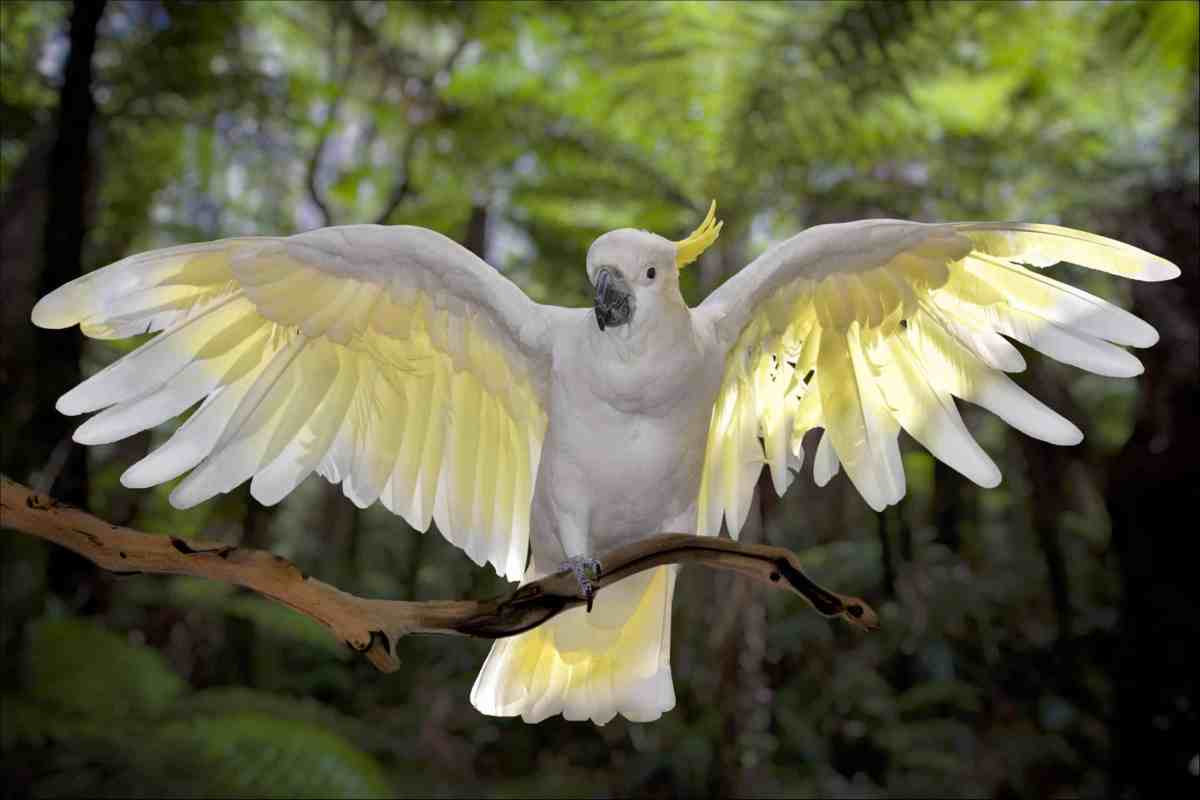
We take a break from our regularly-scheduled cats to check in on two remarkable birds: Snowball the incredible dancing cockatoo, and Ruby the infamously foul-mouthed African grey parrot.
Both animals have been the subject of viral videos, but haven’t become ubiquitous memes or the sort of superstar that transcends certain corners of the internet.
Snowball is clearly the more wholesome of the two, and it’s immediately apparent why: He dances.
Actually, that’s underselling it. Snowball doesn’t just dance, he feels the beat and moves with it, timing his dance moves — headbangs, foot-wiggles, side-steps and more — to the music, often the snare like people do. Snowball isn’t the first animal to move to music, but he’s the first animal to groove to music, which is an important distinction.
“His owner had realized that he couldn’t care for the sulfur-crested cockatoo any longer. So in August 2007, he dropped Snowball off at the Bird Lovers Only rescue center in Dyer, Indiana—along with a Backstreet Boys CD, and a tip that the bird loved to dance. Sure enough, when the center’s director, Irena Schulz, played “Everybody,” Snowball “immediately broke out into his headbanging, bad-boy dance,” she recalls. She took a grainy video, uploaded it to YouTube, and sent a link to some bird-enthusiast friends. Within a month, Snowball became a celebrity. When a Tonight Show producer called to arrange an interview, Schulz thought it was a prank.”
Other animals are prompted to motion by music, but they don’t time their motions to the beat. Snowball’s talents have attracted curious neuroscientists, who believe Snowball is able to coordinate his body movements with the rhythm because, like humans, he can process language.
It might seem a little odd that such an ability seems to hinge on language until you realize that language itself is rhythmic, ordered sound, and that human communication often pairs speech with coordinated movements. (Think of people who “talk” with their hands, TV presenters who move their heads for emphasis or the simple act of nodding, shaking your head or shrugging to punctuate a point.)
Scientists study Snowball because he’s inherently fascinating, but also because he can help us understand how birds and humans communicate, and how homo sapiens and certain avian species, out of all the animals on Earth, developed this skill.
Ruby the Foul-Mouthed African Grey Parrot
Ruby is a different case entirely. She’s interesting to internet audiences because she’s hilarious, and if she holds academic appeal, it’s because of the way she’s been socialized and the things she’s learned.
Ruby, one of Youtube’s earliest viral stars, lives with her human, Nick Chapman, in Brighton, UK.
First thing’s first: If you’re put off by obscenities or you’re easily offended, you should take a pass on these videos.
For everyone else, well, it’s not just that Ruby swears. That sort of novelty would wear off quick. What makes Ruby unique — and consistently hilarious — is that she’s inventively obscene, working insults into unique combinations. And, as you’ll see, she swears in French as well as heavily-accented UK English. It’s the latter that often makes for her most amusing outbursts.
“I love you,” Ruby tells Chapman in one video.
“Well that’s a nice change, sweetheart!” Chapman says.
“Bollocks.” Ruby takes a half step to her right on the small platform in front of her cage, turning her head toward Chapman. “You fat bastard!”
Chapman laughs. “I knew that wouldn’t last.”
Ruby’s foul language is unmistakably British and as casually vicious as it gets. She hurls invective at the seagulls who are a constant presence in seaside Brighton and expresses her love for Chapman by insulting him.
“Fuck off, you tw-t!” the bird says, prompting laughter from Chapman.
“Oh dear,” Chapman says. “That’s not nice!”
“Eh,” Ruby says. “Tw-t! You’re not funny.”
“I know I’m not funny. I’m immature, I’m irresponsible. But so what?”
In another video, Chapman tries to engage Ruby by telling her he loves her in French.
Ruby sits motionless for a few long seconds, then utters a single syllable with expert comedic timing: “Tw-t!”
Chapman does a deep belly laugh.
“Shut up, c–t!’ Ruby says. “You f—er!’
“Oh dear,” Chapman says between laughs. “You’re shocking, you know that?”
One thing becomes abundantly clear over the course of just a few videos: Chapman loves Ruby and, despite the constant verbal abuse she directs toward him, she loves Chapman too.
For a man who owns a bird who loves foul language, you’d think Chapman would have a dirty mouth, but for the most part he doesn’t. It’s often impossible to predict what a parrot will pick up on.
Eric, another Youtube-famous parrot, learned his favorite swear words when his owner’s friends came over to watch football, or soccer to us Yanks. Eric’s fond of yelling “A fookin’ legend! A fookin’ legend!”
Ruby is quick to pick up on new words, and Chapman thinks she likes the harsh sounds of some of the language’s most offensive insults. (Perhaps it’s no mistake that many of the most vulgar words in English have a guttural quality, reflecting their meaning.)
Long before Ruby became a Youtube star, Chapman said he realized the potential for awkwardness. One day he was strolling along the waterfront in Brighton when an older woman stopped to chat and asked about Ruby.
“She’s beautiful,” the woman said, admiring the African grey.
“Shut your c–t!” Ruby snapped back.
The shocked woman looked at Chapman, who pretended he hadn’t heard what his bird said.
The issue of whether parrots understand what they’re saying still hasn’t been settled. Like some other animals — cats and dogs among them — they can understand words in their contextual meanings, though it’s very unlikely a swearing parrot knows precisely what it’s doing.
Then again, to insist parrots are just repeating sounds would be to discount examples like the late Alex, an African grey who could count, distinguish between different items by color and shape, and allegedly innovate to some extent.
Then there’s this video of a parrot telling a cat to “shut the f— up” as the cat meows. It makes me wonder, if I had a parrot, what the bird would pick up from my conversations with Buddy. There’d be a lot of “Hi, Bud!” and “What a good boy!”, and the vast majority of it would be kind, patient and loving, but I won’t pretend there aren’t times when I’ve told him I can’t take any more of his hours-long discourses on teleportation, turkey or unifying classical and quantum physics.
That said, I wouldn’t change a thing about Buddy. He’s my Buddy.
 Pain In The Bud