
Cats are more responsive when their humans use “baby talk” to address them, a new study claims.
A research team from Paris Nanterre University played a series of recordings for cats. One set of recordings featured a stranger addressing each cat, while another set featured the cat’s human servant calling to the cat.
Each set also had clips in two different tones of voice: one in which the humans spoke to the cats in a tone normally reserved for addressing fellow adults, and another in which they baby-talked their felines.
Not surprisingly the cats were mostly content to ignore the strangers calling them by name even when the strangers used higher-pitched tones, but “displayed a constellation of behaviors suggesting increased attentiveness” when they heard audio of their humans calling them.
The kitties were even more responsive when their humans used the “sing-songy” tone of voice many people reserve for pets, babies, young children and Texans. (Sorry, couldn’t help myself! I’m still salty over my Yankees getting swept by the Astros.)
The research team said the study, which was published today in the journal Animal Cognition, was yet another piece of evidence showing felines are not the ultra-stoic, emotionless animals they’ve been portrayed as for as long as anyone can remember.
“For a long time it has been thought that cats are very independent creatures, only interested in [humans for] eating and shelter, but the fact that they react specifically to their owner, and not just anybody addressing them, supports the idea that they are attached,” said Charlotte de Mouzon, the paper’s lead author. “It brings further evidence to encourage humans to consider cats as sensitive and communicative individuals.”
Although the study included just 16 cats — sample size is a recurring problem in feline-related studies, since researchers often have to travel to the homes of house cats to study their normal behavior — it’s just the latest bit of research on tone in human-cat communication.
Those studies tend to use terms like “pet-directed speech” and “kitten-directed speech” instead of baby talk.
As I wrote last year, I don’t use baby talk with Buddy, and I tend to think of him as, well, my little buddy instead of my “child,” as so many “pet parents” do. That’s not to say I think people who view their pets that way are doing it wrong, or that I don’t have parental feelings toward Bud. Of course I do.
But as I also wrote, Buddy does not tolerate baby talk. I joked that he’d paw-smack me if I spoke to him that way, and indeed he has nipped at me and dispensed warning slaps the handful of times I’ve come close to addressing him that way.
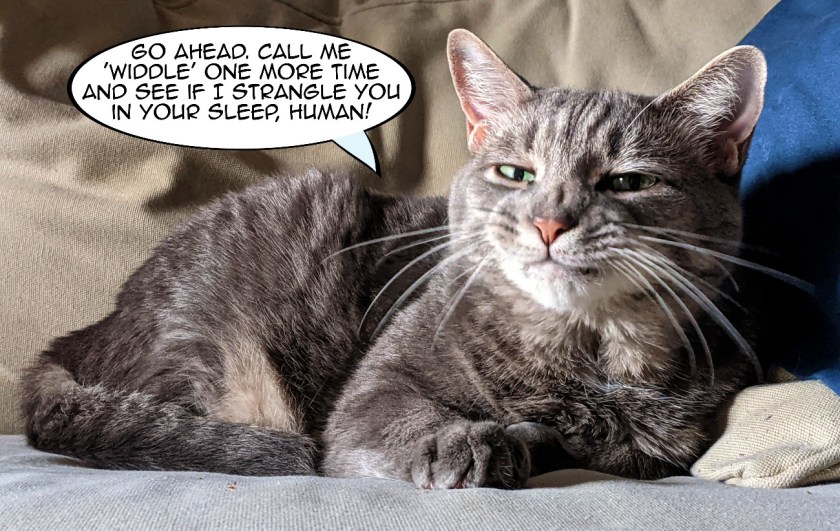
I think it’s because of the way I raised him. He’s not accustomed to it, and he finds it annoying. That makes sense, and it comports with the study authors’ suggestions that the one-on-one relationship between feline and human is an important factor in many facets of cat communication.
But maybe if I’m prepared to dodge a few angry paws I can use the threat of baby talk to nudge Buddy toward being more responsive during those times when he doesn’t feel like coming when called or stopping some important work he’s engrossed in, like chattering away at birds outside.
“Bud! Hey, Bud! Listen to me. I’m talking to you,” I might say. “Okay, have it your way. Who’s da little Buddy wuddy who isn’t wistening to me, huh? Who’s da widdle cwanky boy?”
I’m pretty sure he’ll launch himself at me with a derisive “Mrrrrppp!” and take a big swipe. Haha!
But maybe, just maybe, he’ll be more inclined to listen. Do you baby talk your cats?
 Pain In The Bud