
Pour water into a glass or a jug, and the water takes the shape of the object immediately. Pour honey into a bottle, and it’ll likely take minutes before the slow-moving stuff fully conforms to its new container.
Both are liquid, but they’re not the same.
To differentiate levels of liquidity, rheologists — scientists who study the “deformation and flow” of liquids — use something called the Deborah number. The quicker the liquid takes the shape of its container, the lower its Deborah number, the “more liquid” it is.
On the extreme end are liquids like glass and tar pitch. It took an astounding 69 years for a single drop of the latter substance to fall at Trinity College, which set up a tar pitch experiment in 1944 and finally recorded its first drop on camera in 2013.
So what about cats? Are they really liquid?
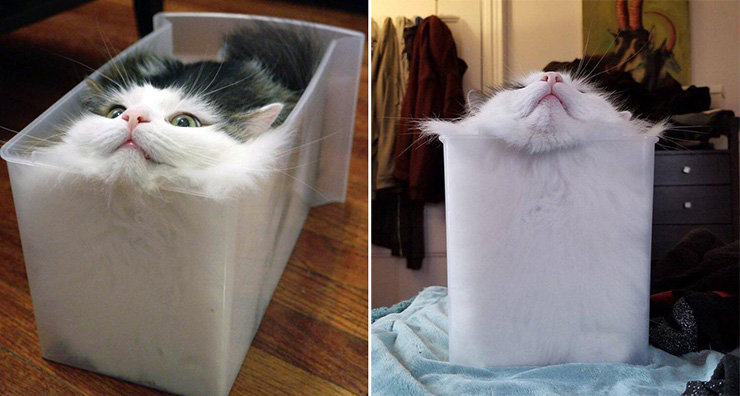
If you’re a cat lover and you haven’t been living under a rock for the last 10 or 15 years, you’ve almost certainly seen memes showing photos of felines and their uncanny ability to conform their bodies to containers, as well as their tendency to “pour” themselves.
My Buddy is an expert in the latter, often electing to drop down from the couch in the laziest possible way, by shifting his weight and letting his body follow the path of least resistance until he slides off the side and onto the floor.

Marc-Antoine Fardin, a physicist with the French National Center for Scientific Research and Paris City University, won an Ignoble Prize for taking the memes seriously and studying the fluid properties of felines. Cats, Fardin wrote in an article about feline liquidity, “are proving to be a rich model system for rheological research.”
Cats, he concluded, are a “non-Newtonian liquid” with the ability to “alter their shapes to fill out the container without changing their volume,” putting them in the same general category as ketchup.
So the next time my cat gets all imperious with me, I’m going to remind him he’s a glorified condiment.

 Pain In The Bud
Holy cow. Yes! I have seen photos where cats fit in tiny things. At first i thought they were photoshopped.
LikeLike
Good to know.
LikeLike
I’m not gonna lie, I kinda love that there’s a “Deborah Number” out there. Thanks for the smile & much love to Buddy 🐾🐾
LikeLike
Did you click the link? The background on why it’s called the Deborah number is interesting, as it’s a reference to the “Song of Deborah” or “Hymn of Deborah,” a biblical verse about mountains “melting” or “flowing” (depending on the translation) before God.
The idea being that on a long enough time scale, even apparently immutable solids flow.
Meanwhile Mr. Ketchup over here is getting ready for his early evening nap, after which he’ll pour himself off the couch.
LikeLiked by 1 person
OMG! I’ll go back & click the link & I’m lmao about Mr. Ketchup, so thanks again to you both 😂. I don’t know why I didn’t catch the reference…I know some of this. I’m getting old & decrepit I guess 🥴. Go enjoy your evening with your handsome condiment king
LikeLike
No worries, it’s not obvious. When I first read about it, I assumed it was named after a scientist named Deborah, as most of these things are named after the people who discovered/invented them.
Sadly there isn’t a universal Deborah number for cats, as Fardin says it depends on the age of the cat and other factors like breed and build.
LikeLike
I’m guessing that Buddy will respond something along the lines of “Whatever. At least I can make myself comfortable anywhere I choose.”
LikeLike
His favorite place to sleep and lounge is on me. In addition to being his faithful servant, apparently I am a pillow as well. That’s one reason why I can’t imagine having a pride like yours, with four or five cats laying on you.
LikeLiked by 1 person
Of course, you’re the best spot. You’re nice and warm. Luckily we have three adults living here
LikeLike