
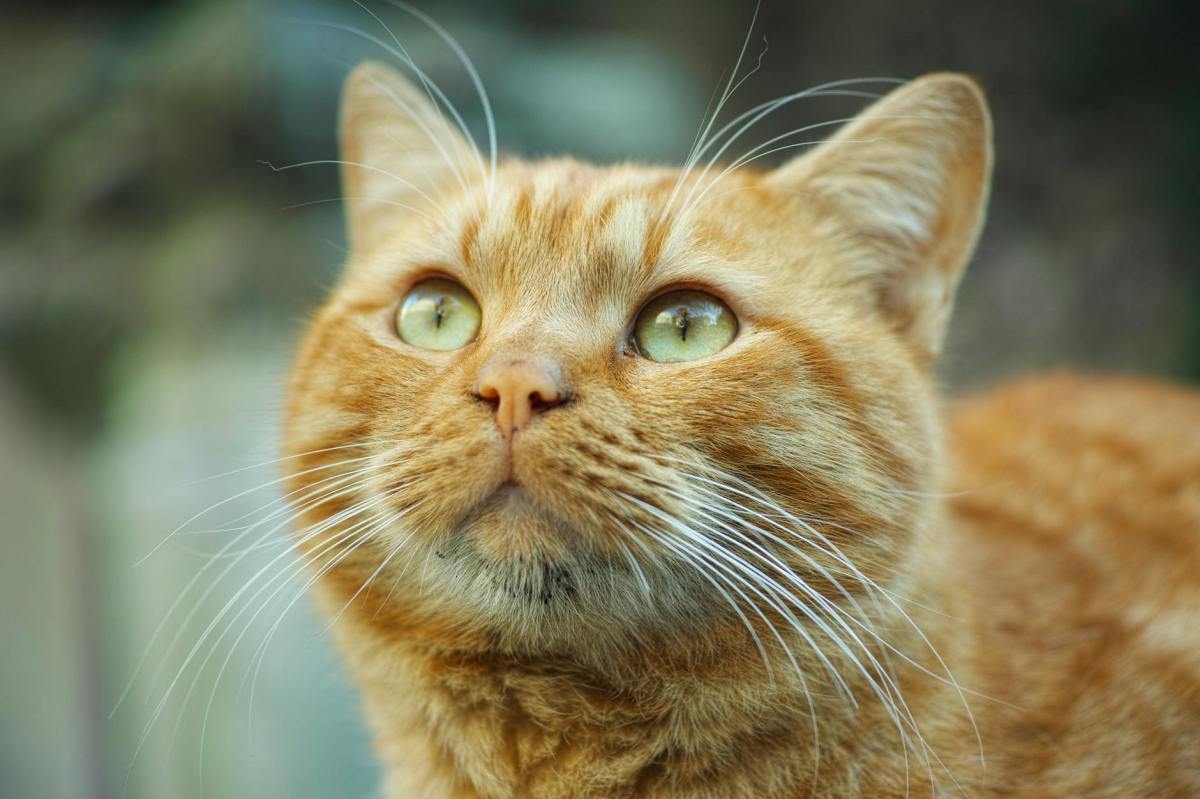
More than 110 years ago, American geneticist Clarence Cook Little developed a theory explaining why some cats have orange coloring and some don’t.
Now Little has been proven correct thanks to the work of separate teams in Japan and the US, which discovered the mechanism that leads to orange coloring, including fully ginger felines as well as calicos and tortoiseshells.
The explanation may be a bit too heavy on genetics for some readers, but essentially the researchers found the specific gene that leads to the growth or orange fur. They’ve known about the gene for a long time, but didn’t realize the totality of its function. Its official name is ARHGAP36, but for the sake of simplicity, scientists are calling it “the orange gene.”
“The orange gene has a known role in hair follicle development, but scientists didn’t previously know it is also involved in pigment production,” a team of geneticists and biotechnologists wrote in The Conversation, a science publication. “This means that a new pathway for pigment production has been discovered, opening the way for exciting and important research into a basic biological process.”

Ginger cats are usually male, but the pigmant can also appear in female cats due to an error in gene copying which deletes one segment of the orange pigment-producing genetic code.
That’s why calicos and tortoiseshells have orange blotches or mixed orange fur. “[T]he orange gene is persistently switched on in orange areas but is mostly switched off in non-orange areas of a cat’s coat,” the authors wrote.
Are there more strays in 2024?
Time magazine has a story examining the problem of stray cats in America’s urban and suburban population centers, why it’s happening, and what can be done about it.
First, might as well get this out of the way: We don’t know if there are “more” cats. The claim that there are more relies on anecdotes, and there’s no hard data to back that up. You have to be highly motivated to invest the time and money into a proper census like the D.C. Cat Count, and it’s an understatement to say most towns and cities are either not willing to do that, or don’t have the resources.
What we do know is there may be more cats in certain areas, with individual shelters in some places reporting record numbers of surrenders and cats scooped up by animal control.

The story quotes rescuers who say they’ve seen more surrendered pets, as well as data from Shelter Animals Count, which tallies self-reported information from shelters and rescues. The latter says 32 percent of cats taken in were owner surrenders in 2024, compared to 30.5 percent in 2019.
“It’s a combination of people surrendering their pets and people not adopting because they’re not sure they can take on the financial commitment,” Animal Care Centers of NYC’s Katy Hansen told Time.
Rescuers say that’s reflected in their experiences trapping the felines, who are friendly and acclimated to humans.
The people surrendering their pets cite inflation, not only impacting the cost of essentials like food and litter, but also more expensive veterinary care.
The story additionally includes this eye-popping detail:
“At Veterinary Care Group, a private equity-owned practice in Brooklyn, the cost of spaying or neutering a cat has soared to $850 per animal. By contrast, at the nonprofit veterinary clinic Zweigart recently founded in Brooklyn, the cost of spaying or neutering a cat is $225 and a mid-sized dog is $300.”
The lesson here: Steer well clear of veterinary clinics that aren’t vet-owned or are obtuse about their ownership. Private equity groups don’t buy clinics out of love for animals.

As for solutions to local spikes in stray populations, the story doesn’t offer any. It mentions TNR (trap, neuter, return) but only in the context of a lawsuit against the San Diego Humane Society for its neuter/vaccination program.
That said, there probably isn’t a one-size-fits-all technique. What works for a small town won’t necessarily work in a city, and there are dozens of factors that could influence the prevalence of stray cats and colonies. Still, city councils and town boards don’t need to reinvent the wheel. Chances are if they look, they’ll find a municipality similar to their own where locals have successfully stabilized feline populations.
As for the Buddies, I’d live in my car before giving Bud up. He wouldn’t be thrilled about that situation, and we’d have to head south because the winters here are brutal, but as long as Bud has his servant, he’s good.
A previous version of this post incorrectly described cat chromosomes. The story has been updated to remove the error.
 Pain In The Bud
One factor they don’t mention is lack of affordable housing. A lot of low-income apartments don’t allow pets, and when people lose their housing, they may be faced with impossible choices.
LikeLiked by 2 people
Yes. That’s a major issue, and it’s deeply unfair to the people and animals. I remember reading about a legislative effort that would allow people to keep their pets in public housing, but can’t remember which state it was. I’ll see if I can dig it up.
LikeLiked by 2 people
My friend sent me Time article. Most are doomed. They will be killed at kill shelters. Poisoned, etc. ASPCA will fix a street cat for a very low cost but takes forever to get an appointment. I am still waiting for a cat that needs trapping to go in my basement for caretaking. Appt is first needed before this cat gets trapped.
LikeLiked by 3 people
I can’t remember if I brought Bud to the Humane Society or SPCA to get the snip when he was a kitten, but it was in Westchester, it was easy to get an appointment and the staff were very nice.
Maybe the chapters in the city can reach out to the suburban chapters on Long Island and north of the city, if they aren’t doing that already.
LikeLiked by 1 person
My friend took her puppy to Humane Society few weeks ago. She was on waiting list. About 4 months to get appt. Which was fine with her.
LikeLike
In Queens? You could try what I did and check out the suburbs, SPCA and Humane Society in Nassau probably aren’t far.
I think I paid a little more than $200 with pain meds included.
LikeLike
Humane Society in Manhattan. People with trucks and cars went to ASPCA clinic in Queens with our ferals. Me and others with no transportation paid person to bring ferals there.
LikeLiked by 1 person
My kittens were already fixed when I got them. You can’t adopt from a rescue or shelter in MN without having it spayed/ neutered and chipped. I don’t know how much it costs to get it done here if they’re not from rescue/shelter. It must not be much because the cost to adopt a cat, at least at the shelter I went to, was $100 bucks. And they were having a special too. Buy one cat for $100 and get another for $5. I know they do this because of the crush of cats they get, but that still seems low to me. Even $100 is cheap to me. I went ahead and paid the full $200 for my kitties. I just couldn’t not pay that. My conscious just wouldn’t let me do anything else.
LikeLiked by 1 person
Thanks to Leah for pointing out a pretty big error in the text. I’ve removed the inaccurate section and attached a note to the bottom of the story for transparency.
LikeLike
Ok, now that they’ve figured out why they have red hair, they really need to find out why all orange cats share one braincell! My orange and white boy Archie hasn’t even gotten the chance to share it yet. He’s lucky he has his looks because he couldn’t survive on his wits! 🤣
LikeLiked by 1 person
To Carmen. Rescuers trust NO ONE. If for any reason kitten is adopted that young because of one reason like mom was killed, very rare for rescuers i know to do this, rescuer will do a house check to get proof kitten was fixed. And group pays for spay or neuter.
LikeLike