The video is thoroughly amusing, but it also illustrates profound truths about feline intelligence, showing cats understand a lot more than people often give them credit for.
I’m loving this video of a sneaky orange tabby pretending to snooze while helping himself to his human’s food.
Little dude lays down and closes his eyes, then slowly reaches a paw out to the cap of an ice cream container, which has a glob of the good stuff on it. He checks to make sure the coast is clear by opening his eyes just a tiny bit, then slowly moves the cap over incrementally, pausing at intervals to make sure he’s still unobserved. (It looks like his human set her phone to record, then left the room so her little buddy thought no eyes were on him).
Aside from being hilarious and cute, this short clip actually illustrates something profound: Cats are much more intelligent than people usually give them credit for.
Consider the fact that to pull this off, the cat needs to be self-aware, and he needs to possess theory of mind. In other words, this cat understands he and his human have different perspectives, know different things, and that if he can move stealthily and appear to innocently nap, he can get away with eating some ice cream.
That may not seem like a big deal at first, but it means the cat understands humans can be deceived, and he understands how to do it. He cannot possibly know we have technology that can record him while we’re not looking, so that’s not a strike against him. There are plenty of things we don’t understand about animals, and we’re supposed to be the more intelligent species.
To truly appreciate how profound this is, consider that human children do not fully possess theory of mind until they’re four or five years old! That’s when they begin to appreciate the fact that other people have internal thought processes and emotions — even if they can’t articulate that — and, crucially, that what a person thinks she knows may not align with reality.
Footage like this goes well beyond refuting the old, debunked claim that animals like cats are biological automatons without thoughts or feelings. It shows they are in full possession of the cognitive tools that form the basis for higher modes of thinking. Again, while some people might hear that and say “What’s the big deal?”, it destroys all arguments that animals don’t have emotions or don’t understand what’s happening to them when humans mistreat them.
It also shows that cats are at least as intelligent as young children in all the ways that matter. They cannot verbalize their thoughts and feelings, but that has no bearing on their existence. After all, no one would argue that a child doesn’t have feelings simply because he’s unable to speak.
Lastly, there’s one more important lesson here: hide your ice cream from your fluffy pals!
Cats are blamed, to the exclusion of almost all other factors, for the decline in native bird populations in New Zealand.
A New Zealand group canceled a cat-hunting competition for kids after receiving massive backlash for the plan, but one Kiwi journalist told a national audience he thinks the cat hunt is a great idea and doesn’t go far enough.
“When it comes to feeral kets, I’m on the soide of the kea, the kākāpō and the kiwi ivery sangle doy of the week and my missige to [the organizers] is ‘Git the competition back on, git the keds back out thea,'” said the vowel-desecrating morning show host Patrick Gower. “If thea gonna hunt and thea’s feeral kets in the way, then we hif to woipe them out. Feeral kets need to be shot, they need to be run ovah, they need to be trepped, they need to be woiped off the foice of Aotearoa and I imploah the school to git it back on, and look, I’ll put up some rewoade as well foah any kets these kids git down theah as well.”
English translation: “I think the cat-killing contest is a wonderful idea, cats need to be shot, run over and exterminated from New Zealand, and I hate cats so much that I’ll put up some of my own money as prizes for the children who bag the most kills.”
You’ve got to wonder what cats have done to Patrick Gower for him to hate them so much, and fortunately dear readers, PITB has the answer!
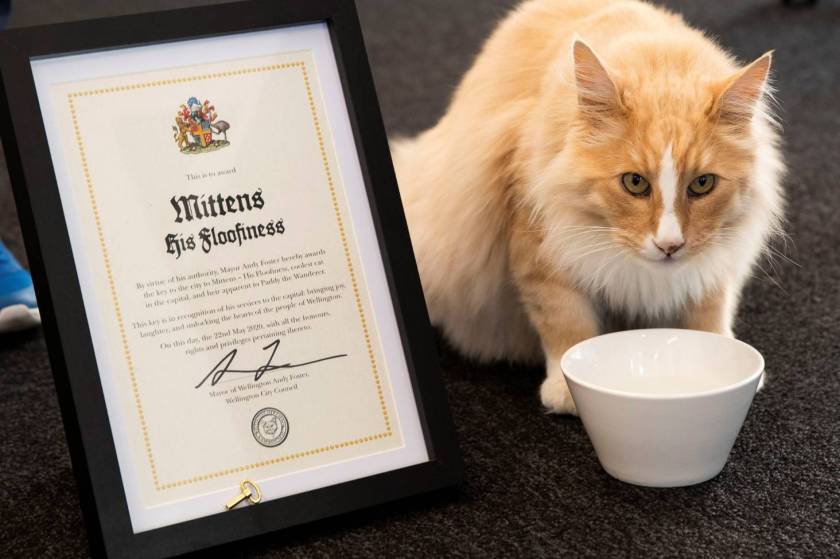
Gower lost the New Zealander of the Year competition of 2020 to a cute orange tabby named Mittens.
Think about that: All those years of doing Pulitzer-worthy breakfast show kitchen demonstrations, of slaving away at the anchor desk bringing viewers important news about reality TV stars and parroting former Prime Minister Jacinda Ardern’s declaration that New Zealand’s government is “the single source of truth” on COVID, and Gower loses the honor to a damn cat. Mittens even has the key to the City of Wellington, and Gower does not.
So sad.
Mittens receiving honors that have eluded morning show host Patrick Gower. Credit: Wellington City Council
It’s unfortunate when a man in influential position, small country or not, enthusiastically encourages children to practice being future serial killers by slaughtering innocent animals because he thinks — despite the complete absence of evidence — that arbitrarily gunning down and running over sentient animals will save birds.
Really, you’d think before calling for the extirpation of an entire species of animal that these people would have something, even a single bogus research study, claiming that bird populations would recover if only people started killing cats on sight.
But no such proof exists, and the burden of proof rests with Gower, fellow Kiwi cat-hater Gareth Morgan and others who harbor an irrational and ill-advised hatred of tiny animals who are simply behaving the way nature designed them to behave.
What we do know is that managing cat populations can be done, but it’s difficult, time-consuming work that requires dedication and patience.
Cities like Washington, D.C., with its exhaustive cat count, and communities across the US have provided the blueprint with TNR efforts and a mass push for all pet owners to spay and neuter their cats. The results have been remarkable, and shelters save more than a million felines a year compared to just a decade ago. There’s still work to be done to bring the number of euthanizations down to zero.
Gower
It’s also worth noting that the organizers of the North Canterbury Hunting Competition and supporters like Gower are coming from a place of ignorance. In their original, now-deleted announcement, the organizers offered a “guide” to telling the difference between feral and pet cats, unaware that they are the same species. The only difference is that pet cats are fortunate enough to have homes, and strays and ferals do not.
The group said it was offering its “guide” as a way to prevent children from killing pet cats, but how exactly would they do that when a pet is indistinguishable from a colony stray or a feral? Would they find a microchip on the corpse of a cat they killed and say “Oops, guess that one doesn’t count!”?
Does a cat somehow feel less if it doesn’t have a home? Is its life worth less if it doesn’t have a collar and eat from a bowl?
It’s barbaric and so poorly thought-out, it really boggles the mind that the idea of a cat-killing competition for kids was voiced, let alone approved, planned and promoted by supposed adults.
As for the contest itself, we’re very glad it’s been called off, even if the organizers want to play victim and say their feelings have been hurt by the response to their murderous event.
That, however, doesn’t solve the problem. The fact that the organizers thought this was a good idea in the first place, and the increasingly pitched rhetoric from the likes of Gower and Morgan, are normalizing the idea of slaughtering innocent animals who have their own minds, thoughts and feelings, and who have been shaped by 10,000 years of history to live with and depend on humans.
Instead of calling for blood and whipping people into a frenzy, influential New Zealanders should read about cats and animal cognition in general, so they’re aware that felines experience the full range of primary and secondary emotions and are very much capable of suffering the same way we do when we’re injured, stressed and our lives are in danger.
That, unlike claims that cats are primarily responsible for the decline in bird populations, is hard scientific fact. We can peer into the brains of felines, watch their neurons fire, see different brain regions light up as they think specific thoughts and respond to specific smells and sights.
Maybe if people who hate cats understand what they are, they’ll feel some empathy for a beautiful species, animals who have been companions and literal life savers to humans since before deepest antiquity, animals whose lives have intrinsic value regardless of what they mean to us. At the very least, we owe them that.
It’s the latest of several studies indicating animals including cats, dogs and horses respond better to higher-pitched, softer voices.
Cats are more responsive when their humans use “baby talk” to address them, a new study claims.
A research team from Paris Nanterre University played a series of recordings for cats. One set of recordings featured a stranger addressing each cat, while another set featured the cat’s human servant calling to the cat.
Each set also had clips in two different tones of voice: one in which the humans spoke to the cats in a tone normally reserved for addressing fellow adults, and another in which they baby-talked their felines.
Not surprisingly the cats were mostly content to ignore the strangers calling them by name even when the strangers used higher-pitched tones, but “displayed a constellation of behaviors suggesting increased attentiveness” when they heard audio of their humans calling them.
The kitties were even more responsive when their humans used the “sing-songy” tone of voice many people reserve for pets, babies, young children and Texans. (Sorry, couldn’t help myself! I’m still salty over my Yankees getting swept by the Astros.)
The research team said the study, which was published today in the journal Animal Cognition, was yet another piece of evidence showing felines are not the ultra-stoic, emotionless animals they’ve been portrayed as for as long as anyone can remember.
“For a long time it has been thought that cats are very independent creatures, only interested in [humans for] eating and shelter, but the fact that they react specifically to their owner, and not just anybody addressing them, supports the idea that they are attached,” said Charlotte de Mouzon, the paper’s lead author. “It brings further evidence to encourage humans to consider cats as sensitive and communicative individuals.”
Although the study included just 16 cats — sample size is a recurring problem in feline-related studies, since researchers often have to travel to the homes of house cats to study their normal behavior — it’s just the latest bit of research on tone in human-cat communication.
As I wrote last year, I don’t use baby talk with Buddy, and I tend to think of him as, well, my little buddy instead of my “child,” as so many “pet parents” do. That’s not to say I think people who view their pets that way are doing it wrong, or that I don’t have parental feelings toward Bud. Of course I do.
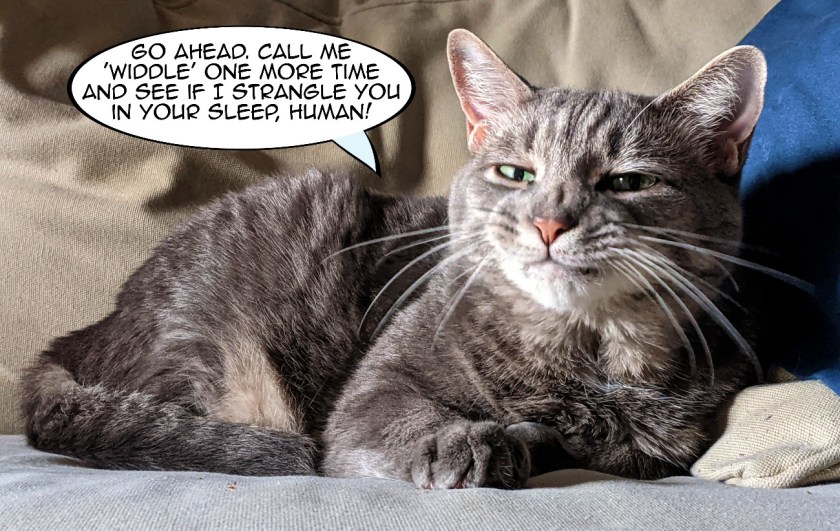
But as I also wrote, Buddy does not tolerate baby talk. I joked that he’d paw-smack me if I spoke to him that way, and indeed he has nipped at me and dispensed warning slaps the handful of times I’ve come close to addressing him that way.
“Aw! Widdle Buddy is angwy, huh?”
I think it’s because of the way I raised him. He’s not accustomed to it, and he finds it annoying. That makes sense, and it comports with the study authors’ suggestions that the one-on-one relationship between feline and human is an important factor in many facets of cat communication.
But maybe if I’m prepared to dodge a few angry paws I can use the threat of baby talk to nudge Buddy toward being more responsive during those times when he doesn’t feel like coming when called or stopping some important work he’s engrossed in, like chattering away at birds outside.
“Bud! Hey, Bud! Listen to me. I’m talking to you,” I might say. “Okay, have it your way. Who’s da little Buddy wuddy who isn’t wistening to me, huh? Who’s da widdle cwanky boy?”
I’m pretty sure he’ll launch himself at me with a derisive “Mrrrrppp!” and take a big swipe. Haha!
But maybe, just maybe, he’ll be more inclined to listen. Do you baby talk your cats?


 Pain In The Bud