

Continuing its mission to probe the greater enigmas of the natural world, and knowing many of us must have pondered the question, Scientific American has set out to determine whether cats break wind.
In what it calls “an investigation into the mysteries of feline flatulence,” the magazine confirms that, yes, our furry friends do pass gas.
The good news? They are infrequent cheese cutters with minimal ass acoustics, particularly compared to the notoriously flatulent canines.
The bad news? When cats do fart, they are silent but deadly (SBD) affairs that deliver maximum olfactory potency due to the sulfurous mix of proteins and amino acids broken down by their digestive systems.
I can personally confirm that factoid, having been on the receiving end of a particularly insidious squeaker while Bud was sitting on my chest and nuzzling against my face. Once second I was rubbing the top of his head and telling him what a good boy he is, the next I was nearly gagging.
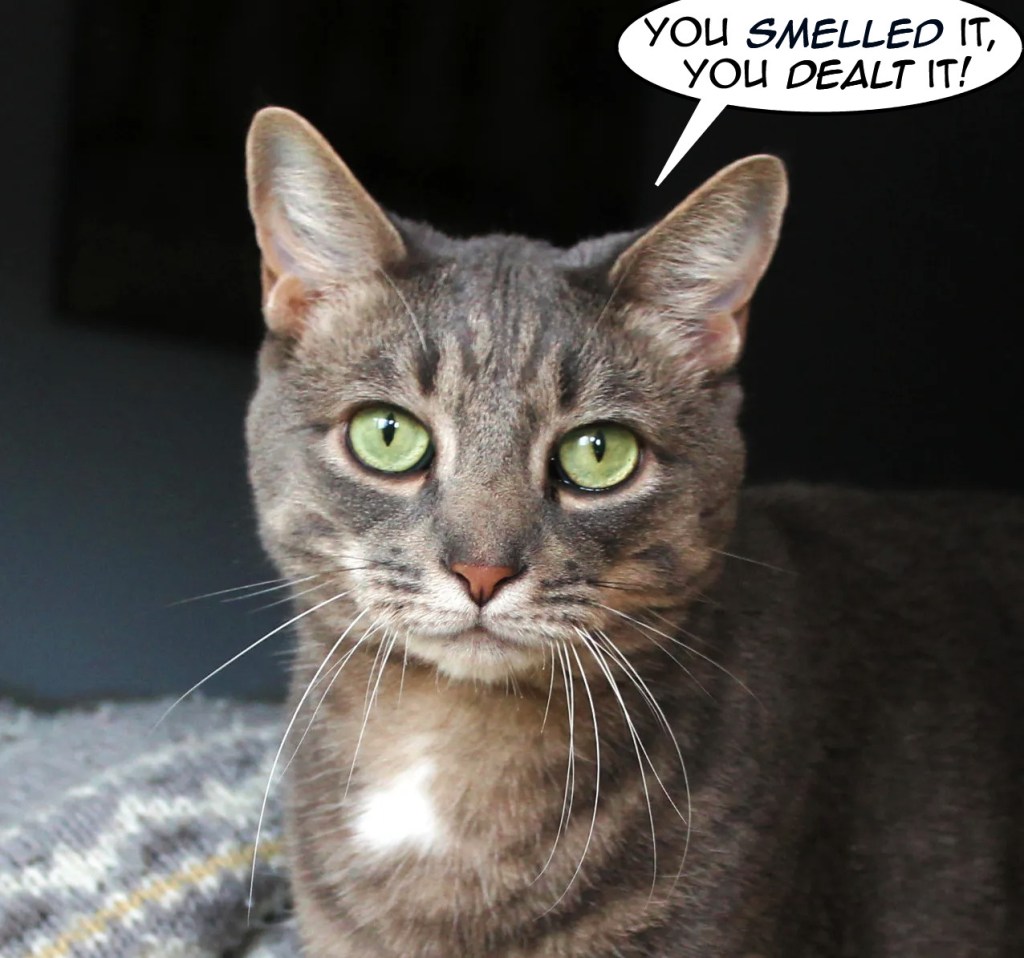
Farting is a normal biological function for cats, veterinarians told the magazine. While New York-based Cat Practice’s medical director, Eric Dougherty, says he doubts “anyone’s ever measured the exact quantity of cat farts in a scientific study,” you should have things checked out by a veterinarian if your little pal’s getting insane in the methane with concerning frequency.
“If you’re coming home and your cat is ripping farts every day,” Dougherty said, “you probably want to have it looked into.”
Same study, different interpretations
A few weeks ago we wrote about a Japanese study that found oxytocin levels spike in cats and their humans when they’re in close proximity.
The chemical – which is essential for bonding and often corresponds to positive feelings – rises in our respective bloodstreams when we’re interacting, the research team found.
Interestingly the effect is tied to distance, or rather lack of it. That means if your little buddy is bonded to you, you’re both at your happiest when you’re next to, or in physical contact with, each other.
The study didn’t find causation, just correlation, and the standard “we need more research” caveat absolutely applies here.
While the research team went to the effort of observing interactions in homes where cats live, and of testing cat and human urine samples for real data on biochemical levels instead of relying exclusively on questionnaires, the sample sizes were small. The team collected complete data on only 24 cats and 17 people.
It also found an unsurprising link between negative human moods marked by higher cortisol levels and stress in cats. That makes sense, as we’re extremely important to our feline friends. We’re the ones who care for, feed, shelter and love them, and they’re highly attuned to our emotions.
VICE, which ran a story on the study on Nov. 5, had a different take, claiming the study found “the oxytocin levels of humans and their cats appear to rise and fall in sync.” That’s not exactly what the paper describes, as negative human emotions were found to precipitate lower levels of oxytocin and higher stress hormones in cats. Again, the paper doesn’t establish causation, so we’re left to infer that our negative emotions are the catalyst without hard proof.
A handful of other publications published articles with interpretations similar to those of VICE, while a story by phys.org concentrates on the proximity aspect and notes that it could account for why different research teams have had varying results when trying to figure out whether having a cat leads to greater happiness.
Caturday Open Comments: You’re welcome to comment on anything, suggest stories, talk about your own cats, or leave a message for Little Buddy about what a really, really ridiculously good-looking cat he is.




I adore the picture of Bud at the top!
Many cats seem to get highly offended if their human dares to . . . release the pressure valve. My Charlie doesn’t seem bothered. The flip side is, she feels very free to let one loose when her butt is pointed in my direction.
LikeLike
Can you hear it when she lets one go? One of the things mentioned in the SA story and others is that since cats basically eat by licking, they’re not “eating air” like dogs (and sometimes people) do. That might be one explanation for why they seem to pass gas less often.
As for Charlie being unbothered, that’s the case with Bud too.
The header photo is one of my favorites too. It was perfect timing and it looks like he’s giving me a look of absolute contempt.
LikeLiked by 2 people
Charlie is silent and deadly!
LikeLike
Well since you bravely admitted Charlie’s response to your own functions, I’ll go ahead and share the anecdote I deleted from this story because I feared people would take me for a lunatic.
As you know, Bud likes to sleep on top of me. As a kitten he’d sometimes sleep on my lower back and rest his head on my butt like it was made to be his pillow.
The problem is, he was so light that one night I just forgot he was there. As I was drifting off to sleep, I unleashed a thunderous blast, as if Thor himself wanted all of Valhalla and Midgard to know he’d overdone it with the Chipotle.
Then I heard a confused, high pitched “rrrrrr?” and started laughing so hard, I was crying. Poor little dude caught the full brunt of it right in the face.
But the part that made me laugh so hard was that he didn’t boot upright or do any of the things cats do when they’re startled, he just vocalized his confusion in his Elmo voice.
LikeLiked by 4 people
AH-HAHAHAHAHHAH! Omg . . . Thank you, I just started my day with a literal, huge LOL!
LikeLike
I really could not believe he wasn’t startled. Glad you found it amusing!
LikeLike
Gyda wants to start a fight. She says that sheâs better looking than Buddy.Sent from my iPhoneOn Nov 7, 2026,
LikeLike
How about an aura battle? Would that settle the dispute over which cat is more ridiculously good looking?
LikeLike
Gyda agrees to thatSent from my iPhoneOn Nov 7, 2026,
LikeLike
Batman was so excited to try wet food for the first time when we first adopted him that he would gobble it up and then the inevitable SBD! It happens infrequently now but usually when he is laying on my lap with his back to me!
Hope Buddy is doing amazing!
LikeLiked by 1 person
Hah so in other words he’s aiming the SBDs right at you. Just one of many tools in Batman’s utility belt, I’m sure.
LikeLiked by 2 people
I can purrsonally attest to the fact that they do.
LikeLiked by 1 person
SBDs for your little dudes too?
LikeLiked by 1 person
Ramses was the culprit, although since I’ve radically changed his diet his poop is normal and no more gas! Whoopie
LikeLike
I took Mavis to the vet because she’s started spending more time around me and she didn’t used to do that. Nope, she’s good. My current theory is it’s because I’m doing better.
LikeLiked by 1 person
Glad to hear there’s nothing wrong. I always try to remind myself that my mood has a serious impact on my cat’s happiness…even when he looks me in the eye and swipes a drink off the coffee table.
LikeLiked by 2 people
Mine did. He gave me a look after like what are you looking at?😂Like that character on SNL. She says yeah i farted.
LikeLiked by 1 person
Well that’s progress. As George Carlin said, cats don’t accept blame. I guess sometimes they do.
LikeLike
My cat Fish has the feline version of irritable bowel syndrome. One of the symptoms is truly horrible gas, along with loose stools. So far no treatment has helped, and I suspect her former owner threw her out because she made messes.
Anyway, now she’s safe with us. Sometimes she will sleep on me when I’m in the recliner. Silent but deadly is right!
LikeLiked by 1 person
Poor Fish. That’s the worst, when cats are in their time of need with illness or stress, and it prompts people to abandon them instead of getting them a checkup.
She found a good home with you though, so that’s a happy ending.
LikeLike
We had a cat when I was growing up, and I can confirm that he farted. His flatulence was infrequent but deadly. I must confess that once or twice I tried to blame Smokey for my own gastric indiscretions, but my mother was never convinced. She was a wise woman, my old mum!
LikeLike
What are cats for if you can’t lay blame at their paws every once in a while? It’s very convenient!
LikeLiked by 1 person
Every kitten I’ve ever had was somewhat gassy. Once they were full grown, I don’t ever recall gassy-ness or farting.
LikeLike
Finally, someone who dares to answer life’s most important questions. In my experience, cats pass gas less frequently than humans and dogs. One of my cats loves to sit on my lap, and I really enjoy it when she lies down on my legs. Over the span of about four or five hours, there have been very few times when she’s passed gas, of course she has done it, but rarely, so I can’t complain.
LikeLike
Indeed, this ranks right up there with “Are we alone in the universe?” and “Should MLB have gotten rid of the designated hitter?”
LikeLike