
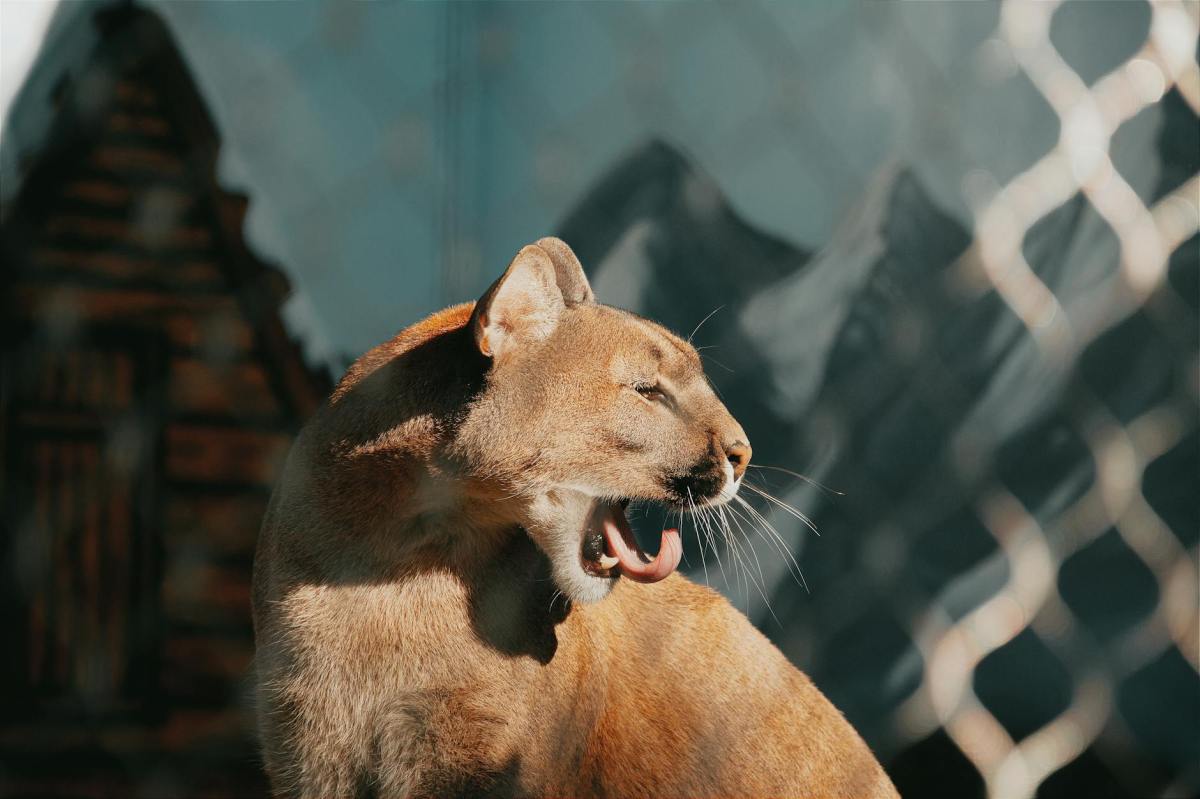
Viral news accounts on social media and less scrupulous news sites have been buzzing this week about a school lockdown in Moses Lake, Washington, which was reportedly caused by a teacher confusing a particularly fat cat for a puma.
I saw red flags immediately while reading the story. While it did give a specific location, it was suspiciously devoid of other details, and the wording on all the posts and stories was dubiously similar. Additionally, a Google news search doesn’t turn up anything recent from reputable press.
Then there’s the photo, which looks a little too good to be true.

So did a school really go into lockdown after a case of mistaken feline identity?
Yes, but it happened in November of 2023, and the photo of the obese cat making the rounds in stories this week does not depict the cat in question. The original story was published by a local news site on Nov. 22, 2023, and says the school went into lockdown at 10:30 that morning, but was quickly lifted after staff confirmed there was no puma stalking the school grounds.
“…educators soon learned that the mountain lion was in fact, a “fat cat eating a rat,” according to the school memo to parents.
‘While we take all reports seriously, this was the first report we’ve ever had of this nature,’ the school wrote in a statement.
Despite the benign nature of it all, safety measures resumed to safeguard students and staff. Classes resumed as normal after a short period of time. “
As for the photo, the particularly rotund moggie’s image is a stock photo from Getty. It was used in a story about feline obesity in 2017 and an April 2018 story from the New York Daily News about public outrage in Jefferson, Iowa, where the police were shooting feral cats instead of dispatching animal control or working with local shelters.
Since the image is from a photo agency and predates the original story about the Washington school lockdown by at least six years, we can rule it out as an image of the feline mistaken for a mountain lion while settling down to a feast of fresh rat.

So what happened here, and why are so many news sites and channels reporting this incident as if it just happened, accompanied by a deceptive photo that is not credited to Getty?
It’s classic clickbait. That is to say, some administrator or editor saw the old story picking up traffic or noticed a blip in certain search strings, and republished the story as if it’s new while omitting the original date.
Others noticed and followed suit to get the clicks while the getting’s good, fighting over the scraps that fall from the Zuckerbergian table in the form of ad revenue. The story is simple, sharable, has been paired with an amusing image, and is exactly the sort of thing people love to post and comment on via social media.
It’s a reminder to all of us to be skeptical about what we read, and to never take anything on Facebook, Instagram, TikTok et al at face value. In fact, it’s best to ignore anything on those platforms presented as news or fact. Everyone’s got their own preferences, but here at Casa de Buddy, we like the Wall Street Journal, Reuters, The Guardian, Associated Press, al Jazeera, the BBC, and aggregators like RealClearPolitics.
That doesn’t mean they’re above reproach or that everything they produce is a sparkling example of journalism, but they’re institutions that operate under the traditional rules, staffed by professionals who take pride in trying to get stories right. I’ll take that any day over a random Facebook account run by some shady guy in Macedonia or Belarus, who will post anything as “news” as long as it brings him clicks and ad revenue.
 Pain In The Bud
Great investigation!
LikeLike
Thanks. I didn’t do much besides run some image searches and find the original story, but this sort of thing — recycling years-old stories to reel in cheap clicks — has become more prevalent in the past few years. We all have to be skeptical of what we read.
LikeLike
People are getting more stupid by the second – or perhaps they’ve always been that stupid but we never learned of them.
LikeLiked by 1 person
Not to let news consumers off the hook, because we all bear some responsibility here, but social media platforms are designed to amplify the outrageous, as well as anything that triggers a strong emotional response, especially negativity.
Most people think they’re getting a free service and don’t realize we are the product, not the customer, training Zuckerberg’s and Musk’s algorithms with every click of the mouse and every temporary pause over a piece of content that catches the eye.
LikeLiked by 1 person
Amen.
LikeLike
You need to be skeptical of anything you read in your preferential “news” sources as well. The biggest purveyor of bullshit is the legacy media.
I get my news from a select group of independent journalists online.
Jimmy Dore (who is not a journalist) often exposes what the legacy media is redacting or misleading. Lee Camp (not a journalist) on Unredacted also exposes news that has been garbled or ignored.
Then there are Vanessa Beeley and Patrick Lancaster, who ARE journalists, who report from areas in the world where mainstream media journalists won’t go.
I apologize in advance for any cognitive dissonance that checking with these resources might cause you to feel.
LikeLiked by 1 person
Our Lynx says he understands how this could happen. He gets called a “bobcat” all the time.
LikeLike
Thanks for the effort!
LikeLike
I agree with your reading material. I get my medical information from NIH (although I guess that will be going downhill pretty soon) or Mayo. There is so much dreck out there, it’s hard to avoid it.
LikeLike
It’s sad, but there’s no easy solution, and readers are responsible too. We all say we want real journalism and honest reporting, but the metrics show that what people really want are to have their views repeated back to them, and the veracity of a story — political or apolitical — doesn’t matter if something is shareable.
LikeLiked by 1 person
I’ve noticed that there have been a few journalists trying to fight the tide, but it’s hard. And now they’ve defunded public radio and TV
LikeLike
If it seems to weird to be true, it’s almost certainly not!
LikeLike