
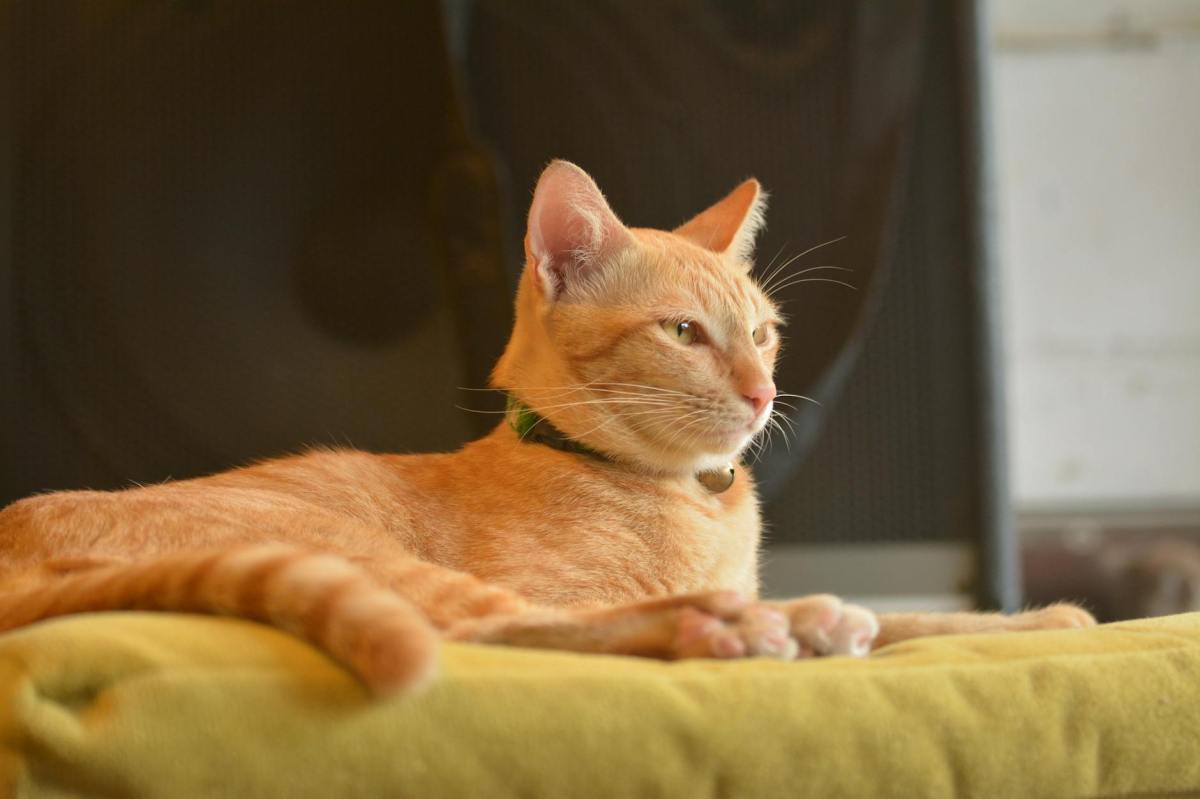
When Professor Hiroyuki Sasaki retired, he wasn’t done with science. He just wanted to use it to better understand his cats.
The Japanese geneticist raised more than $73,000 from Japanese and international cat lovers and put together a team, including partners from the US. Then he began the hard work of scrutinizing feline DNA to find out why some cats are orange, and why most all-orange cats are male while virtually all calico and tortoiseshell cats, whose coats have splotches of orange, are female.
It turns out there’s no genetic instruction telling the fur to take on an orange pigment — it’s the absence of a segment of DNA, which governs pigment production, that does it.
In other words, ginger cats are mutants.
Most fully-orange cats are male because the mutation removes the DNA segment in the X chromosome. As males have X and Y chromosomes, they only need the mutation in the single X chromosome for their coats to express in that shade.

Females have an XX chromosomal arrangement, so they need the mutation in both chromosomes to turn tangerine. If the mutation only shows up in one chromosome, you get patches of the color instead of a consistent coat.
That explains why 80 percent of ginger cats are male, and why only one in 3,000 calicos and tortoiseshells are male. A male cat would need an extra X chromosome, XXY, to be born with a calico or tortoiseshell coat. One of the side effects, however, is sterility.
Scientists estimate only one in a thousand male calicos/tortoiseshells can reproduce and pass their unique mutations on.
It’s not just coat color either. The mutation impacts skin and eye color, which is why a ginger cat might have a pink nose compared to the terracotta shade of a void cat or a silver tabby.
Are orange cats really more friendly and silly?
So how does this relate to temperament, and the many people who attest to a particular personality associated with orange cats? Some people say ginger tabbies are more loyal, affectionate and social than cats of other coat colors, but they’re also more prone to doing boneheaded things.
The stereotypes have picked up steam online, where people often share memes depicting orange felines as earnestly derpy, but they may be on to something — or at least, it can’t be ruled out until we know more.

Because of the missing piece of genetic code, a specific gene, ARHGAP36, isn’t “expressed.” Like so many genes, scientists don’t fully understand everything ARHGAP36 impacts, or how alterations can lead to unexpected changes elsewhere.
“Many cat owners swear by the idea that different coat colours and patterns are linked with different personalities,” Sasaki told the BBC. “There’s no scientific evidence for this yet, but it’s an intriguing idea and one I’d love to explore further.”
Header image via Pexels
 Pain In The Bud
I enjoyed this and I highly suspect humans assign their quirky, interesting ideas onto the idea that a coat color determines how a cat behaves. I’m not going to lie and not say that I’ve not watched my share of videos on YouTube, attesting to what this giant tuxedo guy should behave like. Still, after all is said and done, I’ve been around enough assorted cats, male and female, of varying colors, to know each and everyone of them is like a fingerprint. It is us owners/ servants that know exactly how wonderful the craziness, as well as thoughtful, intelligent things our feline companions can do to us & for us…I mean look at Buddy, all boy boss & meowseculed up! I’ve never known a tabby like him. I think when they made him they broke the mold… Best to you both. Good to read a feel good story…tysm Big Bud👣🐾🐾🫶🏼
LikeLiked by 1 person
Thank you Deborah!! Not sure who to bash first. Scientists or cat owners who think coat color has anything to do with personalities. Example. Black cats are my favorite. I have been around them for decades. Some sweet as syrup and some hellish. Cosmo who i catsit for one of our fosters is always waiting for me to sit down so he can get on my lap or chest is a súper shy street cat. Took OVER TWO YEARS for that to happen. It is a HUMAN who shapes a cats personality most of the time by socialization.When Cosmo and sis Luna first got to fosters apt she barely saw them for months. Under the bed after eating and using litterbox.
LikeLiked by 1 person
It does take a really long time to earn trust from some cats, that’s for sure. There are degrees of it, too. It could take a year for a cat to feel comfortable enough to sit on the couch with you, then another year for the cat to decide you’re safe to sit on.
That said, we know this particular gene impacts several different things in human bodies, so that’s likely with cats too. That’s another reason why gene editing is dangerous.
LikeLiked by 2 people
I love black cats too, never have two been the same. You’re so fortunate to have Cosmo an so many others. I always read your replies to see who’s having what adventure next. Patience is everything for some cats and you’re gifted with it. Plus lots of love, so truly all your furry family and friends are so incredibly lucky to have you. I can’t get another cat now since my big boy is on prescription foods & he’s older now. I’m in this small place, so there’d be no way to separate the feeding situation. It’s also not safe for any of them to be outdoors here.
I’m already walking around at 2AM to feed some feral cuties. I’ve no choice but to do so in secrecy. There’s others doing it with me, but I’ve no idea who my helpers are! My neighbor is going to help with TNR. There’s a few “Voids” (Black kittens) this spring. If it was the right thing to do and if I could, I’d bring ALL the littles home with me… Sadly, for now, I’m just trying to keep them fed & safe & take photos of their sweet faces 🐈⬛🐈⬛🐈⬛ I like to have memories of them at least…
LikeLiked by 1 person
Indeed, there are so many variables in the nature vs nurture debate. Even if the research team does connect disposition to gene expression (or absence), we still won’t know if it makes a real difference.
The phrase “nature vs nurture” is only about 150 years old, but people have been debating this for more than 2,000 years at least, going back to the ancient Greeks.
Anecdotally, Bud was an outgoing, talkative cat from the very beginning, and I’ve tried to nurture that. Would he have turned out much different in another home? Who knows?
LikeLiked by 2 people
True. I think you made Buddys personality what it is. Lets say he was in an abusive home. I can guarantee his personality would be different. Pos family member who thought it would be fun to pull his cats whiskers where he experienced pain bit people all the time. Including me. And i am talking an adult not a child.
LikeLike
That alleged adult should be charged with animal abuse.
LikeLiked by 1 person
We’ll have to assume you have made Buddy want to keep being very vocal/verbal. That’s a wonderful thing. I personally love it when they speak! All the sounds and assorted pitches. even if it’s to remind us to get up to serve them! I know Buddy does that very well 😉 He’s a great guy & as much of a bad a** as he is, he loves you so much. Have a great day you two!
LikeLiked by 1 person
I do not speak to 2 of my siblings because of how cats and dogs were treated. Same sibling is the one i told you that threw my sisters cat away in Prospect Park because she was too stupid to put flea meds on and house was full of fleas. She also was an adult. This was decades ago but you never forget this crap. My friends wonder how i turned out so different
LikeLike
Perhaps this is a naive comment, but I wish they ( whoever ‘they’ are ) would stop playing around with nature …..
LikeLiked by 1 person
Well, this particular study is just research and they’re not touching the genetic code, just analyzing it. But I did see a story about the first gene-edited baby just yesterday. The baby had a condition that impacts only 1 in 1.3 million people and would likely kill him in infancy.
With this sort of thing, you wonder what kind of secret procedures may be done in nondescript labs in relatively lawless countries, where authorities, such as they are, will look the other way if bribed.
LikeLiked by 1 person
Not a good look for Petco. 3 things are in contracts. Do not declaw our cats.Do not let cat out and if you do not want cat it must come back to rescue group.Rules one and two happen but rarely.Rule 3 cannot happen. As you cannot bring to shelter. All groups microchip cats and it is the law that shelters in N.Y. must scan for chip.
LikeLike
Well it was the rescue itself, not PetCo, and while I can understand the reasons for their caution, it wasn’t going to work for me as someone who never had a pet before.
I made a LOT of mistakes, especially early on, but i think I’ve done a pretty good job making sure he’s happy and healthy. In fact I had to put my phone down for a few minutes while writing this because he came over for scritches and to purr while I told him he’s a good boy and my best pal.
LikeLike
i use “tortitude” jokingly about our tortie and haven’t thoroughly researched it. Many swear it’s true, and lately I’ve read that some studies indicate that. Others think it’s an unfair stereotype …Typing this whole listening to a really talkative tortie …
LikeLiked by 1 person
while listening
LikeLiked by 1 person
There should be a gray tabbytude! You’ve got a multi-cat household, so you certainly know much more than me about the personality stuff. Some people even say male and female cats are different. Would you say that’s true?
LikeLiked by 2 people
Well, I try to avoid fixed general opinions because so often they turn out to be untrue or etc … We’ve had two torties.The first wandered a neighborhood as a young adult and settled into our house of 3 cats. The second was found running in the street as a 6 weeks kitten and was taken in as a single cat. Both were/are talkative and assertive, and current tortie Shelley does not like other cats, but few cats do at first. Our boy cats always slapped their sisters first, but the girls quickly slapped back. Not easy to sort …
LikeLiked by 1 person
I’ve lived with several torties over my lifetime and can attest that they DO have “tortitude”. ≋;>
LikeLiked by 1 person
In shelters, ginger cats are always the first to be adopted. There’s just “something” about ’em.
LikeLiked by 2 people
I still think about a friendly orange cat who reached out to me from his cage at PetCo. The rescue group didn’t make it easy to adopt, otherwise I may have ended up adopting him.
LikeLiked by 3 people
Sometimes groups or places like Petco make it hard only hurts them. We had an individual in a cat rescue group who thought she was an expert on cats. Or thinks i should say.Two of my clients went to another cat rescue group i know of because of that person. No one group or individual is an expert on cats.I’m still learning.
LikeLiked by 1 person
They tried to steer me toward certain cats, didn’t let me see the cat I wanted to adopt (a gray tabby female) and their contract stipulated they would still own the cat and could take her back at any time, among other things.
I get that rescues see the worst of people when it comes to assholes who abandon and abuse pets, and I understand that can make them really jaded, but there’s gotta be a happy medium where it doesn’t become legitimately difficult to adopt.
Of course I was also a first time adopter, so I think I would have an easier go of it if I ever adopt in the future. I know people say you say goodbye to one cat and welcome another, but that’s not something I can even think about.
LikeLiked by 2 people
You and Buddy were meant to be.
LikeLiked by 2 people
Sometimes I’ll read about how cats come to resemble their humans and I’m like “Oh shit!” lol. But you’re right, and at times it feels like he’s always been here.
LikeLiked by 2 people
Hi Deborah. Yes. I am very fortunate to be a catsitter. After i had to stop doing rescue after 20 years i did not want to stop my association with cats. Did lots of tnr,etc. Took a toll on me. And i had 2 colonies i fed. All passed away from old age. Only thing i do to volunteer is catsit free of charge for fosters. My priority is taking care of my autistic elderly brother. Can no longer rescue cats.And i can only afford my one rescue kitty. I never really had a desire to have more than one at a time
LikeLiked by 2 people
You’ve done a lot, for many and you care for your brother, that’s really admirable as well as special. As a former hospice aide, I do understand. I’m glad you’re still sitting with the fosters. I’m sure while with you they’re feeling safe, happy, cared for and at home. I believe that’s important. It’s not about the numbers it’s about the cats, you and the huge heart you have, you’ve decided to share it with who you care about… human as well as feline. Good night Gilda and thank you again
LikeLiked by 1 person
I’m amazed at how quickly this news story has spread. The scientific reports (Kyushu U, Japan, and Stanford U, California) appeared Thursday morning. I caught an early news item on the British Broadcasting Company, and by Thursday evening, the U.S. radio program All Things Considered covered it. Here you are on Friday.
The expressed/unexpressed gene sequence also affects the brain, adrenal glands, and other parts of the catanatomy, so I think there could be a possible relationship between an orange tom’s colour, size, and confidence.
LikeLiked by 1 person
[comment by Amanda]
I’m amazed at how quickly this news story has spread. The scientific reports (Kyushu U, Japan, and Stanford U, California) appeared Thursday morning. I caught an early news item on the British Broadcasting Company, and by Thursday evening, the U.S. radio program All Things Considered covered it. Here you are on Friday.
The expressed/unexpressed gene sequence also affects the brain, adrenal glands, and other parts of the catanatomy, so I think there could be a possible relationship between an orange tom’s colour, size, and confidence.
LikeLike
It’s an interesting story from a science perspective, there’s a great backstory with the determined Japanese professor and the crowdfunding, and add in interest from cat lovers.
Plus, I think it’s pretty cool that there was a built-in mystery, since scientists previously found the genetic code that expresses other coat colors, but not this one. Now we know why.
One thing that occurred to me though: is there an explicit genetic instruction for orange/tan in tigers, lions, jaguars, etc? Or pumas, since they’re more closely related to domestic cats?
LikeLiked by 1 person
My son’s girlfriend brought in a ginger Tabby. I don’t know if he’s any less intelligent than other cats, but he did fall out a window once. (First story, onto grass. He was fine)
LikeLike