

That’s a question posed in a new article in The Conversation, and it’s something I’ve never really considered before.
It’s generally accepted that our little buddies are more or less equivalent to small children in terms of intellect and emotional intelligence. In fact kittens develop much more quickly than human children and come to certain understandings — like theory of mind and object permanence — considerably earlier than young kids do.
They also seem to possess some sapient qualities. My niece was born a year before Bud, for example, but in their early interactions he understood she was still developing motor skills and did not intend to cause him harm. I have photos of a young Buddy, still a kitten, cautiously allowing her to touch his fur and being uncharacteristically gentle with her.
There’s growing evidence that pet cats are “kittens in perpetuity.” Not only do their behaviors toward us mirror their behaviors toward their mothers — like meowing and using us as a “secure base” when faced with uncertainties — but they depend on us completely. We care for them, in turn, at least in part because they have neotenous (baby-like) features, which trigger our protective instincts.
Bud is basically a “kid,” so is it ethical for me to give him a potentially mind-altering substance?
Catnip isn’t really a drug
While some catnip companies lean into the whole “marijuana for cats” thing, naming catnip after famous marijuana strains, selling it in gag pharmaceutical bottles and even calling themselves “dispensaries,” those are marketing efforts aimed at us servants. As the authors note, it’s not accurate to consider catnip the equivalent of a drug.
It’s not physically addictive, its effects only last a few minutes and cats can’t overdose on the stuff. In fact the primary “danger” of giving too much catnip is your four-legged friend getting desensitized completely to the effect, which is why it’s an occasional treat, not a routine pick-me-up.

Catnip “won’t induce psychosis and won’t lead to addiction or withdrawal symptoms,” wrote authors Anne Quain, a professor of veterinary science at the University of Sydney, and Mia Cobb, a research fellow at the University of Melbourne’s Animal Welfare Science center.
We don’t have to worry about cats driving on the stuff, and they have no responsibilities to speak of so catnip and silver vine can’t impact important decisions. If they have any deleterious social effects, they end at making our furry friends drool, look silly and rendering them even more drowsy than usual.
The mysteries of the nip effect
But what about a kitty’s subjective experience? How does catnip make your feline overlord feel?
We don’t have a very good answer to that question other than what we can observe, which is that they love the stuff. (Some cats don’t respond to catnip but are put in a state of bliss by silvervine. Some respond to both. A small number may not derive much pleasure from either of the plants.)
Even when they aren’t technically impacted by it, cats seem intrigued by the scent and use their secondary olfactory receptor, the vomeronasal organ, to do that odd-looking “mouth-sniffing” thing they do.
Buddy loves catnip and silver vine. I keep his ‘nip in an out-of-reach cabinet, inside a sealed container, which is itself inside an air-tight plastic bag. Bud can be in a deep sleep yet within seconds of opening it he’ll appear like an overly enthusiastic djinn who thinks the wish thing works in reverse, meowing impatiently and trilling with anticipation as I set the good stuff down for him.
That’s as close to consent as we’re going to get from cats, and I think we can safely conclude Bud’s response is “Hell yes! Gimme that sweet ‘nip and silver vine blend!”
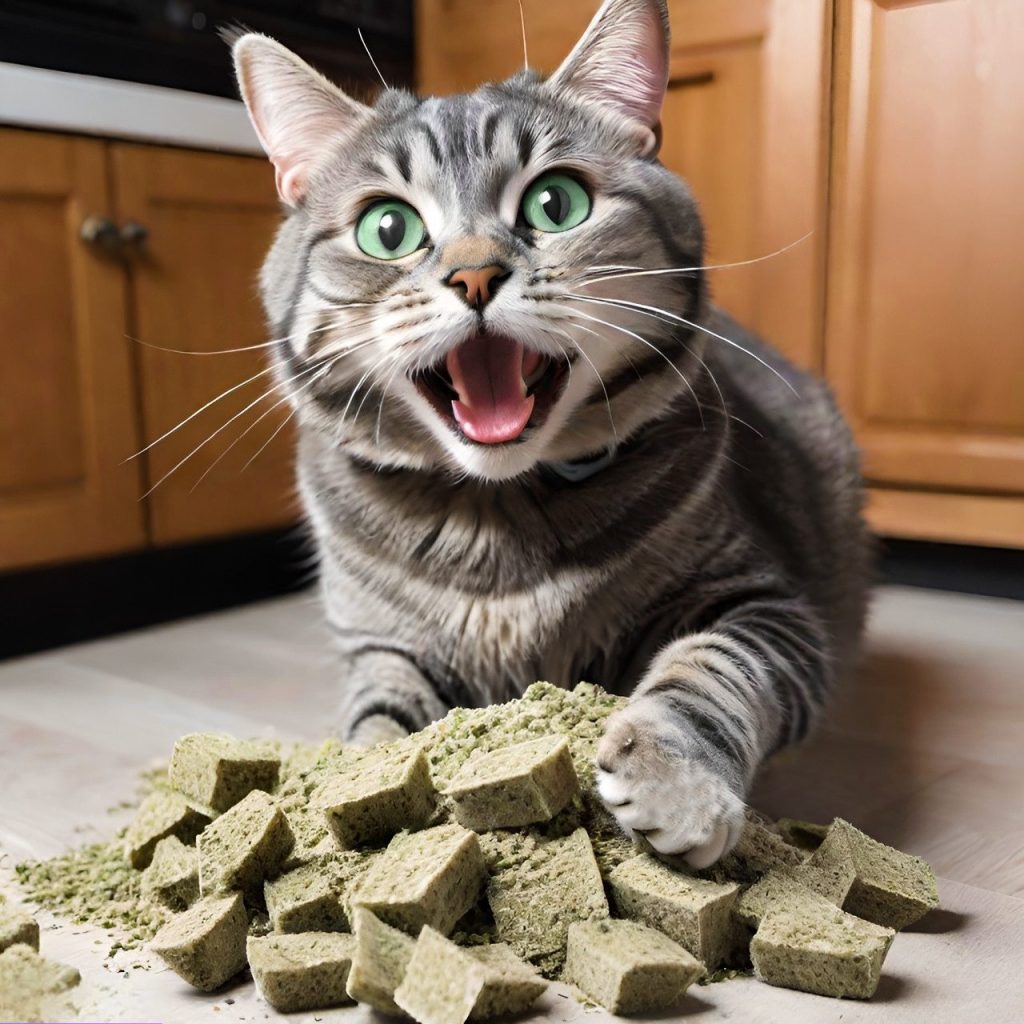
He gobbles the stuff down, by the way, so YMMV on your feline overlord’s reaction. The conventional wisdom is that cats who sniff catnip get more animated while cats who eat it tend to roll around in bliss and meow.
Making life more interesting for your fuzzy liege lord
Which brings us to the final point: catnip and silver vine are ultimately enrichment tools that help make indoor life more exciting for our little buddies, like toys, cat furniture, boxes, intriguing smells and most importantly, time playing with us.
We don’t talk about it enough, but keeping our cats stimulated and happy indoors is important, especially as pressure mounts for everyone to keep their felines inside. If your local area isn’t enforcing curfews and outright bans, it seems only a matter of time before they follow states in Australia, New Zealand and Europe in passing new laws. Every day there are news articles detailing the efforts of city councils and town boards to deal with outdoor, unmanaged feline populations, and it’s a safe bet that most of those elected officials will not have the welfare of the animals high on their list of priorities.
If we want to avoid cruelty toward cats, getting our own pets comfortable with living indoors is a good first step to making sure government doesn’t become involved.

 Pain In The Bud
Bertie likes Catnip toys, but Bella is not remotely interested, they do learn from each other though, Bertie has discovered the wicker laundry basket in our bedroom is a great scratching post ( they have many real scratchy posts around the house) so Bella now uses the basket as a scratchy post. She does look at Bertie with contempt when he plays with his catnip toys…
LikeLiked by 3 people
It could be that Bella doesn’t respond to catnip but might respond to silver vine. The Conversation article I linked to also lists a few other plants that are worth checking out. Catnip is part of the mint family of plants.
LikeLiked by 1 person
I will certainly get some and see if she responds!- will let you know – she really only responds to rats and mice so far…
LikeLiked by 1 person
What about wand toys if you simulate the way prey moves? With Bud, for instance, just waving a toy around won’t do the trick, but if I manipulate the toy so the plushie or feathers move like prey, it triggers his predatory instincts. I move them around very slowly with the wand, then pause for at least a few seconds before yanking the wand so the toy seems to run away, and that’s when he pounces.
Of course he doesn’t actually know what to do when he catches his “prey.” He hops around excitedly on his back feet while bobbling the toy with his front paws in celebration, then runs to the next ambush spot.
Being a pro at the whole hunting thing, I’ll bet Bella would enjoy that sort of game. She may even be a good sport and let Bertie “win” occasionally!
LikeLiked by 1 person
Also worth adding that I’ve found Bud doesn’t really pay any special attention to supposedly catnip-infused toys, but he loves catnip itself.
LikeLiked by 1 person
You mean those banana and apple toys with catnip inside? My cat will tear them to empty them out.Hilarious until i vacuumed way too much.
LikeLiked by 2 people
Bella responds to feather wands and she has a favourite grey wool mouse that she bats around and chases – she also makes her “killing noise” ( a loud howling basically) when carrying it around in her jaws, it regularly disappears and then re-appears!
LikeLiked by 1 person
Ok.I did not have much coffee and in general i am not very smart. I have lots of common sense. I will go back and not skim through this article. Are people saying this could be harmful to cats? If yes, they can take a hike. I put spray catnip on toys and my cat loves it but he loves the laser light much more.
LikeLiked by 3 people
No, it’s more of a question of whether it’s ethical to give “drugs” to animals who are basically little kids. It may seem like an academic or pointless discussion from some angles, but it’s true that while in some cultures it’s okay to let kids have a sip of wine at dinner, it’s not acceptable to allow, say, a 10-year-old to get drunk.
So it invites the questions: Are cats really like children? And is it possible we’re harming them by giving them catnip and silver vine? The conclusion of the article authors, which I agree with, is that catnip has a positive effect.
LikeLiked by 1 person
Got it. And don’t most cats act like kids? Just this am i heard my cat trying to claw his way into canned recyclables in the kitchen. As if i am starving him!!🤣
LikeLiked by 2 people
Yeah exactly, and as I wrote in the post, house cats are very much like perpetual kittens who see us as their parents. They retain the playful behaviors of kittens and learn that being cute yields rewards.
LikeLike
Most of my cats aren’t too crazy about catnip or cat mint or even silver vine. I don’t know why that is, but there we are. 😦 I mean, they will roll around on a pile of nip and a nip plant in the garden won’t last long, but they’re not mad about any stimulants. One of my cats was crazy about peppermint tea. No teabag was safe from her, she’d groom and lick it to pieces. 😀
LikeLiked by 2 people
I had a cat who would aggressively nuzzle my hair after I used a peppermint shampoo. I had to go to another formula. Not before I got a couple of wacky selfies of Budcat zeroing in, though …
LikeLiked by 1 person
To Leah. My other cats used to attack back of my head. Did not know why. My vet said hair looks like an animal to them.
LikeLiked by 1 person
Maybe there are environmental factors as well. Kittens aren’t impacted by catnip and IIRC it takes about a year for sensitivity, so there could be developmental factors in addition to the genetic disposition.
LikeLiked by 2 people
Interesting about the kitten statement. I’m wondering if that is why Brandon turns his nose up at the catnip I offer him.
LikeLiked by 1 person
They generally don’t react to it until maturity or close to it. If you try again when he’s a year old, maybe a little older, you should know for sure. There’s conflicting information on exactly why this happens.
LikeLiked by 1 person
Now that’s very interesting. I didn’t know kittens don’t react to nip! Come to think of it, I’ve never seen a kitten interested in nip, but it’s been so long we’ve had a kitten. Our youngest is in her terrible threes!
LikeLiked by 1 person
I didn’t know it either when I adopted Bud. The first time I went to the pet store to buy his bowls, bed, food, toys, etc, I bought catnip toys and didn’t understand why he wasn’t reacting to them.
LikeLike
Anytime something is being pushed hard (i.e., heavily marketed to the public) there’s some HIDDEN agenda behind it. There will always be some sort of FEAR (They’re killing all the birds!!! Horrors!!!) attached to the marketing/pr schemes. Unfortunately, there are too many stoopid humans living on the Earth today that believe whatever’s being sold to them.
Ramses loves the catnip I grow for him. Brandon doesn’t care for it at all. I’ll be offering them a silvervine toy of some kind this year.
LikeLiked by 3 people
Love the names you’ve chosen for your cats!
LikeLiked by 3 people
No responsibilities to speak of? Tux would like to remind you that without cats running the household, humans would be flailing around aimlessly!
LikeLiked by 3 people
Please tell Tux I apologize profusely and beg his forgiveness. He is right, of course.
LikeLiked by 1 person
Interesting topic! I’m in a now inactive pet forum and years ago someone dissed giving catnip to cats, saying it was “drugging” them. Years ago in the country our cats had supervised outings with us. We were in our sitting area in the forest, with a cat who suddenly began rubbing and rolling on the ground as with catnip, in a a spot of wild, uncultivated vegetation. No catnip was ever planted there, and we never found out what caused that. So, IMO, a completely natural experience for a cat to have those reactions to a wider variety of plants than humans actually know about.
LikeLiked by 2 people
That’s certainly possible. There are also observational studies of cats in the wild using catnip as an insect repellant. Big cats use it for that purpose too. We’re really in the dawn of cat related research. Prior to 2010 or so most researchers in animal-related fields steered clear of anything to do with felines due to their refusal to participate in activities.
Since then most of the progress in behavioral research has been by scientists who design studies with cats in mind and conduct the studies in homes instead of labs.
But even now, most of the research comes out of a handful of universities in Japan and the US. It’s a growing field and I expect we’ll learn a lot more in the next few years.
LikeLiked by 2 people
I got some of the silver vine thanks for the tip
LikeLiked by 1 person