
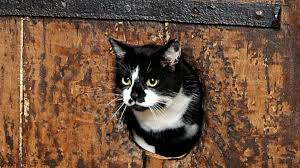
In 1598 Bishop Cotton arrived at his new post to find he had a serious rodent problem.
The new leader of Exeter Cathedral realized mice and rats were attracted to the animal fat used to lubricate the complex inner workings of the ancient structure’s astronomical clock, so he did what any sensible person would — he got himself a cat and had a flap installed so kitty had free reign of the church grounds and the chambers that held the hidden clockwork.
The newly-discovered details came to light thanks to the efforts of Diane Walker, the cathedral’s historian. One record shows the bishop paid a carpenter eight pence to cut a circular, cat-size hole in the heavy wooden door leading to the clockwork chamber, as well as ledgers showing the cat was officially on the church’s payroll.
“Back in the 14th and 15th Centuries we have records in the cathedral of payments of 13 pence a quarter for the cat and occasionally 26 pence a quarter for the cat,” Walker told the BBC. “We don’t know if that was double rations because they had been doing a good job or whether there were actually two cats.”
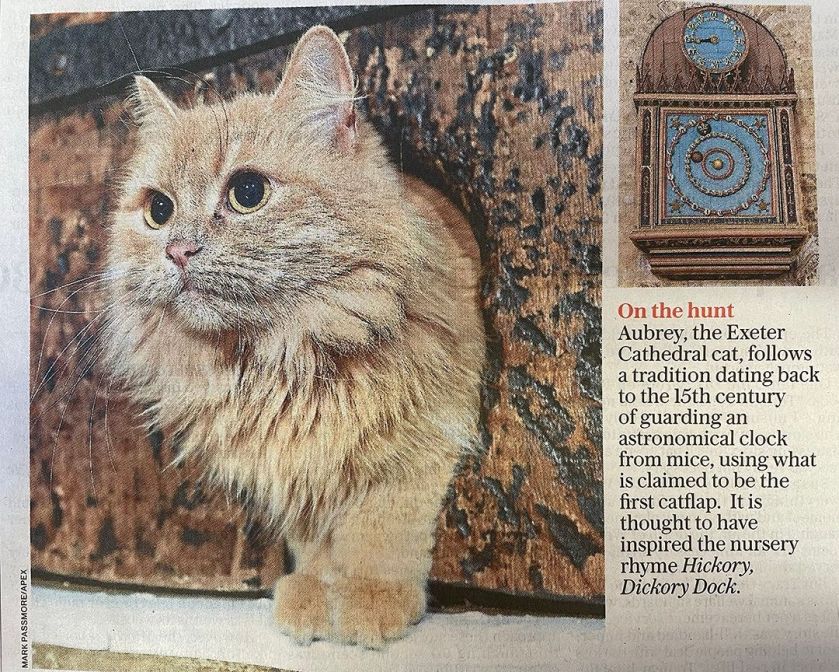
I love the idea of a happy cat licking her lips and cheerfully chowing down on medieval Temptations as reward for a job well done.
The cathedral has provided steady employment for felines, who still keep the rodents at bay on the grounds more than 400 years after Bishop Cotton hired his first mouser. Cute ginger tabby Audrey, pictured above, holds down the fort these days.
Exeter Cathedral has an interesting history besides its feline employees. It owes its existence to the vikings: the church decided to build a new cathedral as the bishop’s seat because his previous post was located near river routes and was vulnerable to raids from viking invaders.
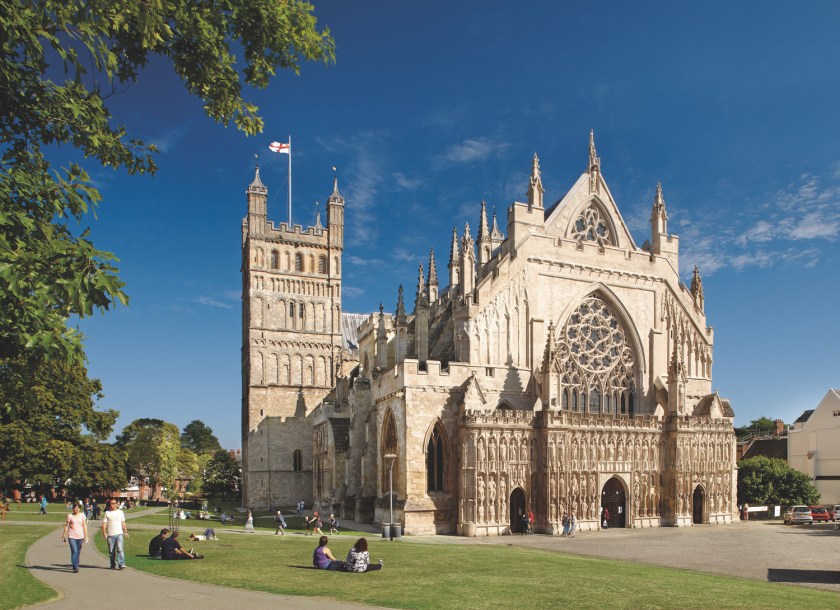
Previously the site of several Roman structures, including a public bath house, the grounds were chosen because Exeter was a prosperous, bustling city and church officials thought it had a bright future.
The cornerstone was laid in 1112 and it took almost 300 years to finish, becoming one of the finest examples of a gothic cathedral in the Norman style.


I did not know this and considering I am from Falmouth in Cornwall which is not far from Exeter I really should have known ! What a brilliant piece of feline history. Actually on a train going through Exeter right now !!! . Thanks for sharing this. Totally brilliant piece !. You are amazing with the degree of research into this and it conclusively proves feline importance to the lesser species known as ‘humans’
LikeLiked by 3 people
I can’t claim too much credit for this because Walker’s research spurred a few news stories about it, but it did lead me down the history rabbit hole with the Roman and viking stuff which is fascinating.
Just updated the story with a photo of the cathedral, which I had forgotten to add earlier.
If you ever stop by to check it out, please give Audrey a head scratch from me and Bud.
LikeLiked by 1 person
I just saw same story on My Modern Met.
LikeLiked by 1 person
Great article! The cathedral is gorgeous and Aubrey looks like a capable mouser/ratter. Thanks, Big Buddy, this was an enjoyable read.
LikeLiked by 1 person
This is so cool!!
LikeLiked by 1 person
I spent three months in Exeter years ago. Even went to a service at the cathedral. But didn’t know anything about the cat story. I hope to return some day, and my first stop will be the cathedral, with hopes of seeing the cat.
LikeLiked by 1 person
Finally, a setting truly worthy of a cat. May Aubrey live long and prosper.
LikeLiked by 1 person
Indeed. I like the idea that cats have called that cathedral home for centuries, and that there’s still a place for them there. Whether it’s stories like this, or stories about ship’s cats who were essential to safeguarding food stores aboard naval and civilian vessels, it shows felines have been partners with humans for thousands of years and have flourished alongside us.
LikeLike
Thank you, Big Buddy. I love cat history.
LikeLiked by 1 person