The Swiss Have A Unique Way Of Stealing Cats: By Feeding Them! PLUS: More Fun Claims About Litter Boxes In Schools

In Switzerland you can be charged with a crime and face significant fines for feeding other people’s cats. Meanwhile. the “kids identifying as cats” culture war rumors are back and as inane as ever.

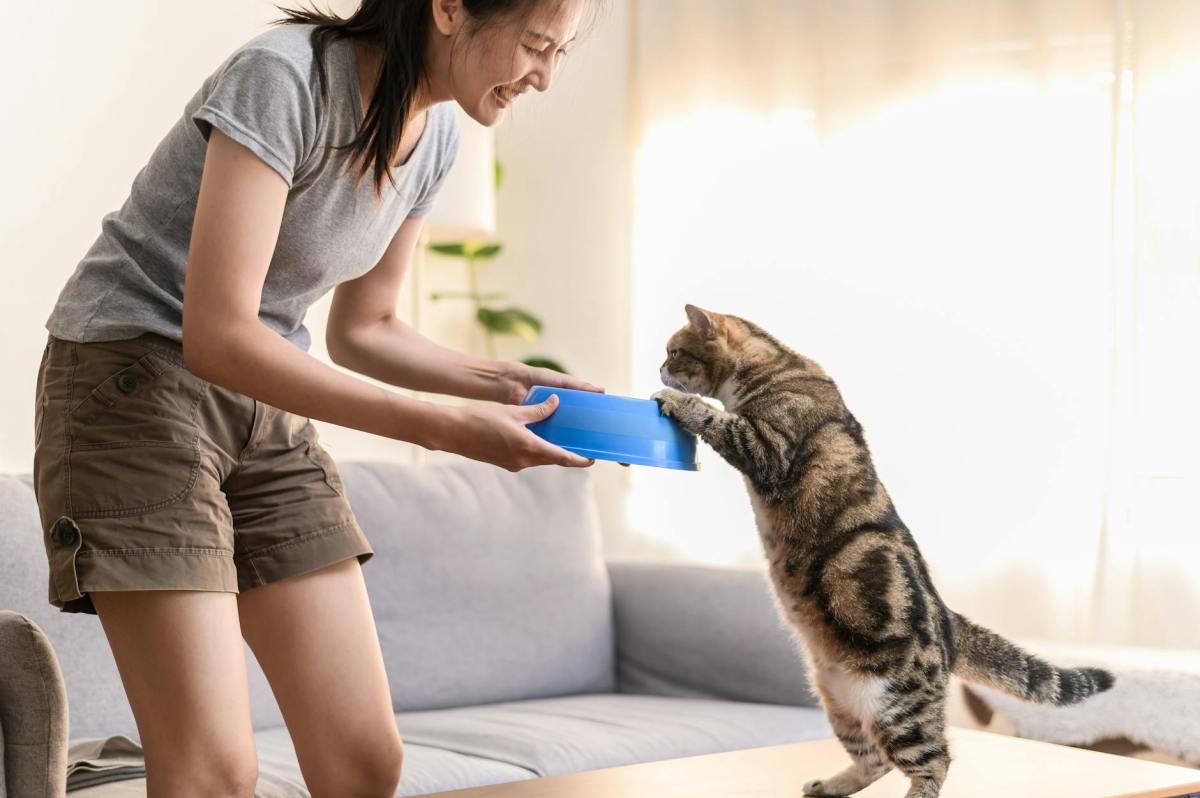
The Swiss seem to take cat theft pretty seriously, to the point where they’re perfectly willing to drag people to court for feeding other people’s cats.

That’s what happened to a 68-year-old woman in Zurich who is accused of being so nice to Leo, a neighbor’s cat, that the little guy decided her house was now his house.

According to local media reports, a Zurich prosecutor wants to fine her 3,600CHF (Swiss francs), which is $4,370 in ‘Merican greenbacks! That’s a lot of money for giving a cat some Temps and cans of tuna.

To be fair, Leo’s original family isn’t happy, especially because they specifically asked the woman to stop feeding their cat. She can’t claim she accidentally adopted him, since she let him into her apartment and even installed a cat flap for him, according to Swiss media reports.

“Cases like this are increasingly ending up in court because the rightful owners report the “feeders”. Under Swiss law, cats are “other people’s property” and systematic feeding and giving a home to another person’s cat is considered unlawful appropriation.

But if a neighbour’s cats are only fed occasionally, this is not a punishable offence in Switzerland.”

There’s really not enough information to form an opinion about this particular case. Was Leo mistreated or not getting enough to eat? Did his new human have designs on him from the beginning? Did she just think she was doing the right thing?

“Gimme the nomnoms, human!” Credit: Wikimedia Commons

As for me, this is another good reason to keep Bud inside. If I let him roam the halls of the building unsupervised, he’d probably start a bidding war between me and neighbors in two or three other apartments, making it clear that whoever supplies him with the most delicious and most frequent snacks will enjoy the great honor of serving him.

Kids identifying as cats: the fake controversy that won’t die

Just a quick recap, for anyone who hasn’t been keeping up on this uniquely American culture war spectacle: Politicians of a certain stripe really like rumors about kids identifying as cats, so much so that they’ve confidently asserted it’s happening all over America, telling anecdotes about it while on the campaign trail during the 2020, 2022, and 2024 political cycles.

That encompasses two presidential elections and a midterm year, but it’s not relegated to federal cycles. State-level pols love to talk about it too.

It’s a culture war dog whistle, and politicians from both parties love stuff like this because it gets everyone all riled up, which means no one’s talking about all the grift, insider trading and other fun activities our “leaders” involve themselves in.

The thing is, to date not a single one of the claims has been backed up by proof. I know this because I’ve investigated every one of them, and invariably they turn out to be rumors. I’ve gotten emails and comments telling me I’m a fool for debunking the claims, and I’ve literally begged people to give me a real example of cat-identifying kids dropping deuces in litter boxes, but again, all the claims collapse under minimal scrutiny.

Every time a politician has told a story about allegedly cat-identifying kids and litter boxes in schools, it follows the same pattern: they insist it’s true, double down on the claim, try to change the goalposts, and finally, they grudgingly admit they can’t point to a single example.

In a week or two, we go from righteous condemnation and fury to “Well, my wife’s best friend teaches sixth grade, and she said she heard from a teacher in another district that kids were meowing in class.”

Furries outside a convention, not a school. Credit: Furscience

Texas state Rep. Stan Gerdes is in the righteous condemnation stage after introducing the Forbidding Unlawful Representation of Roleplaying In Education Act, aka the FURRIES Act.

Gerdes wants to ban meowing, hissing, barking, litter boxes, leashes and animal costumes from school grounds and events, but in his wisdom he’s excluded school mascots and Halloween costumes.

He is, however, fast approaching the “my cousin’s best friend’s co-worker said” stage, after he couldn’t point to a single cat- or furry-related incident when pressed during a committee meeting on May 1. He eventually named a school district, saying he’d gotten a “extremely concerning” and verified account of an incident there, only for the district to issue a statement saying it didn’t happen.

Gerdes did call to ask if there were litter boxes in the school, the district said, and when he was told there was not, he insisted a manual check of all school bathrooms, which also came up empty. Let’s see how long he sticks to his story before he finally admits he has no proof.

The ‘Litter Boxes In Schools’ Lie Just Won’t Die

Montana’s top education official is the latest government official to claim kids who “identify as cats” are relieving themselves in litter boxes at school.

Our esteemed nation’s infantile culture wars were front and center in the lead-up to the 2022 midterm elections, and dozens of candidates — including prospective governors, senators, congressmen and people eyeing local offices — humiliated themselves by promising to end the alleged scourge of public schools providing litter boxes so students who “identify as cats” can comfortably shit in a manner befitting their adopted species during school hours.

As we’ve pointed out before, the litter boxes in schools thing is an urban legend, a hoax or a malicious lie depending on your perspective. It’s also an exercise in unfairly dragging cats into our petty ideological arguments, and the poor little guys can’t seem to claw their way out.

People like podcaster Joe Rogan, congresswoman Lauren Boebert and her sister from another mister, Marjorie Taylor-Green, are among the most prominent public figures to fall for the hoax and do their part in spreading it. Even the Australians got in on the panic.

We looked into the claims at the time, and none of them turned out to have any merit. In most cases, the claims were based on third- and fourth-hand accounts: “My neighbor’s sister works in the Washington Free School District, she says another teacher told her they were putting litter boxes in the middle school!” and that sort of thing.

The other claims evaporated when the people making them were asked to provide specifics. Rogan managed to check both boxes when he finally admitted he couldn’t confirm his story.

‘I have a friend and my friend’s wife is a school teacher,” Rogan said on his podcast. “And she told him that there was discussions in the school that the mother wanted to put a litter box in a school.”

The claims died down after midterms, but they’re back again with the top education official in Montana claiming cat-identified children all over her state are pooping in litter boxes with the blessing of their teachers and principals.

“Let’s talk about boys in girls bathrooms and that safety issue,” said Elsie Arntzen, superintendent of public instruction in Montana, in an Aug. 15 interview with Montana Public Radio. “Let’s talk about those litter boxes that some schools are putting out for children who want to view themselves as some sort of an animal. Is this where public education should be? I say no.”

Arntzen
Arntzen, who has congressional ambitions, hasn’t been able to produce evidence of her claims. Credit: Montana state government

When asked to provide details, Arntzen doubled down, claiming she had evidence that schools in her states were equipping bathrooms with litter boxes. When Montana Free Press looked into the claim and Arntzen’s own office couldn’t produce anything to substantiate it, Arntzen through a spokesperson claimed that, actually, the office has complaints from parents “all over the state,” which they claim qualifies as the aforementioned evidence. In a development that surprised no one, Arntzen’s office couldn’t produce those complaints either and reluctantly admitted it had not fielded calls or emails from concerned parents.

Which means Arntzen, who is eyeing a congressional seat in her state, based her claim entirely on hearsay, just like all the others.

It’d be nice if this is the last we hear of the urban legend, but with 2024 around the corner and the culture war more intense and irritating than ever, chances are this is only a preview of many similar claims to come.

Another Viral Story Claims A Student Identifies As A Cat

Why is it always cats? Why don’t people make up stories about kids identifying as aardvarks or kangaroos?

Humans have dragged cats into the culture wars, and it seems our furry friends can’t claw their way out.

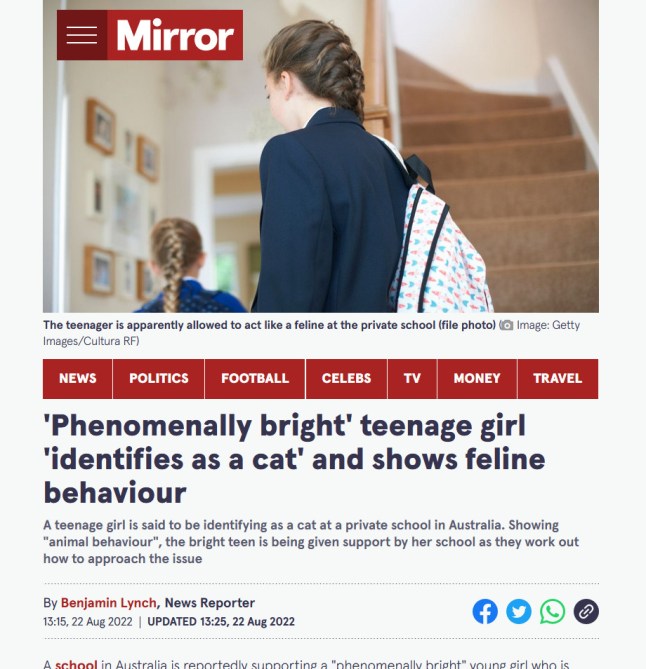
Australia’s Herald-Sun claimed this week, without any evidence, that a “phenomenally bright” teenage girl at a private school in Melbourne identifies as a cat, and the adults who run the school are cool with it as long as she isn’t too much of a distraction to her classmates.

This is the fifth or sixth viral story about school kids “identifying as cats” so far in 2022. They vary in details — some articles claim schools provide litter boxes in student bathrooms, while others assert teachers were fired for refusing to “meow back” to cat-identified children — but they’re all variations on the same theme.

None of the stories have turned out to be true.

There are big time red flags in this story. It doesn’t name the student, but that’s not uncommon. Unless a kid decides to speak to the media directly, most outlets refrain from naming minors. But the article doesn’t name the school and it’s based on the word of one person, with all the details attributed to someone described as “a source close to the family.”

Viral story about alleged cat-identified teenager
The Herald-Sun’s story has spread via News Corp.’s digital platforms to social media, clickbait sites and less scrupulous publishers.

Single-source stories are no-nos in journalism, for obvious reasons. There’s an old joke among journalists: “If your mother tells you she loves you, confirm it with a second source.”

In other words, assume nothing and verify everything, especially if the claim is unusual or extraordinary. The absolute minimum standard is two sources, preferably three.

It used to be that breaking this rule was playing Russian roulette with your career, because it’s bound to blow up in your face at some point, and no editor worth her salt would run a story like that. Unfortunately in the age of “publish now, verify never” the veracity of a story is a secondary or tertiary consideration, far less important than an article’s potential to catch fire, go viral and reel in clicks.

This story doesn’t even come close to meeting minimum standards, because the claims come from someone whose name isn’t revealed. When the source is anonymous, the need to verify becomes even more important.

Viral hoax story
Another News Corp. platform promotes the story.

In this case, if a friend of the girl’s family claims the girl is allowed to behave like a cat in school, and that friend isn’t willing to stand by that claim, no reputable news organization should run the story unless they have confirmation from the school or a legitimate document (like a letter to parents from the school) that backs up the claim.

The Herald-Sun story says the school issued a statement in response to the alleged controversy, but again, the school isn’t named so it’s impossible to confirm any details.

Finally, the Herald-Sun is a News Corp.-owned tabloid whose editors have a reputation for printing stories designed to rile up their readership and drive clicks online. The paper gives its reporters bonuses based on traffic numbers, which is an incentive to fabulate outrageous nonsense and ignore crucial but time-consuming work like serving as watchdogs of government.

The editors of the Herald-Sun may not be stupid, but they’re willing to destroy the remaining scraps of credibility the media still has to enjoy one-time spikes in traffic. They know a story like this will make the rounds on Twitter, Facebook, Youtube, TikTok and the personal sites of culture war vultures whose formula for drawing readership is whipping readers/viewers into a frenzy.

In the meantime, the most recent polls show media credibility with the public is at an all-time low, which is what happens when journalism becomes a race to the bottom. We used to laugh at junk tabloids that ran cover stories about alien abductions and Elvis sightings. Now we click on them and share them on social media.

Thankfully cats remain oblivious, and ignorance is bliss.