
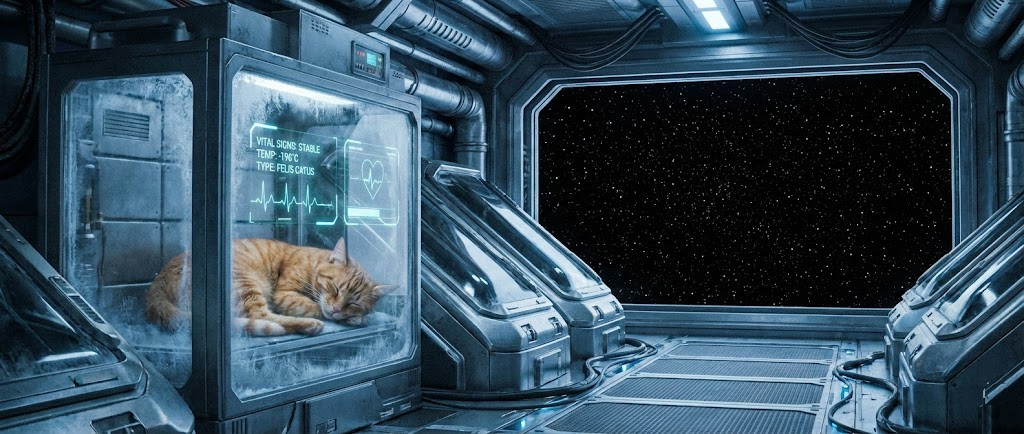
A man in the UK has spent a small fortune on the possibility of reviving his dead cat.
Mark McAuliffe says he was so upset when his 23-year-old cat’s health began to fail that he made arrangements with a Swiss firm to preserve her body when she passed away.
The 38-year-old adopted Bonny, a domestic shorthair, while he was a teenager, and she’s been with him for more than half his life, including his entire adulthood.
Usually when stories like this make the news, they’re about people who preserve their cat or dog’s DNA for cloning.
That’s not what’s happening here.
Bonny has been placed in a cryopreservation unit, which uses liquid nitrogen to freeze her entire body. Freezing a body essentially suspends it in time. Extremely cold temperatures — as close to absolute zero as possible — suspend cellular activity, including decay.
It’s called cryopreservation, and while the concept is most frequently invoked in science fiction, putting a body into cryostasis is real and within the technological capabilities of modern science.
The company McAuliffe paid to preserve his cat is Switzerland-based Tomorrow Bio, which is affiliated with the European Biostasis Foundation. The technology is used for several other purposes in the medical field, the food industry and in certain engineering applications.
McAuliffe is gambling on the future, or a version of it in which people and animals can be revived and repaired, like Lazarus in a lab. But it wouldn’t be much of a future for Bonny if her human wasn’t with her, so McAuliffe has reserved a spot for himself as well, hoping to meet her in better times.
“This cushioned the blow about Bonny’s death,” he said, “because I have got it in the back of my mind that it is not going to be the final goodbye.”
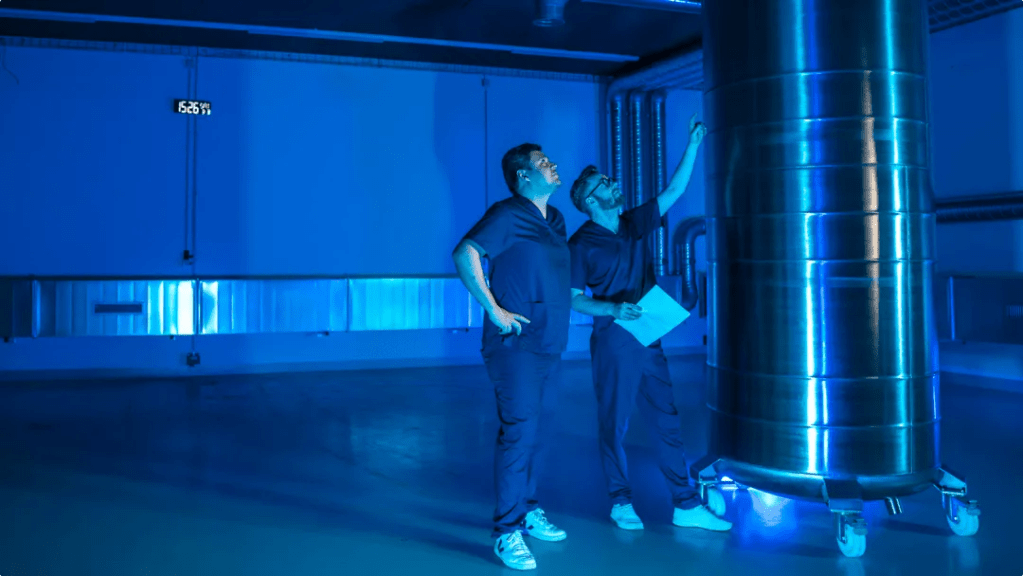
The European Biostasis Foundation runs the cryovaults where clients are kept. The organization told the Daily Mail that it has five “full body patients,” 15 preserved brains, two dogs and eight cats. In addition, more than 700 people have made arrangements to have their own bodies frozen upon death.
There is, of course, a hiccup.
While freezing a body is possible, thawing is not — not without destroying the body.
That’s because ice crystals form and rupture cell walls when the body is brought out of cryopreservation, no matter how slow the process.
The workaround involves using cryoprotectants, essentially a form of anti-freeze that would prevent the formation of damaging ice crystals despite the temperature.
That, however, introduces an entirely new set of problems, including the fact that cryoprotectant is toxic at the levels required for preservation.
Preserving the brain presents an entirely different set of problems, as our neurons and neural pathways begin to decay immediately after death. Our brain topology and neural connections are part of who we are, part of what makes our minds uniquely our own. Neuroscience and cryostasis technology each have a long way to go before scientists can even attempt to thaw a brain.
So by spending almost $22,000 to preserve Bony, and buying a plan to preserve himself (at a cost of $230,000), McAuliffe is banking on major breakthroughs in biology, as well as the ability to precisely control temperatures. To successfully thaw a body without destroying it, the entire body must be warmed at the same time, including all internal organs. That’s a significant technical challenge.
It’s also a gamble on the general shape of the future, placing hope that progress will continue. It assumes we won’t lapse into another dark age, that we won’t lose technology and expertise to devastating wars, plagues or other disasters that could set humanity back decades or centuries.
Finally, there’s a major hurdle that has little to do with science behind cryopreservation. It’s the simple fact that human lives are short, companies that promise centuries of operation can’t guarantee that outcome, and a lot can happen while a person sleeps away those years.
There’s a great short story by the Welsh science fiction novelist Alastair Reynolds about a wealthy man who wakes after centuries of cryosleep to find that the company who managed his crypt went bankrupt. From there it changed hands several times until it ended up in the portfolio of a corporate raider.
So the narrator, expecting to be woken to fanfare, deferential treatment and a bright technological future instead finds himself indebted and facing a reality much different and more depressing than he ever imagined.
I sympathize with McAuliffe, who obviously loves Bonny a great deal, and I see the appeal of becoming a refugee from the past, entering into a cryovault in the hope of emerging into a better future. But man, that’s a huge gamble.
In the meantime, there are plenty of cats who need homes and have a lot of love to give. Every shelter cat is a potential Buddy!
 Pain In The Bud
That’s desperately sad. I totally understand this guy’s love for his cat, but even if the “re-awakening phase” ever becomes possible (which seems unlikely to me), Bonny would be totally freaked out by it. On this matter I am persuaded by the Buddhist philosophy that “all things must pass”. And think how many feline lives could have been saved or improved if the $22k had instead been donated to Cats Protection, the UK’s leading cat welfare charity.
LikeLiked by 1 person
Indeed. Cats Protection and Battersea shelter both do great work, and I’ve written about them quite a bit on the blog because aside from being responsible for Larry and Palmerston, they’re always in the news for doing good.
With the cryo tech, I didn’t want to get too deep into the challenges and bore people, but I think you’re right, it’s very unlikely.
LikeLiked by 2 people
Both are excellent organisations that we are pleased to support financially.
LikeLike
This saddens me. I know what it is like to miss your dear cat as my Cesare is always near in my thoughts. I still can’t believe he’s gone. I feel sorry for the man who paid to have this done.
LikeLike
Your love for Cesare is evident in all your posts and images.
LikeLiked by 1 person
Thank you, BigBuddy.
LikeLike
Horrible in so many ways. Not going to get into religious aspect because i am not very religious. People have warned us about this kind of crap. Freezing people and animals. If you really think about Kings Pet Cemetary. Why did he name the cat Church? Religious reason? Just popped into his head? Will people and pets turn into monsters after rising from the dead? Of course not. Just saw episode of Twilight Zone. 4 men steal millions of dollars of gold. Freeze themselves and go into the future where gold has no value. They all die at the end. Deal with your grief and go to a kill shelter.
LikeLike
The more I think about it, the more this seems like a good racket. Maybe I’ll found my own Biostasis company and charge people $230k with promises of waking up in a bright utopian future!
LikeLike
I feel for the guy losing his cat, and I still think of and long for the cats we’ve lost over the years. But … more homeless cats have always come to our door (as well as a few two-timers, you have to check) … And there are also those in shelters who have no one. If you’ve experienced closeness with one kitty, it seems like you’d feel for those cats who have no homes or people too; go adopt another after a loss.
LikeLike
He could adopt and like P said, write a nice big check to Cats Protection.
LikeLiked by 1 person
I hope it works out for him. Logic doesn’t really rule when it comes to loved ones.
LikeLike
Yep. Grief compels people to do strange things.
LikeLiked by 1 person
I just had the chance to read the whole article. 23 YEAR OLD CAT!! He should be lucky Bonny lived so long. And no. I have only so much sympathy for owner. What’s next? Children? Grief is part of life. I can see why very religious people think playing God is insane. Even atheists i know say this is wrong.
LikeLike
I may be old fashioned, but why didn’t he just have her cloned?
LikeLike
Not sure, but if I had to guess, it may be because cloning merely creates an “identical twin” who may or may not resemble the deceased animal. Same deal with personality: it could be similar, but it could also be completely different.
It’s fodder for the nature vs nurture debate, certainly.
LikeLike