The Most Important Cat Study Ever Has Been Completed, And The Results Are In

For the first time ever, a US city has conducted a true cat census using scientifically proven methods, including doing it the hard way — by counting. The project’s authors hope other cities follow their lead.

The last decade has seen something of a renaissance in cat-related research, with insightful studies about feline behavior coming from researchers in the US and Japan.

On the other hand there’s been a glut of research into feline predatory impact and public policy, and the majority of those studies have been deeply flawed. They’re based on suspect data and tainted by the interests of people who are more interested in blaming cats for killing birds than they are in learning about the real impact of domestic felines on local wildlife.

Those studies have all taken extreme shortcuts — using data that was collected for entirely different studies, for example, or handing out questionnaires that at best lead to highly subjective and speculative “data” on how cats affect the environment.

Several widely-cited studies that put the blame on cats for the extirpation of bird species have relied on wild guesses about the cat population in the US, estimating there are between 20 million and 120 million free-roaming domestic cats in the country. If you’re wondering how scientists can offer meaningful conclusions about the impact of cats when even they admit they could be off by 100 million, you’re not alone.

No one had ever actually counted the number of cats in a location, much less come close to a real figure — until now.

When leaders in Washington, D.C., set out to tackle the feral cat problem in their city, they knew they couldn’t effectively deal with the problem unless they knew its scope. They turned to the University of Maryland for help, which led to the D.C. Cat Count, a three-year undertaking to get an accurate census with the help of interested groups like the Humane Society and the Smithsonian.
DC Cat Count
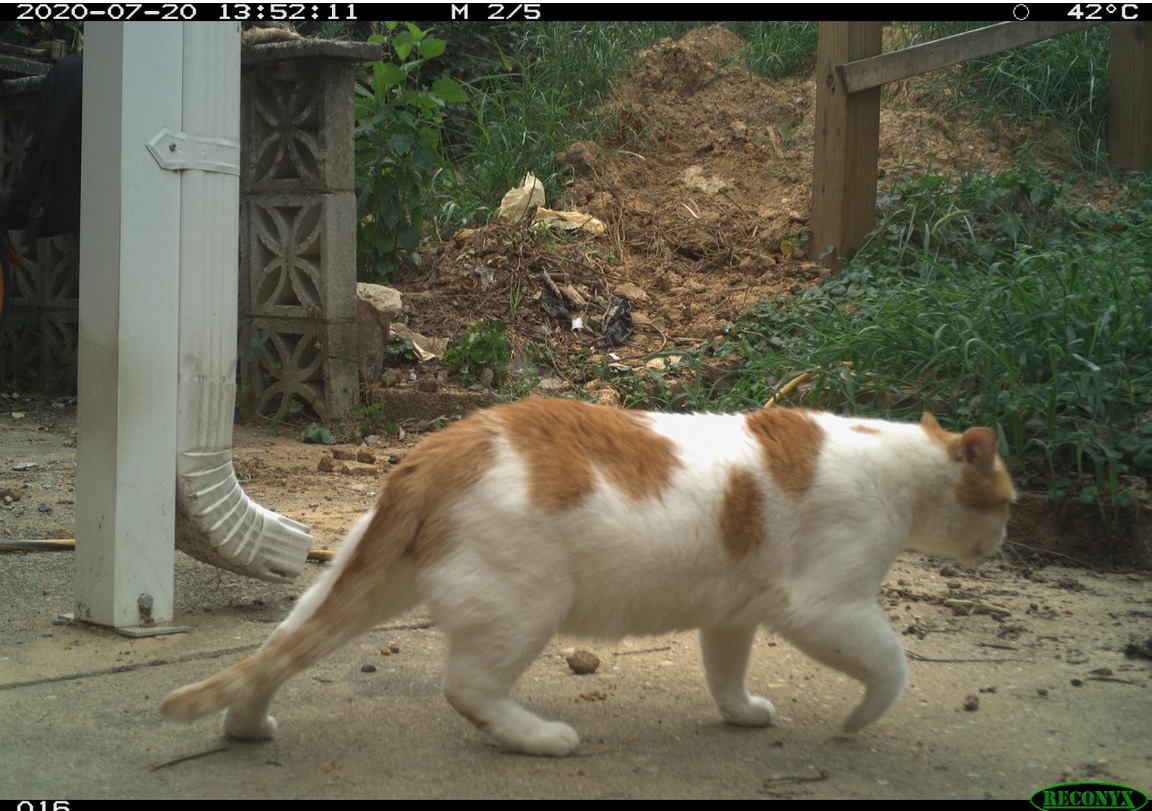
An image from one of 1,530 motion-activated cameras deployed for the D.C. Cat Count. Credit: D.C. Cat Count

The researchers approached each of their local shelters and rescues for data, then assembled a meticulous household survey to get a handle on how many pet cats live in the city, and how many have access to the outdoors.

Finally — and most critically — they used 1,530 motion-activated cameras, which took a combined 6 million photos in parks, alleys, public spaces, streets and outdoor areas of private residences. They also developed methods for filtering out multiple images of individual cats, as well as other wildlife. And to supplement the data, team members patrolled 337 miles of paths and roads in a “transect count” to verify camera-derived data and collect additional information, like changes in the way local cats move through neighborhoods.
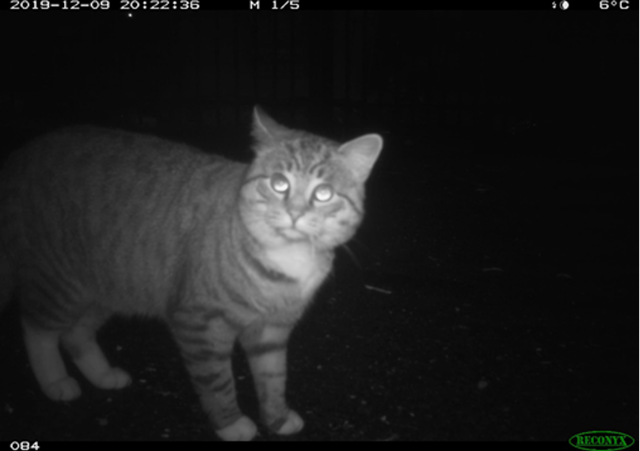
DC Cat Count
A cat who looks a lot like the Budster was captured in this 2019 photo from a motion-activated camera with night vision. Credit: DC Cat Count

Now that all the data’s been collected and analyzed, the D.C. Cat Count finally has a figure: There are about 200,000 cats in the city, according to the study.

Of those, 98.5 percent — or some 197,000 kitties — are either pets or are under some form of human care and protection, whether they’re just fed by people or they’re given food, outdoor shelter and TNR.

“Some people may look at our estimate and say, oh, well, you know, you’re not 100% certain that it’s exactly 200,000 cats,” Tyler Flockhart, a population ecologist who worked on the count, told DCist. “But what we can say is that we are very confident that the number of cats is about 200,000 in Washington, D.C.”

The study represents the most complete and accurate census of the local cat population in any US city to date, and the team behind it is sharing its methods so other cities can conduct their own accurate counts. (They’ll also need money: While the D.C. Cat Count relied on help from volunteers and local non-profits it was still a huge project involving a large team of pros, and it cost the city $1.5 million.)

By doing things the hard way — and the right way — D.C. is also the first American city to make truly informed choices on how to manage its feline population. No matter what happens from here, one thing’s certain — the city’s leaders will be guided by accurate data and not creating policy based on ignorance and hysteria painting cats as furry little boogeymen.
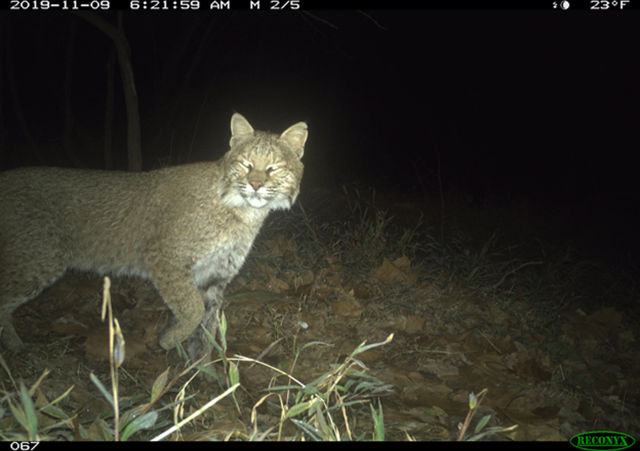
DC Cat Count
Not all the photos captured images of cats, and not all the felines were little: In this 2019 night image, a bobcat wanders in front of a trail camera. Credit: DC Cat Count

Unlike Other Animals, Cats Always Take The Free Meal

When given a choice between an easy meal and food in a puzzle feeder, cats opt for the low-effort yums.

When presented with a simple tray of food and a food puzzle that requires a little work to get at the yums inside, every animal ever tested has opted for the latter.

Except cats.

Rhesus monkeys, rats, chickens, bears, starlings, gerbils, chimpanzees and a wide range of other animals are drawn to food puzzles, perhaps because the food tastes sweeter to them if they’ve had to work for it, or maybe because it’s just something amusing to do.

“There is an entire body of research that shows that most species including birds, rodents, wolves, primates – even giraffes – prefer to work for their food,” said Mikel Delgado, a cat behaviorist and lead author of the newest study on the phenomenon known as contrafreeloading. “What’s surprising is out of all these species cats seem to be the only ones that showed no strong tendency to contrafreeload.”

Puzzle feeder
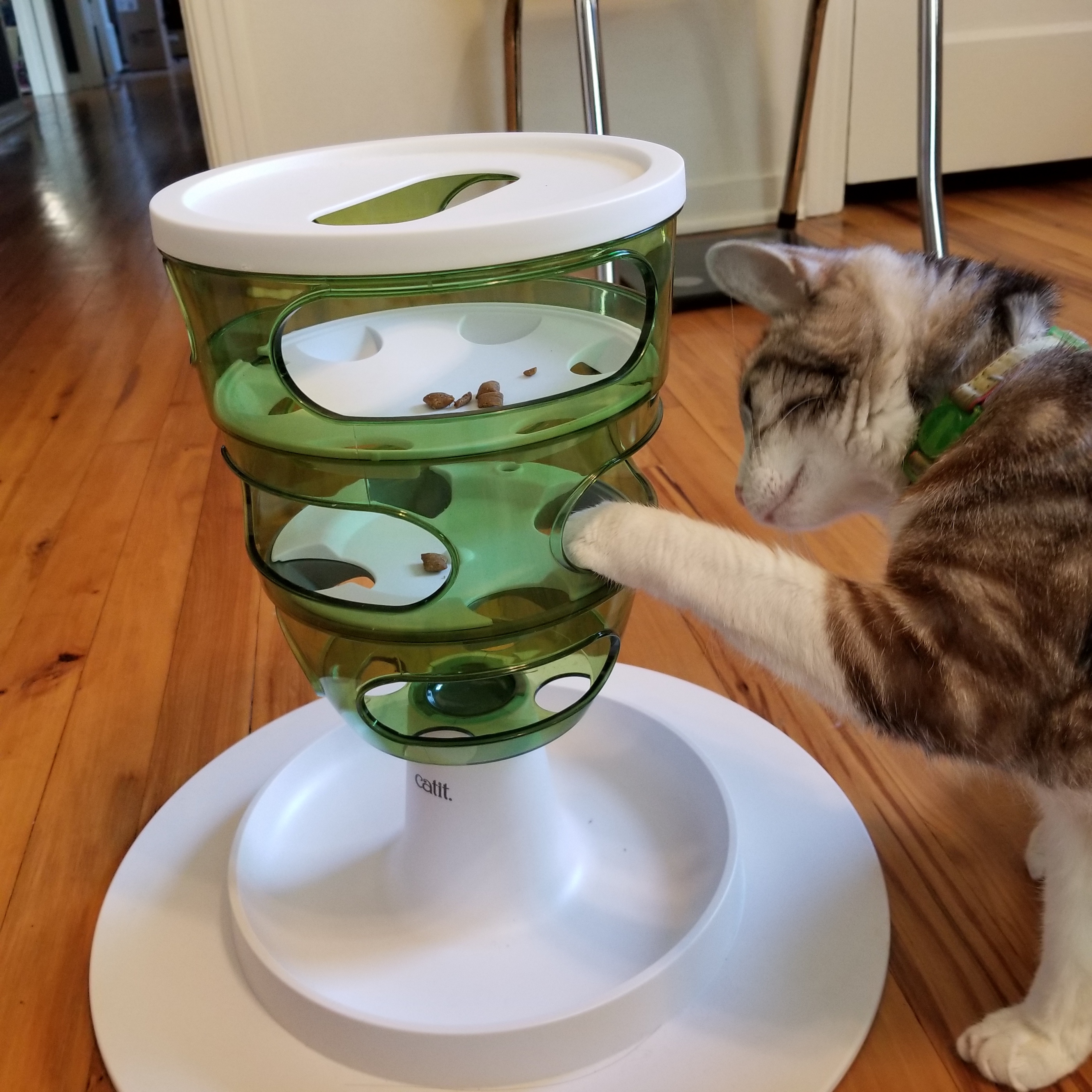
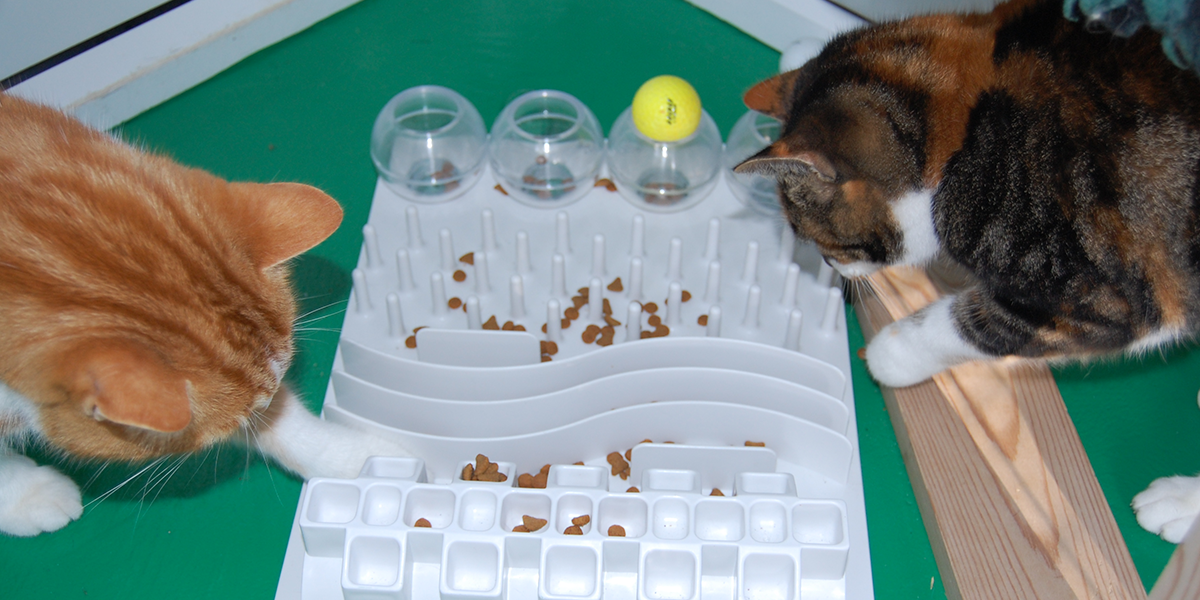
A puzzle feeder used in the study. Credit: UC Davis

Delgado, a research affiliate at UC Davis’ School of Veterinary Medicine, used a clear puzzle feeder so the cats in her study could see the treats inside. A few feline study participants gave it a shot, but only after grabbing themselves some easy grub first. Other cats just ignored the food puzzle and munched exclusively from the tray.

While this is at least the second study to specifically test whether cats “freeload” their meals, the why of this particular feline behavior remains a mystery. Delgado cautioned against the obvious conclusion — that cats are just lazy — and pointed out that several cats in the study were active and expending energy, just not with the puzzle feeder.

One possible explanation: As hunters and obligate carnivores, cats simply may not enjoy games that simulate foraging the way omnivores and herbivores do.

The study was published on July 26 in the academic journal Animal Cognition. Read it here.

Screenshot 2021-08-13 at 08-31-22 MikelDelgadoProfile jpg (WEBP Image, 800 × 800 pixels)
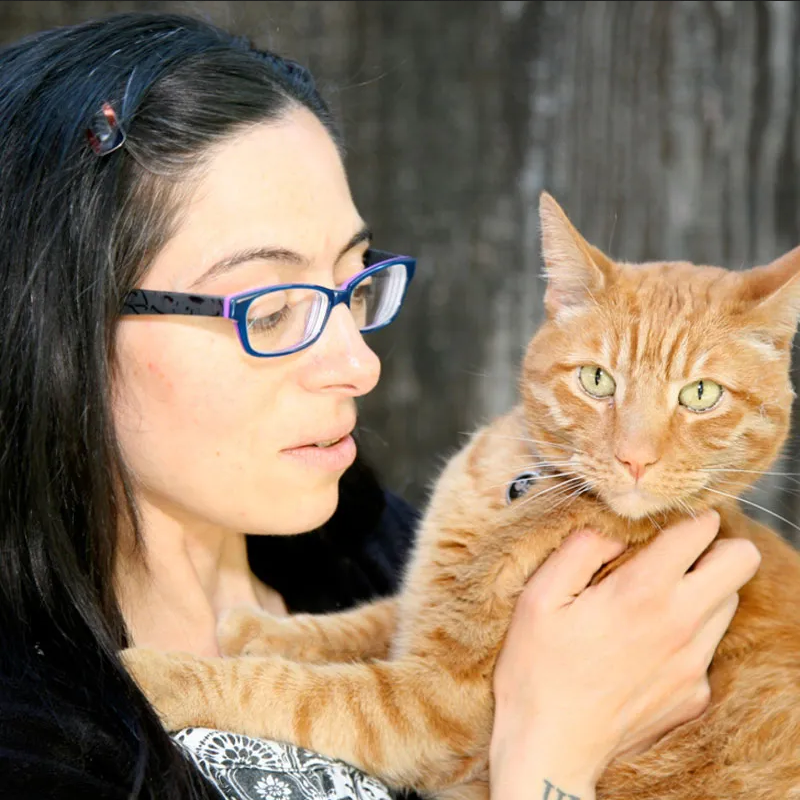
Mikel Delgado with a kitty. Credit: Community Cats Podcast

Local Gov. Employees In California Are Shooting Cats To ‘Protect Wildlife’

The government agency that manages Bay Area parks initially denied killing the cats, then said its employees shot 18 strays because they were a threat to birds who migrate to the area for the winter.

In a sickening story out of California, state government employees have admitted to shooting 18 cats and say they can’t rule out shooting more who venture too close to a marshland where thousands of birds migrate for the winter.

The cats were shot by employees of the East Bay Regional Park District, a government agency that manages parks in the Bay Area, including San Francisco, Oakland, San Jose, Palo Alto and dozens of other cities and towns in a nine-county area.

They’re operating under a broad mandate that allows them to kill any cats “that may pose a danger to wildlife,” according to a report by Bay Area ABC affiliate KGO.

It’s 7:30 at night in an East Oakland office park, Cecelia Theis is trying to trap what’s left of the colony of cats she’s cared for over the past year. She tells the I-Team, “I really want to get them out of here.”

After Theis came here to work for the county, training poll workers in the last primary election, she began helping others feed the feral cats. She fell hard for them, including the little one who climbed on her hood waiting for food, and the first cat she befriended.

“Each of them had a personality and helping them was a priority for me,” Theis said.

She found homes for their kittens, took the adults to be spayed and neutered; the colony was stable at 30 cats. But over the past month, most of them have disappeared.

Theis finally got East Bay Regional Park officials to admit, their staff shot and killed several of the cats that had wandered into a nearby marsh.

Her heartbreak spilled out on social media, “It’s not okay to shoot these beings; some of them were pets that were abandoned.”

The state employees who shot the cats did so without notifying the public, without talking to locals who manage and care for cat colonies in the area, and without asking for the help of local shelters and rescues whose staffers say they could have easily trapped the cats and relocated them.

In fact, the East Bay Regional Park District lied when first asked about the fate of the cats: Employees there initially told Theis and another colony manager that the cats were trapped and taken to shelters in Oakland and nearby Dublin, according to a day-old Change.org petition that already has almost 500 signatures.

3C25179C-2597-4D77-87CD-2FB9A007E358

The state employees only came clean about killing cats when Theis went to KGO and they realized their actions would be detailed in media reports. They’re still obfuscating: KGO journalists filed public records requests for documents related to the cat killings, but the agency has not fulfilled the requests.

That’s illegal according to state and federal law, which dictate that government agencies have 30 days to respond and, if they deny the open records request, must provide a compelling reason why. As a career journalist who has filed my own share of Freedom of Information Act requests over the years, I cannot fathom any valid excuse for withholding those documents from the media and thus, the public.

Policies like this one are a direct result of the dangerous misinformation peddled by a handful of academics who advocate for the extermination of cats, and claim domestic cats kill more than 20 billion birds and small mammals in the US annually.

Despite serious and deep flaws in their methodology — and the fact that the authors invented data rather than trying to gather it — the findings of those studies are reported as fact in the press, without any skepticism, despite push back from other scientists who have been sharply critical of the studies and their conclusions.

5F8F6039-255A-4706-8A34-9E7DF8DEF7C2

The result has been a panic over cats and their impact on smaller wildlife. The studies and the subsequent panic are directly responsible for policies like those adopted by some Australian regional governments, who have an open bounty on domestic cats, paying $10 for adult pelts and $5 for kitten pelts. They also fuel rhetoric of the type we witnessed in the New York Times this August, when a columnist was so incensed by reports of cats killing birds that she admitted to fantasizing about shooting a hungry, sickly stray who showed up in her neighborhood.

We have a serious problem if, on the cusp of 2021, we have government employees shooting cats and paying bounties for kitten pelts, based on the misguided idea, not supported by evidence, that violently killing small domestic animals is somehow an effective way to protect birds.

Cats are sentient creatures who feel pain, fear, anxiety, sadness and the full range of primary emotions. Moreover, they’ve been molded into companion animals who bond closely with humans. According to Theis and KGO, several of the cats who were shot were former pets.

A manager with the East Bay Regional Park District downplayed the shootings, saying there was a “communications breakdown” between his team and local rescues as well as colony caretakers.

“We feel horrible about this, you know, this is really one thing that’s just really sad,” Matt Graul, “chief of stewardship” for the agency, told KGO. “And we really don’t want to ever have to take this step. You know, we are compassionate, and love all wildlife. And many of our staff have cats as pets.”

Despite that, Graul would not rule out killing more cats and his agency has not complied with state public records law, nor did he say why the agency lied to colony caretakers about the fate of the strays. We hope Bay Area media organizations are getting their lawyers involved and working with the state’s open government office to force the East Bay Regional Park District to obey the law and release its records on the cat shootings.

This is unacceptable, and it should be stopped before government officials with too much zeal and too little skepticism enact similar policies in other states.

94744672-DA95-48BA-92AC-A0C6518D9619

Study: There Are 5 Types Of Cat Owners

Do you keep your cats inside, or do you let them roam free?

When it comes to attitudes about hunting and impact on local wildlife, there are five broad categories of cat owners, a new study says.

Four out of the five aren’t particularly worried about their cats killing birds and small mammals, the University of Exeter researchers wrote in the study, which was published in Frontiers In Ecology and the Environment, a research journal.

  1. Concerned Protector. These are people who keep their cats indoors to keep them safe from the world. Their main worries are cats being stolen, lost or killed. They don’t have strong feelings about hunting behaviour and wouldn’t keep their cats indoors solely to stop them hunting.
  2. Freedom Defenders believe cats should be able to roam where they please, like wild animals. Cats hunting is a good sign of normal behaviour and helps control the rodent population. They oppose any restrictions of cat access to the outdoors.
  3. Tolerant Guardians believe that the benefits of roaming outweigh the risks of the cat being injured or lost. They love wildlife and cat hunting is the least attractive part of cat ownership, but it is just what cats do. They’re not sure how cat owners can effectively reduce hunting behaviour.
  4. Conscientious Caretakers believe cats should have access to the outdoors but they don’t oppose some containment. Hunting by cats really bothers them, and they particularly worry about birds. They believe owners should have have some responsibility managing their cat’s hunting behaviour.
  5. Lasseiz-faire landlords believes it’s natural for cats to want to go out into the natural world and if they fall foul of it (dogs, bigger cats, SUVs) that’s natural too. They’ve never seriously thought about the effects of cats on wildlife populations. They’d be more likely to manage their cat’s hunting behaviours if it was killing things all the time.

You can take a short quiz (16 multiple choice questions) to find out what kind of cat caretaker you are. For what it’s worth, the quiz says I’m a “conscientious protector,” which sounds about right.

cat-predation

In his mind, of course, Buddy is a fierce, powerful feline and a mighty hunter. In reality he’s hilariously inept at the hunting games we play, and no matter how many times I’ve brought him outside on his harness, he goes into sensory overload every time, spending the first 20 minutes nervously huddled before he relaxes, his tail shoots up and he starts to enjoy the new sights and smells.

Fortunately I don’t have to deal with a cat who pines for the outdoors. Bud has no desire to go out there on his own, and he won’t even step onto the balcony if it’s too hot, too cold, raining, snowing or especially windy.

Most of all it’s too dangerous out there between traffic, potential predators like coyotes, train tracks, other cats and people who will abuse or kill cats just because they can. I don’t want to lose my little Bud.

Dear readers, if you take the test, please let us know which category it placed you in.

Study Confirms What We All Know: Cats Are Remarkably Lazy

Unlike other animals, cats aren’t big on food puzzles. They just want the food.

My cat has a morning ritual: He’ll meow in front of the treat cabinet, which now contains healthy snacks, then gobble down his first yums of the day before padding over to the carpet or the couch to lay down.

Ya know, because he worked so hard. After a long and tiring night of sleep and the grueling physical exertion of working his jaw muscles to eat, he needs a respite. A cat nap, if you will.

He’s not unique in this respect, and his morning siesta is just the first of many. Cats need their beauty rest after an exhausting day of lounging, sleeping and having their food literally placed before them.

A new study confirms what we already know — that cats are lazy little bastards — and even hints at new levels of laziness unbeknownst to us thus far.

Working hard or hardly working?

“Get a puzzle feeder,” they say. “Make ’em work a little for their food,” they say. “It’ll stimulate their instincts.”

Animal behaviorists have recommended toys like puzzle feeders and treat balls for years, prompted by research that shows animals enjoy “contrafreeloading,” a fancy way of saying when given a choice between free food and food in a puzzle feeder, animals will opt for the latter.

The behavior is consistent across many species of domestic and wild animals, from dogs and rats to chimpanzees and birds. Maybe it stimulates their urge to forage. Maybe it gives them something fun to do. Or maybe food just tastes better to animals when they’ve earned it.

Cats, however, aren’t contrafreeloaders. They want the easy yums.

That’s according to a new study by a University of California at Davis research team. Cats didn’t ignore the food puzzles entirely, but they showed a clear preference for the low-hanging fruit, so to speak.

“It wasn’t that the cats never used the food puzzle, they just used it less, ate less food from it, and typically would eat from the freely available food first,” said UC Davis’ Mikel Delgado, a co-author of the study.

puzzle-feeder
“I’m tellin’ ya, Horace, they do this just to piss us off. How are we supposed to gobble it all down if we have to fish every little kibble out one by one? I hate humans!”

As for why cats aren’t taken with puzzle feeders — besides their inherent laziness, of course — that question will take more studies to answer.

“There are different theories about why animals might contrafreeload, including boredom in captive environments, stimulating natural foraging behaviors, and creating a sense of control over the environment and outcomes,” Delgado said.

When it comes to cats, Delgado’s best guess is that puzzle feeders might just be the wrong game since it doesn’t stimulate their hunting instincts. Maybe the next study should involve small pieces of chicken and turkey tied to the ends of wand toys, so our mighty little hunters can catch their “prey” and dine like proper tigers.