A look at the strange and wonderful world of rare books where, of course, you’ll also find cats.
I’ve always liked the idea of antiquarian bookshops.
I am almost completely ignorant on the subject, mostly because chasing after extremely rare print volumes is the domain of people with a lot of expendable income. The most valuable books in my possession are an original 1939 first edition print of Will Durant’s The Life of Greece, and two novels signed by their authors. Their value is sentimental, not monetary.
But I like the general romanticized image of the antiquarian bookseller: an older man or woman in tweed ensconced in a cozy shop in Manhattan, with every shelf filled with dusty volumes and every surface covered by globes, astrolabes and other curiosities. There’s one of those tight winding staircases with wrought iron railings leading to a loft for access to the highest shelves, the music is from a vinyl collection of light jazz, and it’s always raining outside.
A doted-on shop cat dozes on a red leather armchair, tail twitching from some nightmare in which it’s slightly less adorable than it thinks it is.
Collectors in damp trenchcoats drop in, asking after 17th-century occult tomes, grimoires, and Voynich-esque manuscripts with engravings of impossible creatures, trees with visual organs and arcane rituals. Bibliophiles ask after leatherbound collections of classics like Don Quixote, and the occasionally curious passerby peeks in, surprised that such shops still exist in the age of the internet.
It turns out that’s not too far from the truth, especially the bits about the internet and, of course, the cats.
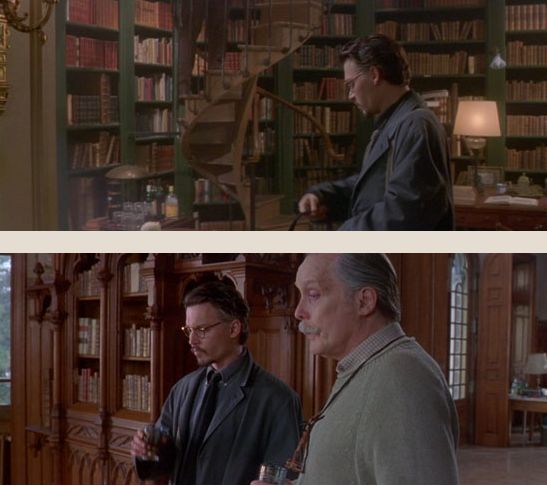
Johnny Depp is constantly smoking and drinking red wine while handling priceless old books in 1999’s The Ninth Gate. Notice the winding staircase in the rare book shop in the top screenshot.
The Booksellers is a documentary that screened in festivals in late 2019 before heading straight to video when the pandemic brought the world to a screeching halt.
It’s an inside look at the annual New York Book Fair and the small world of antiquarian and rare booksellers in New York, a shrinking constellation of people mostly descended from, or formerly apprenticed to, the booksellers of old before Barnes and Noble and Jeff Bezos laid waste to that sector of retail.
Before network TV, cable TV, dial-up internet, broadband, Kindles, iPads and smartphones turned us into a media-gorging — yet paradoxically less literate — society, New York was home to more than 500 bookshops, including generalists and specialists who catered to people with particular and peculiar interests. Now it’s home to fewer than 80, according to the documentary.
When the booksellers were asked about the way the internet has impacted their trade, their weary sighs reminded me of my older colleagues from my brief time experiencing the end of the “good old days” of newspapering, before the internet destroyed or compromised every publishing income stream and delivered us to this moment. This dystopian time when entire swaths of the country have become news deserts, Elon Musk in all his wisdom asserts that Twitter accounts run by anonymous trolls in Belarus are just as reliable — even more trustworthy, in fact — than those liars in legacy media, and corporate raiders are stripping the last handful of newspapers down to assets they can auction off.
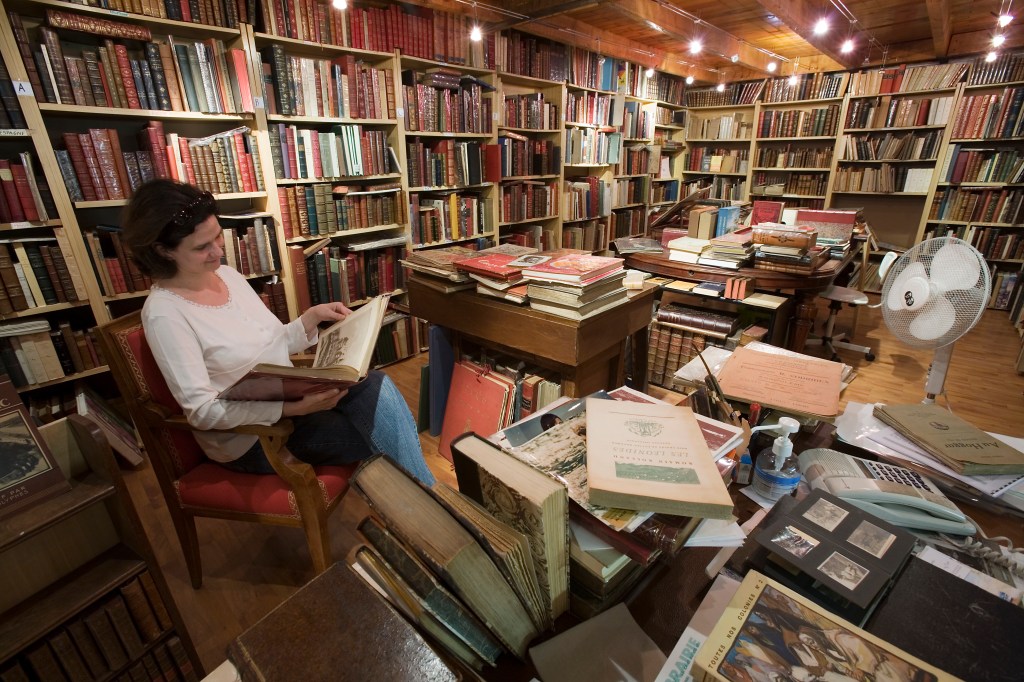
A rare book shop in Paris. Credit: Wikimedia Commons
Not all of it’s bad. One rare book dealer laments the fact that “the thrill of the hunt” is gone, meaning it no longer takes years to track down some obscure volume because you can hop online and find it in a few clicks. I get that, but nostalgia for that sort of thing is the ultimate in looking back through rose-colored glasses. Plenty of us could wax nostalgic about the days when we’d hear a song on the radio and have to hum the damn thing to record store clerks, but we’re forgetting about the considerable frustration involved. Given the choice between “fun” ignorance and access to information, I’ll always choose the latter.
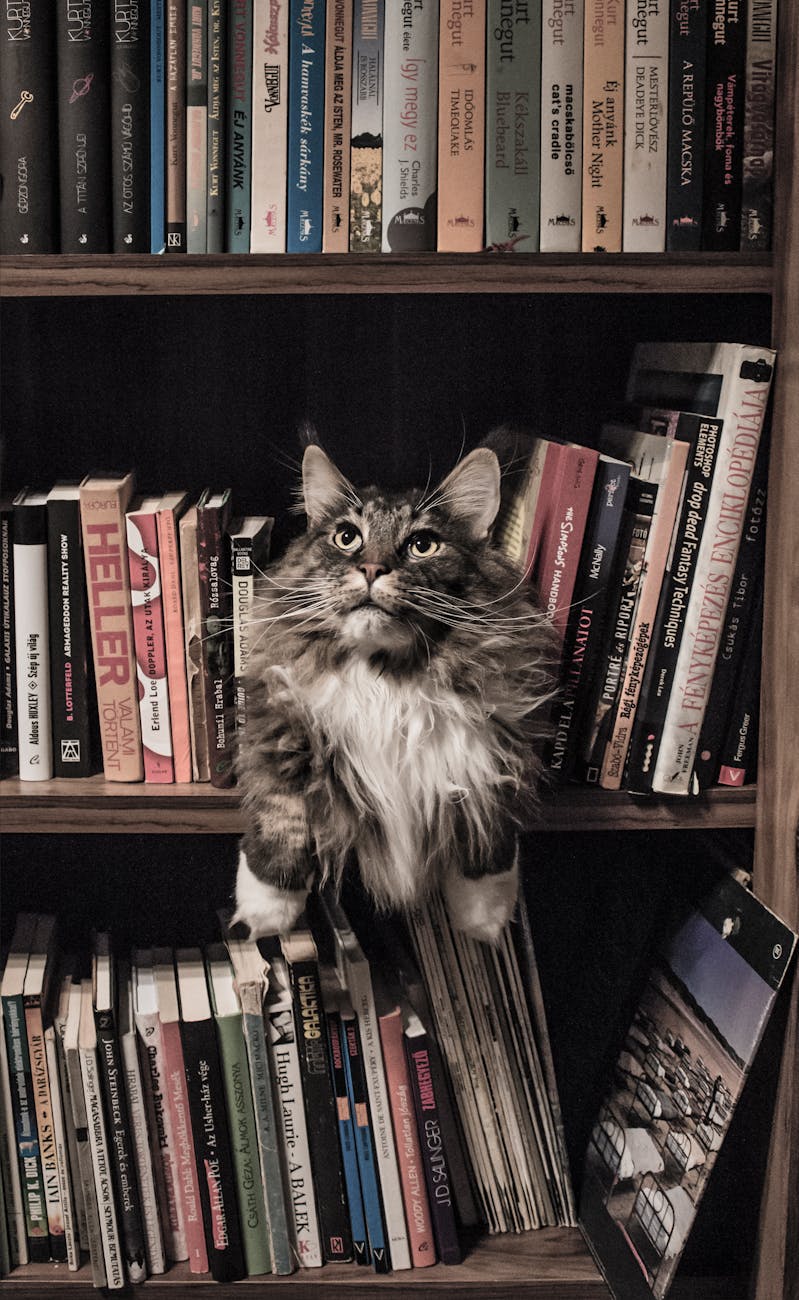
As for the cats, it’s not a surprise when many of the book dealers interviewed for the film identify themselves as cat lovers or idly scratch their feline friends while showing off their vast personal collections. Antiquarian bookshops tend to be warm, quiet, gently-lit spaces, perfect napping spots for cats who guard old books from rodents.
If you’re interested in watching The Booksellers, you can find it on Amazon Prime video, or better yet, just click below:
In the era of Amazon, America’s independent bookstores survive by offering things the online giant can’t.
Like everything else in the realm of print media, bookstores have been having a rough go of it the last decade or two.
Waldenbooks, Crown Books and Borders no longer exist, with the latter chain shuttering its last 400 stores in 2011. Barnes and Noble is the last surviving book chain thanks to an aggressive strategy of expanding their cafe and lounge space, encouraging shoppers to hang out while they sample books and drink coffee.
There are still some 14,000 bookstores in the US, depending on how some hybrid businesses are categorized, and independent booksellers now make up the majority of real-world retail while the giant that is Amazon looms.
The key to survival is offering things Amazon can’t. Some distinguish themselves by catering to specific customers, like fans of mystery or science fiction, offering rare and signed volumes alongside their regular stock. Some pursue a Barnes and Noble-like strategy, leaning heavily into the hybrid coffee shop model. And some become community spaces for book signings and poetry nights.
Others lure customers inside — and back after they’ve already visited — with pets.
In a new story, the New York Times highlights independent book shops around the country that have dogs, lizards, turtles, rabbits, and of course, cats.
When it comes to our furry and clawed friends, some shops are populated with adoptable felines:
At the Literary Cat Co. in Pittsburg, Kansas, readers have the opportunity to adopt a pet while they shop. The store partners with a local rescue organization, hosting about seven cats at a time, along with three permanent feline “employees”: Hank, the regional manager; Scarlett Toe’Hara, the assistant regional manager (she’s polydactyl); and Mike Meowski, the assistant to the assistant regional manager.
Jennifer Mowdy, the store’s owner, described each cat’s role, personality and origin story with the air of a matriarch ticking off successful grandchildren. Speaking of the upper respiratory illness that cost Mike Meowski an eye, she sounded stoic. He was a kitten; she was there for him. They soldiered through.
Mowdy created a glass alcove for allergic customers – and to deter escapees – and a “kitty conference room” (accessible by cat door) for litter boxes. With regular scooping, four air purifiers and daily mists of Mrs. Meyers Room Spray, she said the scent of the store is neutral to positive.
In the past year and a half, the Literary Cat Co. has facilitated 50 adoptions. “We’ve only had one cat that didn’t work out,” Mowdy said. “Too much fight in her.”
Kittens tend to wreak havoc; Mowdy prefers a mature animal of the “Don’t call me, I’ll call you” variety. Felines are welcome to scale shelves and interact with readers as they please, which is their way.
“They get to practice being a good house cat,” Mowdy said. “They get socialized.” Occasionally, the right cat finds the right reader’s lap. The rest is destiny (with the rescue organization handling logistics; the Literary Cat Co. simply makes the introduction).
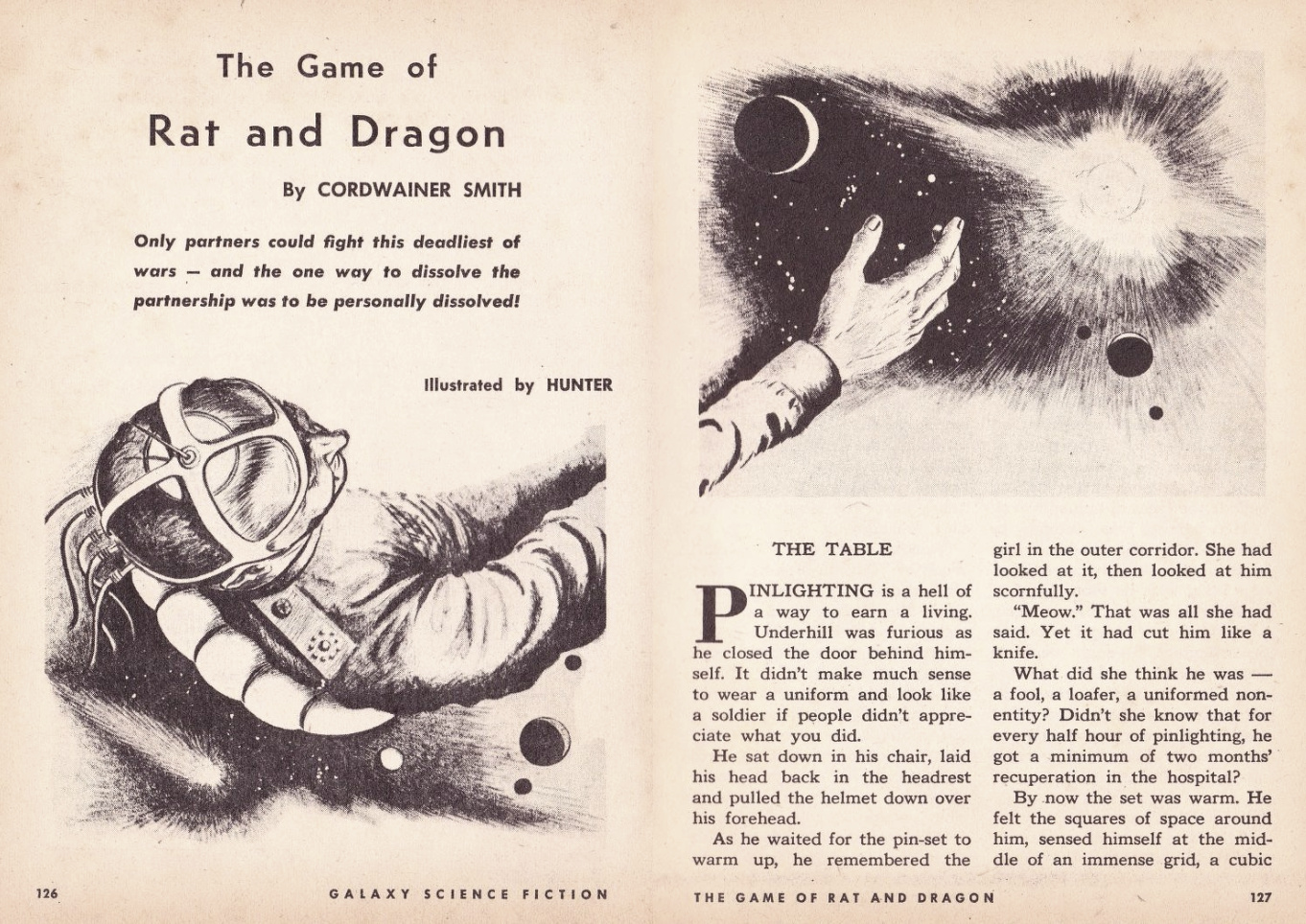
When an interstellar enemy threatens human progress, cats step in to save the day in this science fiction classic from 1954. The Game of Rat and Dragon explores the feline psyche and the cat-human partnership that has existed for 10,000 years.
A week ago we kicked off Bud’s Book Club with a short story, The Game of Rat and Dragon, and a non-fiction book, Man-Eaters of Kumaon. This post deals exclusively with the former. (If you haven’t read the story yet, it’s available here free. Most people will be able to read the story in less than a half hour at a moderate reading pace.)
By now everyone who’s read the story knows what it’s about: Cats, of course! But the story requires a bit of world-building setup before the kitties are introduced:
In an unspecified future humans have become a true spacefaring species, mastering interstellar travel and founding colonies in new star systems.
It’s a lot like the days of colonial powers founding settlements in the New World, but without the ugliness of terrestrial colonization or the quaintness of crossing a mere ocean.
Using a form of traveling called planoforming — essentially faster-than-light (FTL) jumps — human ships are able to reach distant star systems without traveling for the decades or centuries it would normally take to cross the unfathomable distances between solar systems.
Just when it looks like no obstacle remains for humanity to spread out into the galaxy, the intrepid explorers on the rim of human-occupied space realize there’s an insidious threat lurking in the void between stars.
Huge entities, invisible to the human eye, live in the vacuum of the interstellar medium. They haunt the void and attack human ships without warning. They are “beasts more clever than beasts, demons more tangible than demons, hungry vortices of aliveness and hate compounded by unknown means out of the thin tenuous matter between the stars,” author Cordwainer Smith writes.
When the mysterious entities attack, most people are mercifully killed in an instant, but the unlucky ones survive in a permanent state of insanity, their minds unable to cope with whatever alien malevolence they’ve witnessed.
As they learn more from each disastrous encounter, humans come to understand these creatures prefer the deep dark, shying away from star systems and their abundant sunlight.
But without a way to make it across the void, it becomes clear the era of human exploration and colonization is over unless something can be done to stop the enemy.
To extend the nautical theme, you can think of the dragons as giant krakens who prey on trade ships and passenger liners crossing between the American colonies and Europe during the Age of Sail. Although pushing the boundaries of new frontiers has always been dangerous, you can imagine how quickly intercontinental trade and settlement would grind to a halt if, say, half of all ships were sunk en route.
Humans can’t see the dragons, but that isn’t the primary reason they can’t successfully fight them. After all, the history of human warfare proves we’ve become adept at destroying enemies we can’t see, whether a ship’s dropping depth charges on a submarine hidden in murky waters, or some 20-year-old kid on an aircraft carrier hundreds of miles out to sea is using a joystick to lob drone-fired missiles on mainland buildings.
The real problem is that people just aren’t quick enough, unable to target and fire on the dragons before the entities react and speed away to safety.
So they turn to cats.
Kitties to the rescue
With their incredible reflexes, reaction time and hunting instincts, cats are more than a match for the dragons, and here’s where the story starts to get really fun. Cats, we’re told, travel alongside human vessels in their own little football-shaped ships that are equipped with precision miniature nuclear warheads.
Cats are happy to destroy the dragons — if their humans present the conflict as a game, make the “dragons” look like rats, and offer substantial rewards in the form of fish and poultry.
“I come from the Great Litterbox in the Sky!”
That’s why the cats are called Partners: Using some sort of brain link, specially trained humans pair up with the cats, mentally project images of the dragons as “gigantic rats,” and act like spotters so the kitties can pounce on their space rodents before the latter can hurt the human passengers.
Because the dragons are harmed by light, the cats lob “ultra-vivid miniature photonuclear bombs, which [convert] a few ounces of a magnesium isotope into pure visible radiance,” neutralizing the threat before anyone can be harmed.
The mind link between human being and cat is a two-way connection, affording cats a close-up view of human thought patterns just as the humans can feel the kitty’s mental processes.
We learn that our hero, Underhill, loves the feline Partners, and he’s deeply offended when a fellow soldier mocks his work by meowing at him. We also learn the cats understand that, while their task is dressed up as a fun hunting game, they face real danger when they fight the dragons.
The mind of a cat
Through Underhill’s eyes, we meet several of the Partners.
My favorite is an unnamed tomcat, described as “a greedy old character, a tough old male whose mind was full of slobbering thoughts of food, veritable oceans full of half-spoiled fish. Father Moontree had once said that he burped cod liver oil for weeks after drawing that particular glutton, so strongly had the telepathic image of fish impressed itself upon his mind. Yet the glutton was a glutton for danger as well as for fish. He had killed sixty-three Dragons, more than any other Partner in the service, and was quite literally worth his weight in gold.”
“To boldly go where no moggy has gone before!”
We’re told that the cats recognize the complexity of human minds, but aren’t necessarily impressed by them. The things humans concern themselves with and worry about are “silly” from a cat’s perspective (which, perhaps not coincidentally, is how the philosopher John Gray imagines how cats view us), and cats can quickly grow bored with a human too focused on highly abstract thoughts or subjects that simply don’t have much bearing on feline life:
“Usually the Partners didn’t care much about the human minds with which they were paired for the journey. The Partners seemed to take the attitude that human minds were complex and fouled up beyond belief, anyhow. No Partner ever questioned the superiority of the human mind, though very few of the Partners were much impressed by that superiority.
The Partners liked people. They were willing to fight with them. They were even willing to die for them. But when a Partner liked an individual the way, for example, that Captain Wow or the Lady May liked Underhill, the liking had nothing to do with intellect. It was a matter of temperament, of feel.
Underhill knew perfectly well that Captain Wow regarded his, Underhill’s, brains as silly. What Captain Wow liked was Underhill’s friendly emotional structure, the cheerfulness and glint of wicked amusement that shot through Underhill’s unconscious thought patterns, and the gaiety with which Underhill faced danger. The words, the history books, the ideas, the science—Underhill could sense all that in his own mind, reflected back from Captain Wow’s mind, as so much rubbish.”
Underhill is as fond of Captain Wow and Lady May, a friendly Persian, as they are of him. He’s happy when he’s called upon to defend a ship and finds out he’s been paired with the latter:
“When he had first come into contact with her mind, he was astonished at its clarity. With her he remembered her kittenhood. He remembered every mating experience she had ever had. He saw in a half-recognizable gallery all the other pinlighters with whom she had been paired for the fight. And he saw himself radiant, cheerful and desirable.”
What’s unique about this story — and what makes it particularly memorable, in my opinion — is Cordwainer Smith’s decision to explore the feline mind.
Out on a limb, from a feline world view
Minds, human or animal, are called “black boxes” for a reason. Even with the benefit of advanced science, even with fMRI and other forms of imaging, even with algorithmic AI that can read thoughts and sketch rudimentary images from our minds, we really don’t know what others are thinking, human or animal.
Smith goes out on a limb by imagining what must go on in the minds of cats, and it’s obvious he’s not only a cat lover, but he had a lifetime of experience with our furry friends when he wrote the story.
The idea that cats are all about emotion and tangible things — and are bored by things humans concern themselves with — seems dead on, as does the idea that cats aren’t impressed by our intellectual superiority, which only counts as superiority in human terms. Even if they had opposable thumbs and the means to create, would cats be interested in the kind of things we do?
Probably not. God only knows what kind of structures cats might build and what songs they’d write, but I’m pretty sure my cat would write paeans to turkey.



 Pain In The Bud